TL;DR:
- Content cluster SEO organizes related pages around a central pillar to signal authority and improve rankings.
- Structured internal linking and topic-based content help AI engines trust and cite your site effectively.
Content cluster SEO is the practice of grouping related content pages around a single, broad pillar page to form a tightly linked, thematically organized network. This structure signals comprehensive topical authority to search engines and AI answer engines like ChatGPT, Claude, and Perplexity. When you build clusters correctly, you stop competing page by page and start winning topic by topic.
The industry term for this approach is the “topic cluster model,” first popularized by HubSpot’s research into how Google evaluates site structure. The core mechanic is straightforward: one pillar page covers a broad subject, and multiple cluster pages explore specific subtopics, each linking back to the pillar. Topic clusters signal comprehensive topical authority to search engines, improving rankings across the entire cluster rather than just one page.
How does content cluster SEO improve search engine rankings?
Organized clusters do three things simultaneously: they distribute link equity, clarify site structure, and improve user navigation. Each of these benefits compounds over time.
Internal link equity flows from your pillar page down to cluster pages and back up again. This bidirectional flow amplifies the authority of every page in the group. A cluster page on “bathroom remodeling costs” gains authority from the pillar page on “home renovation,” and the pillar gains topical depth from the cluster. Structured content clusters also reduce bounce rates by guiding readers naturally from one related page to the next.
AI answer engines parse cluster structure differently than traditional crawlers do. When a user asks ChatGPT or Perplexity a broad question, these engines break it into sub-queries and surface multiple relevant pages from a single trusted source. A well-built cluster gives AI engines multiple entry points into your content, increasing your citation rate across related queries. That is a direct ranking and visibility advantage most sites are not yet capturing.
Here is what a well-structured cluster delivers:
- Improved crawl efficiency: Search engine bots follow internal links to discover and index cluster pages faster.
- Concentrated link equity: Authority earned by the pillar page flows to cluster pages through internal links.
- Reduced content cannibalization: Each page targets a distinct subtopic, so pages do not compete against each other.
- Higher AI citation rates: AI engines trust sites that demonstrate structured, comprehensive coverage of a topic.
Pro Tip: Link every cluster page back to the pillar using the same descriptive anchor text phrase. Consistency reinforces the semantic relationship for both Google and AI crawlers.
Why has SEO shifted from keywords to topic clusters in 2026?
Targeting isolated keywords no longer builds lasting authority. Modern SEO evaluates topics and semantic relationships rather than individual keyword matches. A page optimized for one keyword phrase sits in isolation. A cluster of 10 pages covering a topic from every angle builds a knowledge graph that search engines and AI engines trust.
The practical implication is significant. Keyword lists are a starting point, not a strategy. They tell you what people search for, but they do not tell you how topics connect or how to structure content for authority building. A keyword like “HVAC maintenance” is useful. A cluster covering “HVAC maintenance,” “HVAC filter replacement schedule,” “HVAC seasonal tune-up checklist,” and “signs your HVAC needs repair” is a knowledge asset.
SEO content strategies in 2026 emphasize pillar pages with supporting topic clusters and semantic interlinking as the primary method for building durable search authority. Consistent publishing and semantic keyword alignment within clusters are what separate sites that rank from sites that stagnate.
The shift also reflects how AI answer engines work. These engines do not just match keywords. They assess whether a site demonstrates genuine expertise across a subject. Topic clusters today function as structured brand knowledge graphs, and that structure is what earns AI trust in your content.
Key reasons the keyword-only approach falls short:
- Keyword targeting produces isolated pages with no structural relationship to each other.
- Without explicit internal linking, rankings stagnate even when content volume is high.
- AI engines favor sites with organized, interlinked content over sites with scattered posts.
- Semantic interlinking helps search engines differentiate your clusters from random content collections.
What are the key steps to implement an effective content cluster strategy?
Building a content cluster is a five-step process. Each step builds on the last, so skipping one creates gaps that weaken the entire structure.

1. Group keywords by topic and search intent
Start with your keyword research and sort terms by semantic similarity and intent. “How to clean gutters,” “gutter cleaning cost,” and “gutter cleaning frequency” all belong in the same cluster. Group by the underlying topic, not just surface-level word matches. Tools like Google Search Console and Google’s “People Also Ask” feature reveal natural groupings.
2. Select pillar topics based on search demand and breadth
A pillar page covers a broad core topic with strong search demand and links to multiple subtopics. Choose pillar topics that are broad enough to support at least five to eight cluster pages. “Home renovation” works as a pillar. “How to tile a bathroom floor” is a cluster page, not a pillar.
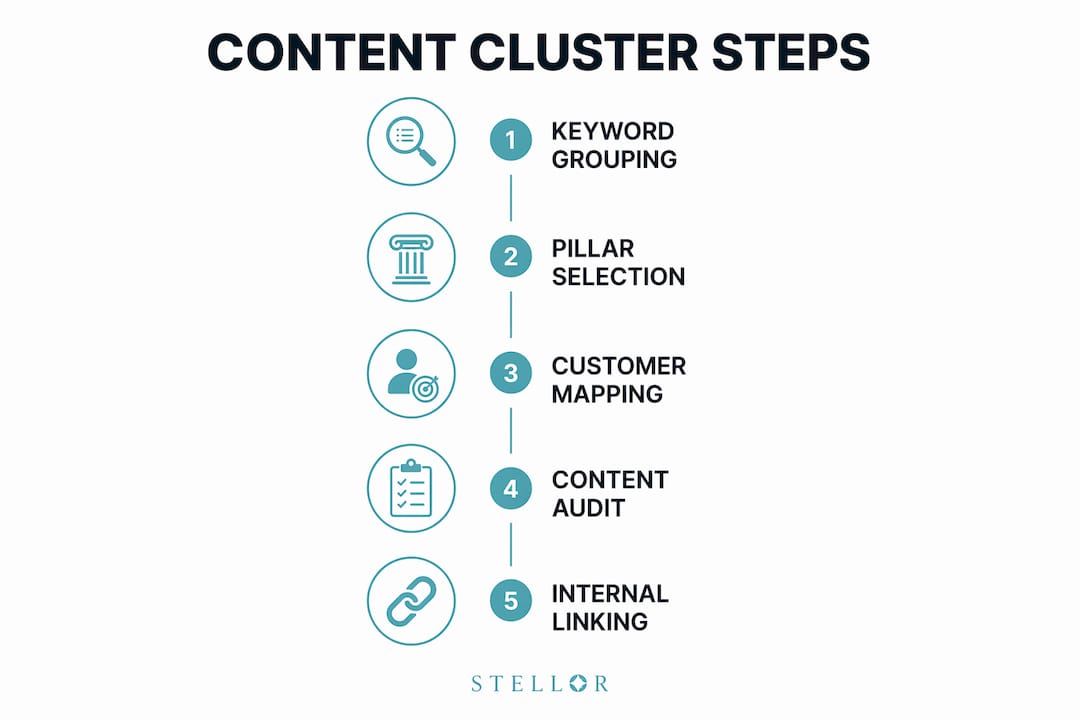
3. Map content to customer journey stages
Mapping content to customer journey stages improves targeting and conversion potential within your clusters. Awareness-stage content answers broad questions. Consideration-stage content compares options. Decision-stage content addresses pricing, timelines, and trust signals. A cluster that covers all three stages serves both rankings and revenue.
4. Audit existing content and integrate it into clusters
Most sites already have content that belongs in clusters. A content audit identifies which pages to keep, which to update, and which to retire. Pages with thin content or overlapping topics should be consolidated. A practical SEO audit checklist helps you assess each page’s value before deciding where it fits in your cluster structure.
5. Build semantic internal links with descriptive anchor text
Connect every cluster page to the pillar and to related cluster pages using descriptive anchor text. “Bathroom remodeling costs” is a strong anchor. “Learn more” is not. Each link should tell both the reader and the search engine exactly what the destination page covers.
Pro Tip: After publishing a new cluster page, update at least two existing cluster pages to link to it. This distributes authority immediately and signals to Google that the new page belongs in the cluster.
How can you optimize internal linking to maximize cluster impact?
Internal linking is the connective tissue of your cluster. Without it, you have a collection of pages, not a cluster. Effective anchor text uses explicit, descriptive phrases that explain the relationship between linked pages. Generic anchors weaken semantic signals and reduce cluster effectiveness.
The goal is to create a navigable web of related content that serves both users and crawlers. Users should be able to move from a cluster page to the pillar and then to a related cluster page without hitting a dead end. Crawlers should be able to map the entire cluster from any entry point.
| Anchor text type | Example | Effect on SEO |
|---|---|---|
| Descriptive and specific | “HVAC filter replacement guide” | Strong semantic signal, reinforces topic relevance |
| Partial match | “filter replacement tips” | Moderate signal, acceptable variation |
| Generic | “click here” or “read more” | Weak signal, no topical context passed |
| Exact keyword stuffing | “HVAC HVAC filter HVAC guide” | Negative signal, appears manipulative |
Practical internal linking rules that hold up in 2026:
- Link cluster pages to the pillar on every page, not just the first mention.
- Link related cluster pages to each other when the connection is genuinely useful to the reader.
- Place links in body paragraphs, not just navigation menus or footers.
- Review internal links quarterly and update anchors when page content changes.
Understanding how AI search engines use your site structure helps you design links that serve both traditional and AI-driven discovery.
What are common pitfalls when applying content cluster SEO?
Real campaigns fail at predictable points. Knowing where clusters break down saves you months of wasted effort.
A home services website is a clear example. A plumbing company might publish 40 blog posts over two years with no internal linking structure. Each post targets a different keyword but none link to each other or to a central pillar. The result is 40 isolated pages, each competing weakly for its own keyword. Reorganizing those posts into three clusters, “drain repair,” “water heater services,” and “pipe installation,” with a pillar page for each, can produce measurable ranking improvements within 60 to 90 days. A local SEO ranking guide for home service businesses shows exactly how this cluster structure applies in practice.
Common mistakes that undermine cluster performance:
- Weak internal linking: Publishing cluster pages without linking them to the pillar or to each other. This is the single most common failure.
- Shallow cluster content: Writing 300-word cluster pages that do not genuinely cover the subtopic. Thin content drags down the entire cluster.
- Disorganized site structure: Placing cluster pages in unrelated site sections so crawlers cannot identify the topical relationship.
- Ignoring legacy content: Leaving old, low-value posts live without integrating or retiring them. These pages dilute topical authority.
- Skipping content audits: Building new clusters without auditing existing content means you duplicate effort and miss integration opportunities.
The fix for most of these problems starts with a structured content audit. Identify every page on your site, assign it to a cluster or mark it for retirement, and then build the internal linking structure from there.
Key Takeaways
Content cluster SEO builds topical authority by organizing related pages around a pillar, connecting them with descriptive internal links, and mapping content to every stage of the buyer journey.
| Point | Details |
|---|---|
| Pillar and cluster structure | One broad pillar page links to multiple focused cluster pages covering specific subtopics. |
| Internal link quality | Descriptive anchor text passes semantic signals; generic anchors like “click here” do not. |
| AI engine visibility | Structured clusters give AI answer engines multiple entry points, increasing citation rates. |
| Content audit first | Audit existing pages before building new clusters to avoid duplication and dilution. |
| Journey stage mapping | Assign cluster pages to awareness, consideration, or decision stages to improve conversions. |
Why structured clusters beat keyword lists every time
The marketers I see struggle most with SEO are the ones still thinking in keyword lists. They produce content at volume, target individual terms, and wonder why authority never accumulates. The answer is almost always structure, or the absence of it.
Clusters force a discipline that keyword targeting does not. You have to decide what your site is actually about, which topics you can genuinely own, and how each piece of content serves the larger picture. That discipline produces better content, not just better rankings. When I audit a site that has been publishing for two or three years without a cluster strategy, the pattern is always the same: dozens of posts, minimal internal linking, and authority spread so thin that nothing ranks well.
The internal linking piece is where most teams underinvest. They write the content, publish it, and move on. But the links between pages are what tell Google and AI engines that your site has genuine depth on a subject. Descriptive anchor text is not a technical nicety. It is the mechanism that makes clusters work. Revisiting and updating internal links on a quarterly basis is one of the highest-return activities in SEO, and almost no one does it consistently.
The shift toward AI answer engines makes this even more urgent. ChatGPT, Perplexity, and Gemini do not rank pages. They cite sources they trust. A well-structured cluster, with a clear pillar, descriptive links, and content that covers a topic from every angle, is exactly what those engines look for when deciding which site to quote. Building clusters now is not just a Google strategy. It is an AI visibility strategy.
— Cole
How Trystellor makes content cluster execution practical
Building and maintaining content clusters at scale requires consistent publishing, structured internal linking, and regular audits. That is a significant operational load for most marketing teams.
Trystellor publishes 30 SEO-optimized articles per month to your CMS, each built with the internal linking structure and schema markup that clusters require. The platform’s 4,000-site backlink network strengthens pillar page authority, and weekly technical audits flag internal linking gaps before they stall your rankings. Daily Reddit intelligence surfaces emerging subtopics worth adding to your clusters. If you want to see where your current cluster structure stands, Trystellor delivers a free AI Visibility Audit within 48 hours, covering 25 buyer prompts and a full product feature overview of what the platform tracks. No credit card required for the three-day trial.
FAQ
What is a content cluster in SEO?
A content cluster is a group of related web pages organized around a central pillar page, all connected through descriptive internal links. The structure signals topical authority to search engines and AI answer engines.
How many cluster pages does a pillar page need?
A pillar page should link to at least five to eight cluster pages covering distinct subtopics. Fewer than five pages produces a thin cluster that does not demonstrate comprehensive coverage.
Does content cluster SEO help with AI answer engines?
Yes. AI engines like ChatGPT and Perplexity parse cluster structure to identify trusted sources. AI engines surface multiple cluster pages when answering broad user queries, increasing your citation rate across related searches.
How long does it take to see results from topic clusters?
Most sites see measurable ranking improvements within 60 to 90 days of restructuring content into clusters with proper internal linking. Results depend on content quality, link equity, and how consistently new cluster pages are published.
What is the difference between a pillar page and a cluster page?
A pillar page covers a broad topic at a high level and links out to multiple subtopics. A cluster page covers one specific subtopic in depth and links back to the pillar. The pillar is the hub; cluster pages are the spokes.