TL;DR:
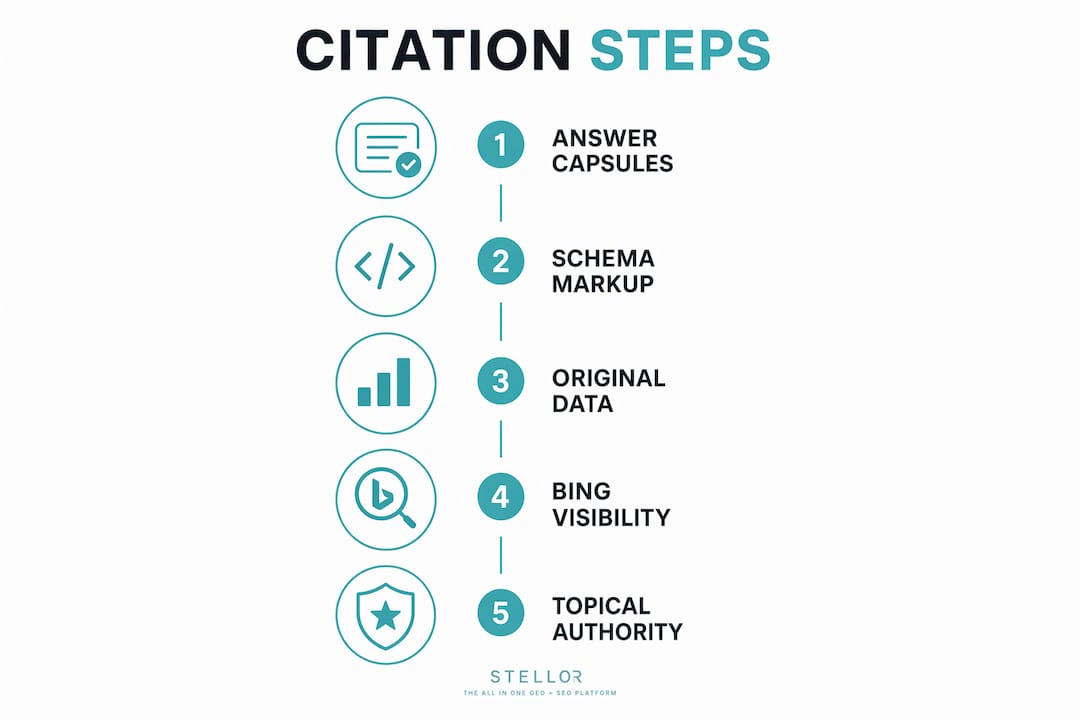
- Getting cited by ChatGPT depends on having your content indexed, structured with answer capsules, and trusted through authority signals. Implementing question-based headings, schema markup, and original data can significantly increase your chances of being referenced. Bing visibility and deep topical authority are essential for consistent AI citations and overall search presence.
Getting cited by ChatGPT is defined as having your web content selected, quoted, and linked by ChatGPT’s live browsing mode when it answers a user’s question. The process depends on three factors: your content must be indexed and visible on Bing, your pages must contain self-contained answer capsules that AI can extract at the passage level, and your site must carry enough authority signals for the model to trust your source. This guide breaks down every step, with current research and practical tactics you can apply this week.
How to get cited by ChatGPT: what content formats work best
ChatGPT performs passage-level retrieval, scoring individual sections of a page independently rather than evaluating the whole document. Burying your answer under a long introduction reduces your citation chance by up to 35%. The fix is structural: place your most direct answer at the very top of each section, before any context or background.
The most effective format is the direct answer capsule. A capsule is a 120–150 character sentence placed immediately below a question-format H2 heading. Pages that use this structure show a 72% citation rate among highly cited content. That number reflects how precisely AI models match a user’s query to a passage that answers it without requiring further reading.
Question-format H2 headings are the second structural requirement. Headings like “What is the fastest way to remove a lien?” or “How much does a commercial roof inspection cost?” align directly with the queries users type into ChatGPT. Question-shaped headings improve semantic matching and extractability, which is the AI’s ability to pull a passage and use it as a standalone answer.
Here is what a citation-ready content block looks like in practice:
- Question H2: “How long does a kitchen remodel take?”
- Answer capsule (first sentence): “A standard kitchen remodel takes 6–12 weeks from demolition to final inspection.”
- Expansion: Three to four sentences adding detail, caveats, and a named example.
- Supporting data: One statistic with a one-sentence interpretation.
- FAQ block: Two to three related questions with short answers at the bottom of the section.
Pro Tip: Keep every answer capsule self-contained. If a reader sees only that one sentence, they should still have a complete, usable answer. Numeric answers (“6–12 weeks,” “$4,200 average”) score higher because they are specific and verifiable.
How does schema markup increase AI citation rates?
Structured data is the technical layer that tells AI crawlers exactly what your content is and who wrote it. JSON-LD schema types most relevant to AI citation are Article, FAQPage, HowTo, Person, and Organization. Using these schemas raises citation likelihood by 22–40% compared to pages with no structured data.
Implementing JSON-LD schema is a four-step process:
- Identify the right schema type. Use Article for editorial content, FAQPage for question-and-answer sections, and HowTo for step-by-step guides. Combine them on a single page when the content warrants it.
- Add author and organization metadata. Include
datePublished,dateModified,author.name, andauthor.url. AI models use these fields to verify recency and expertise. - Validate your markup. Run every page through Google’s Rich Results Test before publishing. Errors in schema reduce, not increase, citation trust.
- Reference schema.org standards. The schema.org vocabulary defines every accepted property. Stick to documented properties rather than custom fields AI crawlers do not recognize.
The table below shows which schema types map to which content formats:
| Content type | Recommended schema | Key fields for AI |
|---|---|---|
| Blog post or guide | Article | datePublished, author, headline |
| FAQ section | FAQPage | Question, acceptedAnswer |
| Step-by-step tutorial | HowTo | step, name, description |
| Author bio page | Person | name, jobTitle, sameAs |
Pro Tip: Full JSON-LD implementation, including Article, Person, and HowTo schemas with accurate datePublished and author metadata, gives AI parsers the clearest possible signal that your content is current, credible, and structured for extraction.
Why does original data increase your chance of being cited by AI?
Original data is the single highest-leverage content asset for AI citation. Proprietary data boosts citation rates by up to 40% because AI models prioritize sources that contain information they cannot synthesize from other pages. If your content repeats what ten other sites already say, the model has no reason to cite you specifically.
“AI models verify claims against trusted external signals before citation. Cross-referencing multiple authoritative third-party sources is not optional. It is how AI decides whether your content is worth quoting at all.” — Search Engine Land, analysis of 8,000 AI citations
Practical ways to generate original data include customer surveys, internal case studies, before-and-after project metrics, and aggregated data from your own service records. A roofing company that publishes average repair costs by zip code from its own job history has data no competitor can replicate. That specificity is exactly what AI citation algorithms reward.
Outbound links to authoritative primary sources also raise your citation rate. Linking to trusted sources increases AI citation rates by 18–25%. This runs counter to the fear that outbound links drain authority. The opposite is true. AI models treat outbound links to government databases, peer-reviewed research, and established industry bodies as a trust signal, not a liability.
Strategies to build third-party authority alongside your original data:
- Publish original research and pitch it to trade publications for coverage.
- Earn mentions in recognized industry directories and association websites.
- Cite primary sources like the U.S. Bureau of Labor Statistics or the CDC when relevant to your industry.
- Update your data annually so AI crawlers see a current
dateModifiedfield alongside fresh numbers.
How does topical authority affect ChatGPT citation eligibility?
Topical authority is the degree to which your domain covers a subject completely, not just superficially. Building deep topical authority with interlinked pages signals domain expertise and increases the chance of multiple citations by AI across different queries. A single well-written page rarely earns consistent citation. A cluster of 10–20 interlinked pages on a core theme does.

Bing visibility is a prerequisite for ChatGPT citation eligibility. ChatGPT uses Bing for live web retrieval, and without Bing visibility, citation eligibility is effectively zero. That means traditional on-page SEO, title tags, meta descriptions, internal linking, and page speed, remain the foundation. AI citation is built on top of search ranking, not instead of it.
Key signals that build topical authority for AI citation:
- Content clusters: Group pages by theme. A financial advisor’s site should have interlinked pages on retirement planning, tax strategy, estate planning, and Social Security timing.
- Author bios: Detailed author pages with credentials, publication history, and social profiles satisfy E-E-A-T (Experience, Expertise, Authoritativeness, Trustworthiness) requirements.
- Consistent updates: AI crawlers weight recency. Pages with a
dateModifiedwithin the past 90 days outperform stale content on equivalent topics. - Internal linking depth: Every cluster page should link to at least three related pages on your site. This distributes authority and helps AI crawlers map your expertise.
The table below compares weak versus strong topical authority signals:
| Signal | Weak implementation | Strong implementation |
|---|---|---|
| Content volume | 1–2 pages per topic | 10–20 interlinked pages per theme |
| Author metadata | No author listed | Full bio with credentials and links |
| Content freshness | Last updated 2+ years ago | Updated within 90 days |
| Internal links | Isolated pages | Every page links to 3+ related pages |
For a real-world example of how local businesses earn AI citations through topical depth, the Calgary HVAC citation case study shows how consistent content clusters drove measurable citation gains within one quarter.
What are the practical steps to start getting cited by ChatGPT?
The process of getting cited by AI is repeatable. Follow this checklist in order:
- Audit your target queries. List 20–30 questions your buyers ask ChatGPT. Use these as the basis for new or rewritten H2 headings across your site.
- Rewrite your introductions. Move your direct answer to the first sentence of every section. Cut any paragraph that does not add new information.
- Add schema markup. Implement Article, FAQPage, and HowTo JSON-LD on every relevant page. Validate with Google’s Rich Results Test before publishing.
- Add a FAQ block. Place three to five short Q&A pairs at the bottom of every major page. Each answer should be one to two sentences.
- Add outbound links. Link to at least one authoritative primary source per page. Government sites, academic institutions, and established trade bodies all qualify.
- Monitor your citations. Query ChatGPT weekly using your target buyer prompts. Note which pages get cited and which do not. Rewrite uncited pages using the structure above.
Common mistakes that block citation eligibility:
- Opening every page with a company history paragraph instead of a direct answer.
- Publishing pages with no schema markup and no author metadata.
- Ignoring Bing. If your site is not indexed on Bing, ChatGPT cannot cite it regardless of content quality.
- Using generic claims without data. “We are the best” earns zero citations. “Our average project completes in 11 days” earns citations.
Pro Tip: Use ChatGPT itself to audit your content. Paste a page’s text into a prompt and ask: “Does this page contain a clear, self-contained answer to [your target question]?” The model’s response tells you exactly what it would and would not cite.
For a deeper look at the technical ranking factors that feed into AI citation eligibility, the ChatGPT SEO ranking factors guide covers the full technical stack.
Key Takeaways
Getting cited by ChatGPT requires direct answer capsules, schema markup, original data, Bing visibility, and topical authority working together as a system.
| Point | Details |
|---|---|
| Answer capsule placement | Place a 120–150 character direct answer immediately below every question H2 heading. |
| Schema markup impact | JSON-LD Article, FAQPage, and HowTo schemas raise citation likelihood by 22–40%. |
| Original data advantage | Proprietary data boosts AI citation rates by up to 40% over generic content. |
| Bing as the gateway | Without Bing indexing, ChatGPT citation eligibility is zero regardless of content quality. |
| Topical authority depth | Clusters of 10–20 interlinked pages on a core theme generate consistent multi-query citations. |
The part most marketers skip entirely
I have reviewed hundreds of sites that should be getting cited by ChatGPT and are not. The content is good. The topics are right. The problem is almost always the same: the answer is buried on paragraph four.
Marketers trained on traditional blog writing learned to warm up the reader before delivering the point. That habit is the exact opposite of what AI citation algorithms reward. The model does not read your introduction. It scans for the passage that most directly answers the query, scores it, and either cites it or moves on. If your answer is not in the first sentence of a section, you are competing at a serious disadvantage.
The second pattern I see constantly is schema avoidance. Business owners assume schema is a developer task and defer it indefinitely. In practice, most CMS platforms, including WordPress with Yoast or RankMath, generate basic Article schema automatically. FAQPage and HowTo schema require a few extra minutes of setup. That investment directly raises your citation rate by a documented 22–40%. There is no other single technical change with that return.
The third thing I would tell any marketer right now: stop treating AI citation as a separate strategy from SEO. It is not. Bing ranking is the prerequisite. Appearing in AI recommendations starts with the same fundamentals that have always driven search visibility. Get those right first, then layer in the answer capsules, schema, and original data. The businesses winning AI citations in 2026 are not doing something exotic. They are doing traditional SEO well and then adding three specific structural habits on top.
— Cole
How Trystellor helps your business get cited by AI
Trystellor is a GEO + SEO platform built for exactly this challenge. It publishes 30 schema-optimized articles to your site every month, runs weekly technical audits across 11 citation-readiness checks, and tracks your citation status across ChatGPT, Claude, Perplexity, and Gemini every week using the prompts your buyers actually type.
The platform’s 4,000-site backlink network builds the Bing authority that makes citation eligibility possible. Its LLM tracking turns AI visibility from a guessing game into a measurable channel with weekly benchmarks. Pricing starts at $199 per month with a three-day free trial and no credit card required. You keep all content produced even if you cancel. Start your free AI Visibility Audit at trystellor.com and see exactly which buyer prompts your competitors are winning right now.
FAQ
How does ChatGPT decide which sources to cite?
ChatGPT uses live Bing search results combined with passage-level scoring to select sources. Pages with direct answer capsules, schema markup, and strong Bing visibility rank highest for citation selection.
Does schema markup really affect AI citation rates?
Yes. JSON-LD Article, FAQPage, and HowTo schemas increase citation likelihood by 22–40% by giving AI crawlers structured metadata about your content’s topic, author, and recency.
What is an AI citation?
An AI citation is defined as a named source link that an AI answer engine, such as ChatGPT or Perplexity, includes when it quotes or summarizes content from the open web. 25% of ChatGPT’s cited URLs do not rank in Google’s top 10, showing that AI retrieval follows its own logic.
How long does it take to start getting cited by ChatGPT?
Most sites that implement answer capsules, schema markup, and FAQ blocks see measurable citation gains within 60–90 days. Bing indexing and topical authority building are the longest lead-time factors.
Do outbound links hurt my site’s authority?
No. Linking to authoritative sources raises your AI citation rate by 18–25% because AI models treat outbound links to trusted primary sources as a credibility signal, not a dilution of your own authority.