TL;DR:
- Topical authority SEO recognizes your website as an expert source through content depth, internal links, and external proof. It leads to faster ranking, longer position retention, and more citations by AI answer engines like ChatGPT. Building authority takes three to six months and depends on creating comprehensive, interconnected content clusters with strong off-site validation.
Topical authority SEO is the recognition by search engines and AI platforms that your website is a comprehensive, expert source on a specific subject. It is built through depth of coverage, deliberate internal linking, and external proof from third-party sources. Sites that earn this recognition rank faster, hold positions longer, and get cited more often by AI answer engines like ChatGPT, Perplexity, and Gemini.
What are the core components of topical authority SEO?
Topical authority is an emergent property of overlapping systems inside Google’s ranking infrastructure. These systems include site-level topic embeddings and cluster-level signals that assess how completely your content covers a subject. No single article earns topical authority. The entire content ecosystem on your site does.
Google measures topical relevance through several distinct signals:
- Entity completeness: Your content must mention the expected entities for a topic. A healthcare article that omits HIPAA, for example, triggers a negative quality signal in Google’s systems. Missing expected terms tells the algorithm your coverage is incomplete.
- Text relevance: Google correlates text relevance to keywords with a 0.47 factor. That number reflects how much keyword alignment still matters, even within a topical framework.
- Fan-out query coverage: This measures how many related user questions your content cluster answers. Fan-out query coverage shows a 0.77 correlation with AI citation likelihood. That is the strongest signal in the research pool for predicting whether an AI engine will quote your site.
- Internal linking structure: Internal links act as the circulatory system of your topic cluster. They tell Google which pages are related and how deeply you cover a subject.
- Content depth per subtopic: Shallow articles spread across many topics produce weaker signals than deep articles concentrated within one subject area.
Pro Tip: Map every article you publish to a specific entity or subtopic within your core subject. If a page does not cover a named concept your audience expects to find, it is filling space rather than building authority.
How does building topical authority differ from traditional keyword strategies?

The traditional SEO playbook centered on two things: keyword density and backlink volume. Topical authority works differently. It rewards depth of coverage over breadth of keyword targeting, and it rewards site-level coherence over raw link counts.
The clearest proof of this shift is how Google treats domain authority. Google does not use third-party domain authority metrics in its ranking systems. A site with a medium DA score but tight topical focus can outrank a high-DA generalist site on the same query. That is a structural advantage for focused businesses willing to go deep on one subject.
| Approach | What it measures | What it produces |
|---|---|---|
| Keyword targeting | Search volume per term | Traffic to individual pages |
| Backlink volume | Number of inbound links | General domain trust signals |
| Topical authority | Depth and completeness of subject coverage | Site-level recognition across an entire topic |
The table above shows why topical authority produces more durable results. Keyword targeting wins individual pages. Topical authority wins entire subject areas. When Google recognizes your site as the authority on a topic, it surfaces your content across hundreds of related queries, not just the ones you explicitly targeted.
Intent-led content planning is the practical difference. Instead of asking “what keywords have search volume,” you ask “what does someone need to know to fully understand this subject.” Those two questions produce very different content calendars.
Pro Tip: Audit your existing content for intent gaps, not keyword gaps. Find the questions your audience asks that your site does not answer, then build those pages first.

What are the practical steps to build topical authority SEO?
Building topical authority requires a structured process. The steps below reflect what the research shows actually produces measurable ranking gains.
-
Choose and map your core topic. Pick one subject your business can own completely. Map every subtopic, entity, and user question within it. This map becomes your content calendar. Sites with 25–30 or more interlinked articles in one cluster achieve ranking gains up to 3x faster than backlink-only strategies.
-
Build a hub-and-spoke content structure. Create one pillar page that covers the core topic at a high level. Then build cluster pages that go deep on each subtopic. Every spoke page should link back to the hub, and related spoke pages should link to each other. This makes the topical graph visible to Google’s crawlers.
-
Use descriptive anchor text in every internal link. Generic anchor text like “read more” or “this article” tells Google nothing. Descriptive anchor text like “local SEO for service businesses” tells Google exactly what the linked page covers. That specificity reinforces your topical graph.
-
Fill content gaps deliberately. Most sites cover the obvious topics and skip the uncomfortable ones: pricing, implementation challenges, common failures, and user objections. Those gap pages are where authority compounds fastest. A competitor who covers pricing and you do not will win those queries and the trust that comes with them.
-
Track progress with the right metrics. Impressions across your topic cluster show whether Google is expanding your coverage. Rankings on cluster pages show whether depth is converting to position. AI citation tracking shows whether your content is being quoted by ChatGPT, Claude, Perplexity, or Gemini. All three metrics matter. Tracking only rankings misses the AI visibility layer that is now driving a growing share of buyer decisions.
Building topical authority through topic clusters typically takes 3–6 months to produce measurable signals. High-authority sites see meaningful traffic gains up to 20 days faster than low-authority sites. The compounding effect is real, but it requires patience and consistency in the early months. You can read more about measurable SEO results to set realistic expectations before you start.
How does off-site proof enhance topical authority in 2026?
On-site content alone does not complete the picture. Search engines and AI platforms need external validation to confirm that your claimed expertise is real. This is where off-site proof becomes critical.
Proof-backed authority includes third-party signals like mentions, reviews, and community discussions that independently verify your topical expertise. AI answer engines rely on these external signals beyond your site content to decide whether to trust and cite your brand.
The most effective off-site proof sources in 2026 include:
- Reddit threads and community discussions: ChatGPT and Perplexity draw heavily on Reddit when generating recommendations. A consistent presence in relevant subreddits builds brand-topic associations that AI engines recognize and cite.
- Third-party mentions and reviews: When authoritative sites in your industry mention your brand alongside your core topic, that association strengthens your topical signal. This is different from a backlink. It is a co-occurrence of your brand name and your subject matter in a trusted context.
- Industry publications and guest content: Articles published on recognized platforms in your niche create the kind of independent verification that turns self-declared expertise into confirmed authority.
- Social signals and brand search volume: Increasing brand search volume tells Google that real people associate your name with a topic. That behavioral signal feeds into the same systems that assess topical authority.
“Brand proof systems that integrate third-party endorsements, mentions, and community presences are essential to turn self-declared expertise into independently verified topical authority recognized by AI search engines and Google alike.”
The shift here is significant. Traditional SEO treated off-site work as a backlink acquisition exercise. Modern topical authority treats it as a brand-topic association exercise. The goal is not just a link. The goal is for your brand name and your subject matter to appear together in trusted, independent contexts. For practical guidance on combining these signals with local visibility, the AI for SEO visibility framework is worth reviewing.
Sites that own topics deeply are retrieved more often in AI overviews than sites with sporadic coverage. That retrieval advantage compounds over time as AI engines learn which sources consistently deliver complete, accurate answers.
Key Takeaways
Topical authority SEO is built through entity-rich content clusters, deliberate internal linking, and off-site proof, producing ranking gains up to 3x faster than backlink-only strategies.
| Point | Details |
|---|---|
| Entity completeness matters | Include all expected entities for your topic or Google flags your content as incomplete. |
| Hub-and-spoke structure wins | Pillar pages linked to deep cluster pages make your topical graph visible to Google. |
| Off-site proof is required | Third-party mentions and community presence turn claimed expertise into verified authority. |
| AI citations follow depth | Fan-out query coverage correlates 0.77 with AI citation likelihood, making breadth of subtopic coverage critical. |
| Results take 3–6 months | Consistent cluster publishing compounds into measurable traffic and ranking gains within one quarter. |
Why most sites get topical authority wrong
I have reviewed content strategies for dozens of businesses over the years, and the same mistake appears repeatedly. Marketers build wide instead of deep. They publish one article on every topic in their industry and call it a content strategy. What they actually build is a collection of isolated pages with no topical coherence. Google sees a generalist site. The AI engines see nothing worth citing.
The fix is uncomfortable because it requires saying no. You pick one subject, go deep on every subtopic within it, and resist the temptation to branch out until that core cluster is genuinely complete. High topical authority content gains visibility 57% faster due to compounding evidence-builder loops within topic clusters. That compounding only works if the cluster is dense enough to trigger it.
The second mistake I see is treating internal linking as an afterthought. Marketers publish the content but skip the linking work. The result is a set of pages that Google cannot connect into a coherent topical graph. Descriptive anchor text and deliberate cross-linking between cluster pages are not optional extras. They are the mechanism that makes the cluster function. Without them, you have articles. With them, you have authority.
The AI era adds one more layer that most strategies still ignore. Your on-site content is necessary but not sufficient. If your brand does not appear in Reddit threads, third-party reviews, and industry publications alongside your core topic, AI engines will cite someone else. The businesses winning AI citations in 2026 are the ones treating off-site presence as a content channel, not a link-building chore. Check the 2026 SEO priority checklist to see where off-site proof fits into a full-year plan.
— Cole
How Trystellor supports your topical authority strategy
Building topical authority at the speed search requires is difficult to do manually. Trystellor publishes 30 GEO and SEO-optimized articles per month to your CMS, each one mapped to a specific subtopic, entity, and buyer query within your core subject. Every article includes schema markup, internal linking structure, and llms.txt configuration so it is readable by both Google and AI crawlers.
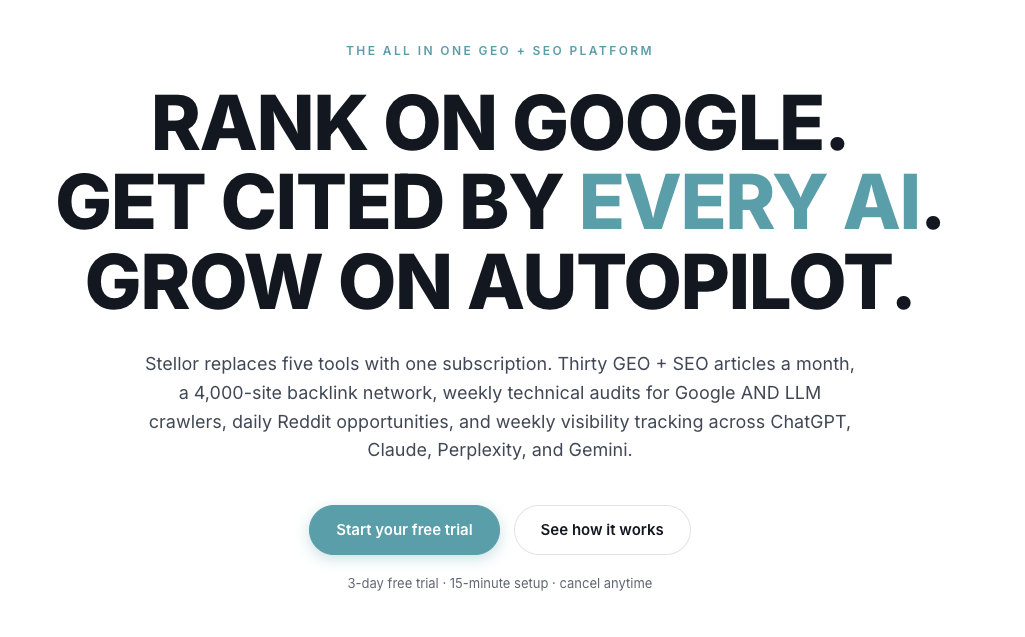
The platform also runs weekly technical audits, surfaces Reddit opportunities daily, and tracks your citations across ChatGPT, Claude, Perplexity, and Gemini every week. A 4,000-site backlink network adds the external authority signals that complete the picture. You can review the full platform features and start a three-day free trial with no credit card required. Every article Trystellor publishes is yours to keep, even if you cancel.
FAQ
What is topical authority in SEO?
Topical authority is the recognition by search engines that your website is a comprehensive, expert source on a specific subject. It is built through deep content clusters, internal linking, and external proof rather than keyword targeting alone.
How long does it take to build topical authority?
Building topical authority through topic clusters typically takes 3–6 months to produce measurable signals. Sites with tightly interlinked clusters see meaningful traffic gains up to 20 days faster than low-authority sites.
Does topical authority help with AI citations?
Fan-out query coverage, which measures how many related questions your cluster answers, shows a 0.77 correlation with AI citation likelihood. Comprehensive topic clusters are the most reliable path to being cited by ChatGPT, Perplexity, and Gemini.
How many articles do I need for a topical cluster?
Sites with 25–30 or more interlinked articles in one cluster achieve ranking gains up to 3x faster than backlink-only strategies. The exact number depends on the complexity of your topic, but depth within a cluster matters more than total article count across your site.
Is domain authority the same as topical authority?
No. Google does not use third-party domain authority metrics. A site with focused topical clusters and a medium DA score can outrank a high-DA generalist site because topical relevance is a stronger ranking signal than raw link volume for subject-specific queries.