Most local service businesses assume that having a Google listing and sprinkling city names across their website is enough to compete online. It isn’t. The businesses ranking at the top of local search results aren’t just showing up by accident. They’ve built a deliberate, layered strategy that covers everything from technical signals to content quality to competitive intelligence. This guide cuts through the noise, breaks down exactly what local SEO requires, and gives you a clear, actionable path to improving your visibility in the markets that matter most to your business.
Table of Contents
- What local SEO really means (and why it matters)
- The core pillars: Listings, content, and localization
- Avoiding pitfalls: Localization and duplicate content
- Winning against competitors: Smart audits and tracking progress
- Why intent and context beat tactics alone in local SEO
- Ready to elevate your local visibility?
- Frequently asked questions
Key Takeaways
| Point | Details |
|---|---|
| Local SEO is specialized | Targeting your local area means adapting your SEO approach to stand out in local search results. |
| Google Business Profile is key | Verification and accurate setup of your Google Business Profile are foundational for visibility. |
| Smart audits drive results | Benchmarking against local competitors sets realistic, effective priorities for your SEO efforts. |
| Intent over tactics | Focusing on searcher intent and context leads to more lasting and meaningful gains than just following checklists. |
What local SEO really means (and why it matters)
Local SEO is not a smaller version of regular SEO. It’s a different game with different rules, different signals, and a very different type of searcher. When someone types “plumber near me” or “HVAC repair in Austin,” they aren’t browsing. They’re ready to call. That buying intent is what makes local search so valuable, and it’s exactly why winning those results has a direct impact on your revenue.
General SEO focuses on ranking a website for broad topics across a national or global audience. Local SEO focuses specifically on showing up when people in your service area search for what you offer. The search engine’s job is to match that searcher with the most relevant, trustworthy, and nearby business. Your job is to give Google every reason to pick you.
“A practical local SEO audit for local service businesses starts with the local keyword/prompt set you want to rank for, then checks how well you’re positioned versus competitors before moving into deeper technical/content audits.”, Search Engine Journal
Understanding this distinction changes how you approach everything. You’re not trying to rank for “roof repair.” You’re trying to rank for “roof repair in Denver” or “emergency roofer Lakewood CO.” Those are the phrases your actual customers type when they’re ready to spend money.
Here’s what a strong local SEO foundation actually covers:
- Keyword and intent research tied specifically to your service area and customer language
- Google Business Profile (GBP) optimization and ongoing management
- On-site content that naturally reflects your location and services
- Off-site signals like citations, backlinks, and reviews
- Technical health of your website so search engines can crawl and understand it
- Competitor analysis to identify where you can realistically gain ground
Getting familiar with local SEO fundamentals before diving into tactics saves you from wasting time on the wrong things. Start with what your customers are actually searching for, then build from there.
The core pillars: Listings, content, and localization
Once you understand what local SEO is, the next step is knowing which levers to pull. There are three core pillars that drive local visibility: your business listings, your website content, and your localization signals. Each one reinforces the others.
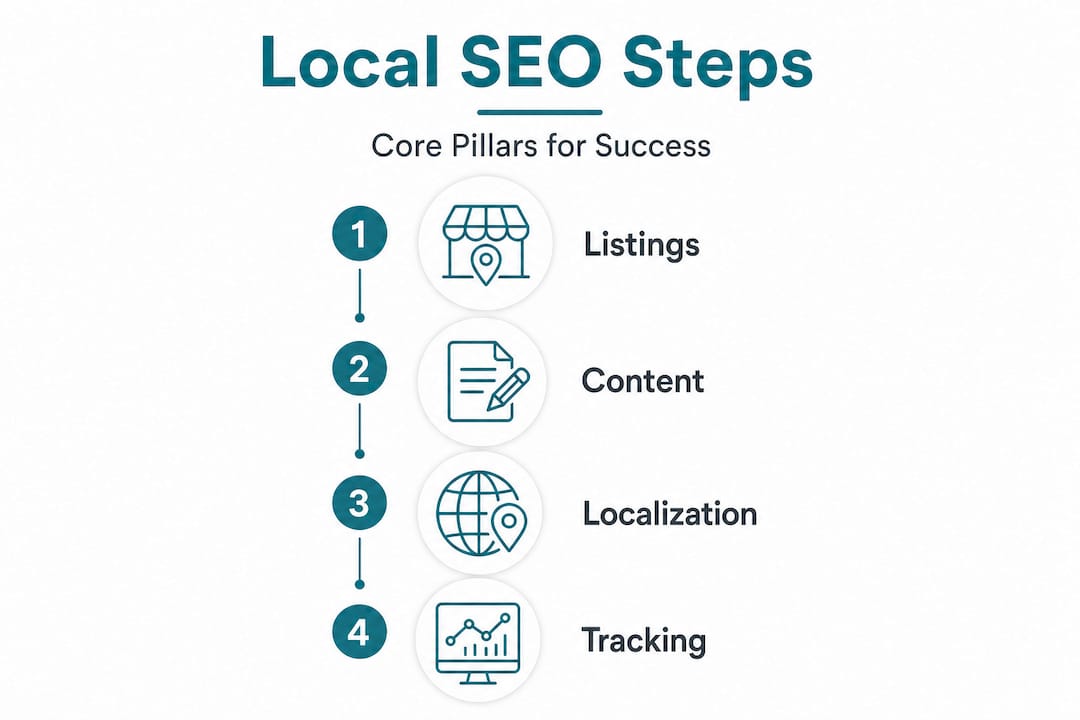
Google Business Profile is the single most important asset in local search. It’s what powers the “map pack,” the three business listings that appear at the top of Google results for local searches. Unverified businesses aren’t publicly visible in Google Maps or Search, which means if you haven’t completed verification, you’re essentially invisible to a huge portion of ready-to-buy customers.
Filling out your GBP completely isn’t optional. That means your business name, address, phone number, hours, service categories, photos, and a keyword-informed business description. Google uses all of this to decide whether your business is relevant to a given search. Businesses with complete, accurate, and regularly updated profiles consistently outperform those with bare-bones listings.
On-site content is your second pillar. Your website needs to speak the same language as your customers and your market. That doesn’t mean stuffing “best plumber in Phoenix” into every paragraph. It means writing service pages that naturally reference your city, your neighborhoods, your service area, and the specific problems you solve for local customers. A page about water heater repair should mention the types of homes in your area, local building codes if relevant, and the specific areas you serve.

Localization signals are the technical and structural elements that tell search engines where you operate. Your name, address, and phone number (NAP) should be consistent across every platform where your business appears. Inconsistencies confuse both Google and potential customers.
| Signal type | Impact on local rankings | Effort to implement |
|---|---|---|
| Google Business Profile | Very high | Low to medium |
| On-site location content | High | Medium |
| NAP consistency (citations) | Medium to high | Medium |
| Backlinks from local sources | High | High |
| Customer reviews | High | Ongoing |
| Technical site health | Medium | Medium to high |
Pro Tip: Don’t just fill out your GBP once and forget it. Post updates, respond to reviews, and add new photos regularly. Google treats an active profile as a trust signal, and it can meaningfully improve your map pack rankings over time. Businesses that post at least twice a month tend to see better engagement and visibility than those that never update their profile.
Improving Google Business Profile management is one of the fastest ways to see measurable results in local search, often within weeks rather than months.
Avoiding pitfalls: Localization and duplicate content
Once you’ve built the foundation, the next challenge is avoiding the mistakes that quietly undermine your progress. One of the most common errors for service businesses with multiple locations or service areas is creating thin, duplicate city pages.
The logic seems sound: if you serve ten cities, create ten pages, one for each city. The problem is that most businesses create nearly identical pages, swapping out the city name and nothing else. Google recognizes this pattern quickly. Those pages don’t rank well, and in some cases they can actually drag down the performance of your entire site.
Localized pages must be clearly indicated to help Google serve the right version to the right searcher. This applies not just to international sites but to any situation where you’re running location or region variants. Each page needs to be genuinely different and genuinely useful.
Here’s how to handle multi-location pages the right way:
- Start with real local research. What are customers in each city actually asking? What problems are specific to that area? Use that to shape unique content for each page.
- Write original content for every location. Include neighborhood references, local landmarks, service-specific details relevant to that area, and testimonials from customers in that city.
- Use correct technical signals. Add each location page to your sitemap. If you’re running true regional variants, use hreflang tags to signal the correct version to search engines.
- Link internally between location pages. A hub-and-spoke structure, where a main service page links out to individual city pages, helps Google understand your site architecture and distributes authority properly.
- Monitor each page’s performance separately. Track rankings and traffic for each location independently so you can identify which pages need more attention.
| Approach | What it looks like | What Google thinks |
|---|---|---|
| Right way | Unique content per city, local references, proper technical signals | Trustworthy, relevant, worth ranking |
| Wrong way | Same content, different city name swapped in | Thin, duplicate, likely to be ignored |
| Right way | Consistent NAP across all pages and directories | Clear, credible business entity |
| Wrong way | Different phone numbers or addresses on different pages | Confusing, reduces trust signals |
Avoiding local SEO mistakes like duplicate city pages is not just a technical concern. It’s a strategic one. Every page on your site should earn its place by serving a real customer need.
Winning against competitors: Smart audits and tracking progress
Knowing what to do is only half the equation. Knowing where you stand relative to your competitors is what turns strategy into results. A competitive local SEO audit is the tool that bridges that gap.
The most effective audits don’t start with your website. They start with your customers. What phrases are people in your area actually using when they search for your service? Not the phrases you prefer, not the industry jargon you use internally, but the real language of your real customers. That’s your keyword set, and everything else in the audit flows from it.
Once you have that list, you compare your current rankings for those phrases against your top local competitors. Where are they outranking you? What are they doing differently? Are their GBP profiles more complete? Do they have more reviews? Are their service pages more detailed? The local SEO audit process is about finding the specific gaps between where you are and where you need to be.
Pro Tip: Before you invest time building new content or chasing backlinks, audit your GBP accuracy first. Google’s entity layer, meaning how clearly it understands what your business is, where it operates, and what it does, is the foundation everything else sits on. A poorly configured GBP will limit your results no matter how much content you publish.
Here’s what to check in your first local SEO audit:
- GBP completeness and verification status across all locations
- NAP consistency across your website, GBP, Yelp, Bing Places, and major directories
- Keyword rankings for your top 10 to 15 target local phrases
- Competitor GBP profiles and review counts compared to yours
- On-site content quality for your main service and location pages
- Technical issues like slow page speed, broken links, or missing meta descriptions
- Backlink profile compared to top-ranking competitors
Local rankings tracking should be an ongoing practice, not a one-time event. Set a monthly cadence to review your rankings, check for new competitor activity, and adjust your priorities based on what the data shows.
Why intent and context beat tactics alone in local SEO
Here’s something most local SEO guides won’t tell you: following a checklist is not a strategy. It’s a starting point. The businesses that consistently dominate local search aren’t just doing more tasks. They’re doing the right tasks for the right reasons, based on a clear understanding of what their customers actually want.
The uncomfortable truth is that many local businesses spend months optimizing for keywords they have almost no chance of ranking for. They target highly competitive phrases in large markets without first assessing whether they have the domain authority, the review volume, or the content depth to compete. That’s not a tactics problem. That’s an intent and context problem.
A high-quality audit starts with intent alignment and competitive comparison, so you avoid optimizing for keywords you cannot realistically win. This reframes the entire process. Instead of asking “what should I optimize?” you ask “what can I actually win, and what does my customer need to see to choose me?”
Context matters just as much. A customer searching for “emergency furnace repair” at 11 PM has a completely different need than someone searching “furnace replacement cost” on a Tuesday afternoon. Both searches are local. Both are valuable. But they require different content, different calls to action, and different positioning. Businesses that recognize these nuances and tailor their content accordingly consistently outperform those that treat all local searches as identical.
The SEO intent strategy that works long-term is one built around genuine customer understanding, not keyword density. Tactics are tools. Intent is the blueprint that tells you which tools to pick up and when.
Ready to elevate your local visibility?
Putting all of this into practice takes time, consistency, and the right tools working together. Most local service businesses don’t have a dedicated SEO team, and hiring an agency often means slow turnaround and high monthly costs.
Stellor is built specifically for businesses like yours. The platform brings together local SEO solutions including smart site audits, rankings tracking, content publishing, and AI citation monitoring into a single subscription. Instead of juggling multiple vendors or waiting weeks for an agency to deliver results, you get a system that works continuously in the background, surfacing opportunities, flagging issues, and helping you outrank competitors faster. If you’re serious about growing your local visibility, Stellor gives you the infrastructure to make it happen at scale.
Frequently asked questions
What is the most important first step for local SEO?
Verifying and fully completing your Google Business Profile is the critical first step, since unverified businesses are not visible in Google Maps or Search and miss out on map pack rankings entirely.
How does Google handle multiple city or region pages?
Each city or regional page needs unique, locally relevant content and proper technical signals. Localized pages must be clearly indicated to Google so it can serve the right version to the right searcher without confusion.
How do I know if my local SEO is working?
Track your rankings for your target local phrases and compare them against your top competitors. A local SEO audit benchmarks your starting point and shows whether your strategy is moving the needle over time.
Does local SEO help with voice search and AI assistants?
Yes. Optimized business listings and clear, locally relevant content increase the probability that your business appears in voice search results and AI-generated answers, where accuracy and completeness of your information are especially important.