TL;DR:
- Appearing in ChatGPT home service recommendations depends on FAQ schema, strong local SEO signals, and updated content. Businesses that continuously optimize these factors increase their chances of being cited by AI in local service answers. Ongoing system maintenance and brand building are essential to sustain visibility and citation accuracy.
Appearing in ChatGPT home service recommendations requires three things working together: FAQPage schema markup in JSON-LD format, strong local SEO signals that Bing can retrieve, and consistently updated service content on your website. ChatGPT pulls recommendations from two sources: its training data and live Bing web retrieval. If your business is not optimized for both, you are invisible to the AI. The good news is that the technical steps are concrete and repeatable, and you can start today without a developer on retainer.
How to appear in ChatGPT home service recommendations
The industry term for this practice is Generative Engine Optimization, or GEO. GEO is the discipline of structuring your web content so that large language models like ChatGPT, Claude, Perplexity, and Gemini can read, understand, and cite your business. Traditional SEO gets you onto Google’s results page. GEO gets you named in an AI’s answer.

Pages with FAQPage markup are approximately 3.2 times more likely to appear in AI-generated answers compared to pages without it. That single statistic tells you where to focus first. Structured FAQ content is the fastest, most measurable lever you have for getting your plumbing company, HVAC business, or landscaping service cited by ChatGPT.
The broader picture matters too. ChatGPT uses Bing web retrieval in browsing mode for queries that need current information. That means your Bing presence, your review profile, and your real-time pricing pages are all part of the equation. Understanding how AI is changing local business discovery is the first step toward building a strategy that actually works.
What tools do you need before you start?
Getting your business into AI-generated home service suggestions requires a specific technical stack. You do not need to buy all of it at once, but you do need to understand what each piece does.
| Tool | Role | Why It Matters |
|---|---|---|
| FAQPage JSON-LD Schema | Marks up Q&A content for AI parsing | Directly increases AI citation probability |
| Bing Webmaster Tools | Submits and monitors Bing indexing | ChatGPT browsing mode reads Bing results |
| Google Search Console | Tracks crawl errors and indexing status | Keeps your site technically healthy |
| Schema Markup Validator | Tests structured data accuracy | Catches errors before they block citations |
| Rich Results Test | Confirms Google can read your schema | Validates FAQ markup for AI and search |
| Trystellor | Automates GEO + SEO content and tracking | Replaces five separate tools in one platform |

Your site content must also meet a baseline before schema markup does any good. Every FAQ question you mark up in JSON-LD must appear as visible text on the page. Your service pages need current pricing, service area details, and availability information. Thin or outdated pages will not earn citations regardless of how clean your markup is.
Pro Tip: Run your FAQ pages through both the Schema Markup Validator and Google’s Rich Results Test before submitting to Bing. Catching errors at this stage saves weeks of indexing delay.
How to implement faqpage schema step by step
FAQPage schema is the single most direct technical action you can take to improve your chances of appearing in ChatGPT recommendations for services. Here is how to do it correctly.
Step 1: Write FAQs that match real homeowner queries. Think about the questions your customers actually ask before hiring you. “How much does a water heater replacement cost in Chicago?” or “Do you offer same-day HVAC repair?” are the kinds of questions ChatGPT users type. Write answers that are direct, specific, and 40–100 words long.
Step 2: Add a visible FAQ section to your service pages. The questions and answers must appear as readable text on the page. Hidden FAQs lead to manual penalties and reduce AI citation likelihood. Do not hide content in collapsed accordions that search crawlers cannot read.
Step 3: Add the FAQPage JSON-LD block to your page’s head or body. The basic structure looks like this in plain terms: a script tag with type “application/ld+json,” a @context pointing to schema.org, a @type of FAQPage, and a mainEntity array containing Question objects, each with an acceptedAnswer. Every question in the JSON-LD must match a question visible on the page.
Step 4: Validate your markup. Use the Schema Markup Validator and the Rich Results Test to confirm there are no errors. Validating structured data with these tools is the step most business owners skip, and it is the step that most often blocks citations.
Step 5: Submit the updated page to Bing Webmaster Tools. Use the URL Inspection tool to request indexing. This accelerates the process of getting your FAQ content into Bing’s index, which feeds ChatGPT’s browsing mode.
Here are the best practices to keep your FAQ content performing over time:
- Write at least 5 FAQ pairs per service page, targeting different stages of the buyer’s decision process
- Update answers whenever your pricing, availability, or service area changes
- Use location-specific language in answers (“serving the Dallas metro area”) to strengthen local relevance
- Avoid duplicate questions across pages; each page should target distinct queries
- Link internally between FAQ pages to build topical authority across your site
For a deeper look at structuring Q&A content for AI visibility, the Trystellor guide on AI-driven local SEO covers this in detail.
How do local SEO and real-time data affect AI suggestions?
ChatGPT’s browsing mode does not operate in a vacuum. It retrieves current web content through Bing, which means local SEO factors like service area relevance, reviews, and accurate NAP citations directly influence which businesses get recommended. NAP stands for name, address, and phone number. Consistency across Google Business Profile, Yelp, Angi, and HomeAdvisor is not optional.
The table below shows how static versus real-time content performs in AI citation scenarios.
| Content Type | Example | AI Citation Likelihood |
|---|---|---|
| Static service page, no dates | “We offer HVAC repair.” | Low |
| Updated page with current pricing | “Emergency HVAC repair starts at $149 as of June 2026.” | High |
| Page with service area and reviews | “Serving Austin, TX. 4.9 stars across 200+ reviews.” | High |
| Outdated page with old phone number | Mismatched NAP across listings | Very Low |
| FAQ page with seasonal availability | “Available 24/7 during summer months.” | High |
Brand familiarity also plays a measurable role. ChatGPT’s Memory feature influences brand recall, meaning users who have interacted with your brand before are more likely to see your business cited in personalized responses. This makes consistent brand building across Reddit, local directories, and review platforms a long-term investment with compounding returns.
The local SEO guide for service businesses from Trystellor breaks down exactly which local signals carry the most weight in 2026. Pair that with a content update schedule, and your Bing presence will strengthen steadily over time.
What mistakes derail your ChatGPT visibility?
Most home service businesses make the same errors when they first try to optimize for AI recommendations. Knowing what to avoid saves you months of wasted effort.
The most common problems are:
- Hidden FAQ content. If your FAQ section is collapsed by default and JavaScript-dependent, crawlers may not read it. Make the text visible in the HTML source.
- Mismatched JSON-LD and on-page content. If your schema says “Do you offer emergency plumbing?” but the page text says “Emergency Services Available,” the mismatch can block rich results.
- Incomplete markup. Missing the acceptedAnswer field or leaving @type undefined are errors the Schema Markup Validator will catch immediately.
- Slow Bing indexing. Submitting to Bing Webmaster Tools manually after each update is the fastest fix. Do not wait for passive crawling.
- Inconsistent NAP data. A different phone number on Yelp versus your website creates a trust signal conflict that hurts Bing retrieval results.
On timing: FAQ schema changes typically take 3–6 weeks to surface in ChatGPT citations, depending on indexing speed and training data refresh cycles. Do not expect overnight results. Set a calendar reminder to test your citations at the four-week mark.
Pro Tip: After updating your FAQ schema, query ChatGPT directly with your exact FAQ questions, such as “Who offers same-day furnace repair in Denver?” If your business does not appear within six weeks, check Bing Webmaster Tools for crawl errors first.
Corrective actions to run on a monthly basis:
- Re-validate all FAQ pages with the Schema Markup Validator
- Check Bing Webmaster Tools for crawl errors and indexing status
- Audit NAP consistency across all directory listings
- Update pricing and availability information on every service page
- Monitor AI citations using a tracking tool like Trystellor’s LLM visibility reports
Understanding why ChatGPT cites certain sources over others also helps you prioritize where to build your external presence.
Key takeaways
Appearing in ChatGPT home service recommendations requires FAQPage schema, consistent local SEO signals, and real-time content updates working together as a system.
| Point | Details |
|---|---|
| FAQPage schema is the priority | Pages with FAQ markup are 3.2x more likely to appear in AI-generated answers. |
| Visible content is non-negotiable | Hidden FAQs trigger penalties and block AI citations entirely. |
| Bing indexing drives ChatGPT results | Submit updated pages to Bing Webmaster Tools after every content change. |
| NAP consistency builds trust signals | Mismatched name, address, or phone data across listings reduces Bing retrieval accuracy. |
| Results take 3–6 weeks | Track citations weekly and validate schema monthly to catch issues early. |
The part most business owners get wrong
I have worked with enough local service businesses to know where the real problem sits. It is not the schema markup. Most owners can follow a JSON-LD tutorial. The real problem is treating GEO as a one-time project instead of an ongoing system.
You add FAQ schema in January, check ChatGPT in February, see nothing, and conclude it does not work. What actually happened is that your pricing page still shows last year’s rates, your Bing profile has not been touched in eight months, and your NAP data on three directories is wrong. The AI did not ignore you. It found your content and decided it was not trustworthy enough to cite.
The businesses I see winning in AI-generated home service suggestions are the ones running a tight loop: publish structured content, update it regularly, monitor citations weekly, and fix errors fast. That loop is not glamorous. It is also not optional. Modernizing your SEO strategy for AI search in 2026 means accepting that the old “set it and forget it” approach is finished.
The other thing I will say plainly: brand building matters more than most technical SEO guides admit. When a homeowner has heard of your company before they open ChatGPT, the AI’s Memory feature increases the probability of a personalized citation. That means your Google Business Profile reviews, your Reddit presence, and your local press mentions are all feeding the same machine. Technical and brand work are not separate strategies. They are the same strategy.
— Cole
How Trystellor helps you get cited by ChatGPT
If you want to run the system described in this article without managing five separate tools, Trystellor is built for exactly that.
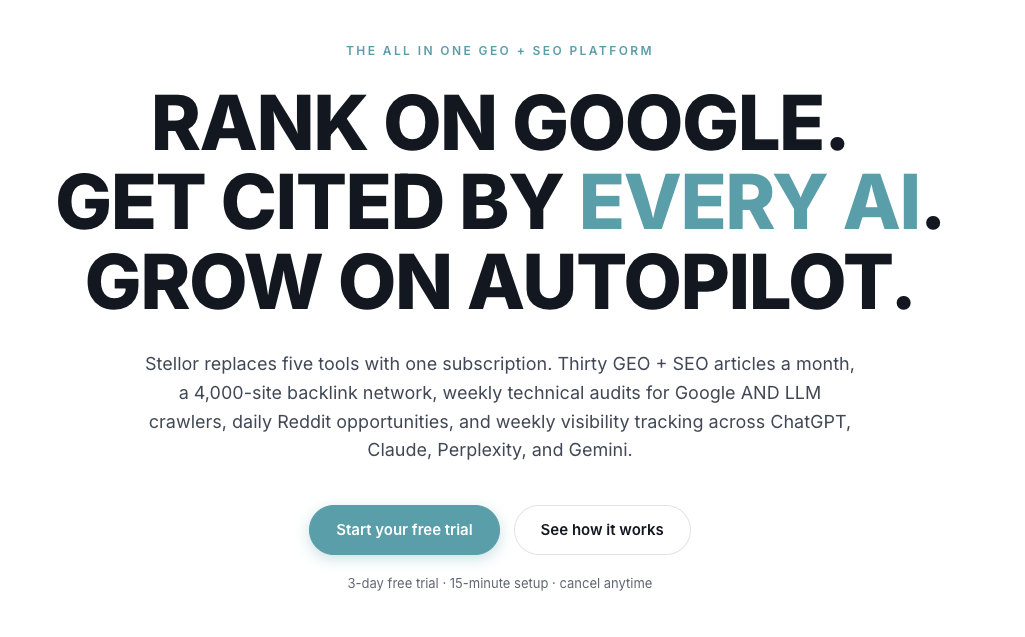
Trystellor publishes 30 GEO and SEO-optimized articles to your site every month, each with FAQPage schema, internal linking, and llms.txt configuration built in. The platform’s 4,000-site backlink network builds the authority signals that Bing and ChatGPT rely on. Weekly technical audits catch schema errors before they cost you citations. The LLM tracking module queries ChatGPT, Claude, Perplexity, and Gemini every week using real buyer prompts and reports exactly where you stand. Pricing starts at $199 per month with a three-day free trial and no credit card required. See the full platform capabilities or explore AI-driven SEO case studies to see what consistent optimization produces.
FAQ
What is faqpage schema and why does it matter for AI?
FAQPage schema is structured data markup in JSON-LD format that labels question-and-answer content for search engines and AI crawlers. Pages using it are 3.2 times more likely to appear in AI-generated answers like those from ChatGPT.
How long does it take to appear in ChatGPT home service suggestions?
Schema changes typically take 3–6 weeks to surface in ChatGPT citations, depending on Bing indexing speed and AI training data refresh cycles.
Does ChatGPT use google or bing to find home service businesses?
ChatGPT uses Bing for live web retrieval in browsing mode. Optimizing your Bing Webmaster Tools presence and keeping service pages current directly affects which businesses get recommended.
What does combining multiple schema types do for AI citation rates?
Pages using Article, FAQ, and author markup together see an 89% higher probability of AI search engine citations compared to pages with no structured data.
How do i test whether ChatGPT is citing my business?
Query ChatGPT directly with your exact FAQ questions, such as “Who offers emergency HVAC repair in [your city]?” For systematic weekly tracking across ChatGPT, Claude, Perplexity, and Gemini, use a platform like Trystellor’s LLM visibility tracker.