Most local service businesses are invisible online, not because they do bad work, but because they’ve never had a clear, affordable roadmap to rank on Google. You’re competing with companies that have dedicated marketing teams and agency budgets, and it can feel like the game is rigged. It isn’t. With the right sequence of steps, the right tools, and a genuine understanding of how review velocity and AI citations now shape search rankings, you can close that gap faster than you think.
Table of Contents
- What you need to get started with SEO and AI
- Step-by-step local SEO optimization process
- Troubleshooting and common mistakes in SEO optimization
- Expected results and benchmarking your SEO success
- Why review velocity is the new SEO secret weapon
- Next steps: Automate and amplify your SEO with Stellor
- Frequently asked questions
Key Takeaways
| Point | Details |
|---|---|
| Prioritize review velocity | Consistent new reviews matter more than a high static count for SEO and AI visibility. |
| Respond quickly to reviews | Answer all customer feedback within 24 hours to increase trust and search ranking. |
| Authenticity boosts AI citations | Specific, genuine reviews signal credibility and are favored by AI tools and Google. |
| Integrate AI tools | AI can automate citation and review analysis, helping your business rank higher. |
| Benchmark regularly | Monitor review velocity and Google ranking to measure progress and stay ahead. |
What you need to get started with SEO and AI
Before you optimize anything, you need the right foundation in place. Skipping this setup phase is one of the most common reasons local businesses stall out early. Think of it like showing up to a job without your tools. You can’t do the work.
Here’s what you need at minimum:
- Website access with editing rights so you can update title tags, meta descriptions, and page content
- A verified Google Business Profile (formerly Google My Business) with accurate name, address, phone number, and service categories
- A review collection system that lets you request feedback via SMS, email, or a direct review link immediately after completing a job
- Basic AI tool awareness, including how platforms like ChatGPT and Google’s AI Overviews pull business citations from review content and web mentions
The review system piece is more critical than most business owners realize. Review velocity and specificity directly influence how Google and AI tools rank and cite your business. Getting 10 or more new reviews per month, with authentic language describing your actual service, outperforms a competitor sitting on 200 stale reviews from three years ago.
Here’s a quick overview of the core requirements:
| Requirement | Tool or resource | Purpose |
|---|---|---|
| Website editing | WordPress, Wix, Squarespace | Update on-page SEO elements |
| Google Business Profile | Google Business (free) | Local map pack and search visibility |
| Review request system | SMS platform, email, or direct link | Build review velocity consistently |
| AI citation tracking | Stellor or similar platform | Monitor brand mentions in AI answers |
| Keyword research | Google Search Console, free tools | Identify local search terms to target |
For businesses just getting started with optimizing home services websites, the table above is your starting checklist. Don’t move forward until each row is covered. Trying to run SEO campaigns without these foundations is like advertising a phone number that’s disconnected.
Pro Tip: Set up your Google Business Profile review link as a short URL or QR code. Print it on your invoice, your truck wrap, or a card you hand customers after the job. Friction kills follow-through.
Step-by-step local SEO optimization process
With your preparation in place, follow these key steps to directly optimize your business for Google and AI visibility.
Step 1: Claim and fully verify your Google Business Profile
If your profile isn’t verified, you don’t exist in the local map pack. Go to business.google.com, claim your listing, and complete the verification process. Fill in every field: business hours, service areas, photos, service descriptions, and your primary category. Incomplete profiles rank lower, full stop.

Step 2: Optimize your on-page SEO
Every service page on your website needs a unique title tag that includes your primary service and your city. For example: “Roof Repair in Austin, TX | Johnson Roofing.” Your meta description should be 150 to 160 characters, include a local keyword, and give people a reason to click. Use your city name and neighborhood names naturally in your page copy, not stuffed awkwardly, but woven into real sentences about your service area.
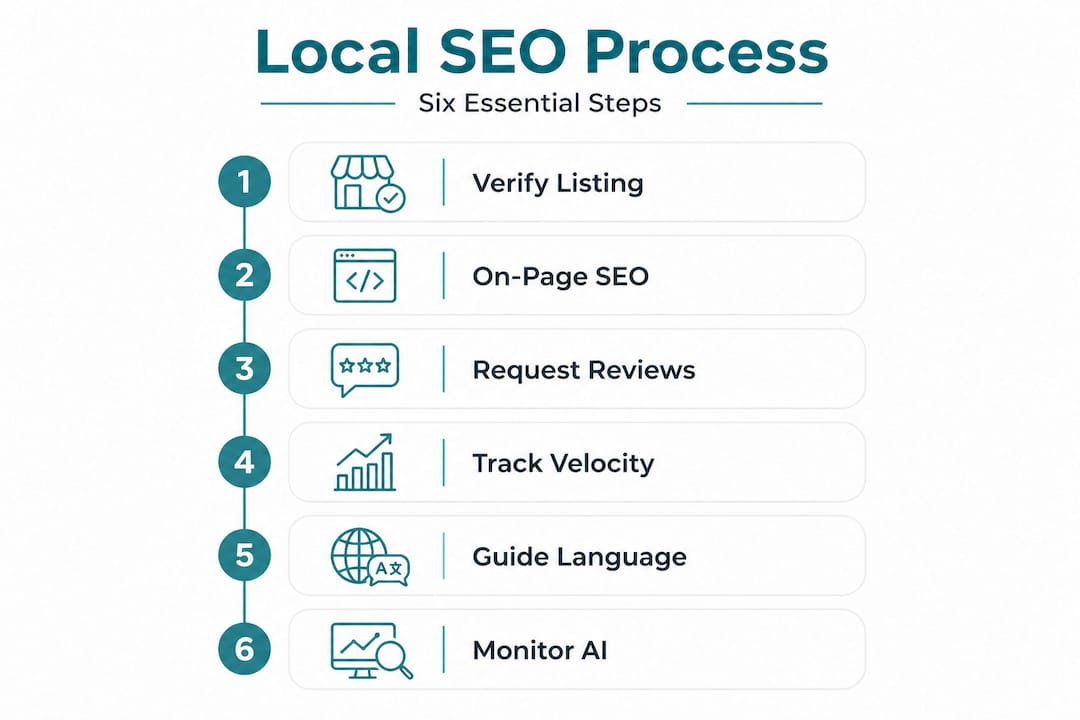
Step 3: Build a structured review request system
This is where most local businesses leave serious ranking potential on the table. Request reviews post-job via SMS, email, or a direct link, and respond to every single review within 24 hours. Responding shows Google that your profile is active and managed, which contributes to ranking signals.
Step 4: Focus on review velocity, not just total count
Here’s the part that surprises most people. A business with 45 reviews but 12 new ones this month will often outrank a competitor with 300 reviews and none in the past six months. Google’s algorithm treats fresh signals as more relevant. Aim for a steady drumbeat of new reviews every month, not a one-time push.
Step 5: Guide customers toward specific, authentic language
Don’t ask customers to “leave a five-star review.” Instead, ask them to describe what you did and how it helped. “They fixed our HVAC in under two hours on a Saturday” is infinitely more valuable than “Great service!” Specific reviews include natural keywords, and they carry more weight with AI citation systems that pull real language from reviews to answer user queries.
Step 6: Integrate AI visibility tracking
AI tools like ChatGPT, Perplexity, and Google’s AI Overviews are increasingly the first place people get answers to local service questions. If your business isn’t cited in those answers, you’re missing a growing traffic channel. Use a platform that tracks where and how often your brand appears in AI-generated responses. This is a newer signal, but it’s growing fast.
Here’s a quick comparison of traditional SEO versus AI-integrated SEO for local businesses:
| Factor | Traditional SEO | AI-integrated SEO |
|---|---|---|
| Review focus | Total count | Velocity and specificity |
| Content goal | Keyword density | Natural, answer-ready language |
| Visibility channel | Google search results | Search + AI citations |
| Response time | Weeks to months | Faster with consistent signals |
| Tracking tools | Rank trackers | Rank trackers + AI mention monitors |
Following this SEO optimization guide sequence consistently for 60 to 90 days produces measurable results for most local service businesses. The key word is consistently. One burst of effort followed by silence won’t move the needle.
Pro Tip: Schedule a 15-minute weekly block to respond to reviews, check your Google Business Profile for new questions, and send any pending review requests. Small, consistent habits compound into significant ranking gains over time.
Troubleshooting and common mistakes in SEO optimization
Even with a step-by-step process, common mistakes can undermine your SEO efforts. Here’s how to avoid them.
Skipping review requests or being inconsistent
The most common mistake is simply not asking. Businesses assume happy customers will leave reviews on their own. A small percentage will. The rest need a direct, easy prompt. If you only ask occasionally, your review velocity drops, and so does your ranking signal. Build the ask into your post-job workflow so it happens every single time.
Relying on generic review language
A review that says “Great job, very professional” does almost nothing for your SEO. Specific, authentic reviews that mention the actual service, the location, and a real detail about the experience are the ones that boost AI visibility and Google rankings. Coach your customers gently by asking specific questions: “What problem did we solve for you?” or “What would you tell a neighbor about our work?”
Ignoring negative reviews
Negative reviews left unanswered send a signal that your business is unresponsive. Worse, they can shape AI-generated answers about your business in a negative direction. Respond to every negative review calmly, professionally, and within 24 hours. Acknowledge the issue, offer a resolution, and move on. One thoughtful response to a bad review often impresses potential customers more than ten five-star ratings.
Overestimating the value of a static review count
Many business owners point to their 150 reviews as a badge of honor, but if those reviews are two years old, they’re doing less work than you think. Google and AI systems weight recency heavily. A competitor with fewer total reviews but a strong monthly cadence will consistently outrank you in local results.
Missing local keyword targeting
Generic keywords like “plumber” or “electrician” are nearly impossible to rank for at a national level. Your opportunity is hyper-local. Target phrases like “emergency plumber in [your city]” or “licensed electrician near [neighborhood name].” These terms have lower competition and higher purchase intent from people who are actually in your service area.
“The businesses that win local SEO aren’t the ones with the biggest budgets. They’re the ones with the most consistent systems for collecting specific, recent feedback and keeping their local presence active.”
Avoiding local SEO mistakes like these doesn’t require technical expertise. It requires discipline and a repeatable process.
Pro Tip: Create a simple checklist for your team or yourself to run through after every completed job. Include: send review request, check for new reviews, respond to any pending reviews. Laminate it and put it somewhere visible.
Expected results and benchmarking your SEO success
Once you’ve optimized your local SEO, you’ll want a way to measure results and track ongoing success.
Here’s what to track and what to expect:
- Review velocity: Are you hitting 10 or more new reviews per month? This is your primary leading indicator. Businesses that maintain this pace consistently outrank competitors with higher static counts.
- Google Business Profile views: Check your profile insights weekly. Look for trends in search views, map views, and direction requests. These numbers should climb steadily as your profile becomes more active.
- Website traffic from local search: Use Google Search Console to track clicks and impressions for your local keywords. You should see gradual improvement in impressions within 30 days and clicks within 60 to 90 days of consistent optimization.
- AI citation frequency: If you’re using a tool that monitors AI mentions, track how often your business appears in responses to relevant local queries. This is a newer metric but increasingly valuable as AI-driven search grows.
- Competitor benchmarking: Look at your top three local competitors on Google Maps. Check their review velocity, their average rating, and how their Google Business Profile is filled out. If they’re getting 15 reviews a month and you’re getting 3, that’s your gap to close.
Automation makes benchmarking much easier. Tools that pull your review data, track keyword rankings, and monitor AI citations in one dashboard save hours of manual checking every week. When you can benchmark your SEO performance automatically, you spend less time in spreadsheets and more time running your business.
The realistic timeline for most local service businesses: noticeable Google ranking improvements within 60 to 90 days of consistent effort, meaningful AI citation presence within 90 to 120 days. These aren’t overnight results, but they’re durable ones.
Why review velocity is the new SEO secret weapon
Here’s the contrarian take that most SEO guides won’t give you: stop obsessing over your total review count. It’s a vanity metric. What actually moves your ranking in 2026 is the rate at which you’re accumulating new, specific, authentic reviews.
Google’s algorithm is designed to surface the most relevant and current businesses for a given search. A business with 400 reviews from 2022 is, in Google’s eyes, less relevant than a business with 60 reviews and a steady stream of new ones this month. The algorithm is asking: is this business still active, still serving customers, still earning trust? Fresh reviews answer that question with a yes.
Now layer in AI systems. When someone asks ChatGPT or Perplexity “who’s the best roofer in city],” those systems pull from indexed content, review text, and web citations. [Velocity and specificity in reviews directly feed the language models with current, relevant data about your business. A review that says “They replaced our flat roof on a Tuesday in March and finished in one day” gives an AI system something concrete to work with. “Great company” gives it nothing.
The practical wisdom here is uncomfortable for businesses that have coasted on an old review base: you have to earn visibility continuously, not once. There’s no “done” in local SEO. The businesses winning in local search right now aren’t the ones who did a big push two years ago. They’re the ones who built a system and kept it running.
The good news? Building that system isn’t expensive or complicated. It’s a habit. And once it’s in place, AI-driven SEO strategies compound the results automatically as your fresh review content feeds both Google and AI citation engines simultaneously.
Next steps: Automate and amplify your SEO with Stellor
You now have the full picture: what to set up, how to optimize, what mistakes to avoid, and how to measure results. The challenge for most local service businesses isn’t knowing what to do. It’s finding the time and systems to do it consistently.
That’s exactly what Stellor is built for. Stellor automates SEO with Stellor by handling review request workflows, tracking AI citations across platforms like ChatGPT and Perplexity, publishing targeted content, and running technical site audits, all from a single dashboard. Instead of juggling five different tools or paying an agency, you get everything in one subscription designed specifically for local service businesses. Your optimization steps don’t have to stay manual. Put them on autopilot and let the results compound.
Frequently asked questions
How many reviews per month should a local business aim for?
Aim for at least 10 new reviews monthly to outrank competitors with higher static counts and improve your AI citation visibility.
Do specific and authentic reviews help SEO more than generic feedback?
Yes, specific authentic reviews that describe real services and outcomes are favored by both Google’s ranking algorithm and AI citation systems over vague, generic praise.
Is total review count more important than review velocity?
No, review velocity outperforms total count because Google and AI systems weight recency and consistency over static numbers from the past.
What is the fastest way to improve my Google ranking with SEO?
Fully optimize your Google Business Profile and implement a review system that sends post-job requests via SMS or email and responds to every review within 24 hours.
How does AI integration help local SEO?
AI citation tracking shows you where your business appears in AI-generated answers, and authentic review content feeds those systems with the specific language they need to recommend your business to potential customers.