TL;DR:
- Emergency service SEO targets urgent local search queries to ensure businesses appear prominently during high-demand moments. It relies on optimizing Google Business Profiles, schema markup, and local citations to quickly convert frantic searchers into calls and service leads. Consistent technical maintenance and integrated paid strategies are crucial for long-term visibility and rapid response.
Emergency service SEO is the specialized practice of optimizing a local business’s website, Google Business Profile, and online presence to appear prominently in urgent, high-intent search queries. When someone types “emergency plumber near me” at 2 a.m. or “24-hour locksmith open now,” your business either shows up or loses that call to a competitor. This guide breaks down every component you need to compete and win those moments.
The industry term for the broader discipline is local SEO, but emergency service SEO applies that framework specifically to urgent, time-sensitive queries where local search intent is at its highest. Search phrases like “emergency dentist near me” signal customers who are actively comparing providers right now, not researching for next week. That distinction changes everything about how you optimize.
What is emergency service SEO and why does it matter?
Emergency service SEO is defined as the targeted optimization of local service businesses’ online profiles, technical infrastructure, and content to capture urgent, high-conversion search traffic. It combines Google Business Profile management, schema markup, service-area targeting, and reputation signals into one coordinated strategy. The goal is simple: be the first credible result a panicked customer sees.
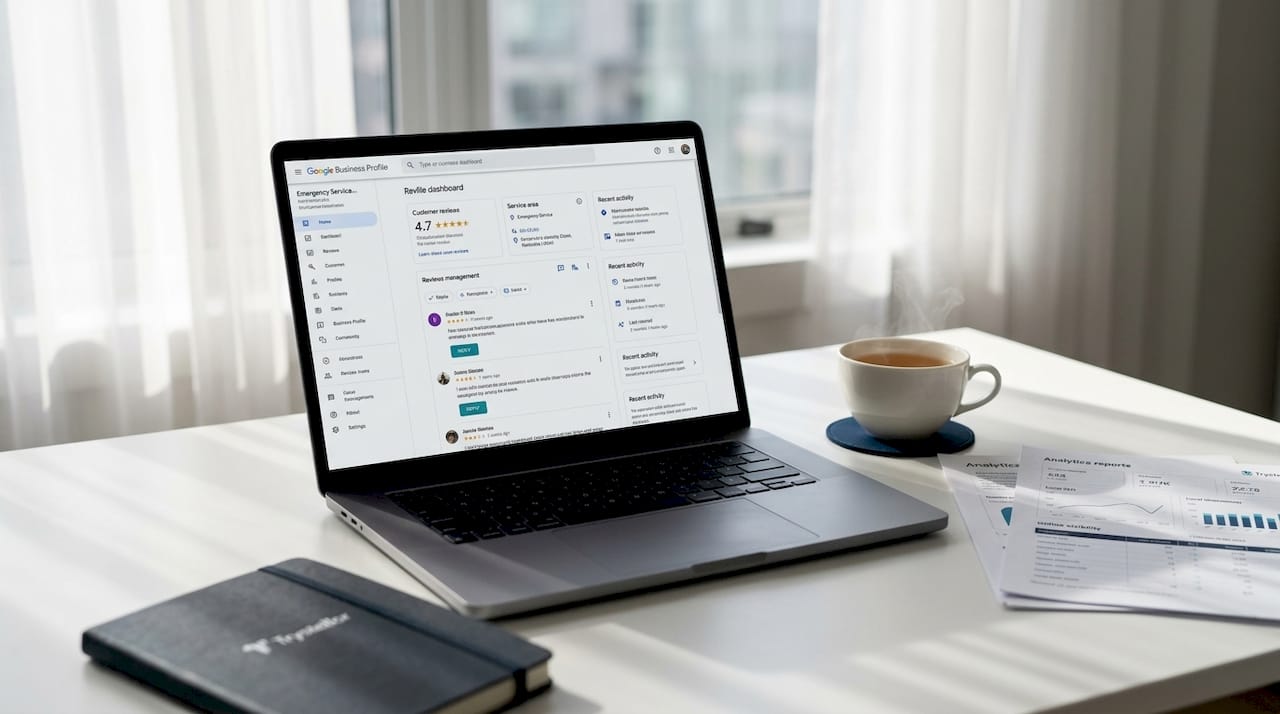
The stakes are higher here than in most local SEO contexts. A user searching for a restaurant can wait. A user searching for an emergency electrician or a burst-pipe plumber cannot. That urgency means your conversion window is measured in seconds, not days. If your listing is incomplete, your phone number is buried, or your page loads slowly, that customer moves to the next result.
For local service businesses, this is not a nice-to-have. It is the plumbing behind the walls of your digital presence. Get it right and you capture leads around the clock. Get it wrong and you fund your competitors’ growth every time someone in your area has a crisis.
What are the core components of emergency service SEO?
Emergency SEO strategies require a mix of technical, content, and reputation tactics timed for fast response to urgent queries. Each component reinforces the others, so a gap in one area weakens the entire system.
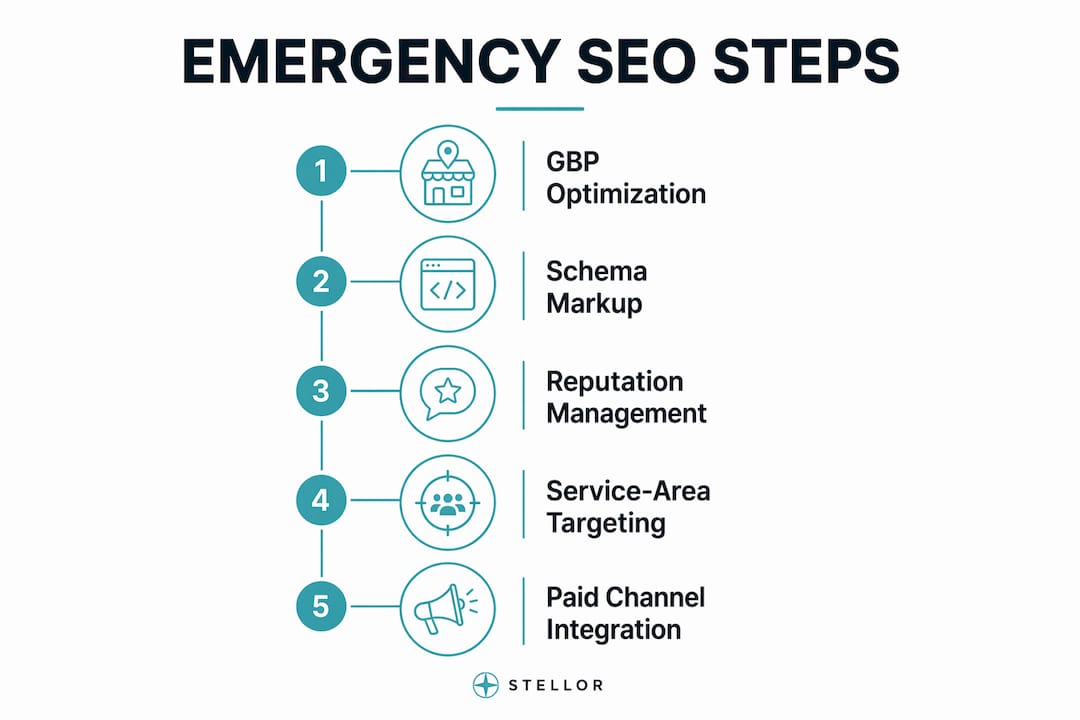
Google Business Profile (GBP) optimization is the single highest-leverage starting point. Your GBP must show your emergency hours, service categories, phone number, and service area accurately. Google pulls this data directly into the local map pack, which is the three-business block that appears above organic results for most local searches. If your GBP is incomplete or outdated, you will not appear there regardless of how good your website is.
Schema markup tells search engines and AI crawlers exactly what your business does, when you are available, and what services you offer. Without it, Google has to infer this from your page text, which introduces ambiguity. With it, you declare your services explicitly in a language machines read fluently.
Service-area and near-me optimization aligns your online presence with the geographic zones you actually serve. Optimizing location relevance helps attract more emergency service calls from users searching nearby, which is the core traffic source for most local operators.
Here is a checklist of the foundational components every emergency service business needs in place:
- A fully completed Google Business Profile with emergency hours, service categories, and a direct call button
- Dedicated service pages for each emergency offering (e.g., “Emergency Water Heater Repair” rather than a generic “Services” page)
- Consistent NAP (Name, Address, Phone) data across all local citations including Yelp, Angi, and HomeAdvisor
- A mobile-first website that loads in under three seconds, since most emergency searches happen on phones
- A steady stream of recent reviews, because review velocity signals active business status to Google’s local algorithm
- Schema markup covering LocalBusiness, Service, and FAQPage types
Pro Tip: Set up a Google Business Profile post every two weeks highlighting your emergency availability. Google treats recent posts as a freshness signal, and it gives customers one more reason to trust you are open and responsive.
How does schema markup enhance emergency service visibility?
Schema markup is structured data code, typically written in JSON-LD format, that you embed in your website’s HTML to communicate specific facts about your business directly to search engines. Think of it as a standardized form you fill out so Google does not have to guess. For emergency service businesses, three schema types matter most.
| Schema Type | What It Declares | Emergency SEO Benefit |
|---|---|---|
| LocalBusiness | Business name, address, phone, hours, service area | Feeds local map pack and AI answer engines directly |
| Service | Specific services offered and their descriptions | Increases eligibility for rich results on service queries |
| FAQPage | Common questions and answers about your services | Enables direct Q&A display in search results and AI Overviews |
A business with full LocalBusiness schema beats competitors without it when other ranking factors are equal. That is a meaningful edge in competitive local markets where the difference between first and fourth place in the map pack can mean dozens of calls per month.
One critical rule: FAQPage schema questions and answers must correspond visibly on the page. If your schema declares an answer that does not appear in the actual page text, Google issues a warning and the rich result disappears. This means your FAQ section on the page and your FAQPage schema must match word for word. Mismatches negate the benefits entirely.
AI answer engines like ChatGPT, Perplexity, and Gemini also read schema data when generating local business recommendations. A correctly structured LocalBusiness schema with emergency service attributes makes your business far more quotable when someone asks an AI for a recommendation in your category.
Pro Tip: Use Google’s Rich Results Test tool to validate your schema before publishing. It shows exactly which rich result types your page qualifies for and flags any errors that would block them.
What are common emergency SEO crises and how do you respond?
An SEO emergency for a service business is not just a flooded basement. It is also a sudden 40% drop in organic traffic, a Google Business Profile suspension, or a manual penalty that removes you from search results entirely. These events require the same urgency as a physical emergency.
Here is a structured response process for the most common SEO crises:
- Diagnose with Google Search Console first. Check for manual actions, coverage errors, and traffic drop dates. Cross-reference the drop date with known Google core update releases to determine whether the cause is algorithmic or technical.
- Run a full technical audit. Check for broken pages, crawl errors, duplicate content, and missing schema. A structured SEO audit checklist catches the most common technical causes within an hour.
- Assess your GBP status. A suspended or flagged Google Business Profile removes you from the map pack instantly. Log into your GBP dashboard and check for any policy violation notices.
- Prioritize quality improvements over quick fixes. Sites often do not recover between core updates; resilience requires proactive quality improvement, not reactive patches. Recovery from a core update can take 60 to 90 days or longer.
- Document everything. Track what changed, when you changed it, and what the traffic response was. This log becomes your recovery roadmap and prevents repeating the same mistakes.
“The businesses that recover fastest from SEO drops are the ones that were already running regular audits. They know their baseline, so they spot anomalies immediately instead of discovering a problem three months after it started.”
Building resilience to Google core algorithm updates requires continuous auditing and quality improvement rather than crisis-driven remediation. For emergency service businesses, this means treating your SEO health the same way you treat your equipment maintenance: scheduled, documented, and proactive.
How to optimize local SEO for emergency services that need immediate action
The goal of local SEO for emergency services is not just to rank. It is to rank, convert, and make contact as fast as possible. Every element of your local presence should reduce friction between the search and the phone call.
Here are the tactics that move the needle most for emergency service providers:
- Create dedicated emergency landing pages for each service type and location. “Emergency HVAC Repair in Denver” converts better than a generic services page because it matches the exact query and signals geographic relevance.
- Add a click-to-call button above the fold on every page. On mobile, this is the single highest-converting element on an emergency service website.
- Build local citations on Yelp, Angi, Thumbtack, and HomeAdvisor with consistent NAP data. Each citation reinforces your geographic authority and feeds the signals Google uses for map pack rankings.
- Use Google Local Service Ads (LSAs) alongside organic SEO. LSAs appear above organic results and carry Google’s screening badge, which builds immediate trust with emergency callers. PPC captures immediate demand while SEO builds long-term map pack authority.
- Respond to every Google review within 24 hours. Review velocity and recency are direct ranking signals in Google’s local algorithm. A business with 12 reviews from the past month outranks one with 200 reviews from three years ago.
- Optimize your page speed for mobile. Most emergency searches happen on smartphones in stressful moments. A three-second load time is the ceiling; under two seconds is the target.
Combining SEO with paid channels accelerates visibility and lead capture, which is critical for emergency service success. The two channels are not competitors. They are complements, with LSAs and PPC filling the gap while your organic rankings build.
Key takeaways
Emergency service SEO requires Google Business Profile optimization, schema markup, service-area targeting, and a combined organic and paid strategy to capture urgent, high-intent local searches reliably.
| Point | Details |
|---|---|
| GBP is the foundation | A complete Google Business Profile with emergency hours and a call button drives map pack visibility. |
| Schema markup declares your services | LocalBusiness, Service, and FAQPage schema make your offerings legible to both Google and AI answer engines. |
| Schema must match page content | FAQPage schema that does not mirror visible on-page text triggers warnings and loses rich result eligibility. |
| Core update recovery takes time | Ranking drops from algorithm updates take 60 to 90 days or longer to recover; proactive audits prevent most crises. |
| Combine SEO with LSAs and PPC | Paid channels capture immediate demand while organic SEO builds durable local map pack authority over time. |
Why most emergency service businesses are leaving calls on the table
I have reviewed hundreds of local service business websites over the years, and the pattern is almost always the same. The business owner has done the basics: they have a website, they have a Google Business Profile, maybe they have run some Google Ads. But the technical layer underneath is either missing or broken. No schema. Inconsistent NAP data across citations. A GBP that lists “Monday to Friday, 9 to 5” for a business that actually takes emergency calls at midnight.
The uncomfortable truth is that most emergency service SEO failures are not caused by bad strategy. They are caused by neglect of the fundamentals. A plumber who fixes burst pipes at 3 a.m. but whose website says they close at 5 p.m. is invisible to the exact customer they want most.
What I have found actually works is treating your digital presence like a piece of equipment that needs regular maintenance. Weekly audits, monthly content updates, and schema validation every time you add a new service. The businesses I have seen grow fastest in competitive local markets are not the ones with the biggest ad budgets. They are the ones with the cleanest technical foundations and the most consistent review velocity.
The future of emergency search is also shifting toward AI. When someone asks ChatGPT or Perplexity for an emergency plumber in their city, the AI pulls from structured data, citations, and review signals. The businesses with complete schema and strong local authority will be cited. The ones without it will not. That gap is only going to widen. You can explore local SEO optimization strategies to start closing it now.
— Cole
How Trystellor helps you win emergency service searches
If managing schema, audits, citations, and AI visibility tracking separately sounds like a full-time job, that is because it used to be. Trystellor consolidates all of it into one platform built specifically for local service businesses that need to compete in urgent search markets.
Trystellor publishes 30 SEO-optimized articles per month to your site, runs weekly technical audits across 11 ranking factors, builds authority through a 4,000-site backlink network, and tracks your citations across ChatGPT, Claude, Perplexity, and Gemini every week. For emergency service businesses, the platform’s schema validation and local map pack tracking mean you always know exactly where you stand and what to fix. See the full platform capabilities and start a three-day free trial with no credit card required.
FAQ
What is emergency service SEO in simple terms?
Emergency service SEO is the practice of optimizing a local business’s website and Google Business Profile to appear at the top of urgent, high-intent search results. It focuses on speed, local relevance, and trust signals that convert panicked searchers into callers.
How does schema markup help emergency service businesses rank?
Schema markup uses structured data types like LocalBusiness, Service, and FAQPage to declare your services, hours, and location directly to search engines. A business with complete schema beats competitors without it when other ranking factors are equal, and it also increases eligibility for rich results and AI citations.
How long does recovery take after a Google core update drops rankings?
Recovery from a Google core update typically takes 60 to 90 days or longer, and sites often do not recover until the next core update cycle. Proactive quality improvements and regular audits reduce the severity of drops before they happen.
Should emergency service businesses use Google Local Service Ads alongside SEO?
Yes. LSAs appear above organic results and carry Google’s screening badge, which builds immediate trust with emergency callers. PPC and LSAs capture demand now while organic SEO builds durable long-term visibility in the local map pack.
What is the most common mistake in emergency service local SEO?
The most common mistake is incomplete or inaccurate Google Business Profile data, particularly emergency hours and contact information. A GBP that lists standard business hours for a 24-hour emergency service makes the business invisible to its highest-value customers.