TL;DR:
- Voice search optimization focuses on creating question-based content, schema markup, and fast mobile load times to improve visibility. To succeed, businesses must build topical authority and maintain accurate local data, as voice assistants rely on comprehensive, well-structured websites. Ongoing technical and content updates are essential for long-term voice search success.
Voice search optimization is the practice of structuring your website content and technical setup to rank prominently when users speak queries to assistants like Siri, Google Assistant, Alexa, and Gemini. It requires question-based content, schema markup from schema.org, fast mobile load times, and topical authority that AI-driven assistants now weigh heavily. Businesses that ignore these factors lose ground to competitors who show up when a customer says “find a plumber near me” or “best accountant in Dallas.” The techniques in this guide reflect how voice SEO works in 2026, including the shift toward LLM-based ranking signals that go well beyond traditional keyword placement.
What are the key differences between voice search and traditional text search?
Voice queries are fundamentally different from typed searches. A person typing might enter “plumber Austin TX,” but the same person speaking says “Who is the best plumber near me in Austin?” That shift from fragment to full sentence changes everything about how you need to structure your content.
Here are the four core differences that shape your voice SEO strategies:
- Query length. Voice queries average five or more words. Typed queries average two to three. Your content must answer longer, more specific questions to match what people actually say.
- Question format. Voice searches almost always begin with who, what, where, when, how, or why. Headings that mirror these question patterns win featured snippets, which voice assistants read aloud.
- Local intent. Local voice searches make up about 76% of voice queries. If your business serves a specific area, local intent is not optional. It is the primary driver of voice traffic.
- Device context. Most voice searches happen on mobile phones or smart speakers. Users want fast, direct answers. Pages that load slowly or bury the answer lose the result before a human even reads it.
Pro Tip: Write a list of the 20 most common questions your customers ask you in person or by phone. Those are your voice search content targets. Build a dedicated page or FAQ section around each one.
The practical implication is clear. You cannot optimize for voice-activated search by repurposing keyword-stuffed text content. You need a different structure, a different tone, and a sharper focus on local relevance.
How to create content that wins featured snippets and AI citations
Conversational, question-based content with clear, concise answers increases the likelihood of winning featured snippets, which voice assistants read aloud. The format matters as much as the information itself.
Follow these content principles to build pages voice assistants prefer:
- Use exact question phrases as H2 and H3 headings. “How much does a roof repair cost?” performs better than “Roof Repair Pricing.” The heading signals to both Google and AI models that your page directly answers that query.
- Write a 40–50 word direct answer immediately after each question heading. Place it before any elaboration. Voice assistants pull from the first clear answer they find, not the most detailed paragraph buried below.
- Expand below the direct answer with depth. AI-powered assistants like Gemini and ChatGPT weigh topical authority over keyword density. A page that covers a topic thoroughly from multiple angles earns more citations than a page that repeats one keyword 15 times.
- Use structured lists and tables. These formats improve snippet eligibility because they present information in a way that is easy to extract and read aloud.
- Build content clusters. A single page on “HVAC maintenance” should link to related pages on “HVAC repair costs,” “how to change an air filter,” and “when to replace your HVAC unit.” Interconnected clusters signal comprehensive authority to LLM-driven assistants.
- Implement FAQPage and Speakable schema. These structured data types tell voice assistants which sections of your page are suitable for reading aloud.
| Content approach | Voice search impact |
|---|---|
| Question-format H2/H3 headings | Matches spoken query structure directly |
| 40–50 word direct answer after heading | Eligible for featured snippet extraction |
| Detailed supporting content below | Builds topical authority for LLM ranking |
| FAQPage schema markup | Signals voice eligibility to assistants |
| Internal content cluster links | Reinforces authority across related topics |
Pro Tip: Test your own content by reading it aloud. If the answer to your heading question does not appear within the first two sentences of that section, rewrite it. Voice assistants do not scroll.
What technical SEO and schema markup does voice search require?
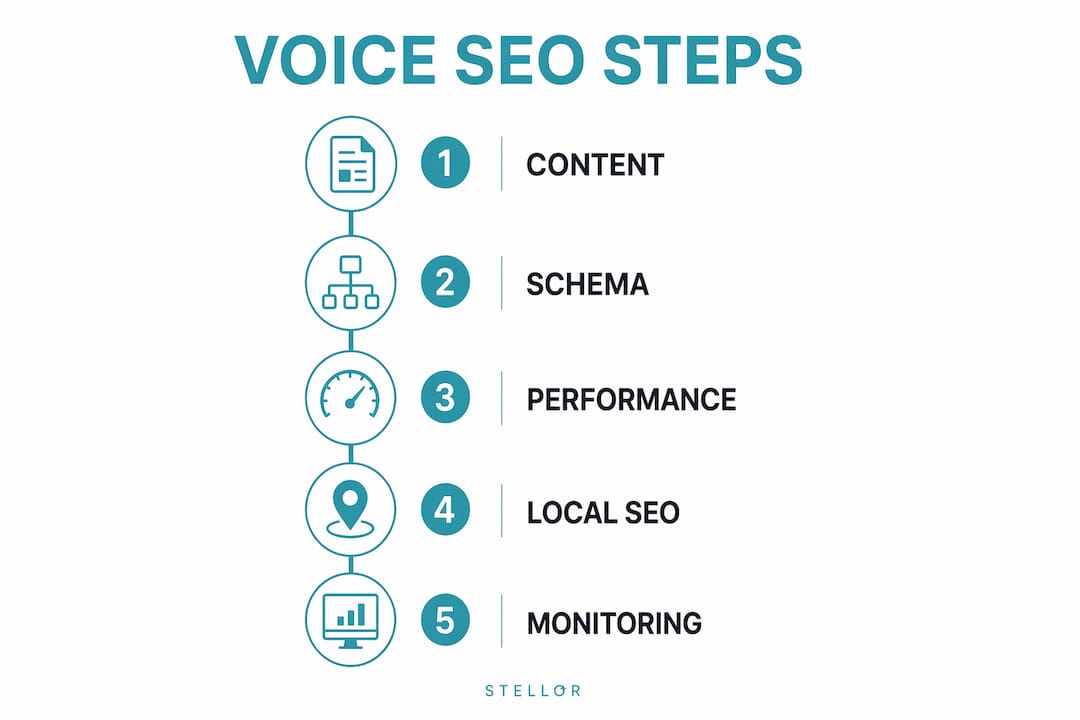
Technical SEO is the plumbing behind the walls of your digital presence. Voice assistants cannot recommend what they cannot read, and they will not read what loads too slowly.

Pages that rank for voice search load 52% faster than average pages. That single statistic defines the performance bar. A page that takes four seconds to load on mobile will not win a voice result, regardless of how well-written the content is.
Here are the technical priorities to address:
- Page speed under two seconds on mobile. Use Google Search Central’s PageSpeed Insights to identify and fix render-blocking resources, uncompressed images, and server response delays.
- HTTPS security. Voice assistants default to secure pages. An HTTP site is disqualified from most voice results.
- Responsive design. Your layout must adapt cleanly to any screen size. Google indexes the mobile version of your site first.
- Semantic HTML structure. Use H1 for your page title, H2 for major sections, H3 for subsections, and proper paragraph tags throughout. ARIA roles help assistants parse page structure accurately.
For schema markup, implement these types in order of priority:
- FAQPage schema for any page with question-and-answer content.
- Speakable schema to mark the specific sections you want assistants to read aloud.
- LocalBusiness schema with complete address, phone number, hours, and service area.
- HowTo schema for step-by-step instructional content.
- Article schema for editorial and blog content.
Implementing Speakable and FAQPage schema has become table stakes for voice optimization in 2026. Absence of these signals tells assistants your site is not voice-ready. Valid, complete schema does not guarantee a ranking boost by itself, but schema markup is essential for voice assistants to identify and read relevant content aloud.
Pro Tip: Validate every schema implementation with Google’s Rich Results Test before publishing. Invalid or incomplete markup confuses assistants and can suppress your content from voice results entirely.
Local SEO strategies tailored for voice search
Local businesses have the most to gain from voice search. A customer asking “Who fixes water heaters near me?” is ready to hire. Your job is to be the answer they hear.
Voice search answers are drawn primarily from the top three search results, which means local map pack rankings directly feed voice results. Getting into that top tier requires a complete and consistent local presence across every platform voice assistants query.
Start with these local SEO foundations:
- Claim and fully complete your Google Business Profile. Add your business category, services, hours, photos, and a keyword-rich description. Incomplete profiles lose to complete ones every time.
- Register on Apple Business Connect and Bing Places. Siri pulls from Apple Maps. Cortana pulls from Bing. Ignoring these platforms means missing voice queries on those assistants entirely.
- Maintain consistent NAP data. Your Name, Address, and Phone number must match exactly across Google, Apple, Bing, Yelp, and every directory where your business appears. Inconsistencies confuse assistants and suppress local rankings.
- Use LocalBusiness schema with full detail. Include your address, phone, hours, geo-coordinates, and service area. This structured data gives assistants the precise information they need to recommend you confidently.
- Incorporate natural location phrases in your content. Write sentences like “Our team serves homeowners in the Denver metro area” rather than stuffing “Denver plumber” into every paragraph. Natural phrasing matches how voice queries are spoken.
- Collect and respond to customer reviews. Reviews act as credibility signals. Assistants favor businesses with strong, recent review activity when recommending local services.
For businesses in the home services space, the connection between smart home technology and voice-activated search is growing fast. Customers who control their home systems by voice are the same customers who search by voice. Showing up in their assistant’s answer is the first step to earning their business.
Businesses that want a deeper look at local search ranking tactics for service providers will find that the same principles that drive map pack rankings also drive voice results.
How do you measure voice search optimization performance?
Direct voice search traffic does not appear as a labeled segment in Google Analytics. You measure voice SEO performance through proxy signals that correlate with voice query behavior.
Tracking voice search performance relies on question-format query data in Google Search Console and featured snippet impression growth. These are your primary indicators.
Follow this measurement sequence:
- Filter Google Search Console by question queries. Search for impressions and clicks on queries beginning with who, what, where, when, how, and why. Growth in these queries signals improving voice search visibility.
- Monitor featured snippet rankings. Track which of your pages hold featured snippets. Voice assistants read these snippets aloud, so snippet ownership equals voice result ownership.
- Watch local pack visibility. Track your position in the local map pack for your core service queries. Voice results for local searches pull directly from this pack.
- Analyze mobile engagement metrics. Bounce rate and session duration on mobile pages reflect whether your content satisfies the intent behind voice queries. High bounce rates signal a mismatch between the query and your answer.
- Use Trystellor’s weekly audits. Trystellor tracks AI citation signals across ChatGPT, Claude, Perplexity, and Gemini, giving you a direct read on whether your content is being recommended by the same LLMs that power voice assistants. This is the measurement layer that traditional analytics tools miss entirely.
Understanding how AI ranking factors influence voice citations helps you interpret these signals correctly and adjust your content strategy with precision.
Key Takeaways
Voice search optimization requires question-based content, valid schema markup, fast mobile performance, and consistent local data to win AI assistant citations and featured snippet placements.
| Point | Details |
|---|---|
| Question-format content wins | Structure H2/H3 headings as spoken questions with 40–50 word direct answers below. |
| Schema markup is non-negotiable | FAQPage, Speakable, and LocalBusiness schema tell assistants your content is voice-ready. |
| Page speed determines eligibility | Pages ranking in voice results load 52% faster than average; target under two seconds on mobile. |
| Local intent drives most queries | About 76% of voice queries carry local intent, making Google Business Profile accuracy critical. |
| Measure through proxy signals | Track question-format queries in Google Search Console and featured snippet impressions to gauge voice performance. |
Why most businesses are still getting voice SEO wrong
The traditional voice SEO playbook said: win the featured snippet, win the voice result. That was accurate in 2019. It is not accurate now.
Modern voice assistants run on LLM-based AI models. Gemini, Apple Intelligence, and the voice layer of ChatGPT do not simply pull the top featured snippet. They synthesize answers from sources they consider authoritative on the full topic. A page that answers one question well but sits in isolation loses to a site that covers the entire subject area with depth, internal links, and consistent publishing.
I have watched businesses spend months chasing snippet formatting while their competitors built content clusters and earned the authority signals that actually move the needle with AI assistants. The snippet is a symptom of authority, not the cause of it. Chase the authority, and the snippets follow.
The other mistake I see constantly is treating schema markup as a one-time setup task. Voice assistants re-crawl your site regularly. If your hours change, your schema does not update automatically. If you add a service, your LocalBusiness schema does not know. Stale or inaccurate schema actively hurts your voice eligibility because it signals unreliable data to the assistant.
Site speed deserves the same ongoing attention. A page that loaded in 1.8 seconds in january may load in 3.2 seconds in june after a plugin update or image upload. Voice ranking is not a set-and-forget outcome. It requires the same maintenance discipline as any other performance channel.
The businesses that will win voice search in 2026 are the ones treating it as an authority-building program, not a formatting exercise. That means publishing consistently, maintaining technical health, keeping local data accurate, and tracking AI citation signals week over week. The AI recommendation landscape for local service businesses is shifting fast, and the gap between businesses that track it and those that ignore it is widening every month.
— Cole
How Trystellor helps businesses win voice and AI search
Voice search visibility depends on the same signals that drive AI citation rankings: topical authority, structured data, fast mobile performance, and consistent local presence. Trystellor addresses all of these in a single platform, replacing what used to require five separate tools for $199 per month.
Trystellor publishes 30 schema-optimized articles per month to your site, runs weekly technical audits covering FAQPage and Speakable schema validity, and tracks your citations across ChatGPT, Claude, Perplexity, and Gemini every week. The platform’s 4,000-site backlink network builds the domain authority that puts you in the top three results where voice search answers originate. A three-day free trial requires no credit card, and your first AI Visibility Audit arrives within 48 hours of setup.
FAQ
What is voice search optimization?
Voice search optimization is the process of structuring website content, schema markup, and technical performance to rank in results read aloud by voice assistants like Siri, Google Assistant, Alexa, and Gemini. It prioritizes question-based content, local SEO, and fast mobile load times.
How does schema markup help with voice search?
FAQPage, Speakable, and LocalBusiness schema tell voice assistants which sections of your page are suitable for reading aloud. Without valid schema, assistants treat your site as not voice-ready and skip it in favor of marked-up competitors.
Why do local businesses benefit most from voice SEO?
About 76% of voice queries carry local intent, meaning users are looking for a nearby business or service. Businesses with complete Google Business Profiles, consistent NAP data, and LocalBusiness schema appear in the local map pack that voice assistants pull from.
How long does it take to see voice search results?
Measurable improvements in question-format query impressions and featured snippet rankings typically appear within weeks to a few months of implementing structured content and schema changes. Full authority gains from content clusters take one to two quarters to compound.
How do I track voice search performance in Google Search Console?
Filter your queries by question words (who, what, where, when, how, why) to isolate voice-style searches. Growth in impressions and clicks for these queries, combined with featured snippet gains, indicates improving voice search visibility.