TL;DR:
- An in-house SEO team priority checklist emphasizes fixing crawlability and indexing issues before all other tasks to ensure pages are discoverable by search engines. It advocates for clear ownership of tasks, quarterly audits, and resource prioritization on high-impact, quick-win activities to achieve measurable SEO results efficiently. Regularly updating stakeholders through concise reports and adopting a living, adaptable strategy helps sustain long-term SEO success.
An in-house SEO team priority checklist is a structured task list that directs your team toward the highest-impact SEO activities first, removing ranking barriers before investing time in lower-priority work. The most effective checklists for in-house SEO strategy start with technical foundations, move through content and on-page optimization, and close with a repeating audit and reporting cadence. Tools like Google Search Console, Ahrefs, and Stellor give your team the data to measure progress at every stage.
1. Fix crawlability and indexing issues first
Ensuring critical pages are indexed is the number one priority before any other SEO fix. This finding holds true in 2026 because Google cannot rank a page it cannot find. If your service pages, location pages, or product pages are blocked by a misconfigured robots.txt file, a stray noindex tag, or a missing XML sitemap entry, every other optimization you run is invisible to search engines.

Start your SEO team task list here by auditing your robots.txt and sitemap.xml files directly in Google Search Console. Check the Coverage report for pages marked as “Excluded” or “Crawled but not indexed.” Resolve these before touching title tags, content, or backlinks. A page that ranks poorly is a problem you can fix. A page that does not rank at all is a problem that blocks everything else.
Pro Tip: Run a site:yourdomain.com search in Google to get a rough count of indexed pages. If the number is significantly lower than your actual page count, you have an indexing problem that belongs at the top of your SEO team action items.
2. Audit and improve site architecture
Internal linking to priority content strengthens crawlability and signals relevance to search engines. Site architecture is the plumbing behind the walls of your digital presence. When it is well-organized, Google moves through your site efficiently and understands which pages matter most. When it is fragmented, link equity leaks and key pages lose authority they should be accumulating.
Your SEO strategy checklist should include a full internal link audit using a tool like Screaming Frog or Ahrefs. Identify orphaned pages that receive no internal links. Consolidate thin or duplicate location pages into single, authoritative pages. Build topic clusters where a pillar page links to supporting content and supporting content links back. This structure tells Google that your site is the authoritative source on a given topic, which is exactly what local service businesses need to compete in the local map pack.
3. Resolve website performance and Core Web Vitals
Addressing backend bottlenecks and Core Web Vitals improves both user experience and rankings after indexing and architecture are stable. Google’s ranking systems factor in page speed, mobile responsiveness, and visual stability. A slow-loading service page loses both rankings and customers.
Use Google’s PageSpeed Insights and the Core Web Vitals report in Google Search Console to identify specific pages failing LCP, CLS, or INP thresholds. Prioritize fixes on your highest-traffic and highest-revenue pages first. Common fixes include compressing images, reducing render-blocking JavaScript, and enabling browser caching. For local service businesses, mobile performance is non-negotiable since most local searches happen on phones.
4. Define roles and ownership for every SEO task category
Assigning clear owners and approvers for SEO strategy, technical fixes, content, and reporting keeps projects moving and prevents the stalls that kill momentum in in-house teams. Without defined ownership, tasks sit in a gray zone where everyone assumes someone else is handling them.
Structure your team’s ownership this way:
- SEO strategist or manager: Sets priorities, owns the roadmap, and communicates results to leadership.
- Technical SEO lead or developer: Owns crawlability fixes, site speed improvements, and schema markup.
- Content lead or writer: Owns on-page optimization, new content production, and metadata updates.
- Analytics owner: Owns Google Search Console, reporting dashboards, and monthly performance reviews.
- Approver (marketing director or CMO): Reviews and signs off on major changes before deployment.
Pro Tip: Reusable project templates in tools like Asana, Monday.com, or Notion reduce setup time for recurring SEO tasks and create a consistent standard across your team. Build one template per task category and update it quarterly.
5. Optimize content for local keywords and user intent
Local SEO content tasks belong on your checklist for SEO success immediately after technical foundations are stable. Your content must match what real buyers in your service area are searching for, not just broad industry terms. A plumbing company in Denver needs pages targeting “emergency plumber Denver” and “water heater replacement Denver,” not just “plumbing services.”
Your in-house SEO priorities for content should include:
- Auditing existing service and location pages for keyword alignment with local search intent.
- Updating title tags, meta descriptions, and H1 headings to include city or neighborhood modifiers.
- Adding LocalBusiness schema markup to every location page so Google can surface your business in AI Overviews and the local map pack.
- Consolidating thin pages that cover the same topic into one authoritative page with depth and original detail.
- Building a content calendar that targets one new local keyword cluster per month.
For a deeper look at how local SEO drives faster rankings for service businesses, the approach is consistent: specificity wins over generality every time.
6. Build a link acquisition process
Backlinks remain a primary trust signal for Google and for AI answer engines like ChatGPT and Perplexity. An in-house SEO team that ignores link building is leaving authority on the table. The goal is not volume. It is relevance and consistency.
Your SEO team task list for link building should include monthly outreach to local business directories, industry associations, and local news outlets. Sponsor a local event and request a link from the event page. Contribute expert commentary to local media. Submit your business to the top 50 local and industry-specific directories. Each of these activities builds the kind of natural, diversified backlink profile that compounds over time. For teams with limited bandwidth, even four to six quality links per month moves the needle measurably over a quarter.
7. Set a quarterly technical SEO audit schedule
Full technical SEO audits every three months, plus an immediate audit after any major site update or migration, are the industry standard for maintaining SEO health in 2026. Sites change constantly. New pages get added, redirects break, and plugins introduce errors. A quarterly audit catches these issues before they compound into ranking drops.
Your quarterly audit should cover:
- Crawlability and indexation status in Google Search Console.
- Internal link health and orphaned pages.
- Page speed and Core Web Vitals across key templates.
- Schema markup completeness for all service and location pages.
- Redirect chains and broken links.
Run your audit using a combination of Screaming Frog for crawl data and Google Search Console for indexation and performance signals. Document findings in a shared tracker so your team can assign owners and track resolution. The SEO audit checklist for local service businesses from Stellor covers each of these areas in detail.
8. Build a monthly reporting cadence
Consistent monitoring and transparent reporting maintain stakeholder engagement and keep your SEO strategy checklist aligned with business goals. Monthly reports give leadership visibility into what is working, what is not, and where resources should shift next.
Your monthly SEO report should include organic traffic trends from Google Search Console, keyword ranking movement for your top 20 target terms, conversion data from organic sessions, and a summary of completed tasks with next-month priorities. Keep reports concise. One page of clear metrics with a brief narrative beats a 20-slide deck that no one reads. For guidance on structuring this process, the monthly SEO reporting cadence framework gives you a repeatable format.
| Reporting metric | Recommended frequency |
|---|---|
| Organic traffic and sessions | Monthly |
| Keyword ranking movement | Monthly |
| Core Web Vitals status | Quarterly |
| Backlink profile review | Quarterly |
| Full technical crawl audit | Quarterly and post-migration |
9. Prioritize tasks when resources are limited
Focusing on quick wins with big impact and low effort is the right framework when your team is stretched. Not every SEO task deserves equal time. The Eisenhower Matrix works well here: urgent and high-impact tasks go first, low-impact maintenance tasks get deferred.
When resources are tight, apply this filter to your SEO priorities for teams:
- Fix indexing and crawlability issues immediately. These block all other gains.
- Update metadata on your top 10 revenue-driving pages before touching lower-traffic pages.
- Build internal links to pages already ranking on page two. A small push can move them to page one.
- Defer redesigns, site migrations, and experimental content until fundamentals are solid.
“The biggest mistake in-house SEO teams make is spending time on low-leverage tasks while critical ranking barriers go unfixed. Prioritize removal of blockers over optimization of already-ranking pages.”
This approach to how to organize SEO tasks by impact rather than urgency is what separates teams that see results within a quarter from those that spin their wheels for six months.
Key takeaways
An effective in-house SEO team priority checklist starts with crawlability and indexing, builds through architecture and content, and sustains gains through quarterly audits and clear team ownership.
| Point | Details |
|---|---|
| Fix indexing first | Unindexed pages cannot rank, making crawlability fixes the top priority before any other task. |
| Define team ownership | Assigning clear owners for strategy, technical, content, and reporting prevents bottlenecks and delays. |
| Audit every quarter | Run full technical audits every three months and immediately after major site changes. |
| Prioritize by impact | Focus limited resources on quick wins and ranking blockers before lower-leverage maintenance tasks. |
| Report consistently | Monthly reporting keeps stakeholders aligned and helps your team adapt priorities based on real data. |
Why most in-house SEO checklists fail before they start
After working with in-house SEO teams across dozens of local service businesses, the pattern is consistent. Teams build detailed checklists, assign tasks, and then stall because no one fixed the indexing problems first. You cannot optimize your way around a page Google is not reading.
The second failure point is ownership. When a task belongs to “the team,” it belongs to no one. I have seen technically excellent SEO strategies produce zero results because the approval workflow required three sign-offs and no one scheduled the meeting. Defining a single owner for each task category is not bureaucracy. It is the difference between a checklist that gets executed and one that collects dust in a shared drive.
The third thing I would push back on is the instinct to chase content volume before technical health is solid. Publishing 20 new blog posts on a site with broken internal linking and unindexed service pages is like painting a house with a cracked foundation. Fix the structure first. Then build on it.
The teams I have seen succeed treat their SEO checklist as a living document, not a one-time project. They revisit priorities monthly, run audits quarterly, and adjust based on what the data actually shows. That discipline, more than any single tactic, is what produces measurable SEO results over time.
— Cole
How Stellor supports your in-house SEO team
Your team should be focused on strategy and execution, not stitching together five separate tools to get a complete picture of your SEO health.
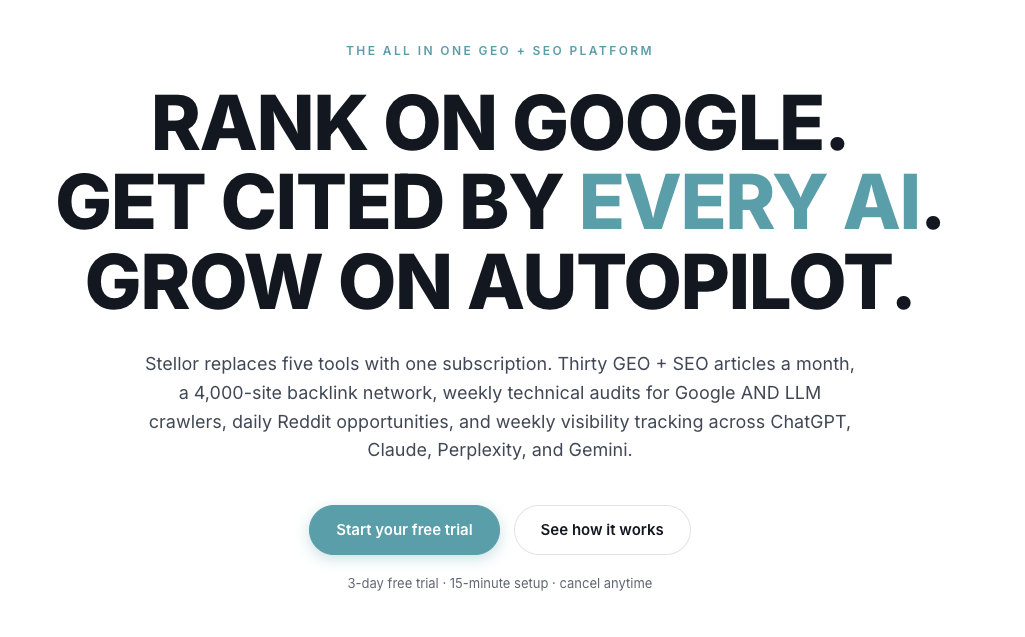
Stellor replaces your content tool, backlink service, technical auditor, community engagement workflow, and AI visibility tracker with one platform at $199 per month. You get 30 GEO and SEO-optimized articles published to your CMS every month, weekly technical audits covering 11 ranking factors, a 4,000-site backlink network, and weekly LLM visibility tracking across ChatGPT, Claude, Perplexity, and Gemini. See exactly where your business is being cited and where competitors are winning answers you should be earning. Explore the full platform features and start a three-day free trial with no credit card required.
FAQ
What should be the first item on an in-house SEO team checklist?
Fixing crawlability and indexing issues is the first priority. Pages that are not indexed by Google cannot rank, regardless of how well-optimized they are.
How often should an in-house SEO team run a technical audit?
Run a full technical SEO audit every three months and immediately after any major site update, redesign, or migration to catch new issues before they affect rankings.
How do you assign SEO tasks effectively within an in-house team?
Assign a single owner to each task category: strategy, technical fixes, content, and reporting. Clear ownership prevents tasks from stalling and keeps projects on schedule.
What tools does an in-house SEO team need for a priority checklist?
Google Search Console covers indexation and performance data. Screaming Frog handles crawl audits. Ahrefs or a similar tool manages backlink and keyword tracking. Stellor consolidates audits, content, backlinks, and AI visibility tracking into one platform.
How do you prioritize SEO tasks when your team has limited resources?
Focus on removing ranking blockers first, specifically indexing errors and crawlability issues. Then update metadata on high-revenue pages. Defer low-impact maintenance tasks until core fundamentals are stable.