TL;DR:
- Most auto repair shops improve their Google rankings by carefully managing their Google Business Profiles through category selection, engaging content, and review responses. Regular activity signals and accurate information increase visibility in local searches and AI-generated answers. Using all-in-one platforms like Stellor simplifies management and accelerates local SEO results for busy shop owners.
Most auto repair shops in your market are fighting for the same three spots in Google’s local map pack, and the gap between who wins those spots and who doesn’t usually comes down to a handful of decisions inside the Google Business Profile (GBP) dashboard. If your shop isn’t showing up when someone nearby types “brake repair near me” or “oil change open now,” these auto shop Google Business Profile tips will walk you through exactly what needs fixing, from category selection to review management, so you can claim more visibility and bring in more customers.
Table of Contents
- Choosing the right Google Business Profile categories for your auto shop
- Crafting compelling business descriptions and service listings that boost SEO
- Maintaining regular posts and managing reviews to increase engagement
- Comparing Google Business Profile optimization strategies: categories, content, and activity
- Which Google Business Profile tips work best for different auto shop types?
- Why many auto shops underestimate category and active management, and how changing that changes everything
- Streamline your Google Business Profile with Stellor’s all-in-one SEO platform
- Frequently asked questions
Key Takeaways
| Point | Details |
|---|---|
| Choose accurate categories | Selecting the right primary and secondary Google Business Profile categories significantly improves your local search visibility. |
| Write clear descriptions | A specific, keyword-smart business description and detailed service listings help Google and customers understand your offerings. |
| Post weekly updates | Regular weekly posts with photos and calls to action keep your profile active and boost rankings in local search results. |
| Manage reviews actively | Consistently acquiring and responding to reviews builds trust and positively influences your position in local pack listings. |
| Consistency matters | Maintain consistent business details and categories across multiple locations to increase algorithm trust and help customers find you easily. |
Choosing the right Google Business Profile categories for your auto shop
Your primary category is the single most powerful signal you send to Google about what your shop does. Think of it as the first filter Google applies when deciding which businesses to show in local search results. Get it wrong and your entire profile works against you, no matter how polished everything else looks.
Google allows one primary category and up to 9 secondary categories as of 2026. For most general repair shops, “Auto repair shop” is the right primary choice. Specialty shops should still consider this first unless their entire business centers on one service.
Here is how to build a strong category structure:
- Set “Auto repair shop” as your primary if you handle multiple vehicle repair types
- Add 3 to 5 secondary categories that reflect your core specialties, such as “Brake shop,” “Oil change service,” “Transmission shop,” or “Auto electrical service”
- Skip categories that are only marginally related to what you do daily
- If you operate multiple locations, keep categories consistent across every listing to build algorithm trust
Picking irrelevant categories doesn’t make your shop appear in more searches. It confuses Google’s matching logic and dilutes your relevance score for the terms that actually bring in customers. Quality over quantity is the right approach here.
You can combine this category work with broader local SEO strategies for service businesses to build authority that supports your GBP performance over time.
Crafting compelling business descriptions and service listings that boost SEO
Your business description and service listings are where keywords live in your GBP. But this isn’t a place to stuff terms and hope for the best. Google reads these fields to understand your relevance, and customers read them to decide if you’re worth calling.
Your business description gives you 750 characters to be specific about your services and location. Use them wisely. Mention your city or neighborhood, name your core services, and note any standout qualities like “ASE-certified technicians” or “same-day appointments.”
A few best practices for your description and services section:
- Open with your location and primary service: “Downtown Austin’s full-service auto repair shop specializing in brakes, transmission, and scheduled maintenance”
- Write naturally. One well-placed keyword per sentence is enough
- Fill out every field in the “Services” section, not just the broad category labels
- Use the service descriptions to match the exact language your customers search, such as “wheel alignment,” “check engine light diagnosis,” or “AC recharge”
What to avoid: Writing a description that reads like a keyword list. AI-driven search engines, including Google’s own AI Overviews, now evaluate whether your content sounds helpful to a real person. A description that flows naturally for a reader will perform better than one that feels mechanical.
Pro Tip: Run a quick search for the top three shops appearing in your local map pack and read their descriptions. If they’re vague, that’s your opening. Be specific where they’re generic, and you immediately differentiate your profile.
Running regular SEO audits for local service businesses helps you catch weak spots in your profile before they cost you rankings.
Maintaining regular posts and managing reviews to increase engagement
A completed profile that never changes is a profile Google stops trusting. Activity is a ranking signal, and two of the most impactful ways to show activity are weekly posts and consistent review responses.

Post updates weekly on GBP to signal that your business is active. Google’s posts expire after seven days, which means you need a rhythm, not a one-time burst. Shops that post regularly rank higher because they consistently refresh their activity signals.
Here’s a simple weekly posting routine to maintain:
- Choose a relevant topic: a seasonal service reminder, a limited-time offer, a recently completed repair highlight, or a customer tip
- Add a photo. Posts with images get significantly more engagement than text-only updates
- Write a clear call to action: “Book online today,” “Call us for a free estimate,” or “Limited spots available this week”
- Schedule or post on the same day each week to build consistency
Review management deserves equal attention. Review velocity, which means how quickly and consistently your shop earns new reviews, can outrank a competitor with more total reviews but slower recent activity. A shop with 80 reviews that earned 10 last month will often outperform one with 200 reviews that hasn’t gotten a new one in three months.
“Profiles that post weekly and manage reviews actively consistently outperform those with static or incomplete listings.”, Google Business Profile Posting Guide
When responding to reviews, keep it brief and genuine. Thank the customer by name when possible, reference the service they received, and always respond to negative reviews with a calm, professional tone. Never argue publicly. A measured, helpful response to a 1-star review often impresses potential customers more than the negative review harms you.
Pro Tip: Set a reminder to ask every customer for a review at checkout or via a follow-up text. A simple ask, “Would you mind leaving us a Google review? It really helps our small shop,” converts surprisingly well when the timing is right.
Pairing this habit with a consistent local SEO optimization guide gives your shop a compound advantage over competitors who only manage one piece of the puzzle.
Comparing Google Business Profile optimization strategies: categories, content, and activity
Understanding which actions to prioritize makes a real difference, especially if your time is limited. Here’s a side-by-side look at the three core GBP optimization areas and what each delivers.
| Optimization area | Effort level | Ranking impact | Frequency |
|---|---|---|---|
| Primary category selection | Low (one-time) | Very high | Set once, review quarterly |
| Business description and services | Medium (setup) | High | Update when services change |
| Weekly posts | Medium (ongoing) | Moderate to high | Weekly |
| Review management | Medium (ongoing) | High | Within 24 to 48 hours of review |
| Photo updates | Low to medium | Moderate | Monthly |
Choosing the correct primary category accounts for roughly 32% of GBP ranking weight for service relevance, making it the highest-leverage single action on this list. But that doesn’t mean you do it once and walk away. Quarterly check-ins on your category structure ensure nothing has shifted in how Google classifies your service area.
The real advantage comes from running all three in parallel. Categories set the foundation, descriptions build keyword relevance, and activity signals keep your profile fresh. Neglect any one pillar and the other two do heavier lifting than they should. Read more about prioritizing Google rankings to understand how these signals compound over time.
Which Google Business Profile tips work best for different auto shop types?
Not every auto shop faces the same optimization challenge. A general repair shop in a city of 200, 000 people has a different competitive landscape than a tire specialist in a suburban strip mall or a mobile mechanic covering three zip codes.
Here’s how to tailor your approach:
- General auto repair shops: Lead with “Auto repair shop” as your primary and build out broad service listings covering every repair category you handle. Your competitive edge is depth and variety, so reflect that in both your services section and your posts
- Specialty shops (brakes, tires, transmission): Shops specializing in brake repair should set “Brake shop” as their primary category and anchor their description around that specialty. Keyword density for your niche matters more than breadth here
- Multi-location shops: NAP consistency, which stands for name, address, and phone number, is critical across every listing. Mismatched information across locations creates algorithm confusion and can suppress your local rankings even if each individual profile looks strong
- Mobile mechanics: Call out your mobility clearly in your business description. Phrases like “mobile auto repair serving [city] and surrounding areas” tell both Google and customers exactly what you offer and where
Pro Tip: If you run a multi-location shop, audit each listing separately every quarter. One poorly maintained location can drag down the overall trust signals for your brand in Google’s eyes.
Deeper local SEO for service businesses guidance can show you how to build location-specific authority that complements your GBP work.
Why many auto shops underestimate category and active management, and how changing that changes everything
Here’s an uncomfortable truth: most auto shop owners who say “we have a Google listing” have never touched it after the initial setup. A stale, incomplete profile isn’t neutral. It actively signals to Google that this business is less relevant than the competitor down the street who posts every Tuesday and responds to every review by Friday.
The shops that win local search aren’t always the most established or the busiest. They’re often the ones running a disciplined GBP routine. Profiles that post weekly and manage reviews actively consistently outperform static or incomplete listings, regardless of how many total reviews or years in business they have.
What changes when you get the fundamentals right? Your profile starts showing up in AI-generated search answers. Google’s AI Overviews and tools like Perplexity now pull structured local business data to answer questions like “best transmission shop near me.” A well-structured GBP with correct categories, a detailed description, and recent activity is exactly what those systems look for when deciding which shop to recommend.
Category accuracy is the plumbing behind the walls of your digital presence. Nobody sees it directly, but everything depends on it working correctly. Pair that foundation with consistent local SEO strategies and the cumulative effect becomes visible in your phone volume within a quarter.
Streamline your Google Business Profile with Stellor’s all-in-one SEO platform
Applying these tips manually takes time you probably don’t have between managing staff, ordering parts, and keeping bays full. That’s exactly the problem the Stellor SEO platform was built to solve.
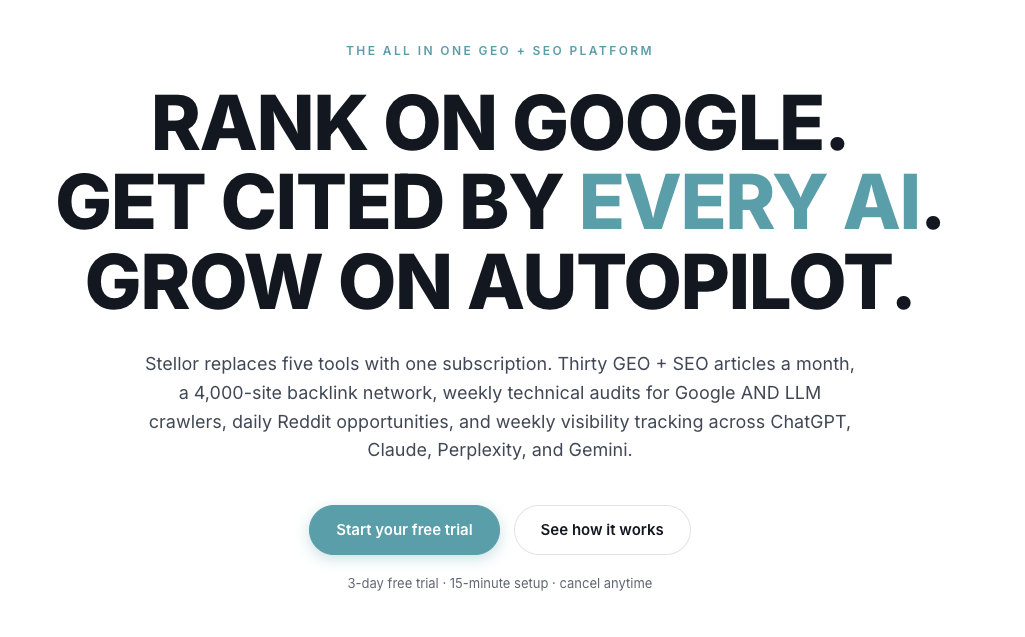
Stellor replaces five separate vendor subscriptions with one platform at $199 per month, covering SEO content publishing, a 4, 000-site backlink network, weekly technical audits, Reddit community presence, and AI visibility tracking across ChatGPT, Gemini, Perplexity, and Claude. For auto shops, that means your profile activity stays consistent without requiring your personal attention every week. You can also explore how Stellor supports GEO and SEO for professional services to see how the platform adapts across service categories. Browse the full Stellor resource library for guides tailored to local service businesses. Try it free for three days with no credit card required.
Frequently asked questions
What is the most important category to choose for my auto shop on Google Business Profile?
The primary category should be “Auto repair shop” if you offer general vehicle repair, as it carries the largest impact on local search relevance. Google allows one primary category and up to 9 secondary categories as of 2026, so choose your primary with care.
How often should I post updates on my Google Business Profile to improve visibility?
Posting weekly updates with photos and clear calls to action keeps your profile active and improves local search ranking. Posts expire after seven days, so a consistent weekly schedule is the minimum to sustain visibility.
Can responding to reviews actually help my shop rank better locally?
Yes, regularly responding to both positive and negative reviews signals engagement to Google, which treats your response rate as a trust indicator. Shops that respond to reviews rank higher in local search compared to those that leave reviews unanswered.
Should I add all possible secondary categories to my Google Business Profile?
No, only add secondary categories that accurately describe your actual services. Adding irrelevant categories can dilute your relevance signals and confuse both Google and potential customers browsing your listing.
Is it worth investing in an all-in-one SEO platform like Stellor for managing my Google Business Profile?
Yes, platforms like Stellor automate posting, review monitoring, backlinking, and AI visibility tracking, saving significant time while improving your local rankings across both Google and AI-driven search engines.