TL;DR:
- Effective SEO for med spas focuses on optimizing Google Business Profile, reviews, NAP consistency, schema markup, and location-specific content to boost local search visibility. It is a medium-term investment that yields increasing returns over six months, unlike paid ads. Consistent effort in these areas helps practices rank higher in local map packs and attracts high-intent clients seeking aesthetic treatments.
SEO for med spas is the process of optimizing your website and local business profile so nearby clients find you first when they search for aesthetic services. It combines Google Business Profile management, targeted keywords, review acquisition, and structured data to turn search traffic into booked appointments. Done right, local search optimization is the highest-ROI channel available to a med spa owner.
What is SEO for med spas and why does it drive bookings?
Med spa SEO, formally called local search optimization, targets clients who are actively searching for services like Botox, lip filler, or laser treatments within a specific geographic area. These are high-intent searches. Someone typing “best lip filler near me” is not browsing casually. They are ready to book.
The core components of a strong med spa search strategy are Google Business Profile (GBP) optimization, keyword targeting, review management, NAP (Name, Address, Phone) consistency, and schema markup. Each one feeds the others. A well-optimized GBP earns more clicks. More clicks generate more reviews. More reviews build the trust signals Google uses to rank you higher in the local map pack.
Local SEO for service businesses compounds over time in a way that paid ads cannot. Every article you publish, every review you earn, and every citation you build adds permanent authority to your domain. That compounding effect is why med spas that invest in search optimization consistently outperform those that rely solely on social media or pay-per-click.
How to optimize your Google Business Profile for med spa local SEO
GBP completeness accounts for roughly 60% of local SEO effectiveness for med spas. That single statistic should tell you where to spend your first hour of effort. A complete, active profile powers the local map pack and drives the majority of local clicks before a potential client ever visits your website.
Start with the fundamentals:
- Primary category: Select “Medical Spa” as your primary category. Add secondary categories like “Skin Care Clinic” or “Beauty Salon” only if they accurately describe your services.
- Services: List every treatment you offer, including Botox, dermal fillers, laser hair removal, and chemical peels, with individual descriptions and prices where possible.
- Photos: Upload at least 20 high-quality photos covering your reception, treatment rooms, staff, and before-and-after results (with client consent).
- Business hours: Keep hours current, including holiday closures. Google penalizes profiles with outdated information.
- Posts: Publish at least one GBP post per week promoting a service, special offer, or educational tip. Active profiles rank higher than dormant ones.
Responding to every review matters as much as earning them. Google reads your responses as engagement signals. A thoughtful reply to a negative review also reassures prospective clients who are reading before they book.
Pro Tip: Set a weekly calendar reminder to request reviews from clients who completed a treatment that day. Timing the ask within 24 hours of their appointment produces the highest response rates.
Short-tail vs. long-tail keywords: which ones should your med spa target?
Keyword strategy for med spas works best as a two-layer approach. Short-tail keywords like “Botox” or “med spa” capture broad, high-volume intent. Long-tail keywords like “best lip filler in Austin” or “laser hair removal for dark skin in Chicago” capture specific, high-conversion intent. You need both.
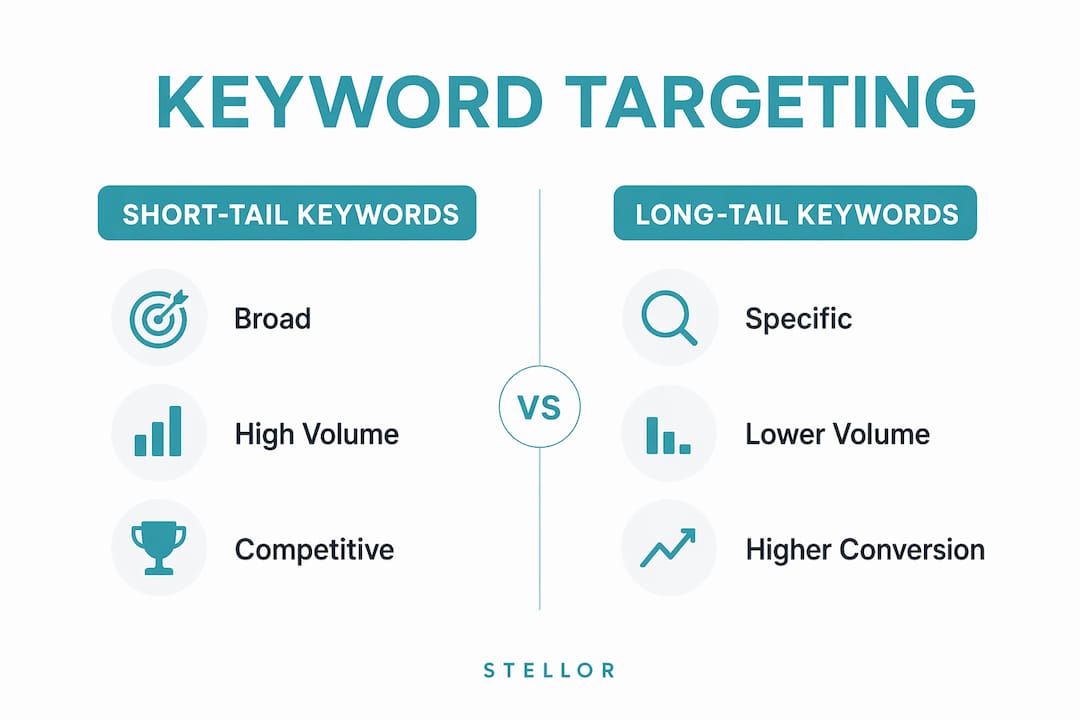
Keyword placement in URLs, page titles, headings, and meta descriptions is critical for ranking individual service pages. A page titled “Botox Treatments in Denver | Radiance Med Spa” will consistently outperform a generic page titled “Our Services.” The title signals to Google exactly what the page covers and where it is relevant.
Build your keyword list around these categories:
- Service keywords: “Botox injections,” “dermal fillers,” “CoolSculpting,” “laser resurfacing”
- Location modifiers: Add your city, neighborhood, and nearby landmarks. “Med spa in Midtown Atlanta” targets a different searcher than “med spa in Atlanta.”
- Problem-based phrases: “How to reduce fine lines,” “best treatment for acne scars,” “non-surgical facelift options”
- Comparison queries: “Botox vs. Dysport,” “filler vs. fat transfer,” “IPL vs. laser”
Avoid stuffing a single page with every keyword you want to rank for. Google reads keyword density as a quality signal. One primary keyword per page, supported by two or three related phrases, produces better results than cramming ten terms into a single paragraph.
Why review management and NAP consistency are non-negotiable
Google reviews are the largest conversion factor for med spas. Clients read an average of 10 reviews before making a booking decision. That means your review count and quality directly affect whether a searcher calls you or your competitor.
A systematic approach to review generation beats a haphazard one every time. Generating approximately 8 new Google reviews weekly produces measurable improvements in local map pack rankings for competitive markets. That cadence requires a repeatable process, not occasional reminders.
Here is a practical review management workflow:
- Ask at checkout: Train front-desk staff to request a Google review from every satisfied client before they leave.
- Send a follow-up text: Use your practice management software to send an automated SMS with a direct review link 2 hours after the appointment.
- Respond within 24 hours: Reply to every review, positive or negative, using the client’s first name and mentioning the specific treatment where appropriate.
- Monitor monthly: Check your review profile on Google, Yelp, and RealSelf at least once a month for new feedback.
NAP consistency is the other half of local trust. Consistent NAP data across 50+ directories builds the trust signals Google uses to confirm your business is legitimate. A single address discrepancy between your GBP and a Yelp listing can suppress your local rankings. Audit your citations quarterly using a directory management tool and correct any mismatches immediately.
Pro Tip: Before building new citations, run an audit of your existing listings. Correcting 10 inconsistent citations does more for your rankings than adding 20 new ones.
How to implement schema markup for your med spa website
Schema markup is structured data you add to your website’s code to help Google understand what your business does. Think of it as a label on the back of a product. Without it, Google has to guess. With it, Google knows exactly what to display in search results.

Schema.org structured data types like MedicalBusiness and HealthAndBeautyBusiness help search engines understand the nature and services of med spas, improving eligibility for rich results. Med spas sit at the intersection of healthcare and beauty, so the choice of schema type matters.
| Schema type | Best used when | Key properties to include |
|---|---|---|
| MedicalBusiness | You employ licensed medical professionals (NPs, PAs, MDs) | name, address, phone, specialty, medicalSpecialty, openingHours |
| HealthAndBeautyBusiness | Services are primarily cosmetic with no clinical staff | name, address, phone, openingHours, priceRange |
| LocalBusiness | Fallback if neither above fits precisely | name, address, phone, geo, url |
Structured data that passes Google’s Rich Results Test includes MedicalBusiness schema with properties like name, address, phone, specialty, hours, and patient acceptance. Rich results display additional information directly in the search results page, including star ratings, hours, and service types. That extra visibility increases click-through rates without requiring a higher ranking position.
Implement your schema as JSON-LD, Google’s preferred format, and paste it into the <head> section of your homepage and each service page. After publishing, test every page using Google’s Rich Results Test tool at search.google.com/test/rich-results.
Pro Tip: Add a FAQ schema block to your most-visited service pages. FAQ schema generates expandable question-and-answer dropdowns directly in Google search results, giving your listing more visual real estate than a standard blue link.
How location pages and content depth improve local rankings
Location-specific pages are one of the most underused tools in med spa digital marketing. Most practices publish a single homepage and a services page, then wonder why they do not rank in neighboring cities or zip codes. A dedicated page for each location or target neighborhood solves that problem directly.
Location pages that include local landmarks, directions, and embedded maps increase topical authority and relevance for nearby searches. A page titled “Med Spa in Buckhead, Atlanta” that mentions nearby landmarks, parking options, and neighborhood-specific client concerns will consistently outrank a generic “Contact Us” page for Buckhead searches.
Effective location pages include:
- A unique H1 title with the city or neighborhood name and primary service
- A written description of the location, including nearby streets, landmarks, and transit options
- An embedded Google Map showing the exact address
- Client testimonials specific to that location
- Original photos of the physical space, not stock images
- A clear call-to-action with a phone number and booking link
Content depth matters beyond location pages. Google rewards websites that demonstrate topical authority, meaning you cover a subject thoroughly rather than superficially. A med spa that publishes detailed educational articles on Botox aftercare, filler longevity, and laser skin preparation signals to Google that it is a credible source on aesthetic medicine. That authority lifts all your pages, not just the ones you are actively promoting.
An SEO audit checklist helps you identify which pages need more depth and which technical issues are suppressing your rankings before you invest in new content.
Key Takeaways
Effective med spa SEO requires consistent execution across Google Business Profile, keyword targeting, review acquisition, NAP consistency, schema markup, and location-specific content to rank and convert local searchers.
| Point | Details |
|---|---|
| GBP is your top priority | GBP completeness drives roughly 60% of local SEO effectiveness for med spas. |
| Reviews require a system | Generating around 8 new Google reviews weekly produces measurable ranking improvements in competitive markets. |
| NAP consistency builds trust | Consistent Name, Address, and Phone data across 50+ directories signals legitimacy to Google. |
| Schema markup earns rich results | MedicalBusiness or HealthAndBeautyBusiness schema improves SERP appearance and click-through rates. |
| Location pages capture nearby searches | Dedicated pages with local landmarks and maps rank for neighborhood-specific queries. |
What most med spa owners get wrong about local SEO
After watching dozens of med spas invest in SEO, I keep seeing the same pattern. Owners spend money on blog content and backlinks before their Google Business Profile is even complete. That is backwards. The GBP is the front door. If it is incomplete, inconsistent, or inactive, no amount of content will move your map pack ranking.
The second mistake is treating reviews as a passive outcome. Reviews are an active acquisition channel. The practices that rank in the top three local results in competitive cities like Miami or Los Angeles are not there by accident. They have a repeatable review process baked into their front-desk workflow. They ask every client, every time.
Schema markup is the area where I see the highest return for the least effort. Most med spas have no structured data at all. Adding MedicalBusiness JSON-LD to your homepage and service pages takes a developer less than two hours and can produce rich results within days of Google recrawling your site. That is a rare situation in SEO where a small technical change produces a visible, fast result.
The last thing I want to say is this: local SEO is a medium-term investment. You will not rank in the top three map pack positions within two weeks. But if you execute consistently on GBP, reviews, NAP, and schema for six months, you will see compounding results that paid ads cannot replicate. The common mistakes in DIY local SEO are avoidable. Patience and process beat budget every time.
— Cole
How Trystellor helps med spas rank and grow on autopilot
Med spa SEO has a lot of moving parts. Managing GBP, publishing content, building citations, tracking schema health, and monitoring AI visibility across ChatGPT, Perplexity, and Gemini is more than one person can handle manually.

Trystellor replaces five separate tools with one platform at $199 per month. It publishes 30 SEO-optimized articles to your CMS every month, runs weekly technical audits across 11 ranking factors, and tracks your citations across a 4,000-site backlink network. The platform also monitors whether AI engines are recommending your med spa when clients ask for local aesthetic services. A three-day free trial requires no credit card, and you keep all published content even if you cancel. For med spa owners who want results without managing a stack of disconnected tools, it is the most direct path forward.
FAQ
What is the most important SEO factor for a med spa?
Google Business Profile optimization is the single most impactful factor for med spa local search visibility, accounting for roughly 60% of local SEO effectiveness. Complete your profile fully and keep it active with weekly posts and consistent review responses.
How many Google reviews does a med spa need to rank locally?
There is no fixed number, but generating approximately 8 new reviews per week produces measurable improvements in competitive local markets. Review recency and rating matter as much as total count.
What schema markup should a med spa use?
Med spas with licensed medical staff should implement MedicalBusiness schema. Primarily cosmetic practices without clinical staff can use HealthAndBeautyBusiness schema. Both types improve rich results eligibility when tested with Google’s Rich Results Test.
How do location pages help med spa rankings?
Dedicated location pages targeting specific cities or neighborhoods signal geographic relevance to Google. Pages that include local landmarks, embedded maps, and neighborhood-specific content rank for hyperlocal searches that a generic homepage cannot capture.
How long does med spa SEO take to show results?
Most med spas see measurable ranking improvements within three to six months of consistent execution across GBP, reviews, NAP consistency, and content. Technical fixes like schema markup can produce visible SERP changes faster, sometimes within weeks of Google recrawling the site.