TL;DR:
- SEO for accountants involves optimizing websites and online profiles to attract local clients within 3 to 6 months. It requires technical SEO, local search tactics, and content that matches client search intent, with E-E-A-T standards shaping rankings. Consistent measurement and updates are necessary to sustain visibility and growth in competitive digital environments.
SEO for accountants is the process of optimizing your firm’s website and online profiles to rank prominently when potential clients search for accounting services nearby. It combines technical SEO, local search tactics, and content built around how real clients think and search. Firms that commit to this process consistently see results within 3–6 months, with compounding growth over time as trust and authority build. Google treats accounting as a “Your Money Your Life” (YMYL) category, meaning it applies stricter quality standards to financial content than to most other industries. That makes E-E-A-T (Experience, Expertise, Authoritativeness, Trustworthiness) the foundation of every ranking decision your firm faces.
What are the essential technical SEO elements for accounting firm websites?
Technical SEO is the plumbing behind the walls of your digital presence. Search engines cannot rank what they cannot read, and a slow or broken site loses clients before they ever see your services.
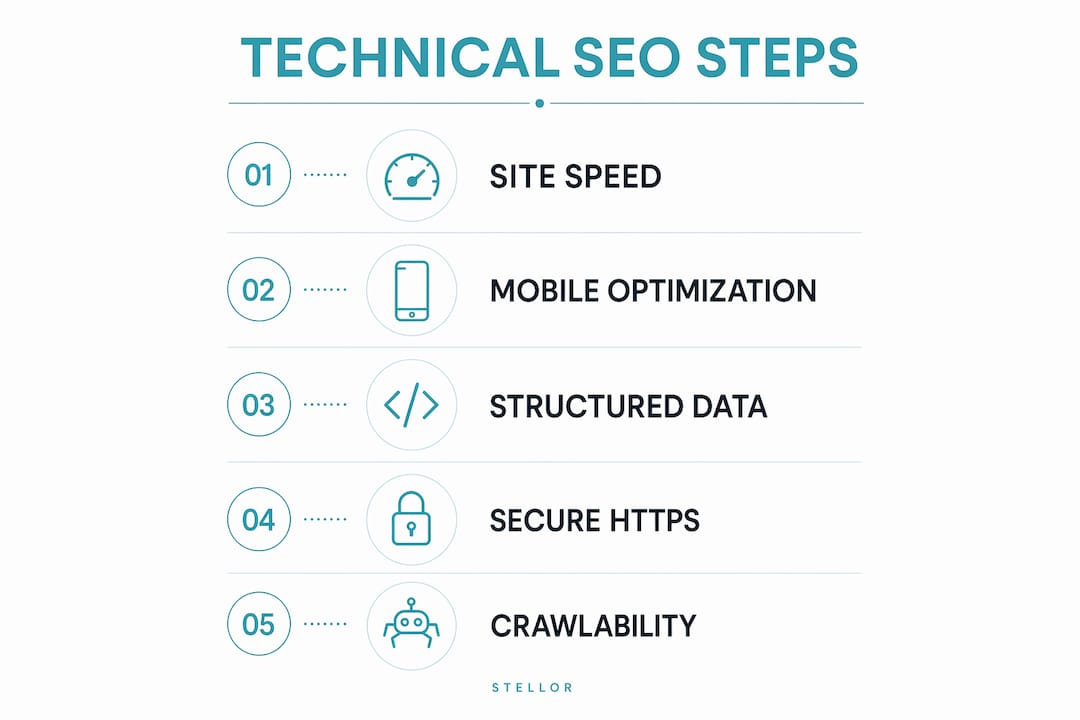
Site speed is the first place to focus. Websites loading in two seconds or less see a 15% increase in conversion rates. Every extra second of load time costs you clients who simply leave.
Mobile optimization is equally non-negotiable. 61% of users are more likely to contact firms with mobile-friendly sites. Most local searches for accountants happen on a phone, often while someone is stressed about a tax deadline.
The technical checklist every accounting firm website needs:
- HTTPS security: HTTPS builds trust with both clients and search engines. It also protects sensitive financial data, which matters enormously in your industry.
- Schema markup: Structured data tailored to accounting services helps Google display rich snippets, like your hours, reviews, and service types, directly in search results.
- XML sitemap: Submit a clean sitemap to Google Search Console so every service page and location page gets indexed promptly.
- Crawlability: A clear site architecture with logical internal linking lets search engines move through your site without hitting dead ends.
- Duplicate content management: Avoid publishing near-identical pages for similar services. Consolidate or use canonical tags to tell Google which version to rank.
Pro Tip: Run a free crawl of your site using Google Search Console’s Coverage report. Fix any “Excluded” or “Error” pages first. Those are pages Google has already decided not to rank.
A well-structured website with optimized page titles, headings, and internal linking enhances both search engine understanding and user experience. Think of your site architecture as a filing system. If Google cannot find the folder, the document does not get read.

How does local SEO work for accounting firms to attract nearby clients?
Local SEO drives higher conversion than national rankings for most accounting firms. A client searching “CPA near me” or “small business accountant in Denver” is ready to hire. Ranking nationally for “accounting tips” brings traffic but rarely brings clients.
The local search system works in layers. Here is how to build each one:
-
Claim and complete your Google Business Profile. Add your services, hours, photos of your office, and a description that includes your city and specialty. A complete Google Business Profile with photos and current information significantly improves local search visibility. Most local accounting leads come directly from map pack results.
-
Build consistent NAP data. NAP stands for Name, Address, and Phone number. Every directory listing, from Yelp to the Better Business Bureau to your local Chamber of Commerce, must show identical information. Inconsistent NAP data confuses search engines and suppresses your local rankings.
-
Create location-specific service pages. If you serve three cities, build a dedicated page for each one. A page titled “Tax Preparation in Austin, TX” targets a specific query that a general homepage never will. This is one of the most underused tactics in local SEO for accounting firms.
-
Collect and manage client reviews. Review velocity (the rate at which new reviews arrive) signals to Google that your firm is active and trusted. Ask satisfied clients to leave a Google review within 48 hours of a positive interaction. Respond to every review, positive or negative.
-
Earn local citations. Get listed in accounting-specific directories and local business directories. Each citation reinforces your location and authority in Google’s eyes.
Pro Tip: Add a short FAQ section to each location page answering questions like “Do you offer virtual tax prep in [city]?” These match the exact phrasing clients type into Google and improve your chances of appearing in AI Overviews.
What content and keyword strategies work best for accounting firms?
Clients searching for accounting services use problem-based queries, not generic terms. Someone does not search “accountant.” They search “tax help for small business” or “accountant near me for startups.” Your content must meet them at that specific moment of need.
The biggest mistake accounting firms make is publishing generic blog posts that attract no one. Firms that fail to build service- and location-specific landing pages confuse both search engines and potential clients. A proper page hierarchy is the fix.
Building a content hierarchy that converts
Your site needs three types of pages working together:
- Core service pages: One dedicated page per service. Tax preparation, payroll processing, bookkeeping, CFO advisory, and estate planning each deserve their own page with a unique keyword focus, a clear description of what you do, and a call to action.
- Location pages: One page per city or neighborhood you serve, as described above.
- Educational content: Blog posts and guides that answer the questions clients ask before they hire anyone. “How much does a CPA cost?” or “What records do I need for a small business tax return?” These pages build trust and capture clients early in their decision process.
Keyword research for accounting firms
| Search intent | Example keyword | Page type to target |
|---|---|---|
| Ready to hire | “CPA for small business near me” | Location service page |
| Comparing options | “bookkeeper vs accountant for LLC” | Educational guide |
| Problem aware | “tax help for freelancers” | Blog post or FAQ page |
| Specific service | “payroll services for restaurants” | Niche service page |
Google rewards thorough topic coverage and semantic relevance. A single page that covers tax preparation for freelancers in depth will outrank a page that mentions it briefly alongside ten other services. Depth signals expertise. Expertise is exactly what Google’s E-E-A-T framework rewards in YMYL categories like accounting.
Pro Tip: Use Google’s “People Also Ask” box for your target keywords. Each question there is a section heading waiting to be written. Answer five of them on one page and you have a resource that earns featured snippets.
How do you measure and scale SEO results for your accounting firm?
SEO is not a one-time project. Regular audits and content updates are what maintain rankings in competitive search environments. Firms that publish ten pages and stop will see those pages slowly lose ground to competitors who keep publishing.
The measurement stack every accounting firm needs:
- Google Search Console: Shows which queries bring visitors to your site, which pages rank, and which pages have technical errors. Check it weekly.
- Google Analytics: Reveals how visitors behave once they arrive. High bounce rates on a service page signal a mismatch between what the searcher expected and what they found.
- Backlink profile monitoring: Inbound links from reputable sites (local news outlets, accounting associations, business directories) raise your domain authority. Track new and lost links monthly. For practical tactics, the guide on local link building strategies covers what actually moves the needle.
- Rank tracking: Monitor your position for your 10–20 most important keywords. Rankings fluctuate, but a consistent downward trend signals a problem that needs attention.
- Content audits: Every six months, review your existing pages. Update statistics, add new sections, and improve pages that rank on page two but have not broken into the top five.
One often-overlooked factor is patience combined with persistence. The SEO timeline for accounting firms typically runs 3–6 months before meaningful traffic arrives. That timeline reflects how long it takes Google to crawl new content, assess its quality, and build trust in your domain. Firms that quit at month four miss the compounding returns that arrive at month six and beyond.
The competitive reality in 2026 is that AI answer engines like ChatGPT, Perplexity, and Gemini now sit between your firm and potential clients. When someone asks an AI “Who is the best small business accountant in Chicago?”, the AI cites firms with strong online authority, consistent content, and structured data. Traditional Google rankings and AI citations now require the same foundational work, but the measurement systems are different. Tracking both is the new standard for local service businesses that want to stay competitive.
Key Takeaways
Effective SEO for accounting firms requires technical foundations, local search dominance, intent-driven content, and consistent long-term measurement to produce sustainable client growth.
| Point | Details |
|---|---|
| Technical foundations first | Fix site speed, HTTPS, schema markup, and mobile optimization before building content. |
| Local SEO drives conversions | A complete Google Business Profile and location-specific pages convert far better than national rankings. |
| Content must match search intent | Build dedicated pages for each service and location; avoid generic blog posts that attract no clients. |
| E-E-A-T shapes rankings | Google holds accounting content to strict quality standards; attribute content to qualified professionals. |
| Measure and update consistently | Use Google Search Console and Analytics monthly; audit and refresh content every six months. |
Why most accounting firms get SEO backwards
The firms I see struggle most with SEO share one pattern: they treat it like advertising. They want to put money in and get clients out immediately. SEO does not work that way, and accounting is one of the fields where that misunderstanding is most expensive.
The firms that win locally are the ones that build pages for how clients actually think. A client does not wake up thinking “I need an accountant.” They think “I have no idea what I owe in taxes this year and I’m terrified.” The firm that has a page answering that exact fear, in plain language, with a clear next step, wins the click and the call.
I have also seen firms spend thousands on backlinks while their Google Business Profile sits unclaimed. Local map pack rankings are often easier to win than organic rankings, and they convert at a higher rate. Fix the free stuff first.
The other thing most articles will not tell you: AI citations are now part of the game. When a potential client asks ChatGPT for a recommendation, the AI pulls from the same signals Google does, plus Reddit discussions and structured data. Firms that ignore this are already losing clients they never knew they had.
— Cole
Trystellor handles the SEO work so you can focus on clients
Accounting firms that want to rank on Google and get cited by AI answer engines need a system that runs without constant manual effort.
Trystellor publishes 30 SEO-optimized articles per month to your site, builds authority through a 4,000-site backlink network, and runs weekly technical audits covering schema, page speed, and mobile performance. The platform also tracks your citations across ChatGPT, Claude, Perplexity, and Gemini every week, so you know exactly where you stand in AI-driven search. One subscription replaces five separate tools, starting at $199 per month. Explore the full platform features and start a three-day free trial with no credit card required.
FAQ
How long does SEO take for an accounting firm?
Most accounting firms see meaningful results within 3–6 months of consistent effort. Significant authority and ranking growth typically require a long-term commitment beyond that initial period.
What is the most important local SEO step for accountants?
Claiming and fully completing your Google Business Profile is the single highest-impact local SEO action. Most local accounting leads come from map pack results, not organic listings.
What keywords should accountants target?
Target problem-based, long-tail keywords like “tax help for small business” or “CPA for freelancers in [city]” rather than generic terms like “accountant.” These match real client search behavior and convert at higher rates.
Does my accounting firm need a blog?
A blog helps, but only if the content targets specific client questions and service-related searches. Generic posts about accounting news add little SEO value. Dedicated service and location pages deliver more consistent results.
How does E-E-A-T affect accounting firm SEO?
Google applies strict E-E-A-T standards to financial content because it falls under the YMYL category. Content must be accurate, attributed to qualified professionals, and supported by credentials or verifiable experience to rank well.