Having a website does not guarantee customers will find you. Thousands of local service businesses have professional-looking sites that sit invisible in search results, generating zero phone calls and even fewer bookings. That reality is uncomfortable but fixable. Google’s ranking systems evaluate relevance, content quality, expertise, and your physical location before deciding whether your business deserves to appear in front of a potential customer. Simply existing online is not enough. This guide explains exactly why SEO is the difference between a website that works for your business and one that just takes up space.
Table of Contents
- What is SEO and why does it matter for local services?
- Key factors that influence search rankings
- Common SEO pitfalls and the impact of Google updates
- From rankings to real business results: Measuring what matters
- Operational SEO: Beyond content, what technical steps matter?
- Why most local SEO advice misses the mark
- Supercharge your local SEO with Stellor
- Frequently asked questions
Key Takeaways
| Point | Details |
|---|---|
| SEO drives local customers | Without optimized search presence, even great businesses stay hidden from local buyers. |
| Quality beats quick tricks | Focusing on real customer needs and Google updates is key to long-term SEO results. |
| Track what matters | Calls and bookings show true SEO ROI, not just website visits or rankings. |
| Technical upkeep is vital | Regular audits and smart use of re-indexing keep your site discoverable and effective. |
What is SEO and why does it matter for local services?
SEO stands for search engine optimization. In plain terms, it means making deliberate improvements to your website and online presence so search engines can understand what you do, who you serve, and where you operate. The goal is simple: show up when someone nearby searches for the service you provide.
For a local plumber, HVAC company, or dental practice, SEO is not an abstract marketing concept. It is the plumbing behind the walls of your digital presence. When done well, it connects your business to customers who are actively looking for help right now. That is a fundamentally different audience than people scrolling through social media. These are buyers with real intent.

Google’s ranking algorithms consider multiple factors including relevance, usability, the expertise of your content, and the searcher’s location. The weight of each factor shifts depending on the query. A search for “emergency electrician” carries strong location signals. A search for “how to lower my electric bill” leans more on content quality. Understanding that distinction helps you create the right kind of content for the right kind of searcher.
Here is where many local business owners go wrong. They assume being online is enough. They build a website, maybe claim their Google Business Profile (GBP), and wait. But without a deliberate SEO strategy, most local businesses remain invisible to the majority of potential customers. Improving your SEO health score is one of the first places to start because it surfaces the exact gaps holding your visibility back.
Key things local SEO handles for your business:
- Matching your services to searches happening in your area
- Establishing your credibility through reviews, citations, and authoritative content
- Making sure your website performs well technically so Google can crawl and rank it
- Feeding accurate, consistent business information across the web
- Positioning you in the local map pack, which appears above organic results for most service queries
Pro Tip: If you serve multiple neighborhoods or cities, create a dedicated service area page for each location. Do not try to stuff all locations onto one page. Separate pages let Google understand your geographic reach much more clearly.
The local search for home services is intensely competitive. Most clicks go to the top three results. If you are not in that group, you are essentially invisible to the majority of searchers.
Key factors that influence search rankings
Now that you understand what SEO involves, let’s look at which specific factors shape your search visibility. Google’s ranking systems evaluate signals across four major areas: relevance, usability, expertise, and location. Each one matters differently depending on your business type.
Relevance measures whether your content actually matches what the user is searching for. If someone searches “roof repair after storm damage” and your page only talks about new roof installations, Google will not consider your page a strong match. Relevance is built through specific, intent-matched content on your service pages.
Usability covers how your website performs as a user experience. Page speed matters enormously. A site that loads in 4 seconds loses a significant portion of mobile visitors before they even see your offer. Mobile optimization is equally important because most local service searches happen on smartphones. Security (HTTPS) also plays a role because Google factors in trustworthiness signals. Check your key SEO terms if any of these concepts are new to you.
Expertise is where local businesses often underinvest. Google evaluates whether your content demonstrates real knowledge. Thin pages with generic descriptions rank poorly. Pages that explain your process, highlight your credentials, showcase real customer reviews, and answer common questions rank better. This is also why review velocity (the steady pace of new reviews over time) matters so much for local businesses.
Location signals include your Google Business Profile, local citations (mentions of your name, address, and phone number across directories), and the geographic content on your website. Businesses that consistently manage these signals rank higher in local results.

| Ranking factor | Impact on local businesses | Impact on national businesses |
|---|---|---|
| Location signals | Very high | Low to moderate |
| Review count and quality | Very high | Moderate |
| Page speed | High | High |
| Content expertise | Moderate to high | Very high |
| Backlink authority | Moderate | Very high |
| Mobile optimization | High | High |
The table above shows one of the most important truths in local SEO: location signals and reviews carry far more weight for a local plumber than they do for a national software company. Your SEO priorities should reflect that reality. Read more about SEO strategies for local services to see how these factors translate into a concrete action plan.
Stat to know: Local pack results (the map listings that appear at the top of local searches) attract a significant share of clicks, often more than organic results for service-related queries. If you are not visible in the map pack, you are missing the highest-traffic section of the search results page.
Common SEO pitfalls and the impact of Google updates
Knowing what can influence rankings is half the equation. It is just as vital to avoid the traps that frequently set businesses back. Google continuously updates its algorithms, and those updates can shift rankings broadly and quickly. Core updates are designed to reward user-focused quality, so businesses that cut corners tend to see the biggest drops.
Here are the most common SEO mistakes that hold local businesses back:
- Keyword stuffing. This means cramming a page full of the same phrase repeatedly, hoping to rank for it. It reads unnaturally and Google penalizes it. Write for your customer first, search engine second.
- Neglecting mobile users. If your site is hard to navigate on a phone, you are losing customers before they even call. Google uses mobile-first indexing, which means it ranks the mobile version of your site.
- Publishing thin or copied content. Pages with very little original information, or content copied from other websites, rank poorly. Every service page should answer real customer questions in enough detail to be genuinely useful.
- Ignoring your Google Business Profile. An unclaimed or outdated GBP is a serious visibility problem. Your profile needs accurate hours, photos, services, and regular responses to reviews.
- Buying low-quality backlinks. Cheap link schemes can trigger penalties that take months to recover from. Focus on earning links through quality content and real business relationships.
- No local citations. If your business name, address, and phone number are inconsistent across directories, Google loses confidence in your information. Consistency builds trust.
“SEO outcomes are shaped by Google’s continuous algorithm updates; rankings can shift broadly after core updates, so sustainable SEO focuses on user-focused quality and intent matching rather than short-term manipulation.”, Search Engine Land
Understanding real strategies for local businesses means accepting that there are no reliable shortcuts. Tactics that game the system tend to work briefly, then collapse after an update. Building genuine authority and relevance compounds over time.
Pro Tip: Subscribe to Google’s official Search Central blog and set a Google Alert for “Google core update.” When a major update rolls out, do not panic and make a dozen changes at once. Instead, wait 2 to 3 weeks for rankings to settle, then analyze which pages moved and why.
Also worth noting: key SEO terms for local businesses often get confused in this space. “Algorithm update” does not mean your strategy is broken. It usually means the bar for quality just got raised.
From rankings to real business results: Measuring what matters
Even perfect rankings are meaningless without actual customer actions. This is where many local business owners lose the thread. They chase ranking positions without tracking whether those rankings actually bring in calls, bookings, or revenue.
Local search intent is frequently action-oriented. Someone searching for “AC repair near me” is not doing research. They are ready to call someone. That makes action-driven metrics far more valuable than ranking position alone.
Metrics that actually matter for local service businesses:
- Phone calls tracked from your website and Google Business Profile
- Direction requests (how many people asked for directions to your location)
- Form submissions and online booking completions
- Chat conversations initiated from local search
- Website sessions from organic search, especially from local keyword queries
| SEO metric | What it measures | Business outcome |
|---|---|---|
| Keyword ranking position | Where your page appears in results | Potential for visibility |
| Organic traffic | Visitors from search engines | Audience reach |
| Click-through rate (CTR) | % of searchers who click your result | Relevance of your listing |
| Phone calls from GBP | Calls triggered by your map listing | Direct leads |
| Direction requests | Navigation requests from your profile | Foot traffic intent |
| Conversion rate | % of visitors who take an action | Actual revenue |
Pro Tip: Inside your Google Business Profile dashboard, you can see exactly how many people called you directly from the listing, how many asked for directions, and how many visited your website. Review this data monthly and compare it to your actual booking volume. That connection tells you how well your SEO is translating to real business. Learn more about measuring SEO results for local service businesses in detail.
If you want to rank faster and win more customers, the shortcut is to stop treating ranking position as the finish line and start treating customer acquisition as the actual goal.
Operational SEO: Beyond content, what technical steps matter?
With business goals in mind, you also need to ensure your website’s technical side is supporting, not sabotaging, your SEO. Think of technical SEO as the structural foundation of your digital presence. If the foundation has cracks, no amount of great content will fully compensate.
Technical SEO covers several areas: your site’s speed, how easily Google can crawl and index your pages, mobile responsiveness, structured data (code that helps search engines understand your content), and security. These are not one-time fixes. They require ongoing attention.
When you publish new service pages or make significant changes, Google needs to discover and process those updates. You can accelerate that process. Requesting re-indexing after publishing new pages helps Google find and rank your content faster rather than waiting for its standard crawl schedule.
Steps to keep your site technically healthy:
- Submit and maintain an updated XML sitemap through Google Search Console. This gives Google a roadmap of every page on your site.
- Fix broken links and redirect old URLs properly when you restructure pages.
- Ensure all pages load in under 2.5 seconds on mobile. Use Google’s PageSpeed Insights tool to identify specific issues.
- Implement local business structured data (also called schema markup) on your service pages and homepage. This helps Google display rich results for your business.
- Verify that your robots.txt file is not accidentally blocking Google from crawling important pages.
- After making major changes, request a crawl through Google Search Console to speed up re-indexing.
Exploring how AI for SEO in local service businesses is evolving is also worth your attention. AI-powered tools are increasingly used to surface technical issues faster than manual audits.
Pro Tip: Schedule a technical SEO audit every quarter. At minimum, check for crawl errors in Google Search Console, run a page speed test on your most important service pages, and confirm your sitemap is current. Catching small issues early prevents them from compounding into bigger ranking problems.
Why most local SEO advice misses the mark
Here is the honest version of what most local SEO guides will not tell you.
The majority of advice you will find online focuses on rankings as the primary goal. “Get to position 1 for your main keyword.” That advice is incomplete at best and misleading at worst. Position 1 for a keyword that does not match buyer intent does not produce revenue. A dental practice ranking first for “what causes tooth decay” will get traffic from curious people doing research, not patients ready to book an appointment.
The businesses that win with local SEO are not the ones obsessing over keyword rankings. They are the ones who understand their customers’ search behavior well enough to be visible at the exact moment a buying decision is forming. That requires understanding intent, not just keywords.
Most guides also ignore how fast Google’s algorithm shifts. What worked 18 months ago for local rankings may actively hurt you today. The businesses that stay visible are the ones treating SEO as an ongoing operational function, not a one-time project. Understanding modern SEO means accepting that the rules change, and your strategy needs to adapt with them.
The other blind spot in conventional advice is AI visibility. As of 2026, a growing share of service research happens inside AI tools like ChatGPT and Perplexity. If your business is not cited in those responses, you are invisible to an entire segment of high-intent buyers who never visit Google at all. Traditional SEO advice simply does not address this, because most content was written before this shift became commercially significant.
The uncomfortable truth is that sustainable local SEO requires doing work that is harder to game and slower to show results, but far more durable. Focus on serving real customers with genuinely useful content, maintain your technical infrastructure consistently, and track business outcomes rather than vanity metrics. That approach survives algorithm updates because it is aligned with what Google is actually trying to reward.
Supercharge your local SEO with Stellor
Ready to put these strategies to work and elevate your local search success?
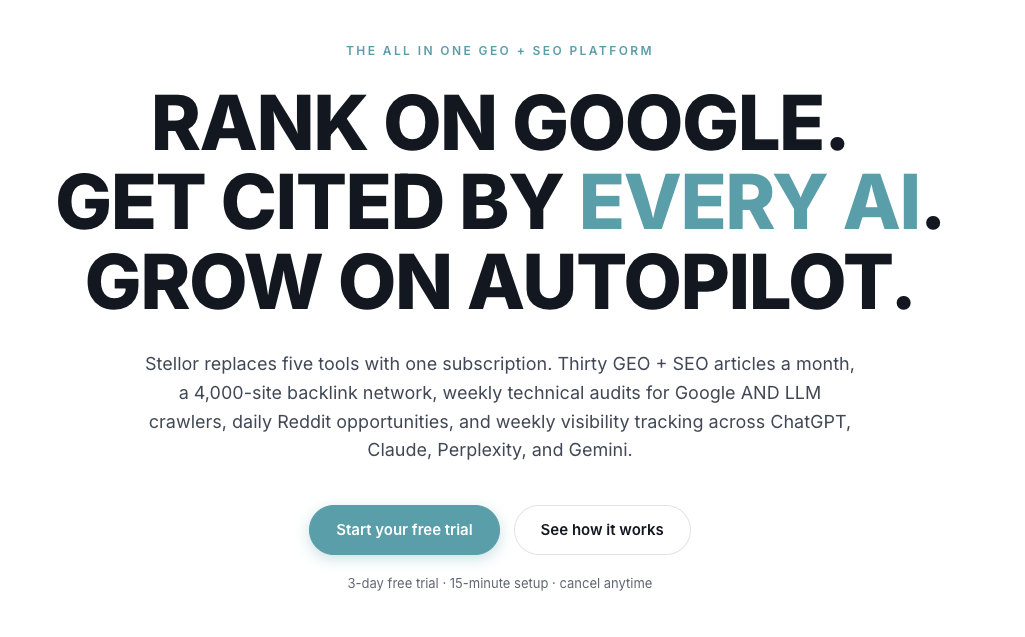
Stellor is built specifically for local service businesses that want to stop guessing about SEO and start seeing real results. The platform covers both traditional Google ranking and AI citation visibility across ChatGPT, Perplexity, Claude, and Gemini, all in one subscription starting at $199 per month. Every plan includes 30 SEO and GEO articles published to your CMS monthly, weekly technical audits, a 4, 000-site backlink network, and daily Reddit opportunity surfacing in subreddits where your buyers actually research. Whether you run a home services company or a professional services firm, the Stellor platform gives you everything you need without stitching together five separate vendors. Try it free for 3 days, no credit card required.
Frequently asked questions
How fast can SEO deliver results for my local business?
Most local businesses see meaningful movement within 60 to 90 days when technical issues are resolved and content is consistent, though competitive markets can take longer. Publishing sitemaps and requesting a crawl after new pages go live helps accelerate the process.
What are the most important metrics to track for local SEO?
Phone calls, direction requests, and booking completions from your Google Business Profile are far more valuable than ranking positions alone. Tracking these action-oriented metrics ties your SEO effort directly to revenue outcomes.
Can my rankings drop after an SEO update?
Yes, and it happens to businesses at every size. Core updates shift rankings broadly, but businesses focused on genuine user value and quality content tend to recover faster and more completely than those using manipulative tactics.
What technical SEO steps are essential for local businesses?
Maintain an up-to-date sitemap, optimize for mobile speed, use local business structured data, and fix crawl errors promptly. Requesting re-indexing after publishing new service pages ensures Google processes your updates without delay.