TL;DR:
- Visibility is the key to attracting local customers, and optimizing your Google Business Profile is essential.
- Consistently NAP information, geo-targeted keywords, and active review management significantly improve local rankings.
You built your business, set up a website, and still your phone is not ringing from local customers. The problem is almost always visibility. Understanding local SEO basics for beginners is the fastest way to close that gap. Local SEO is the practice of optimizing your digital presence so that people searching in your area find you first, whether they type “best plumber near me” or “coffee shop in Austin.” This guide walks you through every foundational layer: your Google Business Profile, keyword research, citations, website optimization, and how to measure what is actually working.
Table of Contents
- Key Takeaways
- Understanding Google Business Profile for local SEO
- Local keyword research for beginners
- Building citations and managing your reputation
- On-page SEO for your local business website
- Measuring success and avoiding common mistakes
- My honest take on local SEO for beginners
- How Trystellor helps you put this into practice
- FAQ
Key Takeaways
| Point | Details |
|---|---|
| Google Business Profile comes first | Claim, verify, and fully complete your GBP before doing anything else. |
| NAP consistency is non-negotiable | Your business name, address, and phone number must match exactly across every directory. |
| Geo-targeted keywords drive local traffic | Use location-specific phrases in your website content and GBP description to attract nearby buyers. |
| Reviews directly influence rankings | Actively request and respond to reviews to build trust signals Google uses in local rankings. |
| Track performance to refine your strategy | Monitor GBP insights and website traffic regularly so you can identify what is working and fix what is not. |
Understanding Google Business Profile for local SEO
Your Google Business Profile (GBP) is the single most powerful free tool in local SEO. It is the listing that appears when someone searches for your business type in your city. It shows your name, address, phone number, hours, photos, and reviews directly on Google Search and Google Maps. GBP drives both offline and online traffic for businesses that set it up correctly.
How to create and verify your profile
Go to google.com/business and claim your listing. Google will mail a postcard with a verification code to your physical address, or, depending on your business type, offer phone or email verification. Once verified, fill out every single field. Incomplete profiles perform worse in local map pack rankings, which is the cluster of three business listings that appears at the top of local search results.
What to get right from day one
These are the elements that matter most when you set up or audit your GBP:
- Business name: Use your real-world business name only. Do not add keywords like “Best Plumber Dallas” to your name field. Google requires consistent real-world business names and flags keyword-stuffed names as violations.
- Address: Enter your precise address. If you run a service-area business and meet clients at their homes or offices, use the service-area setting instead of displaying a home address.
- Categories: Choose the fewest, most specific categories that describe your core service. A general contractor should not pile on 12 categories. Pick two or three that match your main revenue lines.
- Hours: Keep these accurate and updated, especially for holidays. Customers who show up when you are closed do not call back.
- Photos: Businesses with photos receive significantly more requests for directions and website clicks than those without. Upload exterior shots, interior shots, team photos, and examples of your work.
Pro Tip: Set a monthly calendar reminder to log into your GBP and post an update, a new photo, or a special offer. Google treats active profiles as more credible than dormant ones, and this small habit compounds into better local map pack rankings over time.
One mistake that trips up beginners constantly: creating more than one GBP for the same location. Maintaining one GBP per business location prevents confusion, avoids suspension risk, and keeps your review count consolidated where it does the most good. You can also read more about optimizing your GBP for leads to make the most of every feature on the platform.
Local keyword research for beginners
Keyword research sounds technical, but the core idea is simple: figure out exactly what words your customers type into Google when they need what you sell, then use those words in your content. Start by brainstorming terms customers might use, then refine with data from real tools.
Here is a straightforward process to follow:
- List your services in plain language. Write down what you do as if you were explaining it to a neighbor. “Roof repair,” “emergency plumbing,” “tax prep for small businesses.” These become the seeds for your keyword list.
- Add your location to each service. Combine your core services with your city, neighborhood, or region. “Roof repair Denver,” “emergency plumber South Loop,” “tax prep Portland Oregon.” These geo-targeted phrases are the backbone of local SEO for small businesses.
- Research search volume with free tools. Google Keyword Planner (free with a Google Ads account) shows how often people search each phrase. Aim for keywords with consistent monthly searches but not so competitive that national brands dominate every result.
- Check what Google autocomplete suggests. Type your service plus your city into Google and watch what autofill offers. Those suggestions are pulled from real search behavior and reveal phrases you may not have thought of.
- Identify “near me” variations. Searches like “electrician near me” or “24-hour locksmith near me” are high-intent and growing. Include these naturally in your content even though the location portion is handled automatically by Google based on the searcher’s position.
Pro Tip: Do not optimize one page for ten keywords. Create a separate page for each core service, each focused on one primary geo-targeted phrase. A plumbing company in Houston should have a dedicated page for “water heater repair Houston” and a separate one for “drain cleaning Houston.” This structure signals depth and relevance to Google far better than one generalist page.
For a deeper look at how to apply geo-targeted keywords on your service pages, the concept of keyword mapping is worth understanding early in your local SEO journey.
Building citations and managing your reputation
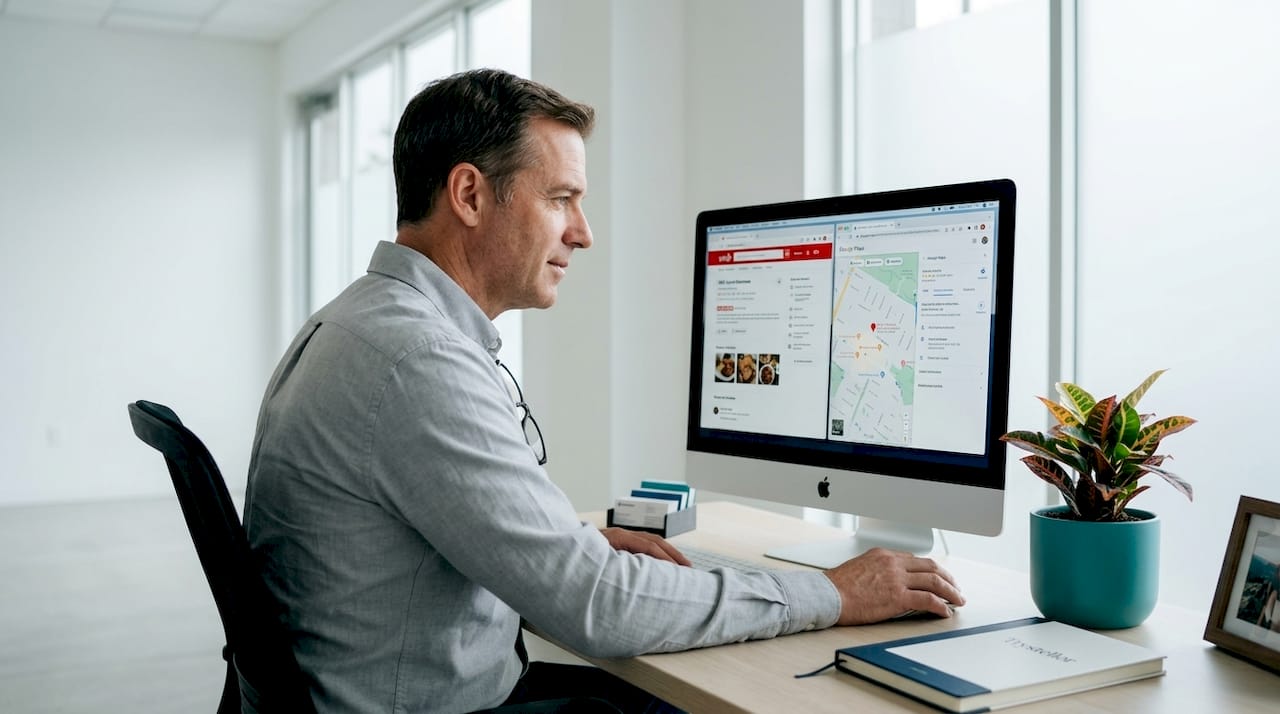
Think of a local citation as any mention of your business name, address, and phone number on the internet. That combination is called NAP (Name, Address, Phone). Consistent and accurate citations across directories and platforms strengthen local SEO trust and improve your ranking signals.
Structured vs. unstructured citations
| Type | What it is | Examples |
|---|---|---|
| Structured | A formal directory listing with dedicated fields for NAP data | Yelp, Google Business Profile, Facebook, BBB |
| Unstructured | A mention of your business in editorial content, blog posts, or news | A local news article mentioning your café, a blogger referencing your shop |
Both types matter. Structured citations are easier to build deliberately. Unstructured citations are harder to control but carry strong trust signals because they come from editorial contexts.
How to build and audit your citations
- Start with the top general directories: Yelp, Facebook, Apple Maps, Bing Places, and your local Chamber of Commerce website.
- Add industry-specific directories. A restaurant should be on OpenTable and Zomato. A contractor should be on Angi and HomeAdvisor.
- Search your business name on Google periodically to find any existing mentions that have your NAP wrong. Outdated listings with old phone numbers or former addresses actively hurt your rankings.
- Use a tool like Moz Local or BrightLocal to audit citation consistency across dozens of directories at once.
Reviews and why they cannot be ignored
Reviews are public proof that your business delivers on its promises, and Google treats them as a prominence signal in local rankings. Ask every satisfied customer directly and make it easy by sending a short text or email with a direct link to your GBP review page.
Respond to every review, positive and negative. A one-line “Thank you, we appreciate your business!” on a five-star review shows engagement. A professional, solution-focused reply to a negative review shows potential customers you take problems seriously. Never argue or get defensive in a public response.
On-page SEO for your local business website
Your website is the plumbing behind your digital presence. If it is not optimized for local searches, even a perfect GBP will not carry you far. Local website optimization covers four core areas: content, technical setup, mobile experience, and backlinks.
Here is what to prioritize:
- Title tags and meta descriptions: Every service page needs a unique title tag that includes your primary keyword and city. “Water Heater Repair in Houston | [Your Business Name]” is better than “Our Services.” Meta descriptions do not directly affect rankings, but a clear, benefit-focused description improves click-through rates from search results.
- Header tags (H1, H2, H3): Use your main keyword naturally in the H1 of each page. Break up content with H2 and H3 subheadings that include secondary keywords and location modifiers.
- Location-specific landing pages: If you serve multiple cities or neighborhoods, create a dedicated page for each one. A cleaning company serving five Dallas suburbs should have five separate pages, each written for that specific area, not one page that lists all five locations in a bullet point.
- LocalBusiness schema markup: Schema is a block of code that tells Google structured information about your business: name, address, phone, hours, service areas, and price range. Adding LocalBusiness schema to your homepage and service pages helps Google understand your offerings and improves your chances of appearing in rich results.
- Mobile optimization and page speed: More than half of local searches happen on phones. A page that loads slowly or displays poorly on a small screen loses customers before they ever read your offer. Test your site with Google’s PageSpeed Insights and fix the top three issues it flags.
Pro Tip: Add your city and neighborhood to your image alt text where it fits naturally. “kitchen-renovation-chicago.jpg” with alt text “kitchen renovation in Lincoln Park, Chicago” is a small signal that, combined with dozens of others, reinforces your local relevance to Google’s crawlers.
For more detail on building local authority through backlinks, explore local link building strategies that actually move rankings.

Measuring success and avoiding common mistakes
You cannot improve what you do not measure. Tracking local SEO performance means monitoring GBP insights, website traffic sources, and search query data on a consistent schedule.
Here is a simple tracking routine to follow monthly:
- Check your GBP insights. The dashboard shows how many people found your listing through direct searches (they searched your name) vs. discovery searches (they searched a category or service). A growing discovery number means your local SEO is working.
- Review your website traffic by source. In Google Analytics 4, check how much traffic comes from organic search. Look specifically at which pages are gaining or losing visits.
- Use UTM parameters on any marketing links. If you share your website in an email campaign or social post, add a UTM tag so Google Analytics can separate that traffic from organic search visits. This prevents attribution errors that make your data unreliable.
- Audit for duplicate listings. Search your business name and phone number on Google every quarter. Duplicates split your review count and confuse search engines about which listing to rank. Request removal of any duplicates through your GBP dashboard.
- Check NAP consistency across directories. Even a difference as small as “St.” vs. “Street” in your address creates a mismatch signal. Standardize your format and keep it consistent everywhere.
The most common mistake beginners make is doing the initial setup and then walking away. Local ranking factors including relevance, proximity, and prominence shift as competitors update their profiles, earn new reviews, and publish fresh content. The businesses that stay visible are the ones that treat local SEO as an ongoing practice, not a one-time task.
My honest take on local SEO for beginners
I have watched hundreds of local business owners get distracted by every new tactic that surfaces online, only to neglect the fundamentals that actually drive results. In my experience, the business that dominates local search in any mid-sized city is rarely the one chasing the latest algorithm update. It is the one with a fully built-out GBP, 200 consistent five-star reviews, and service pages that clearly state what they do and where they do it.
The biggest myth I see repeated is that small businesses cannot compete with larger brands locally. That is simply wrong. Local results vary based on searcher location, which means a one-person plumbing operation in a specific zip code can outrank a national brand in that same zip code if the local signals are stronger. Proximity and hyper-local relevance are advantages that big brands cannot manufacture.
What I tell every beginner is this: do not touch anything advanced until your GBP is complete, your NAP is consistent across 20 directories, and you have at least 10 reviews. Those three things alone will move you past the majority of your local competitors. Complexity comes later. Consistency comes first.
— Cole
How Trystellor helps you put this into practice
Managing all of these local SEO tasks manually takes real time, and for most business owners, time is the one resource that is always in short supply. That is exactly what Trystellor was built to solve.
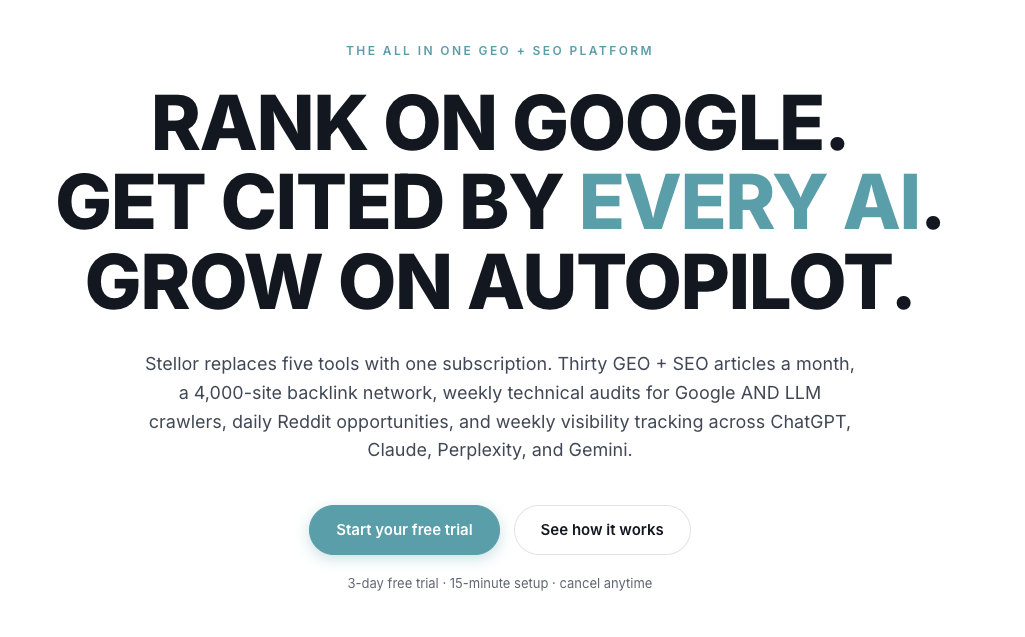
Trystellor is an all-in-one GEO and SEO platform that handles the heavy lifting for you. It publishes 30 optimized articles to your site every month, runs a 4,000-site backlink network to build your authority, performs weekly technical audits, and tracks your visibility across Google, ChatGPT, Claude, Perplexity, and Gemini. That is five separate vendor relationships replaced by one subscription at $199 per month. You can explore exactly what the platform does and start a three-day free trial with no credit card required. The free AI Visibility Audit alone is worth the 15 minutes it takes to set up.
FAQ
What is local SEO and why does it matter?
Local SEO is the process of optimizing your business’s online presence so it appears in location-based search results. It matters because buyers searching for services near them are ready to spend, and businesses that rank locally capture that demand before competitors do.
How long does it take to see results from local SEO?
Most businesses see meaningful movement in local map pack rankings within 60 to 90 days of completing their GBP, building consistent citations, and publishing optimized content. Competitive markets may take longer.
What are the most important local SEO terms beginners should know?
The terms that matter most at the start are NAP (Name, Address, Phone), GBP (Google Business Profile), local map pack, citations, schema markup, and geo-targeted keywords. Understanding these gives you a working vocabulary for every tactic in this guide.
Do I need a physical address to rank in local search?
No. Service-area businesses that operate without a public storefront can set a service area in their GBP instead of displaying a physical address, and they can still rank for local searches within that area.
How many reviews do I need to compete locally?
There is no fixed number, but in most markets, 10 to 25 recent, positive reviews puts you in a competitive position. Review velocity, meaning how consistently you earn new reviews over time, matters more than the total count alone.