SEO jargon can stop a local business owner cold. Words like “crawl budget,” “SERP,” and “local intent” get thrown around by agencies and marketing blogs as if everyone already knows what they mean. The problem is that misunderstanding even one core term can lead to real, costly mistakes, like paying for the wrong services, ignoring high-value ranking opportunities, or failing to fix issues that keep your website buried on page three. This guide cuts through the noise and gives you plain-English definitions, practical examples, and action steps you can use right away.
Table of Contents
- Foundational SEO terms every business should know
- On-page SEO: Optimizing what’s on your website
- Local SEO explained: Stand out in your community
- Demystifying local keyword intent
- The biggest SEO terminology mistake businesses make
- Grow your local visibility with expert SEO support
- Frequently asked questions
Key Takeaways
| Point | Details |
|---|---|
| Understand core SEO terms | Knowing basic SEO language empowers better decisions and clearer conversations with providers. |
| Local SEO is unique | Optimizing for local results requires targeting geographic keywords and maintaining accurate listings. |
| On-page SEO is critical | Updating your site’s titles, tags, and content boosts search visibility especially for local searches. |
| Intent drives keywords | Use local and intent-based keywords to match how potential customers really search. |
| Application beats jargon | Focusing on what works in practice is more important than memorizing technical terms. |
Foundational SEO terms every business should know
With the importance of clear SEO language set, let’s break down the core terms that form the foundation of all SEO work.
Before you can improve your search rankings, you need to understand how Google actually processes your website. The entire system runs on four interconnected steps: crawling, indexing, ranking, and displaying results. Most business owners mix these up, and that confusion leads to real diagnostic errors when something goes wrong.
Crawling is how Google discovers your pages. Google sends out automated programs called “crawlers” or “spiders” that follow links across the web, requesting pages and reading their content. As Google Search Console help explains, crawling is the process Google uses to discover new or updated pages by requesting them. Think of it like a mail carrier walking every street in a city, noting which houses exist.
Indexing is the next step. After crawling a page, Google decides whether to add it to its massive database of web content. That database is called the index. Here is where many business owners get confused: a page must be crawled before indexed, but not every crawled page gets indexed. If you submitted a page to Google and it still does not appear in search results, the issue is almost always at the indexing stage, not the crawling stage.
Ranking refers to where your page appears in search results for a given query. Google uses a complex algorithm (a set of rules and calculations) to decide which pages deserve the top spots. SERP stands for Search Engine Results Page. That is the page you see after typing a query into Google, complete with organic results, ads, maps, and featured snippets.
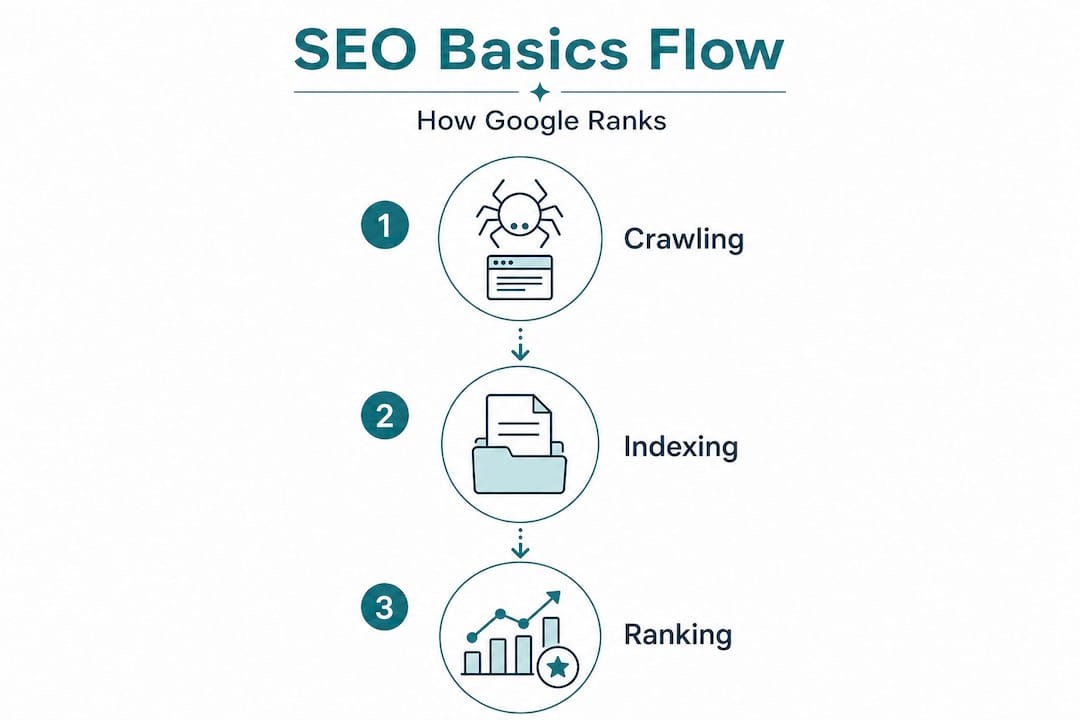
Here is a quick reference table to keep these terms straight:
| Term | What it means | Why it matters |
|---|---|---|
| Crawl | Google visits and reads your page | Your page must be crawlable to rank |
| Index | Google stores your page in its database | Only indexed pages can appear in results |
| Algorithm | Google’s ranking ruleset | Determines your position for each query |
| Ranking | Your position in search results | Higher rank means more clicks and traffic |
| SERP | The full search results page | Where your business competes for visibility |
Key points to remember about these foundational terms:
- A page blocked by a “noindex” tag will be crawled but never indexed
- A page with no inbound links may never be crawled at all
- Rankings fluctuate daily because Google’s algorithm updates constantly
- Your position on the SERP depends on dozens of factors, not just keywords
Understanding these four terms alone puts you ahead of most small business owners who are paying for SEO services without knowing what they are actually buying.
On-page SEO: Optimizing what’s on your website
Now that you have mastered SEO’s basic building blocks, it is time to focus on improvements you can control right on your website.

On-page SEO is everything you do directly on a web page to make it more relevant and readable for both Google and your visitors. According to HubSpot’s on-page SEO fundamentals, on-page SEO covers optimizations like title tags, meta descriptions, header tags (H1/H2/H3), image alt text, internal and external linking, and content and keyword usage. Each element sends a signal to Google about what your page is about and who it should be shown to.
Here is what each element means for a local service business:
- Title tag: The clickable headline that appears in search results. For a plumber in Austin, this might read “Emergency Plumber in Austin, TX | Fast Same-Day Service.” It should include your primary keyword and ideally your city.
- Meta description: The short paragraph under your title in search results. It does not directly affect rankings, but a compelling meta description increases click-through rates, which does influence how Google values your page over time.
- Header tags (H1, H2, H3): These organize your page content. Your H1 is the main headline on the page itself. Subheadings (H2, H3) break up content and signal topic structure to Google’s crawlers.
- Alt text: A short description added to images. Google cannot “see” images, so alt text tells it what the image shows. For a roofing company, an image alt text might read “roof repair on two-story home in Denver.”
- Internal links: Links from one page on your site to another. They help Google understand your site structure and keep visitors exploring your content longer.
- Keywords: The specific words and phrases your customers type into Google. These should appear naturally throughout your page content, not stuffed in awkwardly.
Understanding the importance of local SEO terminology is what separates businesses that rank from those that do not. When you know what each on-page element does, you can audit your own pages in minutes and spot obvious gaps.
Pro Tip: Open your most important service page right now. Check whether the H1 includes your service type and city name. If it just says “Our Services,” you are leaving ranking potential on the table. A simple rewrite to “Landscaping Services in Phoenix, AZ” can produce noticeable results within weeks.
Local SEO explained: Stand out in your community
With a strong grasp of on-site strategies, let us turn attention to winning searches specific to your local area.
Local SEO is not just regular SEO with a city name added. It is a distinct set of strategies designed to help businesses appear in geographically relevant searches. As Search Engine Land defines it, local SEO is traditional SEO plus targeting visibility in results that are localized to a searcher’s geography, often triggered by local intent queries.
The clearest example of local SEO in action is the “map pack,” also called the Local Pack. When someone searches “HVAC repair near me,” Google shows a map with three business listings at the top of the SERP before any organic results. Getting into that map pack is often worth more than ranking number one in the regular organic results, because map pack clicks convert at a much higher rate.
Here is how local SEO compares to general SEO:
| Factor | General SEO | Local SEO |
|---|---|---|
| Target audience | Anyone searching globally or nationally | People in a specific city or region |
| Key ranking signals | Backlinks, content quality, authority | Google Business Profile, reviews, local citations |
| Primary goal | Traffic volume | Foot traffic, calls, local leads |
| Main tools | Google Search Console, keyword tools | Google Business Profile, review platforms |
| Content focus | Broad topics | City-specific service pages |
To improve your local SEO, focus on these steps in order:
- Claim and fully complete your Google Business Profile. Add your business name, address, phone number, hours, service categories, and photos. This is the single highest-impact action for local visibility.
- Build consistent citations. A citation is any online mention of your business name, address, and phone number (often called NAP). Inconsistent NAP data across directories confuses Google and hurts your local rankings.
- Collect and respond to reviews. Google uses review quantity, quality, and recency as ranking signals. Responding to reviews also signals that your business is active and engaged.
- Create location-specific service pages. If you serve multiple cities, each city deserves its own dedicated page with unique content, not a copy-paste job with the city name swapped out.
- Earn local backlinks. Links from local news sites, chambers of commerce, and neighborhood blogs carry significant weight in local rankings.
Pro Tip: Search your own business name in Google right now. If your address, phone number, or hours look different across your website, Yelp, and Google Business Profile, fixing that inconsistency is your first priority before doing anything else.
Demystifying local keyword intent
Knowing how Google interprets “local” helps you attract the right search audience. Here is what you need to know about keywords.
Not all keywords work the same way in local search. Google distinguishes between two types of local keyword intent, and understanding this distinction changes how you write your content and choose your targets.
Explicit local keywords include a geographic term directly in the search phrase. Examples: “electrician in Nashville,” “best dog groomer Seattle,” “roof repair 90210.” The location is spelled out, so Google knows exactly what geographic area to prioritize.
Implicit local keywords do not include a location but carry clear local intent. Examples: “plumber near me,” “emergency dentist open now,” “oil change today.” Google uses the searcher’s device location to return nearby results. As Search Engine Land notes, local search keywords often include explicit geography like city, neighborhood, or ZIP code, or implicit local intent terms like “near me” or “nearby,” and Google uses these signals to trigger local results.
“Near me” searches have grown dramatically over the past several years. Businesses that optimize for both explicit and implicit local keywords capture a much wider share of high-intent, ready-to-buy customers than those targeting only one type.
Here is how to apply this in practice:
- Include your city and neighborhood names in your page titles, H1 headings, and service descriptions
- Add “near me” variations naturally in your content, such as “If you are looking for a reliable electrician near you in Charlotte…”
- Create separate pages for each major service and location combination you want to rank for
- Use Google’s autocomplete feature to discover how real customers phrase their local searches
- Check which keywords your competitors are ranking for using free tools like Google Search Console or Ubersuggest
The biggest mistake local businesses make with keywords is targeting only broad, competitive terms like “plumber” or “landscaping.” Those terms are dominated by national directories like Yelp and Angi. Your real opportunity is in specific, local combinations like “drain cleaning service in Boise” or “lawn care company Scottsdale AZ.”
The biggest SEO terminology mistake businesses make
After unpacking the essential concepts, there is a common pitfall worth warning about, one that trips up even experienced marketers.
Here is the uncomfortable truth: knowing SEO terminology and actually improving your rankings are two completely different things. We see this constantly. A business owner spends hours reading about “domain authority,” “E-E-A-T,” and “core web vitals,” then gets paralyzed trying to optimize for all of it at once. They end up doing nothing because the list feels infinite.
The real problem is not ignorance. It is mistaking vocabulary for strategy. Knowing that a “backlink” is a link from another website to yours does not automatically tell you which backlinks to pursue, how to earn them, or whether your current backlink profile is helping or hurting you. Terms are just labels. What matters is the action behind them.
There is also a chasing-buzzwords problem. Every year, a new term takes over the SEO conversation. One year it is “topical authority,” the next it is “helpful content,” then “AI overviews.” Businesses that pivot their entire strategy every time a new term trends end up with an inconsistent, unfocused online presence. Google rewards consistency and depth, not trend-chasing.
Our experience working with local service businesses points to the same conclusion every time: the businesses that win in local search are not the ones with the most sophisticated SEO vocabulary. They are the ones who consistently do the fundamentals well. They keep their Google Business Profile updated. They publish relevant content regularly. They earn honest reviews. They fix technical errors when they appear.
The terminology in this guide exists to help you communicate with vendors, understand reports, and make smarter decisions. But the moment you find yourself debating whether to focus on “semantic SEO” versus “entity optimization” instead of actually publishing a new service page, you have lost the plot. Focus on real-world SEO improvements that move the needle for your specific business, not on mastering every new term that surfaces in a marketing blog.
Grow your local visibility with expert SEO support
Understanding SEO terminology is a powerful first step, but applying it consistently across your website, content, and local listings is where most businesses hit a wall. The gap between knowing what a title tag is and actually optimizing every page on your site for local search is significant, especially when you are also running a business.
Stellor is built specifically for local service businesses that want real results without hiring an agency or building an in-house team. The platform combines Stellor local SEO solutions including content creation, backlink building, technical audits, and AI citation tracking into one subscription. You get the speed and expertise of a full SEO team at a fraction of the cost, with tools designed to keep your business visible in both Google search and AI-generated answers. If you are ready to turn your new SEO knowledge into actual rankings, Stellor is where to start.
Frequently asked questions
What is the difference between crawling and indexing?
Crawling is how Google discovers your pages by following links and requesting content, while indexing is when Google adds those pages to its searchable database. Importantly, not every crawled page gets indexed, which is why a submitted page may still not appear in results.
What makes a keyword “local”?
A keyword is local if it contains explicit geography or “near me” terms, or if it implies location-based intent even without a place name. Google uses both the search phrase and the searcher’s location to decide when to show local results.
Why is on-page SEO important for local services?
On-page SEO directly tells Google what services you offer and where you operate, which is essential for matching your pages to relevant local searches. Optimizing content and HTML elements like title tags and header tags boosts your relevance for the specific queries your customers are typing.
Can I do SEO myself or do I need an expert?
You can absolutely handle foundational SEO tasks yourself, like updating your Google Business Profile, adding keywords to your page titles, and collecting reviews. For more advanced work like technical audits, backlink building, and competitive analysis, expert support saves significant time and avoids costly errors.