TL;DR:
- LLM SEO optimizes content for citation by large language models in AI-generated answers. It emphasizes passage-level relevance, attribute-rich schema, and topical clusters to enhance AI visibility and citations. This approach differs from traditional SEO, focusing on content structure and depth rather than rankings alone.
LLM SEO is the practice of structuring content so large language models like ChatGPT, Claude, Perplexity, and Gemini select it as a cited source in AI-generated answers. It shares 70–80% of its foundation with traditional SEO but adds a distinct 20–30% layer focused on passage-level extraction and machine-readable signals. The clearest proof of that gap: pages using attribute-rich schema earn a 61.7% AI citation rate versus 41.6% for pages using generic schema markup. That 20-point difference is not a rounding error. It is the entire argument for treating LLM SEO as its own discipline.
What is LLM SEO and how does it work?
Large language models do not rank pages. They extract passages. That distinction changes everything about how you should write and structure content.
When ChatGPT or Perplexity generates an answer, it pulls the most concise, authoritative passage it can find on a given topic. A 4,000-word all-in-one guide is less extractable than focused sections built around a single question. The model reads your content the way a researcher skims a textbook: it looks for the clearest answer to a specific question, not the most comprehensive document overall.
LLMs also evaluate authority differently than Google’s PageRank algorithm does. They weigh semantic coherence, named entity mentions, and topical depth. A page that names specific standards, cites recognized sources, and answers questions in plain language signals credibility to the model. A page stuffed with keywords but light on substance does not.
This is why the industry term “Generative Engine Optimization,” or GEO, has emerged alongside LLM SEO. GEO is the broader practice of optimizing for all AI-mediated discovery. LLM SEO zeros in specifically on large language model citation. Both matter, and the tactics overlap significantly.
How LLMs select content to cite
- Passage-level relevance: The model identifies the paragraph or section that best answers the query, not the page as a whole.
- Answer-first structure: Paragraphs that open with a direct claim get extracted more reliably than paragraphs that build to a conclusion.
- Named entity density: Mentioning specific standards, tools, organizations, and data points signals expertise.
- Source credibility: Pages with backlinks from authoritative domains and consistent topical coverage earn higher trust scores.
- Content freshness: Substantive updates to facts and answers carry weight. Changing a publication date without updating content does not.
Pro Tip: Write every section as if it could stand alone. If a reader landed on that paragraph with no context, they should still get a complete, useful answer.
What content structure best serves AI citation?
Structure is the single most controllable variable in LLM SEO. You cannot control which model crawls your site or when. You can control how clearly your content is organized.

Use hierarchical headings with direct answers
Every H2 and H3 heading should reflect a question a real buyer asks. The paragraph immediately below that heading should answer it in 80–100 words. That answer block is what the model extracts. Burying the answer in the third paragraph after context-setting prose costs you citations.
Implement FAQPage schema correctly
FAQPage schema with 40–120 word answers is the gold standard for LLM citation. Two common mistakes destroy its effectiveness. First, hiding FAQ answers behind accordions or “read more” toggles reduces citation likelihood because the text is not immediately visible to crawlers. Second, writing vague, one-sentence answers provides too little signal. Each FAQ answer should be a complete, self-contained response.
Apply Article schema with full attributes
Generic Article schema with only a title and URL provides weak AI signals. Populate every relevant field: datePublished, dateModified, author, description, image, and publisher. These attributes help LLMs confirm that a human expert produced the content and that it is current.
Here is a quick reference for schema priority by impact:
| Schema element | AI citation impact | Common mistake |
|---|---|---|
| FAQPage with visible answers | High | Hiding answers in accordions |
| Article with full attributes | High | Leaving author and date blank |
| BreadcrumbList | Medium | Skipping on blog posts |
| HowTo schema | Medium | Using it for non-procedural content |
| Generic schema only | Low | Treating it as a checkbox |
Build internal linking into topic clusters
Interlinked pillar and sub-pages signal domain authority to LLMs and improve content extraction. A pillar page on “local SEO for service businesses” linked to sub-pages on specific trades, like local ranking for plumbers or lead generation for roofers, tells the model that your site covers the topic from every angle. That topical depth increases the probability of citation across multiple query types.

Pro Tip: Map your internal links before you write. Decide which pages support which pillar, then write each sub-page to answer one specific question the pillar does not fully address.
How does LLM SEO differ from traditional SEO?
Traditional SEO focuses on ranking signals: keyword placement, backlink volume, page authority, and click-through rate. LLM SEO focuses on citation signals: semantic clarity, structured data completeness, and topical authority demonstrated through content depth.
The two approaches share a foundation. Semantic intent and demonstrable expertise matter in both worlds. A page that ranks well on Google because it is authoritative, well-structured, and genuinely useful is also a strong candidate for AI citation. The difference is in the 20–30% of tactics that are LLM-specific.
| Dimension | Traditional SEO | LLM SEO |
|---|---|---|
| Primary goal | Rank on page one | Get cited in AI answers |
| Content unit | Full page | Extractable passage |
| Key signal | Backlinks and keywords | Schema and semantic depth |
| Success metric | Organic traffic and rankings | Citation frequency by AI |
| Content length | Longer tends to rank better | Shorter, focused sections win |
The behavioral shift driving this difference is real. Buyers increasingly ask ChatGPT for vendor recommendations before they open a browser tab. They ask Perplexity to compare service providers. They read Claude’s summary before visiting a website. If your brand does not appear in those AI-generated answers, you are invisible to a growing segment of your market, regardless of your Google ranking.
Traditional SEO also rewards content freshness, but LLMs are particularly sensitive to it. Artificially refreshing content by changing a date without updating the substance degrades trust with AI systems. Models evaluate whether the technical depth of an update is real. Substantive changes to facts, examples, and answers are what register.
What practical steps improve LLM visibility in 2026?
The following framework applies whether you manage one site or a portfolio of clients. Each step builds on the previous one.
-
Audit your existing content for extractability. Read each section as if you were an LLM looking for a passage to cite. If the answer is buried, rewrite the opening sentence of that paragraph to lead with the direct claim.
-
Implement attribute-rich schema on every published page. Do not leave
author,datePublished, ordescriptionblank. These fields are the difference between a 41.6% and a 61.7% citation rate. -
Write answer-first paragraphs under 100 words. Pages that cite 3–5 named sources inline within those short answer blocks see materially higher citation absorption. Name the standard, the organization, or the data point directly in the sentence.
-
Build audience-specific and use-case-specific pages. Pages mapped precisely to each audience and use case achieve better LLM visibility because the model can parse relevance more clearly. A general “SEO tips” page competes with everything. A page titled “SEO for solo attorneys in Texas” answers a specific query with precision. For a practical example of this approach applied to a specific trade, the SEO strategies for local services guide shows how narrow targeting compounds over time.
-
Update content with substantive changes, not date refreshes. Add new FAQ entries, update statistics, and expand answer blocks when new information becomes available. LLMs detect the difference between a real update and a cosmetic one.
-
Track citation frequency as a performance metric. Query ChatGPT, Perplexity, Gemini, and Claude weekly using the exact prompts your buyers use. Record which pages get cited and which competitors appear instead. This data tells you where your content gaps are.
Pro Tip: For passage-level optimization, treat each H3 section as a standalone answer unit. Write the heading as a question, answer it in the first sentence, and support it with one concrete example or data point. That three-part structure is what models extract.
Key Takeaways
LLM SEO requires answer-first content, attribute-rich schema, and topical cluster architecture to earn consistent AI citations alongside traditional search rankings.
| Point | Details |
|---|---|
| Schema richness drives citation rates | Attribute-rich schema produces a 61.7% AI citation rate versus 41.6% for generic schema. |
| Passage-level extraction changes content structure | Write short, self-contained answer blocks under 100 words, not long all-in-one guides. |
| FAQPage schema must be fully visible | Hiding FAQ answers in accordions reduces citation likelihood; keep answers rendered on the page. |
| Topical clusters signal authority to LLMs | Interlinked pillar and sub-pages increase citation probability across multiple query types. |
| Substantive updates outperform date refreshes | LLMs evaluate the depth of content changes; cosmetic date edits do not improve citation rates. |
The uncomfortable truth about LLM SEO adoption
Most SEO professionals I talk to treat structured data as a technical checkbox. They add a schema plugin, leave half the fields blank, and move on. That approach worked well enough when the only audience was Googlebot. It fails completely when the audience is a large language model deciding whether your page is worth citing.
The passage-level extraction mechanic is the insight that changes how I approach every piece of content. I stopped asking “does this page rank?” and started asking “can a model pull a clean, complete answer from this section?” Those are different questions with different answers. A page can rank on page one and still never get cited by an AI because the answer is buried in paragraph four.
The other pitfall I see constantly is the date-refresh habit. Teams update a timestamp, call it a content refresh, and wonder why their AI citation rates do not improve. LLMs are not fooled by metadata alone. They read the content. If the facts, examples, and answer blocks are the same as they were two years ago, the model treats the page as stale regardless of what the dateModified field says.
My forecast: LLM SEO will be a standard line item in every SEO audit within 18 months. The professionals who build these habits now, answer-first writing, full schema implementation, topical cluster architecture, and weekly citation tracking, will have a measurable head start. The ones who wait will spend that time catching up.
— Cole
How Trystellor handles LLM SEO for you
Trystellor is built for exactly this challenge. The platform publishes 30 GEO and SEO-optimized articles to your CMS every month, each one structured with the schema markup, internal linking, and llms.txt configuration that make pages quotable by ChatGPT, Claude, Perplexity, and Gemini.
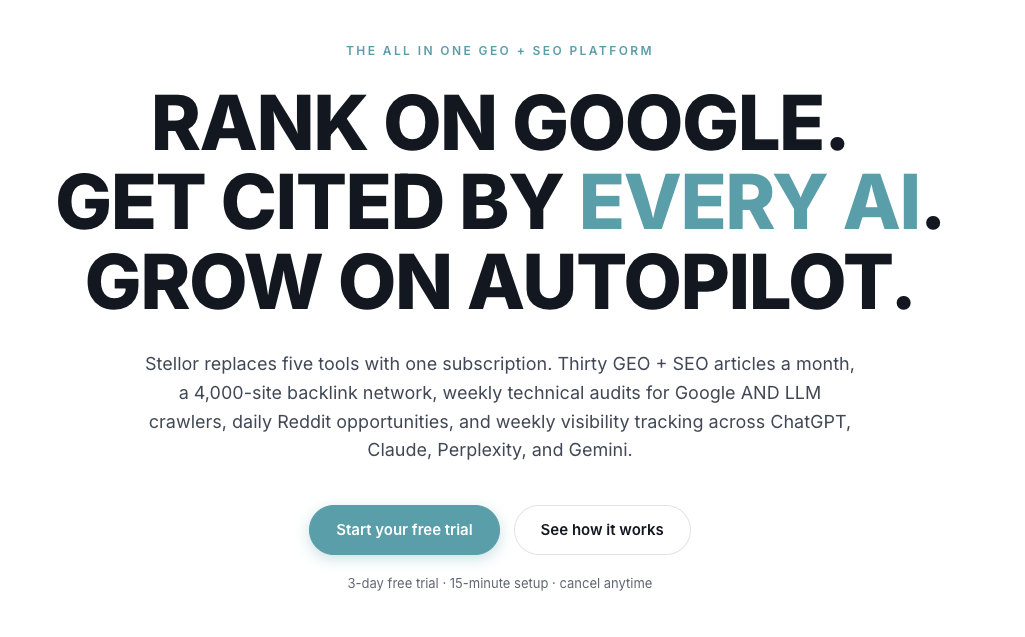
On top of content, Trystellor’s 4,000-site backlink network builds the authority signals LLMs use to gauge trust. Weekly technical audits check schema completeness, llms.txt readiness, and structured data integrity. The LLM visibility tracker queries AI platforms weekly using your buyers’ actual prompts and reports exactly where you are and are not being cited. Pricing starts at $199 per month with a three-day free trial and no credit card required. Every article your site earns stays yours, even if you cancel. See the full platform at Trystellor.
FAQ
What is LLM SEO?
LLM SEO is the practice of optimizing content to be selected and cited by large language models like ChatGPT, Claude, and Perplexity in AI-generated answers. It builds on traditional SEO but adds passage-level structuring, attribute-rich schema, and topical cluster architecture as distinct requirements.
How does LLM SEO differ from traditional SEO?
Traditional SEO targets keyword rankings and backlink volume. LLM SEO targets citation frequency in AI answers, requiring concise answer-first paragraphs, full schema markup, and demonstrable topical depth rather than keyword density alone.
Does schema markup really affect AI citation rates?
Pages with attribute-rich schema earn a 61.7% AI citation rate compared to 41.6% for pages using generic schema. Populating fields like author, datePublished, and description is the single highest-leverage technical change most sites can make.
How often should I update content for LLM visibility?
Update content whenever facts, statistics, or best practices change in a meaningful way. LLMs evaluate the technical depth of updates, so adding new FAQ entries or expanding answer blocks matters far more than changing a publication date.
What metric should I track for LLM SEO performance?
Track citation frequency: how often your pages appear when you query ChatGPT, Perplexity, Gemini, and Claude using the prompts your buyers actually use. This metric reveals content gaps and shows whether your optimization efforts are producing real AI visibility gains.