TL;DR:
- Most patients search online before booking, making organic SEO essential for long-term practice growth. Optimizing local profiles, creating patient-focused content, and improving technical site health drive inquiries and conversions effectively. Consistent tracking and fast lead follow-up are crucial for maximizing SEO efforts and AI citation visibility.
If your practice isn’t showing up when patients search for care nearby, you’re losing appointments to competitors who are. 77% of patients use search engines before booking, which means organic visibility directly drives your schedule. Paid ads fill gaps, but they stop the moment you stop paying. The goal of this guide is to show you how to grow patient inquiries with SEO using strategies that compound over time, covering everything from on-page content and local SEO to technical fixes and AI-driven search optimization.
Table of Contents
- Key Takeaways
- How to grow patient inquiries with SEO: the essentials first
- On-page content that attracts and converts patients
- Local SEO tactics that turn map searches into calls
- Technical SEO and conversion fixes that complete the picture
- Measuring SEO impact and adjusting over time
- My honest take on what actually moves the needle
- How Stellor helps healthcare practices grow inquiries faster
- FAQ
Key Takeaways
| Point | Details |
|---|---|
| Search drives bookings | Most patients search before booking, making organic SEO your most reliable long-term patient acquisition channel. |
| Local SEO wins inquiries | Optimizing your Google Business Profile and location pages can increase calls and direction requests by 70% or more. |
| Content must answer real questions | Patient-centered content targeting long-tail, symptom-based queries attracts visitors who are ready to book. |
| Technical health converts traffic | Fast load times, mobile optimization, and frictionless booking forms directly determine whether visitors become patients. |
| Measurement guides improvement | Tracking rankings, form submissions, and call volume monthly lets you adjust before small gaps become big problems. |
How to grow patient inquiries with SEO: the essentials first
Before writing a single blog post or tweaking a meta title, you need to understand how your future patients actually search. Most healthcare searches fall into three categories: treatment-based (“knee replacement surgeon near me”), symptom-based (“why does my shoulder hurt when I lift”), and location-based (“pediatrician accepting new patients in Austin”). Each of these carries different intent, and each needs a different content response.
The tools you need before you start are free and accessible:
- Google Search Console shows which queries already bring visitors to your site, where you rank, and which pages get clicks.
- Google Business Profile (GBP) controls your appearance in local map results. Without a fully completed GBP, you’re invisible to a large share of nearby searchers.
- Stellor tracks both traditional SEO rankings and AI citation visibility across platforms like ChatGPT, Claude, Perplexity, and Gemini, which is critical because AI health queries grew 527% year-over-year and now reach over 230 million weekly health questions worldwide.
Generative Engine Optimization (GEO) is the practice of structuring your content so AI answer engines can read, summarize, and cite it. Think of it as the plumbing behind the walls of your digital presence. Patients who ask ChatGPT “best orthopedic clinic in Denver” are getting a curated answer from an AI that scanned published web content. If your site isn’t structured for that, you won’t be cited. Leads from AI-structured content convert at 27%, which is a meaningful number for any practice.
| Metric to Track | Why It Matters | Tool to Use |
|---|---|---|
| Organic traffic | Shows growth in search visibility over time | Google Analytics |
| Keyword rankings | Tracks position for target patient queries | Google Search Console |
| Appointment form submissions | Measures how well SEO converts to leads | Google Analytics Goals |
| Phone calls from search | 39.2% of healthcare conversions happen by phone | Call tracking software |
| AI citation frequency | Measures presence in ChatGPT, Claude, Gemini answers | Stellor LLM tracking |
On-page content that attracts and converts patients
Your website content is doing one of two things: answering what patients are already asking, or talking about your practice in terms patients don’t search for. Most practice websites default to the second. Fixing this is where the biggest SEO gains come from.
Long-tail keyword searches like “best dental implant clinic in Adyar” or “sports medicine doctor accepting new patients Chicago” signal high intent. These visitors aren’t browsing. They’re ready to act. Your content should meet them at that point by giving them exactly the information they need to make a decision.
Here’s what a strong healthcare content strategy includes:
- Service pages for every treatment or specialty you offer, written in plain language that explains what the procedure is, what patients experience, and why your practice is the right choice.
- Symptom-based content that walks patients through what their symptoms might mean and what care options exist. Be informative and calm. The goal is to guide, not alarm.
- Location pages for every area you serve, including your address, phone number, parking information, accepted insurance, and hours.
- FAQ pages using structured FAQ schema markup so your answers appear directly in Google search results as rich snippets.
- A consistent blog publishing at least two to four posts per month. Active health content libraries generate 3 to 4 times more organic traffic than sites that publish rarely.
Schema markup types like MedicalClinic, Physician, LocalBusiness, and FAQ improve how search engines understand your pages and increase click-through rates by displaying rich information directly in results. Adding FAQ schema to your treatment pages can surface your answers for patients who haven’t even clicked through yet, which builds trust before they arrive.
Pro Tip: Never write content for search engines first. Write it for the patient in your waiting room who has five questions and limited medical knowledge. Google rewards that. Keyword stuffing a service page with “best orthopedic surgeon” repeated twelve times will hurt more than help.
The search engine optimization for healthcare that works is the kind that genuinely serves the reader. Comprehensive, jargon-free, structured content that builds topical authority while answering real questions is what ranks and what converts. You can learn more about content frameworks for local services that apply directly to healthcare practice growth.
Local SEO tactics that turn map searches into calls
For most practices, the local map pack (the three listings Google shows above organic results for location-based searches) is where most new patient inquiries come from. Dominating that section requires a specific approach.
- Complete your Google Business Profile fully. Fill in every field: services, hours, photos, accepted insurance, appointment link, and a description with your key services and location. Incomplete profiles rank lower and convert poorly.
- Keep your NAP consistent. Your Name, Address, and Phone number must match exactly across your website, GBP, Healthgrades, Zocdoc, Yelp, and every other directory. Even a small inconsistency (Suite 100 vs. Ste. 100) confuses Google and erodes your local authority.
- Build review velocity. A clinic with 200 reviews averaging 4.7 stars outperforms one with 12 reviews and 4.2 stars even at the same map position. Ask every patient for a review at checkout. Respond to every review, positive or negative, within 48 hours.
- Create location-specific service pages. If you have three locations, build three distinct pages with unique content, each with the local address, driving directions, parking info, and photos of that location.
- Target “near me” and neighborhood keywords. Phrases like “family doctor near Lincoln Park” or “urgent care open now Chicago” drive high-intent local traffic. Use them naturally in your headings and page copy.
Pro Tip: Post to your Google Business Profile weekly. Short updates about services, patient education tips, or seasonal health reminders signal to Google that your listing is active. Active listings rank higher in the local pack.
| Strategy | Impact | Time to See Results |
|---|---|---|
| Complete GBP with photos and services | Higher local map pack ranking | 2 to 4 weeks |
| Consistent NAP across 20+ directories | Stronger local authority | 1 to 3 months |
| 50+ reviews with active responses | More calls and appointment clicks | Ongoing |
| Location-specific service pages | 70% more direction requests and calls | 1 to 2 months |
| Weekly GBP posts | Improved listing engagement | 2 to 6 weeks |
Understanding local SEO tactics that rank faster can help you prioritize which of these steps to execute first based on your current standing.
Technical SEO and conversion fixes that complete the picture
Getting traffic is only half the work. If your site is slow, hard to navigate on a phone, or buries the booking form three clicks deep, you’re losing patients who were already interested. Technical SEO is the part most practices skip, and it’s often the difference between a 1% and a 5% visitor-to-booking conversion rate.

Over 60% of healthcare searches happen on phones, and a mobile-friendly site increases patient call inquiries by 32%. If your site isn’t fast and responsive on a small screen, you’re already losing a majority of your potential leads to competitors who built mobile first.
Here’s what to address in order of impact:
- Page speed. Aim for a load time under three seconds on mobile. Use Google PageSpeed Insights to identify image compression issues, render-blocking scripts, and server response problems.
- HTTPS security. Google treats unsecured sites (HTTP) as a trust signal failure. Every healthcare site must run on HTTPS without exception.
- Booking form friction. Top-converting healthcare sites reduce appointment forms to the minimum required fields: name, phone, preferred appointment type, and availability. Anything beyond that reduces completion rates.
- Real-time availability integration. Connecting your booking widget directly to your practice management software so patients see live open slots eliminates the “we’ll call you back” gap that kills conversions.
- Click-to-call buttons. Since 39.2% of healthcare conversions happen over the phone, a visible, tappable phone number on every mobile page is not optional.
Once a patient submits a form or sends a message, the clock starts immediately. Contacting a web lead within 5 minutes makes your team up to 100 times more likely to qualify that lead compared to waiting 30 minutes. Most practices respond within hours. That gap is where patient inquiries go to disappear.
Pro Tip: Set up automated SMS or email confirmation the moment a patient submits an inquiry form. It acknowledges their message instantly, reduces anxiety, and keeps your practice top of mind while your team prepares to follow up.
Measuring SEO impact and adjusting over time
SEO for medical practices typically takes 3 to 6 months to move rankings and drive measurable inquiry volume. Paid ads produce immediate calls but require constant spending to maintain. SEO compounds: each new page, backlink, and review builds on what came before.
Tracking the right numbers each month keeps you from guessing. Review these metrics monthly at minimum:
| Metric | Target Benchmark | What to Do if Flat |
|---|---|---|
| Organic traffic | 10 to 20% monthly growth | Add new content, target new keywords |
| Top keyword rankings | First page for 5+ core terms | Improve on-page content, add internal links |
| Form submissions | Consistent growth month over month | Reduce form fields, test button placement |
| GBP call clicks | Increase with each review added | Increase posting frequency, request more reviews |
| AI citation frequency | Mentioned in 3+ AI platforms | Add FAQ schema, improve content structure for GEO |
Use Google Analytics to track form completions as goals. Use Search Console to monitor which queries drive traffic and spot ranking drops early. Use Stellor’s LLM visibility reports to track whether ChatGPT, Perplexity, and Gemini are citing your practice when patients ask AI tools for recommendations in your specialty and location.
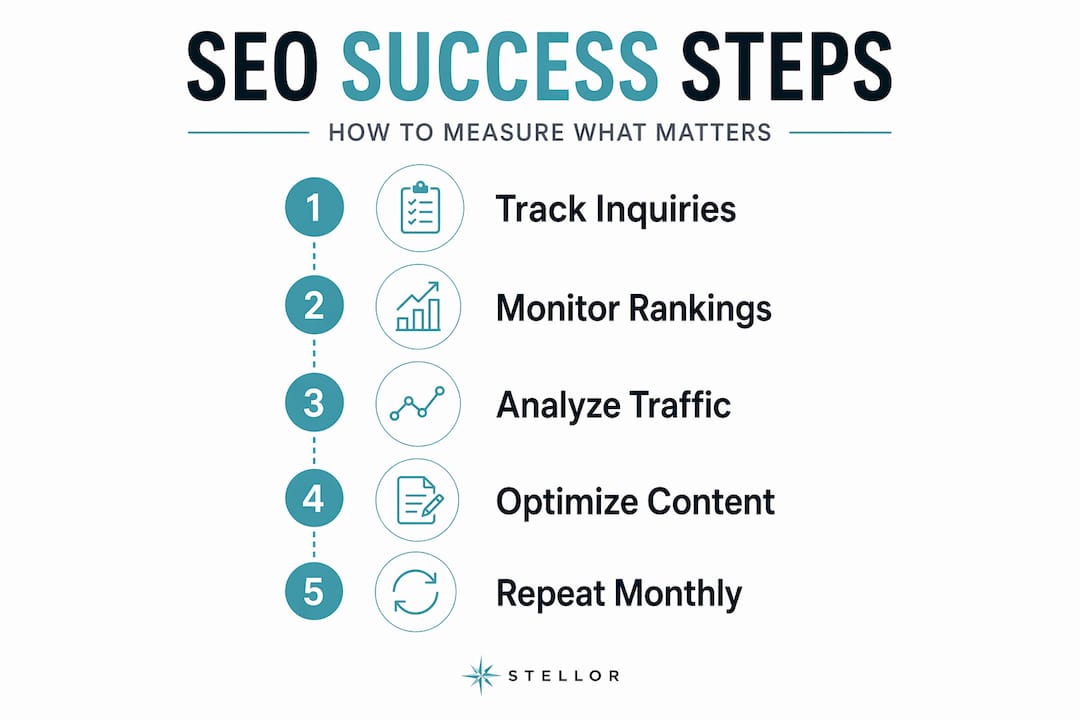
Avoid the common trap of checking rankings daily and making changes too fast. SEO is a longer game. Give new content at least 60 to 90 days before deciding it isn’t working. The practices that win are the ones who stay consistent and make small, data-informed adjustments rather than overhauling their strategy every few weeks.
My honest take on what actually moves the needle
I’ve worked through enough healthcare SEO situations to say with confidence that the biggest wins are rarely the most technical ones. The practices that see the sharpest growth in patient inquiries are almost always the ones that fix two specific things: their response speed and their content specificity.
In my experience, most practice websites try to sound authoritative by staying vague. “We offer high-quality, patient-centered orthopedic care” says nothing. “We perform outpatient ACL reconstruction with same-week MRI coordination and average return-to-sport timelines of 6 to 8 months” says everything a patient needs to hear. That specificity is what earns rankings and trust at the same time.
The speed-to-lead gap is even more common. I’ve seen practices invest seriously in SEO, generate real inquiry volume, and then lose 60% of those leads because no one followed up until the next business day. That’s not an SEO problem. It’s a process problem that makes your SEO investment irrelevant.
My take on GEO and AI search is that it’s not optional anymore. With over 40 million people using AI daily for health questions, the practices that get cited in AI answers will have a significant visibility advantage within 12 months. Start structuring your content for AI readability now, before your competitors do.
The good news is that you don’t need five vendors and a $10,000 monthly budget to execute well. You need a consistent publishing cadence, clean technical fundamentals, an active GBP, and a fast follow-up process. The practices that commit to those four things see measurable results. Everything else is refinement.
— Cole
How Stellor helps healthcare practices grow inquiries faster
If everything in this guide sounds like the right plan but the execution feels like it requires more time and budget than you have, that’s exactly the problem Trystellor was built to solve.
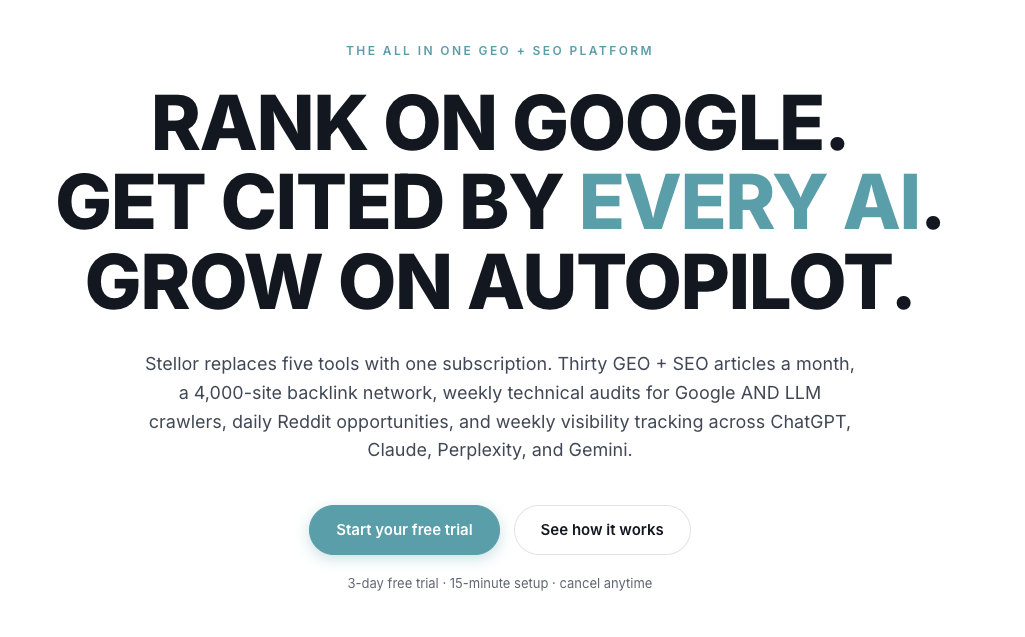
Stellor replaces five separate vendors with one platform at $199 per month. It publishes 30 GEO and SEO-optimized articles to your site every month, each structured with schema markup and AI-readable formatting. It builds your backlink authority through a 4,000-site network, runs weekly technical audits with one-click fixes, surfaces daily Reddit opportunities to build your reputation in the communities AI tools cite, and tracks your citation presence across ChatGPT, Claude, Perplexity, and Gemini weekly. Healthcare practices benefit from the built-in review workflow that keeps every published asset compliant before it goes live. Explore what the Stellor platform can do for your practice, and start your three-day free trial with no credit card required.
FAQ
How long does SEO take to increase patient inquiries?
SEO for medical practices typically takes 3 to 6 months to meaningfully impact rankings and inquiry volume. Paid ads deliver immediate leads but stop the moment spending stops, while SEO compounds and builds authority over time.
What’s the most important local SEO factor for healthcare?
Your Google Business Profile is the single highest-impact local SEO asset. A fully completed profile with consistent NAP data, regular posts, and active review management directly drives calls and map pack visibility.
How do AI search engines affect patient inquiry growth?
AI health queries grew 527% year-over-year, with over 230 million weekly health questions processed globally. Practices with GEO-optimized content get cited in AI answers, generating leads that convert at rates around 27%.
Why are my SEO leads not converting to appointments?
The most common cause is slow follow-up. Contacting a web inquiry within 5 minutes makes you up to 100 times more likely to book that patient. Pair fast response with a short booking form and real-time availability to maximize conversions.
Do reviews really affect how many patient calls I get?
Yes, directly. A clinic with 200 reviews averaging 4.7 stars receives significantly more calls than a competitor with fewer, lower-rated reviews, even when both appear at the same map pack position. Review volume and recency are active local ranking signals.