TL;DR:
- Modern SEO for AI search requires fixing technical issues, creating authoritative content, and tracking AI citations beyond traditional rankings. Focusing on crawlability, trust signals, structured data, and measuring AI mentions ensures visibility in generative AI platforms. Implementing these strategies alongside tools like Stellor maximizes AI-driven lead generation and digital authority.
Most digital marketers built their SEO playbooks for a world where Google returned ten blue links and winning meant landing in position one. That world still exists, but it now shares territory with ChatGPT, Perplexity, Claude, and Gemini. When a buyer asks one of those platforms “who’s the best contract attorney in Denver,” your rankings in Google don’t automatically translate to a citation. To modernize legacy SEO strategy for AI search, you need to fix the technical foundation, rethink how content is structured, and measure things that didn’t exist as KPIs two years ago. This guide walks you through exactly how to do that, grounded in Google’s official 2026 AI optimization guidance.
Table of Contents
- Key Takeaways
- Modernize Legacy SEO Strategy for AI Search: Start with Technical Health
- Transforming your content strategy for AI search intent
- Building trust signals and structured data that AI engines recognize
- Avoiding pitfalls and measuring what actually matters
- My perspective on getting AI SEO right
- Ready to modernize your SEO? Stellor makes it autopilot.
- FAQ
Key Takeaways
| Point | Details |
|---|---|
| Technical health comes first | Fix crawlability and redirect chains before rewriting a single page of content. |
| Content must be non-commodity | Add original data, expert perspective, and direct answers to stand out in AI-generated responses. |
| Trust signals drive citations | Author bios, reviews, and last-updated dates influence whether AI engines quote your content. |
| Structured data helps but isn’t magic | Schema improves rich result eligibility yet won’t compensate for thin or inaccessible content. |
| Measure AI visibility directly | Track citations, referrals, and assisted conversions from AI platforms alongside traditional rankings. |
Modernize Legacy SEO Strategy for AI Search: Start with Technical Health
Before you change a single headline or publish a new content cluster, get your technical house in order. Crawl and index eligibility is the gating factor for AI retrieval. If Google or an AI crawler can’t access and understand your page, no amount of content optimization will get you cited.
Most legacy sites carry years of accumulated technical debt. Redirect chains are the most common offender. A URL that was moved three times now routes through three separate 301 redirects before landing on the destination. Each hop bleeds authority and burns crawl budget. The fix: audit all redirects, then collapse each chain into a single direct redirect from the original URL to the final destination. Redirect loops and chains waste crawl budget and damage user experience in ways that compound over time.
Here’s a quick reference for the technical checks that matter most when you’re preparing for AI-ready SEO:
| Issue | What to check | Why it matters |
|---|---|---|
| Redirect chains | More than one hop between original and destination URL | Dilutes authority and crawl efficiency |
| Broken canonical tags | Canonical pointing to a different domain or a 404 | Confuses indexing signals for AI and Google |
| Slow page speed | Core Web Vitals score below 75 | Hurts eligibility for AI Overviews and rich results |
| Poor mobile rendering | Content hidden or clipped on mobile | Reduces crawlability and user experience scores |
| Missing semantic HTML | No H1, poor heading hierarchy, unstructured content | Makes AI extraction of key answers harder |
The checklist approach works here. Inventory, map, and test redirects before touching content so that migrations don’t undo the work you’re doing on quality. Semantic HTML is equally critical. AI systems parse heading structure to extract direct answers. If your page buries a direct answer inside a wall of unsectioned paragraphs, an LLM will skip it for a competitor whose content is cleaner.
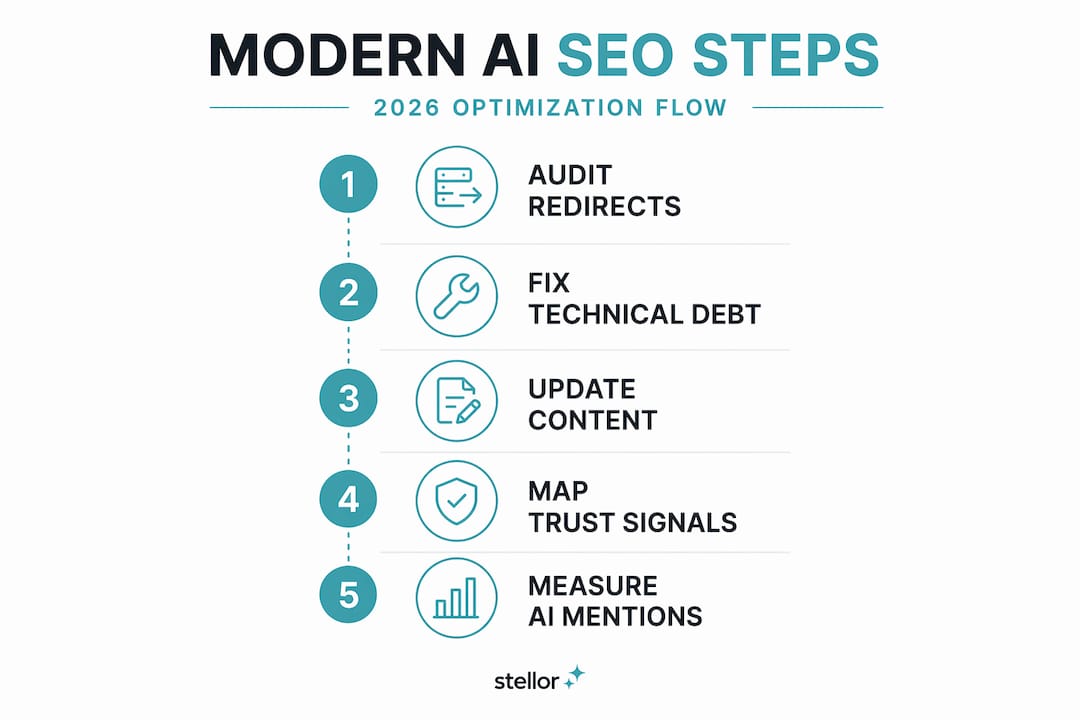
Pro Tip: Run a crawl audit using a tool like Screaming Frog or Sitebulb before any content rewrite campaign. Specifically look for redirect chains longer than one hop and canonical tags pointing to non-canonical URLs. Fixing these takes hours but protects months of content investment.
Transforming your content strategy for AI search intent
Optimizing for generative AI is, at its core, still SEO. Google is explicit that its generative AI features build on the same ranking systems that have always evaluated content quality, authority, and relevance. That’s reassuring because it means you’re not starting over. You’re updating the playbook, not discarding it.
Here’s what content transformation actually looks like in practice:
-
Identify real intent, not just keywords. A search for “best HVAC maintenance schedule” isn’t asking for a keyword-stuffed FAQ. It’s asking for a practical, expert answer. Map each target keyword to a specific buyer question before you write a word.
-
Put the direct answer near the top. AI systems scan content to extract concise answers. If your response to the question lives in paragraph eight, a competitor whose answer is in paragraph one will get cited instead. Lead with the answer, then support it with context and detail.
-
Add what commodity content can’t. Non-commodity content means real data, original case studies, expert opinions, and audience-specific context. Generic tips that appear on 200 other pages won’t surface in AI responses. If you run a law firm, cite a real case outcome. If you run a marketing agency, share a specific client result with numbers attached.
-
Build content clusters, not isolated posts. A single article on “local SEO” won’t build topical authority. A cluster covering local SEO fundamentals, Google Business Profile optimization, review strategy, citation building, and AI visibility for local businesses signals to both Google and AI engines that you’re a credible source across the entire topic.
-
Stop chasing long-tail AI hacks. Keyword stuffing doesn’t work for Google. Stuffing content with AI-specific question variants doesn’t work for LLMs either. Write for people, structure for machines.
Pro Tip: Use AI tools to generate research summaries, content outlines, and gap analysis. Then bring in a human expert to add original data, real examples, and opinions that the AI couldn’t produce on its own. Mass-producing AI content without that human layer accelerates mediocrity at scale.
One more tactic that’s underused: place location-specific and service-specific context inside content that would otherwise read as generic. An article about contract law that references Dallas’s specific court procedures is more likely to be cited when someone in Dallas asks an AI for a contract attorney recommendation. Specificity is the signal that generalist AI-generated content can’t replicate.
You can also explore how AI search affects local visibility to understand how these content principles apply at the local level.
Building trust signals and structured data that AI engines recognize
Trust signals are the plumbing behind your digital presence. Readers don’t always notice them consciously, but they influence both human click behavior and AI citation decisions. Visible trust signals like author credentials, customer reviews, certifications, and last-updated dates tell AI engines that content is authoritative and current.
Here’s what actually moves the needle:
- Author bios with credentials. A post credited to “John Smith, CPA with 12 years of tax litigation experience” carries more weight than one credited to “Staff Writer.” Google’s Quality Rater Guidelines and AI systems both assess authorship. Name, credentials, and a photo are the minimum.
- Last-updated dates. Freshness matters for AI citations. An article last updated in 2022 will lose to an equivalent article updated in 2025 when an AI is deciding which source to quote.
- Customer reviews and case studies on relevant pages. Don’t silo reviews to a single testimonials page. Embed them in service pages where they reinforce the specific claim being made.
- Professional certifications and affiliations. A badge from a recognized industry body on a service page gives both human readers and AI systems an additional trust signal.
- Internal consistency between schema and visible content. Mismatched schema, where the markup says one thing and the page says another, creates trust issues that can suppress visibility.
Structured data helps with rich result eligibility but isn’t mandatory for AI search visibility. Don’t treat schema as a shortcut. It amplifies content that’s already strong. It doesn’t rescue content that’s weak.
Pro Tip: Map your trust signals to specific page intents. A product comparison page needs pricing transparency and review counts. A service page needs certifications and case studies. A blog post needs author credentials and a clear published or updated date. Each page type has different trust requirements.

For businesses in regulated industries like healthcare, legal, or financial services, trust signals aren’t optional. They’re what separates content that gets cited from content that gets filtered.
Avoiding pitfalls and measuring what actually matters
One of the fastest ways to waste a year’s worth of SEO effort is to chase AI-specific hacks that don’t hold up. Google directly cautions against AEO and GEO hacks like gaming llms.txt files, aggressive content chunking for AI retrieval, and manufacturing inauthentic mentions. These tactics produce short-term noise and long-term damage to your credibility.
The measurement problem is equally serious. Most legacy SEO dashboards report keyword rankings and organic sessions. Both metrics have real blind spots now. A page can lose ranking position while gaining AI citations that drive qualified leads. Conversely, you can hold your rankings while your competitors are getting cited in ChatGPT answers for every query your buyers are asking.
What to track instead:
- AI citations and mentions. How often does your brand appear when a buyer asks an AI platform for a recommendation in your category?
- AI-assisted conversions. GA4 can capture some of this through referral source tagging when visitors click through from Perplexity or other AI engines.
- Lead quality by channel. AI-referred visitors often convert at higher rates because they arrived with a specific recommendation in hand.
- Competitor citation share. Who else is being cited when your brand isn’t? That gap is your opportunity map.
Measuring AI mentions and qualified traffic ties SEO work to business outcomes in a way that rankings alone can’t. It’s the difference between reporting that you moved from position four to position three and reporting that AI citations drove 40 new qualified leads last month.
Pro Tip: Align your SEO, content, PR, and analytics teams around a shared measurement framework that includes AI visibility metrics. Siloed reporting means AI citation wins go unattributed and decisions get made on incomplete data. You can also use local SEO optimization guidance to extend this framework to service-area businesses.
One concrete step: query ChatGPT, Claude, and Perplexity monthly with the exact prompts your buyers use. “Best [your service] in [your city].” Record the results in a spreadsheet. That’s your baseline. Now you have something to improve against.
My perspective on getting AI SEO right
I’ve talked with enough digital marketing teams to know the biggest mistake isn’t a technical one. It’s treating AI SEO as an entirely separate discipline that requires a separate playbook.
It doesn’t. What I’ve seen work consistently is the same thing that’s always worked: technically clean sites, authoritative content, and real trust signals. The teams that sprint to implement every new AI-specific tactic, whether that’s aggressive llms.txt configurations or mass-producing content designed to hit AI retrieval patterns, almost always burn resources on things that don’t compound.
What I’ve learned is that crawl and index integrity is the single biggest leverage point most businesses are ignoring. I’ve seen sites doing everything right on content and still getting zero AI citations because a redirect chain buried three pages deep was creating indexing gaps. Fixing that one issue unlocked visibility that months of content work couldn’t.
Redirect migrations specifically deserve more respect. Most teams treat them as a dev task. They’re a strategic SEO decision. Getting them wrong during a site rewrite or platform migration can cost you rankings that took years to build, and those losses show up in AI citation rates just as fast as they show up in Google traffic.
The trust signal piece surprised me too. I expected technical improvements to have the biggest impact. In practice, adding credentialed author bios and updated dates to existing pages moved citation rates faster than new content in several cases I’ve tracked. AI engines genuinely weight freshness and authorship. That’s a fast win most teams leave on the table.
— Cole
Ready to modernize your SEO? Stellor makes it autopilot.
If this article mapped out the strategy, Stellor executes it. At $199 per month, Stellor’s GEO + SEO platform replaces five separate vendors: content production, backlink building, technical SEO auditing, Reddit engagement, and AI visibility tracking across ChatGPT, Claude, Perplexity, and Gemini. You get 30 fully optimized articles per month, a 4,000-site backlink network, weekly technical audits with one-click fixes, and weekly LLM visibility reports showing exactly where you’re being cited and where competitors are winning instead.
The free AI Visibility Audit benchmarks your current citation status across 25 buyer prompts and maps the gap between where you are and where you should be. No credit card required. The audit is yours to keep. Start your 3-day free trial and see exactly which AI prompts your business should be winning right now.
FAQ
What does it mean to modernize legacy SEO for AI search?
It means updating your technical foundation, content structure, and measurement approach so your site is eligible for both traditional Google rankings and AI-generated citations in platforms like ChatGPT and Perplexity. The core SEO principles haven’t changed, but the execution requirements have expanded.
Does structured data improve AI search visibility?
Structured data improves eligibility for rich results in Google but is not required for AI answer engines to cite your content. Strong, accessible, authoritative content matters more than schema markup alone.
How do I know if AI engines are citing my business?
Query ChatGPT, Claude, and Perplexity directly using the prompts your buyers actually type, such as “best [service] in [city].” Record which businesses get cited. Repeat monthly to track changes. Platforms like Stellor automate this across 25 buyer prompts with weekly reporting.
What’s the biggest mistake businesses make when updating SEO for AI?
Chasing AI-specific hacks like aggressive llms.txt configuration or mass-producing thin AI-written content without expert review. Google explicitly cautions against these tactics. Technical health and content quality produce durable results. Gimmicks don’t.
How should I measure AI-driven SEO success?
Track AI citations, AI referral traffic in GA4, lead quality by source, and competitor citation share alongside traditional metrics like rankings and organic sessions. AI mentions and qualified traffic give you a clearer picture of actual business impact than keyword positions alone.