TL;DR:
- Google’s E-E-A-T framework for content quality now heavily influences rankings and AI citations in 2026.
- Building verified author profiles, firsthand experience content, and trust signals are key to improving visibility.
E-E-A-T is defined as Google’s framework for evaluating content quality through four signals: Experience, Expertise, Authoritativeness, and Trustworthiness. For EEAT SEO 2026, these signals now carry measurable weight in Google’s ranking algorithms, particularly for Your Money or Your Life (YMYL) queries, and they directly influence whether AI platforms like ChatGPT and Gemini cite your content. Understanding this framework is the difference between ranking and being invisible.
What does each EEAT component mean under 2026 guidelines?
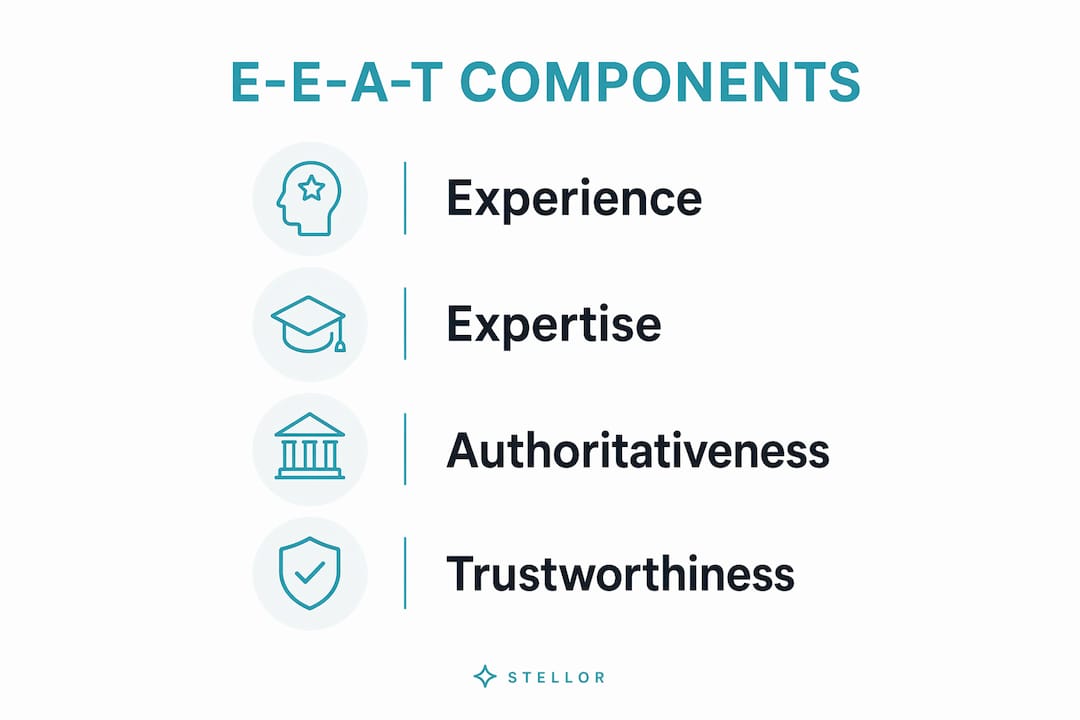
Google’s 2026 Quality Rater Guidelines define each E-E-A-T component with more precision than earlier versions. Each one signals something distinct, and conflating them leads to wasted effort.
Experience is the newest addition to the framework. It requires firsthand involvement with the topic, not just knowledge of it. A financial advisor who documents real client outcomes demonstrates experience. A site that publishes generic money advice does not. Google’s raters look for original data, screenshots, and outcome evidence that only someone who has done the work could provide.
Expertise refers to verified knowledge at the appropriate level for the topic. A medical article needs a licensed clinician. A home improvement guide needs a credentialed contractor. Google’s 2026 guidelines calibrate the required expertise level to the stakes of the topic, not just the subject matter.
Authoritativeness is your reputation in the eyes of others. Backlinks from reputable sources and external mentions of your authors and site raise this signal. You cannot manufacture authoritativeness through internal claims. It has to be earned through citations, press coverage, and third-party validation.
Trustworthiness is the most foundational signal. Site-level trust signals like a clear About Us page, visible contact information, and disclosed ownership directly affect how raters score your site. HTTPS, a published privacy policy, and editorial transparency round out the picture.
Google’s September 2025 updates expanded YMYL categories to include government, elections, and civic trust topics. That expansion means more content now faces the highest scrutiny tier, not just health and finance.
Pro Tip: Review your site against Google’s Quality Rater Guidelines self-assessment questions at least once per quarter. They are publicly available and give you the exact criteria raters use.
How do EEAT signals impact SEO rankings and AI visibility in 2026?
E-E-A-T signals are not a direct ranking factor. There is no E-E-A-T score in Google’s algorithm. Instead, the framework guides human Quality Raters, whose assessments train the machine learning systems that do influence rankings. The distinction matters because it means you cannot game a single metric.

The correlation data from june 2026 is specific: E-E-A-T signals account for approximately 8% of ranking weight overall. For YMYL queries, that figure rises to 24%. That gap tells you where to concentrate your effort first.
The march 2026 core update raised the stakes further. Google integrated AI detection and authorship verification as baseline requirements for E-E-A-T compliance. Sites without verifiable author identities saw measurable ranking drops in health, finance, and legal categories.
AI platforms compound the effect. ChatGPT, Gemini, and Perplexity pull from sources they assess as authoritative and trustworthy. A site with strong E-E-A-T signals is more likely to be cited in AI-generated answers. A site without them gets passed over, even if the content is technically accurate.
The practical implication is clear:
- YMYL content without verified authorship faces the highest risk of ranking loss
- AI citation rates correlate with the same trust signals Google’s raters evaluate
- Authorship verification is now a baseline requirement, not a best practice
- Human rater assessments and algorithmic signals reinforce each other over time
What practical strategies can digital marketers implement to optimize for EEAT in 2026?
Building genuine E-E-A-T signals requires a structured approach. These tactics address each component directly.
-
Build verified author profiles. Create dedicated author pages with credentials, professional history, and links to external profiles like LinkedIn or published work. Structured author pages with verifiable credentials show measurable ranking improvements after the march 2026 update. Add Person schema markup to every author page so Google can parse the identity programmatically.
-
Publish firsthand experience content. Include original data, real project outcomes, and specific details that only someone with direct experience could provide. A roofing company that documents actual job photos, material costs, and client results signals experience in a way that generic advice cannot. For local service businesses, this approach is especially effective, as shown in measurable SEO results from companies that document real work outcomes.
-
Strengthen site-level trust signals. Your About page, contact information, and ownership disclosure are evaluation points in Google’s Quality Rater Guidelines. Trustworthiness requires HTTPS, a clear privacy policy, and editorial transparency. These are not optional for YMYL topics.
-
Cite authoritative external sources. Link out to peer-reviewed research, government data, and recognized industry bodies. Outbound citations signal that your content is grounded in verified information, not isolated opinion.
-
Keep content current. Outdated content loses trust signals over time. Schedule quarterly reviews for your highest-traffic pages and update statistics, examples, and references to reflect current conditions.
-
Use structured data to clarify identity. Schema markup for Organization, Person, Article, and FAQPage helps both Google and AI crawlers understand who created the content and what it covers. This is the technical layer that makes your E-E-A-T signals machine-readable.
Pro Tip: For home services businesses, workforce vetting documentation and contractor credentials are direct evidence of expertise. Publishing this information on your site, as outlined in plumbing workforce vetting practices, gives Google’s raters concrete proof of qualifications.
What common pitfalls and misconceptions about EEAT SEO should be avoided?
The most damaging misconception is treating E-E-A-T as a checklist. Adding a short author bio or switching to HTTPS does not satisfy the framework. Google’s raters evaluate the totality of your site’s credibility, not individual boxes checked.
- Superficial author bios fail. A name and a stock photo do not constitute verifiable credentials. Raters look for external validation: published work, professional affiliations, and links to recognized profiles. A bio without any of these signals is worse than no bio because it draws attention to the gap.
- Comprehensive but impersonal content underperforms. Firsthand experience content with original data outperforms exhaustive but generic coverage. A 5,000-word guide written by an anonymous team ranks below a 1,500-word article written by a named expert with documented outcomes.
- AI-generated content is not a substitute for experience. Google does not penalize AI-assisted content as a category, but it rewards genuine firsthand experience. Using AI to produce content that lacks original insight or verifiable authorship creates the exact gap raters are trained to identify.
- Ignoring YMYL standards is high-risk. If your content touches health, finance, legal advice, or now civic and government topics, the trust bar is significantly higher. Applying general content standards to YMYL topics is the fastest way to lose rankings after a core update.
- Treating E-E-A-T as a one-time project. The march 2026 update demonstrated that algorithm changes can shift the goalposts. Sites that built E-E-A-T signals once and stopped auditing lost ground to competitors who maintained ongoing compliance.
How to audit and measure EEAT signals effectively in 2026?
Auditing E-E-A-T requires a structured review across four dimensions. No single tool produces an E-E-A-T score, so you build the picture from multiple data points.
| Audit area | What to check | Signal it measures |
|---|---|---|
| Author identity | Author pages, Person schema, external profile links | Expertise, Experience |
| Site trust | HTTPS, About page, contact info, privacy policy | Trustworthiness |
| External authority | Backlink profile, author mentions, press coverage | Authoritativeness |
| Content freshness | Last-updated dates, accuracy of statistics, current examples | Trustworthiness, Experience |
| Structured data | Schema completeness, Article markup, FAQPage markup | All four signals |
Start with Google’s Quality Rater Guidelines self-assessment questions. They are the closest proxy to how raters actually evaluate your site. Work through the questions for your five highest-traffic pages and note every gap.
For authoritativeness, track your backlink profile monthly. Backlinks from reputable sources and external author mentions are the primary signals. A growing profile of relevant, editorial links indicates improving authority. A flat or declining profile signals stagnation.
For content freshness, set calendar reminders for quarterly reviews of your top pages. Update statistics, replace outdated examples, and add new firsthand evidence where possible. For blog promotion strategies that build external citation, consistent content distribution through channels like effective blog promotion increases the likelihood of earning the external mentions that raise authoritativeness.
Pro Tip: Run a structured data validation check using Google’s Rich Results Test after every major content update. Schema errors silently undermine the machine-readable signals that support your E-E-A-T profile.
Key Takeaways
Winning at EEAT SEO 2026 requires verified authorship, firsthand content evidence, site-level trust signals, and consistent auditing across all four E-E-A-T dimensions.
| Point | Details |
|---|---|
| E-E-A-T is not a direct ranking factor | It guides Quality Rater assessments that train the algorithms influencing your rankings indirectly. |
| YMYL content faces the highest scrutiny | E-E-A-T signals account for 24% of ranking weight for YMYL queries, versus 8% overall. |
| Authorship verification is now baseline | The march 2026 update made verifiable author identity a compliance requirement, not a recommendation. |
| Firsthand experience outperforms generic depth | Original data and documented outcomes rank above comprehensive but impersonal content. |
| Auditing must be ongoing | Algorithm updates shift the requirements; quarterly reviews keep your signals current and competitive. |
Why I think most marketers are still misreading EEAT in 2026
The early 2026 core updates revealed something most marketers were not prepared for. Sites that had invested heavily in content volume without building author identity lost rankings fast. Sites with thinner content but verified, credentialed authors held their positions. That pattern tells you something important: Google is not rewarding effort. It is rewarding proof.
The shift I find most significant is the treatment of author identity as ranking infrastructure. A year ago, an author bio was a nice-to-have. Now it is the foundation the rest of your content sits on. If your authors are not verifiable entities with external profiles and documented expertise, your content is effectively anonymous in Google’s eyes, regardless of how thorough it is.
The other observation worth sharing is that AI platforms are accelerating this dynamic. When ChatGPT or Gemini generates a recommendation, it draws from sources it can verify as credible. Anonymous content does not get cited. Named, credentialed, externally validated content does. The same signals that satisfy Google’s Quality Raters are the signals that get you cited by AI. That alignment is not a coincidence. It reflects a shared definition of trustworthy information.
My honest advice: treat your author pages with the same seriousness you give your service pages. Build them out, link them to external profiles, add schema markup, and update them when credentials change. That single investment pays dividends across both traditional search and AI visibility. You can get a deeper grounding in how this plays out in practice through the E-E-A-T guide for marketers on the Trystellor blog.
— Cole
How Trystellor supports your EEAT SEO strategy in 2026
Trystellor is built for exactly the challenge this article describes: maintaining E-E-A-T signals across traditional search and AI platforms without managing five separate tools.
The platform publishes 30 SEO and GEO-optimized articles per month to your CMS, each with schema markup, author identity configuration, and llms.txt setup that makes your content readable by both Googlebot and AI crawlers. Its 4,000-site backlink network builds the external authority signals that raise authoritativeness over time. Weekly technical audits flag schema gaps, missing trust signals, and content freshness issues before they cost you rankings. Trystellor’s SEO platform starts at $199 per month with a three-day free trial and no credit card required. See the full capability set at trystellor.com.
FAQ
What is E-E-A-T in SEO?
E-E-A-T stands for Experience, Expertise, Authoritativeness, and Trustworthiness. It is Google’s framework for evaluating content quality, used by human Quality Raters to assess pages and train the algorithms that influence rankings.
Is E-E-A-T a direct Google ranking factor?
No. There is no E-E-A-T score in Google’s algorithm. It is a conceptual framework that guides Quality Rater judgments, which in turn influence the machine learning systems that affect rankings indirectly.
How much does E-E-A-T affect rankings for YMYL content?
E-E-A-T signals account for approximately 24% of ranking weight for YMYL queries in 2026, compared to 8% for general content. Health, finance, legal, and civic topics face the highest scrutiny.
Does AI-generated content hurt E-E-A-T?
Google does not penalize AI-assisted content as a category. It rewards genuine firsthand experience and verified authorship. AI content without original insight or a named, credentialed author fails to satisfy the Experience and Expertise signals raters evaluate.
How do I start building E-E-A-T signals for my site?
Begin with verified author pages that include credentials, external profile links, and Person schema markup. Add site-level trust signals including HTTPS, a clear About page, and a published privacy policy. Then build external authority through editorial backlinks and consistent content that documents firsthand experience.