TL;DR:
- Energy efficiency content SEO integrates search optimization and digital sustainability to improve rankings while reducing a website’s energy footprint. Focusing on technical performance, semantic depth, and authoritative structured data enhances visibility in both traditional search and AI answer engines, making sites faster, more relevant, and more citable. Implementing consolidation, schema markup, and green hosting strategies increases organic traffic, AI citations, and environmental responsibility simultaneously.
If you’re creating content about energy efficiency and wondering why it isn’t ranking, the problem is rarely the writing. Understanding what is energy efficiency content SEO means recognizing that it sits at the intersection of two separate disciplines: search optimization and digital sustainability. Traditional SEO gets you partway there. But energy content has unique demands, from highly specific user intent to the growing pressure to build websites that consume fewer server resources. This article covers the definitions, the technical moves, the content strategy, and how AI-driven search is changing the rules entirely.
Table of Contents
- Key takeaways
- What energy efficiency content SEO actually means
- Technical optimizations that serve SEO and sustainability
- Content strategy for energy efficiency topics
- How GEO is reshaping energy content visibility
- My honest take on combining these strategies
- How Trystellar simplifies energy content SEO
- FAQ
Key takeaways
| Point | Details |
|---|---|
| Green SEO matters | Faster, leaner sites rank better and consume less energy, making performance a dual-purpose priority. |
| Content quality over volume | Updating existing pages beats publishing thin new ones for both authority and server efficiency. |
| GEO is the new frontier | AI answer engines like ChatGPT and Perplexity cite structured, authoritative content over keyword-dense pages. |
| Schema markup is non-negotiable | Structured data helps both Google and AI systems understand and quote your energy content accurately. |
| Search intent drives rankings | Long-tail, specific queries around energy efficiency tips convert better and align with how AI delivers answers. |
What energy efficiency content SEO actually means
Energy efficiency content SEO is the practice of optimizing energy-related web content to rank in search engines while simultaneously reducing the digital carbon footprint of the site delivering that content. Most people hear “SEO for energy content” and assume it just means writing blog posts with the right keywords. That’s only a fraction of the picture.
The concept draws from two converging ideas. First, there’s the content side: creating pages about topics like solar installation, smart thermostats, or home insulation that match what real people search for and serve their intent completely. Second, there’s the Green SEO side: building and maintaining a website that performs efficiently enough to lower its own energy demand on data centers and servers.
Here’s why this convergence matters for you. Faster, efficient websites reduce energy consumption and improve both user experience and search rankings simultaneously. Google’s Core Web Vitals already factor page speed and load performance into rankings. When you optimize for speed, you’re not just chasing a ranking signal. You’re lowering the energy cost of every page visit.
The content piece matters just as much. Over 60% of traffic to Department of Energy innovation sites comes from search engine referrals. If your energy content isn’t structured to capture that traffic, you’re leaving a massive channel untapped.
Key principles that define this discipline:
- Search visibility: Content structured around queries real users type about energy savings, utility costs, and home efficiency
- Semantic depth: Pages that cover a topic thoroughly enough that AI models recognize your site as an authoritative source
- Technical performance: Clean code, fast load times, and minimal server overhead that reduce digital energy use
- Content longevity: Pages designed to stay relevant with periodic updates rather than constant new creation
Pro Tip: Think of your website’s performance and your content quality as two sides of the same coin. Improving one without the other leaves you with a fast site nobody finds, or a well-ranked site that burns unnecessary server energy on every visit.
Technical optimizations that serve SEO and sustainability
This is where most content marketers stop paying attention, and it’s a mistake. The technical layer of your website is like the plumbing behind the walls of your digital presence. You don’t see it, but it determines how efficiently everything runs.
Image and asset optimization
Images are typically the heaviest assets on any page. Switching to modern formats makes a measurable difference. WebP files are roughly 30% smaller than JPEGs at the same visual quality. AVIF compresses even further. Combine format changes with lazy loading, which delays loading off-screen images until the user scrolls to them, and you reduce the initial page weight significantly. Less data transferred means fewer server cycles burned per visit.

Site architecture and crawl efficiency
Removing redundant pages and consolidating content reduces crawl budget waste and server load at the same time. If you have fifteen thin blog posts about “energy efficient windows,” Google’s crawler visits all fifteen. That burns crawl budget, dilutes authority across too many URLs, and wastes server resources on every bot request. Consolidate them into one thorough resource, and you fix all three problems.
Clean URL structures also help. Short, descriptive URLs with no unnecessary parameters reduce the cognitive load on crawlers and make internal linking cleaner. Every unnecessary redirect adds a server round-trip.
Hosting and infrastructure choices
Here’s a direct comparison of the hosting decisions that affect both your SEO performance and your energy footprint:
| Factor | Traditional shared hosting | Performance-optimized / green hosting |
|---|---|---|
| Page speed | Variable, often slow under traffic | Consistent, fast with edge caching |
| Server energy use | High, idle resources often on | Optimized or renewable-powered |
| Core Web Vitals score | Frequently fails LCP thresholds | Regularly meets Google’s benchmarks |
| Crawl efficiency | Slow responses waste crawler time | Fast responses maximize crawl budget |
| SEO impact | Indirect negative from slow TTFB | Positive through speed signals |
Sustainable hosting providers use renewable energy or carbon offsets. Moving to one is both an environmental decision and a practical SEO decision, because server response time directly affects Time to First Byte (TTFB), which Google measures.
Pro Tip: Run a free Core Web Vitals check through Google Search Console before you do anything else. It shows exactly which pages are failing performance thresholds and gives you a prioritized list of fixes. Start with your highest-traffic energy content pages first.
Content strategy for energy efficiency topics
Getting the technical side right creates the foundation. What you build on top of it determines whether you actually rank and get cited.
Here’s a numbered approach for building a content strategy specifically for energy efficiency topics:
-
Audit what you already have. Before creating anything new, map your existing content. Identify pages covering the same topic from slightly different angles, thin posts under 500 words, and pages with zero organic traffic in the past 12 months. These are consolidation candidates.
-
Update rather than create. Maintaining and improving existing content over constant expansion is a core Green SEO principle. A well-maintained guide on home heating efficiency that gets updated quarterly outperforms five new posts on adjacent topics. It also reduces the number of pages Google needs to crawl and index.
-
Target long-tail queries with clear intent. Generic keywords like “energy efficiency” have enormous competition and vague intent. Specific queries like “how much can a smart thermostat save on heating bills” attract users ready to take action. Smart thermostats save around 8% on heating and cooling costs, and insulation saves roughly 10%. Content built around those specific numbers answers a precise question and attracts readers with purchase or decision intent.
-
Build semantic depth, not just keyword coverage. A page about home energy efficiency should cover related concepts: R-values, Energy Star ratings, HVAC efficiency ratings, utility rebates, and net metering basics. AI systems prioritize semantic density and well-defined entity relationships over keyword frequency. You’re not stuffing keywords. You’re building a knowledge structure.
-
Apply schema markup to every key page. FAQ schema, How-To schema, and Article schema all signal to search engines and AI crawlers what your content contains and how to interpret it. Schema markup helps AI and search engines understand and accurately cite content. For energy content specifically, schema around product comparisons, cost estimates, and step-by-step guides performs well.
-
Reduce redundant browsing paths. When content is well-organized and answers questions completely, users find what they need faster. Fewer page loads to get to an answer means lower server demand and a better user experience score. Both improve your local SEO optimization performance if you’re serving a specific geographic market.
The underlying logic here is simple. Less content that does more work beats more content that does less. For energy efficiency topics, a focused content library of 30 thorough, well-structured resources will consistently outperform a scattered library of 150 thin posts.
How GEO is reshaping energy content visibility
Generative Engine Optimization, or GEO, is the practice of structuring content so that AI answer engines select it when generating responses to user queries. GEO in 2026 has moved from a niche concept to a practical requirement for any business that wants to appear in ChatGPT answers, Perplexity summaries, or Google AI Overviews.
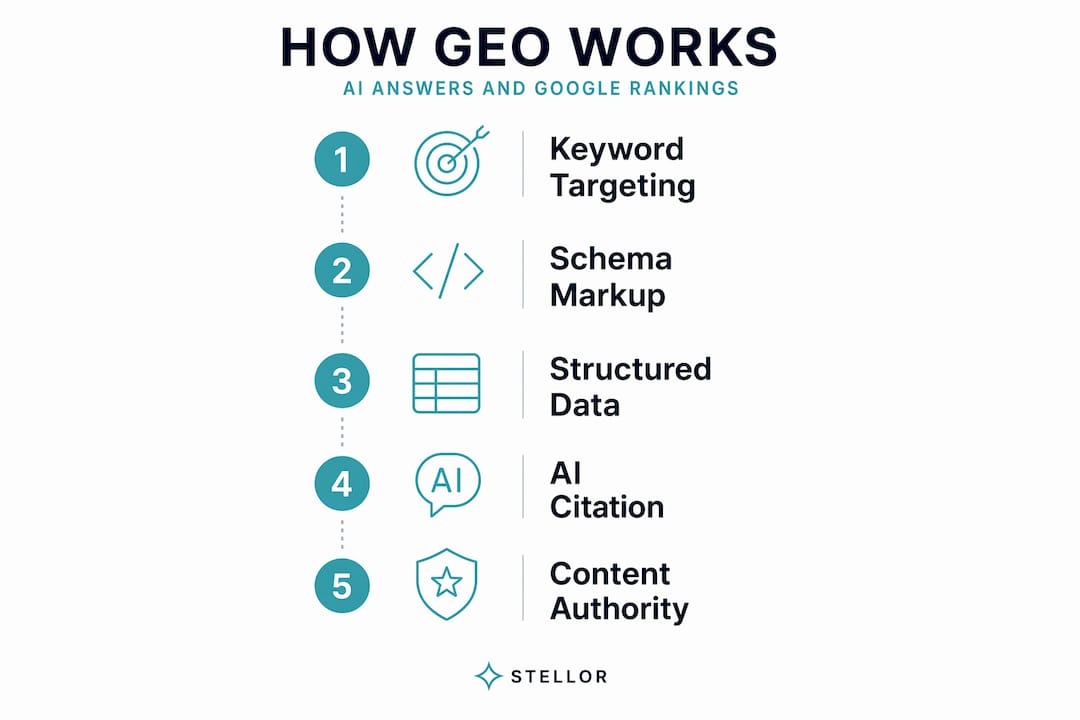
Traditional SEO targets a position on a results page. GEO targets being quoted in an AI-generated answer. The distinction matters because when someone asks ChatGPT “what are the best ways to reduce my home energy bill,” the AI doesn’t return ten blue links. It generates an answer, citing sources it considers authoritative and well-structured.
How GEO applies specifically to energy content:
- Entity recognition: Your content should clearly define what your business is, what topics it covers, and where it operates. Vague, general pages don’t get cited. Pages about “residential solar installation in Phoenix, AZ” with clear facts and figures do.
- Structured citations: AI models favor content with references, data points, and clear sourcing. Including utility cost statistics, government data references, and named standards (Energy Star, IECC codes) gives AI models citable anchors.
- Focused guides over broad overviews: Specific, well-structured content is favored by AI models for generating direct answers. A 1, 500-word guide on “how to choose the right insulation R-value for a cold climate” will be cited more often than a 3, 000-word post trying to cover all insulation topics at once.
- Authoritative backlink profile: Brands recognized as authoritative entities with structured content get cited by AI, marking the evolution beyond keyword rankings.
“The shift from SEO to GEO isn’t about abandoning what works. It’s about recognizing that being findable and being citable are now two separate goals that require two separate strategies, and the businesses winning in energy content are pursuing both at once.”
A practical hybrid approach: keep building keyword-targeted content for Google rankings, and layer in schema markup, topical depth, and authoritative citations to simultaneously qualify for AI citations. For GEO applied to home services, the combination of local intent and structured data is particularly powerful.
My honest take on combining these strategies
I’ve watched content marketers treat SEO as a purely technical checklist for years. Add keywords, get backlinks, done. What I’ve found is that the marketers who see the biggest gains in energy-related content are the ones who treat performance, content quality, and AI readiness as a single integrated practice rather than three separate workstreams.
The misconception I keep seeing is that sustainability and SEO are competing priorities. They’re not. In my experience, every time a team has cleaned up crawl bloat, consolidated thin pages, and switched to faster image formats, their rankings improved within 60 to 90 days. The energy saving was a byproduct of doing SEO correctly.
What I’ve also learned is that GEO requires a mindset shift that most content teams aren’t making yet. They’re still writing for Google’s crawler, not for an AI that needs to trust your content enough to quote it directly. Getting ahead of that shift in the energy sector, where authoritative, data-backed content is scarce, is a real competitive advantage right now.
My advice: start with a technical audit of your site’s performance, consolidate your weakest content, apply schema to your best pages, and then build a backlink strategy that establishes topical authority. Do that consistently, and both your rankings and your AI citation rate will move.
, Cole
How Trystellar simplifies energy content SEO
Managing technical audits, content production, backlink building, and AI citation tracking separately is expensive and slow. Trystellor’s GEO and SEO platform puts all of it under one subscription, starting at $199 per month.

Every month, Trystellor publishes 30 SEO and GEO-optimized articles directly to your CMS, each one built around real buyer queries, complete with schema markup and internal linking designed to rank on Google and get cited by ChatGPT, Claude, Perplexity, and Gemini. A 4, 000-site backlink network builds your authority without manual outreach. Weekly technical audits catch performance issues before they cost you rankings. And the LLM visibility tracker shows you exactly which AI prompts your competitors are winning that you should be earning. For energy content specifically, the platform’s focus on topical depth and structured data makes it purpose-built for the GEO era. Try it free for three days, no credit card required, at trystellor.com.
FAQ
What is energy efficiency content SEO?
Energy efficiency content SEO is the practice of optimizing energy-related web content for search rankings while also reducing the digital carbon footprint of the site itself. It combines traditional SEO tactics with Green SEO principles like fast load times, clean code, and efficient site architecture.
How does site speed affect SEO for energy content?
Page speed is a direct Google ranking factor through Core Web Vitals, and faster sites consume fewer server resources. Improving load times with image compression and efficient hosting simultaneously boosts rankings and lowers energy use per page visit.
What is GEO and why does it matter for energy topics?
Generative Engine Optimization (GEO) focuses on making content citable by AI answer engines like ChatGPT and Perplexity, rather than just ranking in traditional search results. For energy content, structured data, topical specificity, and authoritative sourcing are the key factors AI models use to select which sources to quote.
Should I update old energy content or create new pages?
Updating and consolidating existing content is more effective than constant new creation. It builds page authority over time, reduces crawl budget waste, and lowers the server load from managing a bloated content library.
What schema markup works best for energy efficiency content?
FAQ schema, How-To schema, and Article schema are the most useful for energy topics. They help both Google and AI crawlers understand the structure and intent of your content, increasing the chance of appearing in AI-generated answers and featured snippets.