TL;DR:
- SEO results take time because search engines need to crawl, index, and evaluate content using many ranking signals. Tactical fixes like updating metadata or repairing links can boost traffic within weeks, but building authority and trust spans months to a year. Patience combined with consistent strategy and active monitoring is essential for sustainable SEO success.
SEO results take time because search engines must crawl, index, and evaluate your content against hundreds of ranking signals before assigning a position. Tactical fixes like updating metadata or repairing broken links can produce a 10–20% traffic boost in as little as 2–6 weeks. Building the authority and trust that drive sustained rankings, however, takes 6–12 months of consistent work. Understanding why SEO results take time explained properly means accepting that both timelines are real, and both require your attention.
Why SEO results take time: the core mechanics
Search engines do not rank pages the moment you publish them. Google’s Googlebot must first discover your page through crawl requests, then process and store it in the index, and finally evaluate it against competing pages using its ranking algorithm. Each stage takes time, and crawl frequency varies significantly based on your site’s authority and update history.
New sites with little authority get crawled infrequently. An established e-commerce site publishing daily might see new pages indexed within hours. A brand-new service business website might wait days or weeks before Googlebot even visits. That gap alone explains a large portion of the delay most business owners experience.
After indexing, Google’s algorithm reassesses rankings continuously. A page that enters the index does not immediately compete at full strength. It earns ranking signals gradually through user engagement, backlinks, and E-E-A-T signals (Experience, Expertise, Authoritativeness, and Trustworthiness). Think of it like the plumbing behind the walls of your digital presence. You cannot see it working, but every signal you earn is building pressure toward better positions.
Crawl and index timeline: new vs. established sites
| Site Type | Crawl Frequency | Indexing Delay | First Ranking Signal |
|---|---|---|---|
| New site (under 6 months) | Every 1–4 weeks | 1–4 weeks | 3–6 months |
| Established site (1–3 years) | Every few days | 1–7 days | 4–8 weeks |
| High-authority site (3+ years) | Daily or faster | Hours to 2 days | Days to weeks |
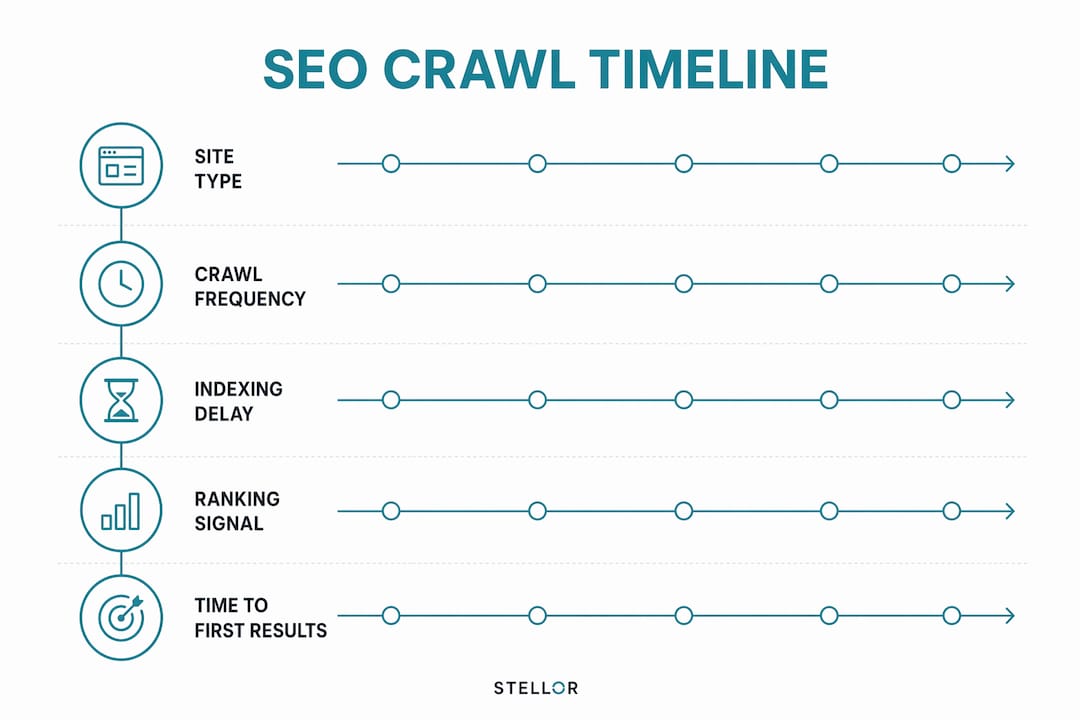
The table above shows why patience is not optional. A new site simply does not have the crawl budget or trust signals to compete immediately. Your job is to build those signals systematically.
How do competition and keyword difficulty delay results?
Competition is the single most underestimated factor in the SEO results timeline. When you target a keyword like “best accountant in Chicago,” you are competing against pages that have accumulated years of backlinks, user reviews, and topical authority. Established authoritative pages hold top positions because Google trusts them. Displacing them requires you to match or exceed their authority, and that does not happen in a month.

The practical implication is that keyword selection directly controls how fast you see results. Businesses that target high-difficulty keywords from day one often wait 12 months or longer without meaningful movement. Those that start with lower-competition, long-tail queries can see rankings appear in 6–10 weeks.
Here is what a smart early-stage keyword strategy looks like:
- Target long-tail queries first. A query like “emergency HVAC repair north Denver” has far less competition than “HVAC repair Denver” and attracts buyers who are ready to act.
- Build topical clusters. Publishing 8–10 articles around a narrow topic signals to Google that your site is an authority in that area, which accelerates ranking for all related terms.
- Monitor keyword difficulty scores. Tools like Google Search Console show which queries you are already appearing for, even on page 3 or 4. Those are your fastest wins.
- Track competitor backlink profiles. Understanding local SEO competition tells you how much authority you need to build before you can realistically compete.
Pro Tip: Start your SEO program by identifying 15–20 keywords with a difficulty score under 30. Rank for those first, then use that authority to attack harder terms in months 4–6.
How do backlinks and authority affect SEO speed?
Backlinks are Google’s primary trust signal. A link from a reputable, relevant website tells Google that your content is worth recommending. Sites with older domains and established backlinks rank faster because they carry accumulated trust. A new site starts with zero of that trust and must earn it one link at a time.
Natural link acquisition is slow by design. A quality backlink typically comes from another site owner choosing to reference your content because it genuinely helps their readers. That process requires you to publish content worth linking to, then wait for the right people to find it. Most businesses earn 2–5 quality links per month organically in the early stages.
The temptation to shortcut this process is real, but the consequences are severe. Bulk link buying and thin AI-generated content commonly trigger Google penalties that set your SEO progress back by months or even years. A penalty does not just pause your growth. It actively demotes your existing rankings, meaning you lose ground you already earned.
Link acquisition methods: timeline and risk comparison
| Method | Avg. Time to Results | Risk Level | Long-Term Value |
|---|---|---|---|
| Organic content-driven links | 3–6 months | Low | High |
| Guest posting on relevant sites | 1–3 months | Low to medium | Medium to high |
| Digital PR and press mentions | 2–4 months | Low | High |
| Paid link schemes or link farms | Immediate (short-term) | Very high | Negative |
| Vetted backlink networks (e.g., Stellor) | 4–8 weeks | Low | High |
Domain age also plays a role. A site registered in 2019 with a clean history ranks faster than one registered last month, even with identical content. You cannot accelerate domain age, but you can accelerate trust by publishing consistently and earning links from relevant sources.
Pro Tip: Focus your link building efforts on relevance over volume. One link from a respected industry publication outweighs 50 links from unrelated directories.
What tactical SEO fixes can show results in weeks?
Not every SEO improvement takes months to show up. A specific category of technical and on-page fixes produces measurable gains within 2–6 weeks. These are the optimizations that remove friction Google is already penalizing you for.
Fixing broken links, updating metadata, and refreshing stale content can produce a 10–20% traffic increase in that short window. That is a meaningful gain for a local service business, and it requires no new content creation or link outreach.
Here is the prioritized sequence for quick wins:
- Audit and fix broken internal links. Use Google Search Console to identify crawl errors. Broken links waste crawl budget and frustrate users.
- Rewrite title tags and meta descriptions. Pages with vague or duplicate metadata consistently underperform. A specific, benefit-driven title tag can improve click-through rate within days of re-indexing.
- Update your top 5 existing pages. Adding current data, expanding thin sections, and improving internal linking signals freshness to Google. Frequently updated sites benefit from faster crawl cycles.
- Add schema markup to key pages. Structured data helps Google understand your content and can trigger rich results in search, which increases visibility without requiring a ranking change.
- Improve page speed on mobile. Google’s Core Web Vitals are a direct ranking factor. A page that loads in under 2.5 seconds on mobile outperforms a slower competitor, all else being equal.
Running a thorough SEO audit before starting any content campaign is the fastest way to identify which of these fixes will move the needle first for your specific site.
How has algorithm volatility changed the SEO timeline in 2026?
Google’s update cadence has accelerated significantly. Seven major algorithm updates in 2024 led to faster ranking fluctuations and quicker penalty actions than in previous years. That trend has continued into 2026. The practical effect is a dual-clock model for SEO results.
The first clock is tactical. Fix technical issues, update content, and improve metadata. You see results in 2–6 weeks. The second clock is strategic. Build authority, earn backlinks, and publish consistently. You see compounding gains at the 6–12 month mark.
The mistake most business owners make is treating SEO as a one-time project rather than an ongoing program. In 2026, passive SEO does not exist. Algorithm changes can shift your rankings overnight, and active monitoring with tools like Google Search Console is the only way to catch and respond to those shifts before they compound into larger losses.
AI-driven search has added another layer of complexity. Platforms like ChatGPT, Perplexity, and Gemini now surface business recommendations directly in their answers, pulling from the same trust signals Google uses. A business that ranks well on Google and earns citations in AI answers has a compounding visibility advantage. Tracking both channels simultaneously is no longer optional for businesses serious about growth. You can read more about AI-driven SEO tactics to understand how these two channels interact.
Key takeaways
SEO results take time because trust, authority, and relevance are built incrementally through crawling, indexing, backlinks, and consistent content, not through any single action.
| Point | Details |
|---|---|
| Crawl and index delays are real | New sites wait weeks before Google even discovers and evaluates their pages. |
| Competition controls your timeline | High-difficulty keywords require months of authority-building before rankings move. |
| Backlinks build trust slowly | Natural link acquisition takes 3–6 months; shortcuts trigger penalties that set you back further. |
| Tactical fixes deliver fast wins | Fixing metadata, broken links, and page speed can boost traffic 10–20% within 2–6 weeks. |
| Active monitoring is non-negotiable | Algorithm volatility in 2026 means passive SEO loses ground; weekly tracking is required. |
The uncomfortable truth about SEO patience
I have watched business owners abandon SEO programs at the four-month mark, right before the compounding gains were about to kick in. That timing is not a coincidence. Month four is when the work feels invisible and the results feel thin. It is also, almost universally, when the foundation is finally solid enough to start producing real movement.
The conventional advice is to “be patient.” That is incomplete. Patience without a measurement system is just hope. What actually works is pairing patience with a weekly review of Google Search Console data, a clear record of which pages were updated and when, and a backlink tracker that shows you the trust you are accumulating even when rankings have not moved yet.
The other thing I have learned is that the businesses that win at SEO are not the ones with the biggest budgets. They are the ones that treat SEO as a quarterly business function, not a marketing experiment. They set 90-day goals, track measurable SEO results, and adjust based on data rather than gut feel. That discipline is what separates a business that ranks in month nine from one that is still waiting in month eighteen.
One more thing: do not let the promise of quick wins distract you from the strategic work. Tactical fixes are real and worth doing. But a business that only chases quick wins never builds the authority that makes rankings durable. The goal is both clocks running at the same time.
— Cole
Start compressing your SEO timeline with Trystellor
Understanding why SEO takes time is the first step. Shortening that timeline without cutting corners is the second.
Trystellor replaces five separate SEO subscriptions with one platform at $199 per month. You get 30 SEO-optimized articles published to your site every month, a 4,000-site backlink network that builds authority without penalty risk, weekly technical audits with one-click fixes, and LLM visibility tracking across ChatGPT, Claude, Perplexity, and Gemini. Every component is designed to accelerate both the tactical and strategic clocks simultaneously. Explore the full platform features and start a three-day free trial with no credit card required.
FAQ
How long does SEO take to show results?
Tactical fixes like metadata updates and broken link repairs can show a 10–20% traffic increase within 2–6 weeks. Strategic authority-building typically produces significant ranking gains over 6–12 months.
Why is SEO slow for new websites?
New sites have low crawl frequency and no established backlink profile, so Google takes longer to discover, index, and trust their pages. Domain age and authority history directly affect how fast rankings develop.
Can i speed up SEO results without risking penalties?
Yes. Focus on fixing technical issues, publishing consistent high-quality content, and earning backlinks from relevant sources. Bulk link buying and thin AI content commonly trigger penalties that delay progress by months or years.
How does competition affect my SEO timeline?
High-competition keywords require you to match the authority of pages that have accumulated years of backlinks and trust signals. Starting with lower-difficulty, long-tail keywords produces faster early results and builds the foundation for harder terms later.
How do algorithm updates affect my SEO timeline?
Google deployed seven major updates in 2024, and that pace has continued into 2026. Each update can shift rankings quickly in either direction, making weekly monitoring with tools like Google Search Console a practical requirement rather than an optional extra.