TL;DR:
- A well-structured author bio for SEO signals expertise, credentials, and verified identity to search engines. Consistent, detailed bios with schema markup build trust signals and improve AI recognition, leading to higher rankings. Regular updates and maintained links strengthen the author’s online authority and content credibility.
An author bio for SEO is a concise professional summary that signals your expertise, credentials, and verified identity to both human readers and search engines. Google’s E-E-A-T framework (Experience, Expertise, Authoritativeness, Trustworthiness) treats named authorship as a direct trust signal, and a well-built bio feeds every layer of that framework. Tools like schema.org Person JSON-LD, LinkedIn, ORCID, and GitHub turn a plain text bio into a machine-readable identity that both Google and AI engines like ChatGPT and Gemini can evaluate, verify, and cite.
What must an author bio for SEO include?
An SEO author biography starts with one non-negotiable element: your full real name paired with a specific professional title. Avoid generic labels like “content writer” or “blogger.” Instead, use a title that directly matches the subject matter you cover, such as “Senior Cybersecurity Analyst at CrowdStrike” or “Certified Financial Planner specializing in small business tax.” That specificity tells Google exactly who you are and why you are qualified to write on this topic.

After the name and title, your bio needs verifiable credential signals. Third-party proof points like certifications, speaking engagements at named conferences, and media coverage in recognized publications strengthen E-E-A-T signals far more than self-described expertise. A line such as “Featured speaker at Content Marketing World 2025 and contributor to Search Engine Journal” carries weight because it is checkable.
External profile links complete the picture. Your bio should connect to LinkedIn, ORCID (for academic or research authors), GitHub (for technical authors), and Wikipedia where applicable. These links form the sameAs array in your Person schema, tying your on-site identity to authoritative external entities. Multiple bio lengths serve different placements: a short version of 50–150 words for article bylines, a medium version for about pages, and a long version for book covers or media kits.
Here is what every complete SEO author biography should contain:
- Full real name with consistent spelling across all platforms
- Specific professional title tied directly to the content topic
- Relevant credentials including certifications, degrees, or named publications
- Speaking engagements or media mentions from recognized organizations
- Links to LinkedIn, ORCID, GitHub, or Wikipedia for identity verification
- Third-person voice for on-site bios (first person works for newsletters)
- Multiple length versions adapted to each placement context
Pro Tip: Write your bio in third person for all on-site placements. Search engines and AI engines parse third-person bios more cleanly because the subject is named explicitly rather than implied by “I.”
How to implement structured data schemas for author bios

Structured data is the technical layer that makes your author bio readable by machines. The correct approach uses schema.org Person JSON-LD on a dedicated author profile page, then references that page from every article using the @id property. This centralizes your identity data in one place and prevents schema drift across hundreds of articles.
Your author profile page should use ProfilePage schema wrapping Person schema. ProfilePage with metadata like dateCreated and dateModified tells Google the page is dedicated to one person, not a generic about page. That distinction improves entity resolution and increases the chance of earning a Knowledge Panel.
The sameAs property is where most content creators underinvest. This array of URLs connects your on-site Person entity to your LinkedIn profile, ORCID record, GitHub account, and any Wikipedia or Wikidata entries. Dedicated author pages with full Person schema and sameAs links enable cumulative E-E-A-T signals from every article you publish. Each new article referencing your canonical @id adds to your entity authority rather than starting from zero.
Here is a step-by-step implementation sequence:
- Create one canonical author profile URL (e.g., yoursite.com/authors/jane-smith) that hosts the full Person and ProfilePage JSON-LD.
- Add the sameAs array with verified URLs for LinkedIn, ORCID, GitHub, and Wikipedia.
- Include dateCreated and dateModified in the ProfilePage schema to signal active maintenance.
- Reference the canonical URL via @id in the Article schema on every post you author.
- Validate the schema using Google’s Rich Results Test and Schema.org’s validator before publishing.
- Audit sameAs links quarterly to confirm none have changed or broken.
| Schema element | Purpose | Common mistake |
|---|---|---|
| Person JSON-LD | Defines author identity for machines | Placing it on article pages instead of a canonical author page |
| ProfilePage wrapper | Signals a dedicated person page | Skipping dateModified, making the page look stale |
| sameAs array | Links identity to external authorities | Using outdated or redirected profile URLs |
| @id reference in Article | Connects articles to canonical author entity | Duplicating full Person schema on every article |
Pro Tip: Most SEO plugins like Yoast SEO and Rank Math generate basic Person schema but do not add ProfilePage wrapping or a complete sameAs array. Extend their output manually with a custom JSON-LD block or a plugin like Schema Pro.
What are best practices for maintaining author bios over time?
The single highest-leverage tactic in author bio SEO is one canonical person identity with a complete sameAs graph. Consistency over time is what builds entity authority. A bio that changes URLs, drops credentials, or loses external links degrades the identity signal you have spent months building.
Maintaining a stable author profile URL regardless of job changes or role updates preserves accumulated entity history. If your title changes from “Marketing Manager” to “VP of Content,” update the bio text but never change the URL. The URL is the anchor of your identity graph.
Here are the core maintenance practices every content creator should follow:
- Keep the author profile URL permanent. Redirect old URLs to the canonical one if a site migration forces a change.
- Update bio text when credentials change, but do not remove older credentials that remain accurate.
- Validate sameAs links every quarter. Broken or missing sameAs links reduce a search engine’s ability to match your bio to the correct real-world person, weakening your Knowledge Panel chances.
- Align bio topics with the articles you write. An author bio claiming cybersecurity expertise should not be attached to lifestyle content. Topic consistency reinforces topical authority.
- Build internal links from articles to your author page and from your author page back to your most authoritative articles. This creates a closed loop that distributes authority in both directions.
- Add new credentials and proof points as you earn them. A bio that grows over time signals an active, credible expert rather than a static placeholder.
The AI-driven content evaluation used by engines like ChatGPT and Gemini favors authors with consistent, verifiable identity records. An author whose LinkedIn, ORCID, and on-site bio all tell the same story is far easier for an AI to trust and cite than one whose profiles contradict each other.
Strong vs. minimal author bios: what is the real SEO difference?
E-E-A-T is not a single ranking factor. It is a framework realized through visible author bio elements: named authorship, credentials, and linked authoritative profiles. A minimal bio with just a first name and a vague title provides almost none of these signals. A rich bio with full credentials, external links, and structured data provides all of them.
Structured, information-dense author bios outperform poetic or vague bios for AI answer engines. Systems like ChatGPT and Google’s AI Overviews extract specific fields: role, tenure, credentials, and expertise. A bio that reads “Jane is passionate about helping people understand finance” gives an AI nothing to extract. A bio that reads “Jane Smith, CFP, has advised 200+ small business owners on tax strategy since 2018 and is a contributor to Forbes” gives an AI everything it needs.
| Feature | Strong author bio | Minimal author bio |
|---|---|---|
| Name and title | Full name, specific title with organization | First name only or generic label |
| Credentials | Named certifications, publications, speaking events | None or vague self-description |
| External links | LinkedIn, ORCID, GitHub in sameAs array | No external links |
| Structured data | Person + ProfilePage JSON-LD with @id | No schema or basic plugin output |
| AI extractability | High: explicit role, tenure, expertise | Low: narrative or poetic language |
| E-E-A-T signal strength | Strong across all four dimensions | Weak, primarily on trustworthiness alone |
“A well-structured author bio page does more than SEO optimization. It increases credibility, trust, and engagement with readers by transparently showing author qualifications.” — AIOSEO
The engagement effect matters beyond rankings. Readers who see a credible bio with verifiable credentials stay longer and interact more. Those interaction signals feed back into search ranking, creating a compounding benefit that a minimal bio simply cannot generate.
Key Takeaways
A strong author bio for SEO combines a specific professional identity, verifiable credentials, and structured Person schema to build cumulative E-E-A-T authority that compounds across every article you publish.
| Point | Details |
|---|---|
| Use a specific title and real name | Generic labels weaken trust signals; name your exact role and organization. |
| Build a complete sameAs array | Link to LinkedIn, ORCID, and GitHub so search engines can verify your identity. |
| Host schema on one canonical URL | Place full Person and ProfilePage JSON-LD on one author page, then reference it via @id. |
| Maintain the URL permanently | Changing your author page URL resets accumulated entity authority. |
| Write for AI extraction | Use explicit, information-dense language so AI engines can pull role, tenure, and credentials. |
Why most content teams treat author bios as an afterthought (and pay for it)
I have audited content operations at dozens of companies, and the pattern is almost always the same. The editorial team spends weeks perfecting article structure, internal linking, and keyword targeting. Then the author bio gets three sentences written in five minutes and never touched again. That gap is where real ranking potential leaks out.
The most common mistake I see is inconsistent identity. A writer’s LinkedIn says “Content Strategist at Acme Corp,” their on-site bio says “Digital Marketing Expert,” and their ORCID profile has not been updated since 2021. Google and AI engines cannot confidently resolve those three records into one trusted entity. The result is a weaker knowledge graph signal and a lower chance of being cited by AI answer engines.
The fix is not complicated, but it does require treating author bios as living infrastructure rather than static text. I recommend scheduling a quarterly bio audit the same way you schedule a technical SEO audit. Check every sameAs link. Update credentials. Add new proof points. Confirm the canonical URL is stable and the schema validates cleanly.
The payoff is real. Authors with complete, consistent structured data accumulate E-E-A-T signals across every article they publish. Each new article referencing the canonical @id adds to that entity’s authority. Over 12 months, that compounding effect produces a measurable difference in how Google and AI engines evaluate and rank your content. Treat your author bio like the SEO asset it is, not a formality.
— Cole
How Trystellor helps you build author authority at scale
Content creators who publish consistently need more than a one-time bio fix. They need a system that keeps author identity, schema, and backlink authority aligned as their content library grows.
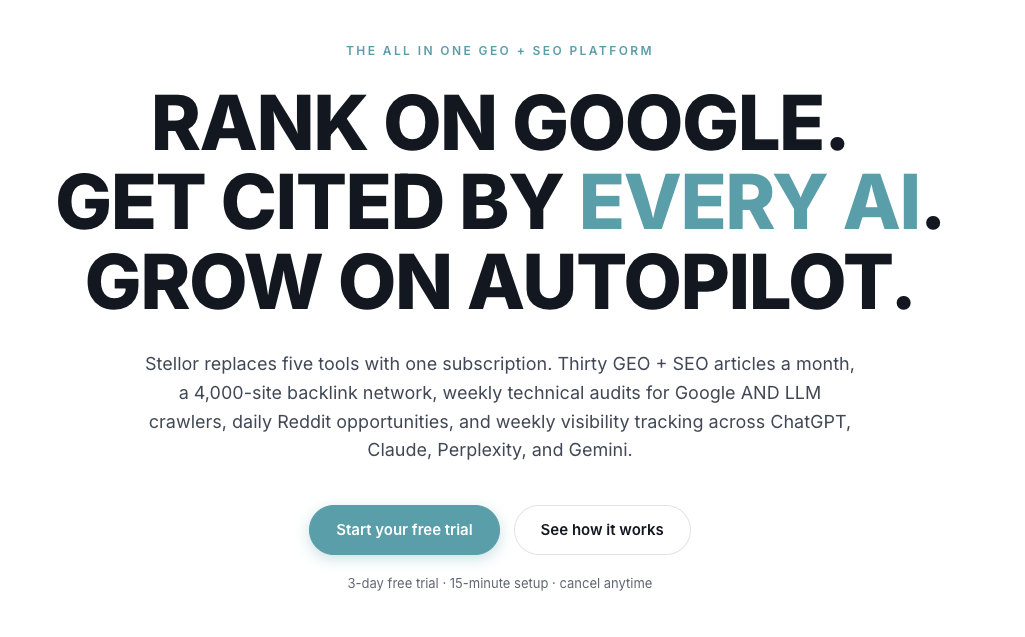
Trystellar’s SEO platform publishes 30 structured articles per month, each referencing your canonical author entity via @id, so every piece of content you produce adds to your cumulative E-E-A-T score. Weekly technical audits check schema completeness, sameAs link integrity, and structured data accuracy across your entire site. The 4,000-site backlink network builds the external authority signals that reinforce your author credibility with search engines. You can start with a free audit and see exactly where your author bio and structured data stand today, with no credit card required.
FAQ
What is an author bio for SEO?
An author bio for SEO is a structured professional summary that identifies the content creator by name, title, and verifiable credentials, signaling expertise and trust to both readers and search engines through E-E-A-T signals and Person schema.
How does Person schema improve author bio SEO?
Person schema in JSON-LD format makes your author identity machine-readable. Placing it on a canonical author page and referencing it via @id in article schema builds cumulative entity authority across all your published content.
What should I include in an SEO-friendly author bio?
Include your full real name, a specific professional title, named credentials or certifications, links to LinkedIn and ORCID in the sameAs array, and at least one third-party proof point such as a media mention or speaking engagement.
How often should I update my author bio?
Update your bio text whenever your credentials or role changes, but never change the canonical author page URL. Validate all sameAs links at least once per quarter to prevent broken links from degrading your entity resolution.
Do AI engines like ChatGPT use author bios to evaluate content?
Yes. AI answer engines extract explicit fields like role, tenure, and credentials from author bios to assess content authoritativeness. Structured, information-dense bios perform significantly better than vague or narrative-style bios in AI-driven content evaluation.