
TL;DR:
- AI answer engines cite the brands they can describe most confidently based on consistent, externally confirmed descriptions across the web. Building a coherent footprint with third-party confirmations, schema, and clear entity profiles improves the chances of being cited in AI answers. Regularly tracking citations across major engines helps measure and optimize your brand’s visibility in AI responses.
Competitors appear in AI answers because AI answer engines cite the entity they can describe most confidently, and that confidence comes from consistent, externally confirmed brand descriptions across the web — not from having the best product. Your first move: open ChatGPT, Perplexity, and Gemini right now, run six buyer-intent prompts in your category, and record exactly which brands get named and which URLs get cited. That 48-hour baseline snapshot is the foundation of every fix in this playbook.
Before you go further, run a quick first-pass audit on three items: your Organization schema (does it exist and is it complete?), your brand string (is the exact same name and descriptor on your site, Google Business Profile, and every directory?), and a short FAQ-style answer on your homepage that directly answers the question a buyer would ask an AI. These three gaps account for the majority of missed citations for brands that otherwise have solid SEO.
According to research on AI answer engine citation behavior, models don’t prefer competitors for subjective reasons. They choose the business they can describe most confidently. Specificity and consistency across the web reduce ambiguity and increase citation likelihood. The rest of this playbook shows you exactly how to close that gap.
Table of Contents
- Why competitors appear in AI answers and what drives the engine’s choice
- The specific reasons AI names your competitors instead of you
- How training data, real-time grounding, and recency shape which brands get cited
- How to audit where you’re missing AI citations
- A 30/60/90 playbook to increase your AI citation share
- Technical readiness: what your dev team needs to check
- Building the entity profile and third-party footprint LLMs trust
- How to measure AI citation share and define success metrics
- Weekly LLM visibility tracking: how to interpret results and act on them
- Key Takeaways
- The part of AI visibility most SEOs underestimate
- Trystellor tracks your AI citations and builds the footprint that earns them
- Useful sources and further reading
- FAQ
Why competitors appear in AI answers and what drives the engine’s choice
Modern AI answer engines are not running a popularity contest. They are running a confidence test. When a user asks ChatGPT “best emergency HVAC contractor in Chicago,” the model scans its training data and any live web grounding it has access to, then names the entity it can describe with the least ambiguity. If your competitor has a clean, consistent description across their site, their Google Business Profile, three industry directories, a YouTube channel, and a handful of Reddit mentions, the model can construct a confident sentence about them. If your brand description varies across sources or barely exists outside your own site, the model hedges, or skips you entirely.

This is the core mechanism behind why competitors appear in AI answers. The fix is not writing longer content. It is building a consistent, externally confirmed identity that models can lift and quote without risk of being wrong.
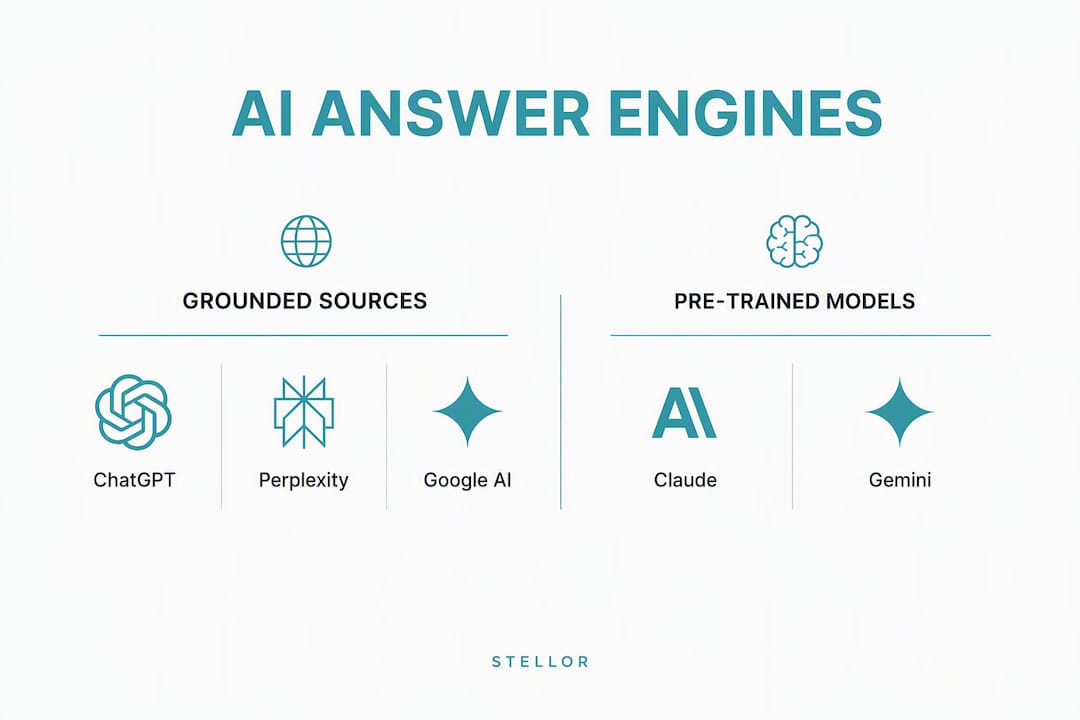
How each major engine sources its answers
The five engines your buyers use most behave very differently, and that changes your strategy per channel.
ChatGPT combines pre-trained knowledge with real-time web search when the browsing tool is active. It cites heavily: cloro’s monitoring data shows ChatGPT includes at least one source in a very high percentage of answers and averages many sources per answer. That high citation volume means more slots to compete for, but also means the bar for earning one of those slots is set by a large pool of competitors.
Perplexity is built around real-time web retrieval. It cites sources in 95.0% of answers and averages about 9.6 sources per answer. Because every answer is grounded to a live search, your on-page content and third-party footprint are directly in play on every query.
Google AI Overviews and Google AI Mode operate differently from each other. AI Overviews cite sources in 72.8% of answers; Google AI Mode reaches 97.8%. Both draw on Google’s index, which means your traditional SEO signals — authority, schema, structured data — carry direct weight here.
Gemini is the outlier. It returns at least one source in only 41.3% of answers. When Gemini does cite, it averages just 2.5 sources per answer. Winning a Gemini citation often requires changing the underlying grounding method rather than improving on-page signals alone. Google’s Grounding with Google Search documentation explains how enabling the google_search tool returns inline URL citation annotations, but that behavior is context-dependent and not guaranteed.
Claude (Anthropic) relies primarily on pre-trained knowledge unless connected to a retrieval tool. It cites less frequently than ChatGPT or Perplexity in standard use, making it more dependent on what was in its training data at cutoff.
| Engine | Citation presence (% answers with ≥1 source) | Avg. sources per answer |
|---|---|---|
| Copilot | 97.8% | Not reported |
| Google AI Mode | 97.8% | 9.7 |
| ChatGPT | 97.8% | 12.3 |
| Perplexity | 95.0% | 9.6 |
| Google AI Overviews | 72.8% | Not reported |
| Gemini | 41.3% | 2.5 |
Source: cloro State of AI Search
The practical implication: don’t treat AI visibility as a single channel. A strategy that wins ChatGPT citations may do nothing for Gemini, and vice versa.
The specific reasons AI names your competitors instead of you
Run through this diagnostic list in order. The first gap you find is usually the biggest one.
- No third-party confirmations — Your site saying you’re the best HVAC contractor in Brooklyn means nothing to a model. A YouTube video, a Reddit thread, and an industry directory all saying the same thing means a great deal. Models trust a chorus of external confirmations more than self-promotion.
Pro Tip: Search for the exact phrase you want a model to associate with your brand — something like “Brooklyn emergency HVAC for multi-family buildings” — across Google, YouTube, and Reddit. If that phrase doesn’t appear anywhere outside your own site, the model has no external confirmation to draw on.
The most impactful external confirmations, ranked by how often AI engines cite them: YouTube first (by a wide margin, per cloro’s domain analysis), followed by Reddit, high-authority industry review sites, and Wikipedia-style reference pages. A short YouTube video description optimized for your exact service phrase can outperform a 2,000-word blog post for citation purposes.
How training data, real-time grounding, and recency shape which brands get cited
Recency matters differently per engine. Perplexity and ChatGPT (with browsing active) ground answers to live web results, so a page published this week can appear in citations next week. Claude and Gemini in their default configurations rely more heavily on pre-trained knowledge, which means a competitor mentioned frequently before the model’s training cutoff has a built-in advantage that doesn’t disappear when you publish new content.
This explains a frustrating pattern: you’ve updated your site, added schema, and earned new mentions, but the AI still names your competitor. If the engine isn’t grounding to the live web, it’s drawing on what it learned during training. The fix isn’t more content on your site alone. It’s building enough external signal that the next training cycle or the next live-search grounding event picks up your brand.
To test which mode you’re up against, run these prompts and look for inline source links:
- “Who are the top [your service] providers in [your city]?” on ChatGPT with browsing on
- The same prompt on Perplexity (always grounded)
- The same prompt on Gemini (note whether sources appear at all)
- The same prompt on Claude (note whether it hedges with “as of my knowledge cutoff”)
If ChatGPT and Perplexity cite your competitor but Claude doesn’t mention anyone, your competitor likely has strong live-web presence but limited pre-training signal. If all four engines name the same competitor, that brand has both. Citation slots per answer have also been compressing across engines, meaning the window to earn a citation is narrowing over time. Acting now costs less than acting after the field consolidates further.
For grounded engines, submitting authoritative updates matters: keep your Google Business Profile current, publish new content regularly, and earn fresh third-party mentions so the model’s next retrieval event finds updated information. For non-grounded engines, the path is longer but the same: build enough external signal that the next training cycle reflects your brand accurately.

How to audit where you’re missing AI citations
Run a six-prompt visibility snapshot across ChatGPT, Perplexity, Gemini, and Claude, and record every citation. That single exercise tells you more about your AI visibility gap than any rank tracker.
Step-by-step audit checklist:
- Map each cited URL — to the page type: competitor homepage, competitor service page, review site, Reddit thread, YouTube video, or directory.
Sample audit spreadsheet columns:
| Column | What to capture |
|---|---|
| Prompt | Exact text submitted |
| Engine | ChatGPT / Perplexity / Gemini / Claude |
| Date/time | Timestamp of the run |
| Cited domains | All domains appearing as sources |
| Citation type | Inline link / source list / none |
| Quoted snippet | Exact text the model lifted |
| Your page candidate | URL of your best-matching page |
| Gap type | Missing page / weak copy / no schema / no external confirms |
Run this audit weekly for four weeks before making changes. The baseline data tells you which prompts are most urgent and which gaps are structural versus fixable with a single content edit.
A 30/60/90 playbook to increase your AI citation share
Prioritize in this order: clarity first (entity string and short answer copy), then third-party confirmations, then scale content and backlinks. Trying to scale before you’ve clarified your entity is like building on a cracked foundation.
30-day quick wins (assign to an entry-level SEO or content editor):
- Write and publish your canonical brand string: one sentence, 15–20 words, that describes exactly what you do, for whom, and where. Use it verbatim on your homepage, Google Business Profile, and every directory profile.
- Add Organization schema to your homepage with
name,description,url,sameAs(linking to your GBP, LinkedIn, and top directories), andareaServed. - Publish concise FAQ answers on your top three service pages. Each answer should open with a direct sentence the model can lift: “Brooklyn Emergency HVAC provides 24-hour heating and cooling repair for multi-family buildings in Brooklyn, NY.”
- Seed three to five Reddit replies in relevant subreddits using your exact brand string. Authentic, helpful replies that mention your service category and location naturally.
- Add
llms.txtto your site root pointing crawlers to your most important pages.
60-day medium efforts (content lead + outreach):
- Run outreach for three to five authoritative third-party mentions: a local business journal feature, an industry association directory listing, or a guest post on a trade publication.
- Publish two to three short YouTube videos (90–120 seconds) optimized for the exact phrases your audit identified as high-miss prompts. The video title and description should contain your canonical brand string.
- Launch a targeted review campaign to increase volume on Google and industry-specific review platforms. Review velocity signals real-world reputation to both traditional search and AI engines.
90-day long plays (dev + content lead):
- Scale to 30 GEO-optimized pages per month covering service variations, location combinations, and comparison queries. This is the content volume that builds topical authority fast enough to shift citation rates within a quarter. Trystellor’s GEO + SEO approach for home service businesses shows how this model works in practice.
- Build a consistent guest article cadence on industry sites: one per month minimum, each one using your canonical brand string in the author bio.
- Establish a weekly measurement cadence (see the measurement section below) so you can confirm citation gains are tracking with your actions.
For a deeper look at updating an existing SEO program to meet AI citation requirements, the modernize legacy SEO strategy for AI search guide covers the transition in detail.
Technical readiness: what your dev team needs to check
Technical readiness reduces friction for grounding and citation. A page that loads fast, is correctly indexed, and carries complete structured data is simply easier for a retrieval system to quote than one that isn’t.
Dev and SEO checklist:
- Organization schema on the homepage:
@type: Organization,name,url,logo,description,sameAs,areaServed. Reference schema.org/Organization for the full property list. - FAQ schema (QAPage or FAQPage) on every service page that contains direct Q&A content. This signals to both Google and AI crawlers that the page contains structured answers.
- Correct canonicalization: every page should have a self-referencing canonical tag. Duplicate or missing canonicals confuse crawlers about which version to index and cite.
llms.txtfile at your site root: a plain-text file listing your most important pages and a brief description of each. This is the AI-era equivalent ofrobots.txtfor guiding LLM crawlers.- Meta titles and descriptions that contain your canonical brand string and a direct answer phrase. The meta description is often the snippet a model lifts when it can’t parse the page body.
- Mobile-first, fast-loading pages: Google’s indexing is mobile-first, and slow pages are deprioritized by retrieval systems that have to choose between sources quickly.
Testing guidance: fetch your page with Google Search Console’s URL Inspection tool and confirm it returns the same content a plain HTTP request would. If your page requires JavaScript to render key content, a model’s crawler may see a blank page. Use server-side rendering or static generation for any content you want cited.
SourceBench research confirms that citation presence increases perceived credibility, but also that source quality matters. A citation from a fast, well-structured page with complete schema carries more weight than one from a slow, poorly marked-up page, even when the underlying content is similar.
Pro Tip: Run a simple curl request against your homepage and check whether your brand string, FAQ content, and schema markup appear in the raw HTML. If they don’t, a model’s crawler may not see them either.
Building the entity profile and third-party footprint LLMs trust
Models trust a chorus of external confirmations more than self-promotion. The goal is to make your brand describable from sources the model already cites heavily.
Entity profile checklist:
- Identical brand string across your homepage, Google Business Profile, LinkedIn, and every directory where you’re listed
- Matching short descriptor (one sentence, consistent wording) in your author bios, video descriptions, and press mentions
- Organization schema with
sameAslinks connecting your site to your GBP, LinkedIn, and top directories - Knowledge Panel signals: claim and verify your Google Knowledge Panel if one exists; if not, the Organization schema and consistent NAP (name, address, phone) across directories are the inputs that eventually generate one
Third-party targets, ranked by AI citation impact:
- YouTube is the single most-cited domain across AI engines per cloro’s domain analysis. A 90-second video with your canonical brand string in the title, description, and spoken transcript is one of the highest-ROI moves in this playbook.
- Reddit is heavily cited by ChatGPT in particular. Authentic participation in relevant subreddits, using your exact service description naturally, builds the kind of user-generated confirmation models trust. Trystellor’s guide on AI search changing local business discovery covers the Reddit opportunity in more depth.
- Industry review sites (Google Reviews, Yelp for service businesses, G2 or Capterra for SaaS) provide the social proof layer that models interpret as real-world validation.
- Wikipedia-style references and industry association pages: if your brand or a principal is mentioned on a Wikipedia page, an industry association member directory, or a .edu or .gov site, that mention carries outsized weight.
For exact phrasing to use across these surfaces, write one canonical block: “[Brand name] is a [service type] serving [geography], specializing in [specific service]. [One sentence of proof or differentiator].” Use this block verbatim in your YouTube description, your directory listings, and your author bio on guest posts. The consistency is the signal.
Vaultio’s analysis of how AI ranks home service companies reinforces this: the brands that appear most consistently in AI answers for local service queries are those with the most coherent external identity, not necessarily the largest sites.
How to measure AI citation share and define success metrics
Measure citation share and citation quality, not just organic rank. A page ranking #3 on Google that never appears in an AI answer is invisible to a growing share of buyers.
Weekly snapshot cadence:
- Select 8–12 buyer-intent prompts that represent your highest-value queries.
- Run each prompt on ChatGPT, Perplexity, Gemini, and Claude every Monday morning.
- Record results in a spreadsheet using the columns below.
- Flag any week-over-week change in citation presence or cited domain for your brand.
Spreadsheet template columns:
| Column | Definition |
|---|---|
| Date | Week of the snapshot |
| Prompt | Exact prompt text |
| Engine | ChatGPT / Perplexity / Gemini / Claude |
| Citation present | Y / N |
| Cited domain | Domain of the cited source |
| Cited URL | Full URL |
| Quoted snippet | Exact text lifted by the model |
| Your page candidate | Your best-matching page URL |
| Trend flag | Up / Down / Stable vs. prior week |
KPI definitions:
- Citation presence rate: percentage of your tracked prompts where your brand is cited, per engine
- Citation share: your citation count divided by total citations across all tracked prompts, compared to your top two competitors
- Time-to-first-citation: weeks between publishing a new page and its first appearance in a tracked prompt
- Citation accuracy rate: percentage of citations where the model’s description of your brand matches your canonical brand string
The local SEO optimization guide for service businesses covers how to build the NAP consistency and directory presence that feeds these metrics over time.
Weekly LLM visibility tracking: how to interpret results and act on them
A weekly LLM visibility snapshot ties your actions directly to citation outcomes. Without it, you’re making changes and hoping, rather than measuring and iterating.
Sample weekly report structure:
| Prompt | Engine | Citation count | Citation share | Top cited domains | Recommended action |
|---|---|---|---|---|---|
| “Best HVAC in Brooklyn” | ChatGPT | 0 | 0% | Competitor A, Yelp, Reddit | Publish FAQ snippet; seed Reddit reply |
| “Best HVAC in Brooklyn” | Perplexity | 1 | 8% | Your site, Competitor B | Strengthen schema on cited page |
| “Emergency heating repair NYC” | Gemini | 0 | 0% | No sources returned | Focus on YouTube + GBP; Gemini rarely cites |
| “Emergency heating repair NYC” | Claude | 0 | 0% | No sources returned | Build pre-training signal via press mentions |
Before/after example: A brand that starts with 0% citation presence on ChatGPT for six tracked prompts, then publishes FAQ schema on three service pages, seeds four Reddit replies, and adds a YouTube video, can expect to see citation presence climb on the grounded engines (ChatGPT, Perplexity) within four to six weeks. Gemini and Claude move more slowly because they depend on grounding events or training cycles.
Engine-specific win definitions:
| Engine | What a “win” looks like | Primary lever |
|---|---|---|
| ChatGPT | Named in answer with inline source link | On-page FAQ copy + third-party confirms |
| Perplexity | Cited URL in source list | Strong on-page content + backlinks |
| Google AI Overviews | Featured in overview panel | Traditional SEO signals + schema |
| Gemini | Any citation at all (41.3% baseline) | YouTube + GBP + grounding-friendly content |
| Claude | Named in answer text | Pre-training signal: press, directories, Wikipedia |
Tracking this data weekly turns AI visibility from a vague concern into a measurable channel. The AI visibility tracking approach Trystellor uses queries all four engines with real buyer prompts and reports citation changes week over week.
Key Takeaways
AI citations go to the brand a model can describe most confidently, which means consistency, external confirmation, and structured technical signals matter more than content volume alone.
| Point | Details |
|---|---|
| Entity clarity is the first fix | Publish one canonical brand string and use it verbatim across your site, GBP, and every directory. |
| Engine behavior varies sharply | ChatGPT cites in most answers; Gemini cites in fewer than half, requiring a different strategy per engine. |
| YouTube and Reddit dominate citations | These two platforms are the most-cited domains across AI engines; prioritize them before adding more site content. |
| Weekly snapshots drive improvement | Run 8–12 buyer prompts across four engines weekly and track citation presence rate and citation share. |
| Trystellor automates the full system | Trystellor’s platform tracks citations across ChatGPT, Claude, Perplexity, and Gemini weekly and publishes 30 GEO-optimized pages per month to build citation share at scale. |
The part of AI visibility most SEOs underestimate
There’s a tendency in this industry to treat AI citation optimization as a content problem. Write more, write better, add FAQ schema, and the citations will follow. That framing is partially right but misses the harder truth: the brands winning AI answers at scale aren’t just producing good content. They’ve built an identity that the model can describe without hedging.
The distinction matters because it changes where you spend your time. A brand with a perfectly optimized service page but no YouTube presence, no Reddit footprint, and inconsistent directory listings will lose to a competitor whose site is mediocre but whose external identity is coherent and widely confirmed. The model isn’t reading your page and judging its quality. It’s asking: “Can I describe this brand confidently, using sources I trust?” If the answer is no, you don’t get cited, regardless of how good your content is.
The other thing most practitioners underestimate is engine specificity. Optimizing for ChatGPT and Perplexity is largely an on-page and third-party footprint game. Optimizing for Gemini is a different problem entirely, one that often requires changing the grounding context rather than the content. Treating all five engines as a single target is how brands end up with a strategy that works on two channels and does nothing on the other three.
The playbook in this article is sequenced the way it is for a reason: clarity before scale, external confirmation before content volume, measurement before optimization. Skip the sequence and you’ll spend budget on the wrong fixes.
Trystellor tracks your AI citations and builds the footprint that earns them
Most businesses discover they’re missing from AI answers only after a competitor mentions it. Trystellor gives you the baseline data within 48 hours: a free AI Visibility Audit that shows your current citation status across 25 buyer prompts, a competitor benchmark, a full technical site report, and a 90-day action plan.
From there, the platform runs on autopilot: 30 GEO and SEO-optimized articles published to your CMS every month, a 4,000-site backlink network building your authority profile, weekly technical audits covering schema, llms.txt, and crawlability, daily Reddit opportunity identification, and weekly LLM tracking across ChatGPT, Claude, Perplexity, and Gemini. That’s five separate vendor subscriptions replaced by one, starting at $199 per month. The three-day free trial requires no credit card, and you keep every piece of content the platform produces even if you cancel. Start your free AI Visibility Audit and see exactly which prompts your competitors are winning and why.
Useful sources and further reading
- Grounding with Google Search (Google AI for Developers): Google’s official documentation on how Gemini uses the
google_searchtool to return inline URL citations and real-time grounding. - Schema.org Organization type: The canonical reference for implementing Organization structured data, including
sameAs,areaServed, anddescriptionproperties. - State of AI Search: How the Major AI Engines Cite Their Sources (cloro): The most detailed public dataset on citation presence rates and sources-per-answer across ChatGPT, Perplexity, Gemini, Google AI Overviews, and Copilot.
- SourceBench: Can AI Answers Reference Quality Web Sources? (arXiv): Academic research on citation quality in AI answers and why source quality matters beyond mere citation presence.
- Tools for your weekly snapshot: ChatGPT (browsing on), Perplexity, Gemini, and Claude. Run prompts manually or use Trystellor’s automated LLM tracking to capture and trend results weekly without manual effort.
FAQ
Why do AI answers keep citing the same competitors?
AI engines cite the entity they can describe most confidently, and that confidence is built through consistent, externally confirmed brand descriptions. Competitors cited repeatedly have a coherent identity across their site, directories, YouTube, and Reddit, giving the model multiple sources to draw on.
Why does AI give different answers on different engines?
Each engine uses a different sourcing model. ChatGPT and Perplexity ground answers to live web results and cite sources in over 95% of answers, while Gemini relies more on pre-trained knowledge and cites in only 41.3% of answers. The same brand can appear on one engine and be invisible on another.
What is the fastest way to start measuring AI citation share?
Run six buyer-intent prompts across ChatGPT, Perplexity, Gemini, and Claude, record every cited domain and quoted snippet, and compare them against your own pages. That 48-hour baseline snapshot is the starting point for every improvement you make.
Can I turn off AI in my Google searches?
Google allows you to filter AI Overviews out of results using the “Web” filter tab in Search, which returns traditional blue-link results without the AI Overview panel. This is a user-side setting and does not affect whether your brand appears in AI answers for other users.
Does publishing more content automatically improve AI citations?
Not on its own. Content volume helps build topical authority, but models also require external confirmation from sources they already trust, such as YouTube, Reddit, and industry directories. A consistent entity string and third-party footprint typically move citation rates faster than additional on-site content alone.