
Running a local service business is already a full-time job. Now add five or six separate SEO subscriptions, each with its own dashboard, billing cycle, and learning curve, and you have a recipe for burnout before you’ve answered a single morning service call. The problem isn’t effort. It’s fragmentation. When your review management tool doesn’t talk to your Google Business Profile (GBP) tracker, which doesn’t connect to your backlink checker, nothing compounds the way it should. A consolidated AI local reviews stack led to a 21% increase in review velocity during a 30-day test, which tells you something important: the way your tools work together matters as much as the tools themselves.
Table of Contents
- The high cost of juggling multiple SEO tools
- What makes all-in-one SEO platforms different?
- Who benefits most, and is all-in-one right for you?
- Proven results: Case data on real local service businesses
- The overlooked advantage most experts miss
- Ready to grow? Try a smarter approach with Stellor
- Frequently asked questions
Key Takeaways
| Point | Details |
|---|---|
| Single dashboard advantage | Managing everything in one platform saves time and reduces confusion for local service businesses. |
| Proven to increase reviews | Switching to all-in-one SEO platforms can boost review volume by over 20 percent in just one month. |
| Best fit for local focus | Businesses that rely most on local reputation and Google rankings see the biggest benefit. |
| Owner time reclaims | Automating reviews and profiles means more time can go to actual customer care and business growth. |
| Consider your priorities | If you need deep backlink analysis, a blended or more specialized approach may still be best. |
The high cost of juggling multiple SEO tools
Most local service businesses don’t start with five SEO tools. They add one, then another, then a third when a consultant recommends it. Before long, you’re paying $800 a month across platforms that don’t share data and require separate logins. That’s not a strategy. That’s subscription overload.
Here’s what that fragmented stack typically looks like for a plumber, HVAC company, or dental practice:
- A review request tool that sends emails but doesn’t track which customers actually responded
- A separate GBP management dashboard that requires manual updates
- A content service that produces articles without knowing which keywords your local competitors are ranking for
- A backlink checker that gives you data but no action plan
- A reporting tool that pulls from all the others, except half the integrations are broken
The hidden cost is time. Every week you spend an hour or two logging into different tools, trying to piece together what’s working. That time adds up to 50 to 100 hours per year just on tool management, not actual marketing.
There’s also the problem of slow review response times. When a customer leaves a review, whether positive or negative, the window for responding in a way that builds trust is narrow. Automated systems that aren’t integrated with your main workflow get missed. A consolidated reviews workflow reduced median response times to 2 hours and 14 minutes while increasing review velocity by 21% over 30 days. That’s the difference between a business that looks alive online and one that looks like it’s only half-paying attention.
“When your tools don’t talk to each other, your business pays the price in slower responses, missed reviews, and a fragmented picture of where you actually stand in local search.”
You can read more about what measurable SEO results for local services actually look like when systems are working together properly.
Now that we’ve established the widespread inefficiency, let’s dig into what makes all-in-one SEO platforms different.
What makes all-in-one SEO platforms different?
An all-in-one SEO platform isn’t just a bundle of tools under one login. Done right, it’s a system where each component feeds the others. Your content strategy informs your keyword tracking. Your review data informs your local ranking insights. Your technical audit findings trigger immediate fixes, not a to-do list that sits in a spreadsheet for three months.
Here’s a direct comparison between the two approaches:
| Feature | Fragmented tool stack | All-in-one platform |
|---|---|---|
| Dashboard | 4 to 6 separate logins | Single unified view |
| Review management | Manual or siloed automation | Automated, integrated workflows |
| GBP updates | Requires manual scheduling | Managed within the platform |
| Content + SEO | Separate vendors | Unified strategy and publishing |
| Reporting | Manual data pulls | Real-time, consolidated reporting |
| Monthly cost | $800 to $13,000+ | $199 to $500 (typical range) |
| Time investment | 5 to 10+ hours/week | Under 1 hour/week |
The workflow automation piece is where businesses feel the biggest immediate difference. Instead of manually requesting reviews and then logging into a separate platform to track them, everything runs through one system. Automated prompts from consolidated platforms contributed directly to increased review velocities and better average ratings in real-world testing.

For Google Business Profile management specifically, staying current matters. Outdated hours, missing photos, or unresponded reviews are signals Google notices. When your GBP management is inside your SEO platform, those updates happen consistently, not only when you remember.
Pro Tip: When evaluating an all-in-one platform, check whether it handles both traditional Google SEO and AI visibility. Tools like ChatGPT, Claude, Perplexity, and Gemini now answer millions of buyer questions every day. If your platform isn’t helping you show up in those answers, you’re only solving half the problem. Learn how AI for local visibility is changing the landscape for service businesses, and why your SEO health score needs to account for it.
Understanding what makes these platforms different leads naturally to deciding whether all-in-one is right for you.
Who benefits most, and is all-in-one right for you?
Not every business has the same SEO needs. A solo estate attorney in a mid-size city has different challenges than a 12-location HVAC company. But there’s a clear pattern in which types of businesses get the most value from all-in-one platforms.
Businesses that benefit most:
- Home services (plumbers, roofers, electricians, HVAC, painters, cleaners): These businesses live and die by local pack rankings and online reviews. A missed review request or a slow response is a lost customer. Review automation and GBP management are the highest-impact tools for this segment.
- Healthcare practices (dental clinics, chiropractors, physical therapists): Patients read reviews before booking. Response time and review volume directly affect appointment volume. Reputation and local SEO are inseparable here.
- Legal services (personal injury, family law, small business law): Trust-building happens online before the first call. Local rankings and consistent citation signals matter enormously.
- Real estate teams and brokerages: Visibility in neighborhood-specific searches drives leads. Content and GBP optimization are the biggest levers.
“All-in-one platforms can cut total subscription count, but the best fit depends on whether reviews and local pack are the main focus, versus deep backlink analysis at scale.” Ahrefs vs SEMrush — Platform Nuances
That’s the honest trade-off. If you run a large in-house SEO team that does intensive backlink prospecting across thousands of domains, you may need standalone tools with more granular data. But for the vast majority of local service businesses, the local pack ranking, review volume, review rating, and content consistency are what move the needle. All-in-one platforms are built exactly for that.
The question to ask yourself is simple: Is my current SEO approach actually generating more calls, more form fills, and more booked jobs? If the answer isn’t a clear yes, the problem is probably fragmentation. Explore proven SEO strategies for local services to see what a focused approach actually looks like.
Once you know whether all-in-one aligns with your needs, the next step is understanding what the results actually look like.
Proven results: Case data on real local service businesses
Numbers matter more than promises. Here’s what the research shows when local businesses consolidate their SEO workflows into a unified platform.
| Metric | Before consolidation | After 30 days | Change |
|---|---|---|---|
| Review velocity | Baseline | +21% increase | Significant gain |
| Median response time | 8+ hours | 2 hours 14 minutes | Dramatic reduction |
| Average star rating | Baseline | +0.06 stars | Positive improvement |
| Monthly tool subscriptions | 4 to 6 | 1 | Major simplification |
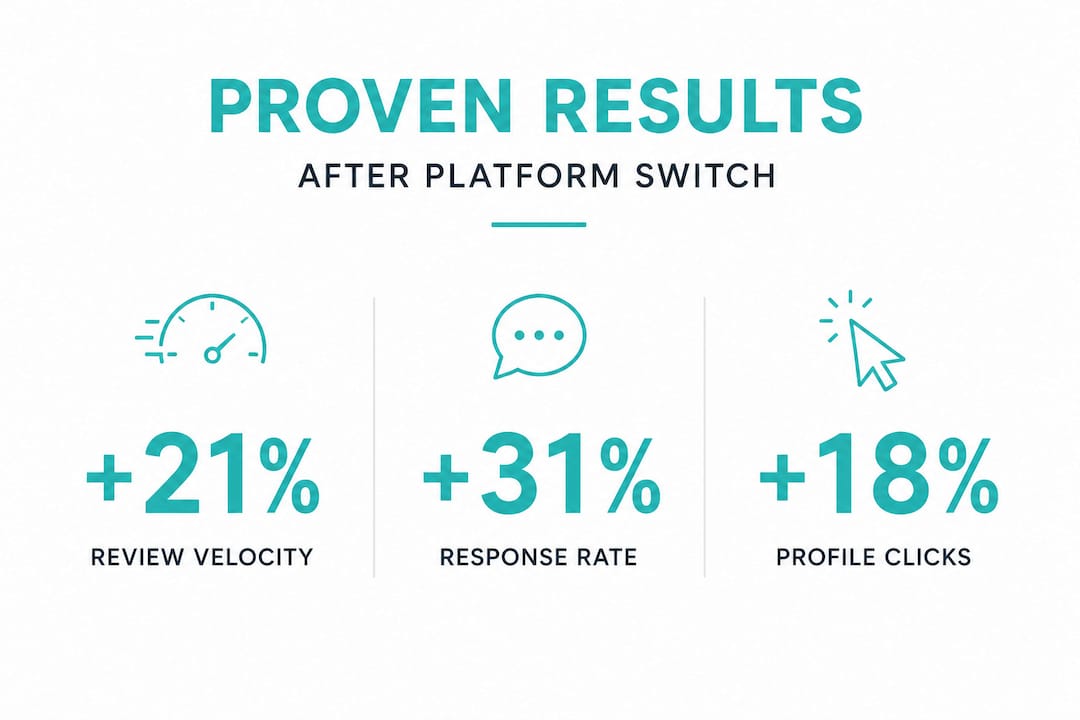
A review velocity increase of 21% alongside a rating increase of 0.06 stars might sound small in isolation, but in competitive local markets, these changes can shift your position in the local map pack (the three-business cluster that appears at the top of Google’s local search results). More reviews coming in faster, combined with quicker response times, signals to Google that your business is active and trusted.
Here’s how to get started without falling into analysis paralysis:
- Audit what you’re currently paying for. List every SEO-related subscription, its monthly cost, and the last time you actually used it. You’ll likely find at least one tool you forgot you were paying for.
- Identify your biggest gap. Is it review volume? Slow response times? Inconsistent content? Poor local rankings? Start there.
- Prioritize review automation first. This delivers the fastest visible results. More reviews, better ratings, and faster responses all happen within the first 30 days when automation is set up correctly.
- Set up your GBP integration. Make sure your platform is publishing updates, managing your hours and photos, and flagging any inconsistencies in your business information across directories.
- Track weekly, not monthly. All-in-one platforms give you a real-time view. Check your review count, response rate, and ranking position once a week. Adjust based on what you see.
Pro Tip: Don’t try to optimize everything at once. Pick two metrics to improve in month one, review count and response time, then add content optimization and backlink tracking in month two. Staged implementation prevents overwhelm and makes it easier to see what’s actually working.
Learning more about local SEO for service providers can help you prioritize the right steps for your specific business type.
The overlooked advantage most experts miss
Every article about all-in-one SEO platforms focuses on the same things: cost savings, fewer logins, better reporting. Those benefits are real. But the most important advantage rarely gets mentioned.
It’s time. Not time savings in the abstract, but the specific, tangible kind: the two hours on a Tuesday morning you used to spend pulling reports from three different tools, now available to call back a customer who left a voicemail at 7 AM.
Here’s what happens in practice when business owners switch to a unified system. For the first few weeks, they keep waiting for something to break or for the platform to miss something. When it doesn’t, they stop checking obsessively. They start trusting the automation. And then, almost without planning it, they start spending that recovered time on the part of the business that no tool can replicate: actually talking to customers, following up after jobs, asking face to face for referrals.
Those conversations generate organic reviews. They generate word-of-mouth. They generate repeat business. None of that shows up on a feature comparison chart.
The businesses that win with all-in-one SEO aren’t necessarily the ones using the most advanced features. They’re the ones who freed themselves from tool management long enough to be genuinely present in their customer relationships. That presence translates directly into the kind of reputation that no algorithm change can take away.
The shift in AI search and business discovery is accelerating this dynamic. When ChatGPT or Perplexity recommends a local plumber to someone who asked “who’s the best plumber near me,” it’s pulling from patterns of trustworthiness: review volume, content consistency, business profile completeness. You can’t game that with five disconnected tools. You build it by showing up consistently over time, which is exactly what a unified platform makes possible.
The conventional wisdom says the ROI is in the dashboard. The real ROI is in what you do with the hours the dashboard gives back to you.
Ready to grow? Try a smarter approach with Stellor
If any part of this article sounded familiar, whether it’s the subscription fatigue, the slow review responses, or the nagging sense that your SEO should be doing more, you’re not alone. Most local service businesses are in exactly that position.
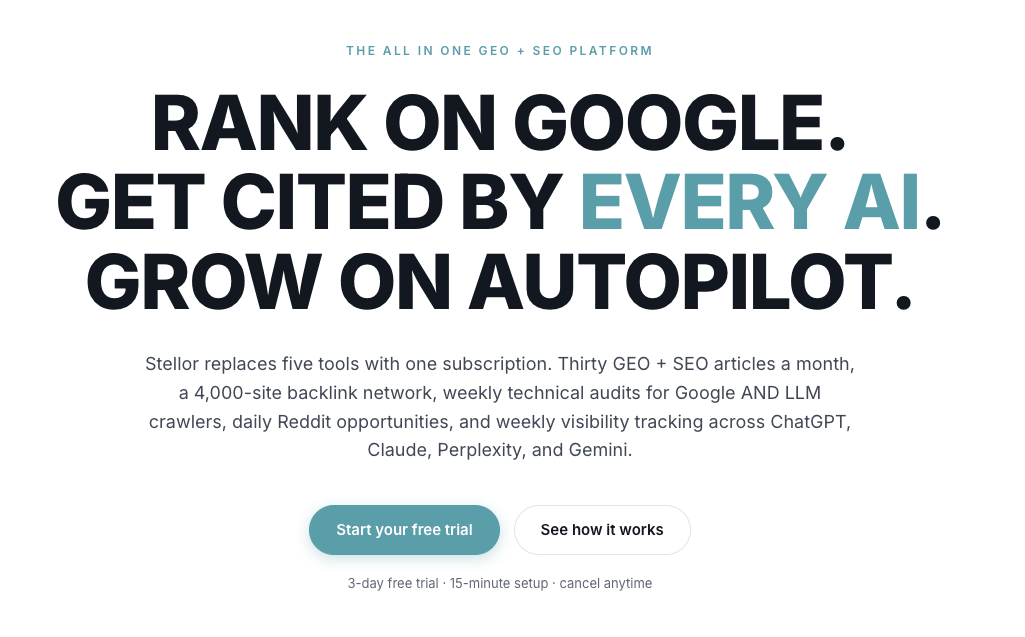
Stellor is built specifically for businesses like yours. Every plan includes 30 SEO and GEO articles published to your site each month, a 4,000-site backlink network, weekly technical audits covering both Google and AI crawler issues, daily Reddit opportunity surfacing, and weekly AI visibility tracking across ChatGPT, Claude, Perplexity, and Gemini. It replaces the content agency, the backlink service, the technical SEO consultant, and the AI tracking tool, starting at $199 a month. Whether you run a professional services firm or a home services company, Stellor gives you one platform that handles both traditional Google ranking and AI citation visibility. Three-day free trial, no card required, cancel anytime.
Frequently asked questions
How quickly can local businesses see results with all-in-one SEO platforms?
You can see measurable increases in review velocity within 30 days using a consolidated platform, based on recent industry testing. Improvements in local map pack rankings typically follow within two to three months as your review signals strengthen.
Is an all-in-one platform always cheaper than multiple specialized tools?
Usually yes, but businesses focused heavily on large-scale deep backlink analysis may prefer specialized tools even if it means higher total cost. For most local service businesses, all-in-one delivers more value per dollar.
Which local services benefit most from these platforms?
Home services (plumbers, HVAC, roofers), healthcare practices, legal firms, and real estate teams all see strong gains because their growth depends directly on review volume, response speed, and local map pack visibility.
What features are essential in an all-in-one SEO platform for local businesses?
Look for review automation, fast response tools, Google Business Profile integration, content publishing, backlink management, and a clear reporting dashboard that shows ranking changes over time.
Do these platforms help with both SEO and online reputation?
Yes. The best all-in-one platforms treat SEO and reputation management as two sides of the same coin, because Google increasingly does too. More reviews, faster responses, and consistent business information all contribute to both your reputation and your local rankings.