

Yes, white-label AI SEO is a scalable agency offering, but only when paired with real human review of every deliverable. The efficiency gains are genuine: AI now handles audits, topic research, and first-draft content at a scale no in-house team can match, while new channels like ChatGPT and Gemini have created a citation game agencies can charge for. Your next move is concrete: audit your current fulfillment capacity this week, then run a 30-day pilot with one client before you sell it agency-wide.
TL;DR:
- AI-driven SEO speeds up technical audits, content drafts, and rank monitoring but still requires human review for accuracy and compliance.
- A credible white-label AI SEO package must include AI-powered audits, human-reviewed content, technical fixes, transparent backlink sourcing, and AI citation tracking.
- Pricing typically ranges from $750 to $1,200 monthly for entry-level plans, with full-service tiers costing $3,000 or more, using a markup of two to three times vendor wholesale costs.
- A successful 30 to 60-day pilot should deliver initial technical improvements, content, and measurable AI citation gains, with clear benchmarks established upfront.
- Beware of vendors that cannot provide sample reports, disclose backlink sources, or guarantee human review, as these indicate unreliable or outdated offerings.
Table of Contents
- What Is White-Label AI SEO and How Does It Change Delivery?
- What Should a White-Label AI SEO Package Actually Include?
- How Should You Price and Package White-Label AI SEO?
- How Do You Run White-Label AI SEO Inside Your Agency Without Bottlenecks?
- What Are the Red Flags When Choosing a White-Label AI Partner?
- How Stellor Fits an Agency’s White-Label AI SEO Strategy
- How Should Agencies Position and Market This Service to Clients?
- What Technical Integration Challenges Should Agencies Expect?
- How Do You Educate Clients Who Don’t Understand AI SEO Yet?
- How Should Agencies Manage Dependency on a Third-Party AI SEO Vendor?
- Build In-House or Go White-Label? A Quick Decision Checklist
- Try Stellor’s Agency-Ready AI SEO Platform
- Sources
- FAQ
What Is White-Label AI SEO and How Does It Change Delivery?
White-label SEO means one company does the work and another company sells it under its own brand. A specialized vendor produces the audits, content, and technical fixes; your agency puts its logo on the report and keeps the client relationship. That part hasn’t changed in over a decade.
What’s different now is the word “AI” sitting in front of it. In this context, AI-driven SEO tools don’t replace the white-label vendor. They change what that vendor can produce and how fast. A process that used to take a five-person team two weeks (a full technical crawl, a content gap analysis, and twenty draft articles) can now happen in days, because large language models can draft, cluster, and flag technical issues at a pace human teams can’t match.
That speed comes with a catch, though. AI is good at some things and unreliable at others, and knowing the difference is what separates a credible SEO reseller program from a liability.
What AI genuinely does well:
- Crawls a site and flags technical issues (broken schema, missing alt text, slow pages) across hundreds of URLs in minutes
- Clusters keywords into topical groups so content calendars stop guessing at structure
- Drafts first-pass content, meta descriptions, and FAQ blocks from a brief
- Monitors ranking and citation changes daily instead of monthly
What it can’t safely do without a human in the loop:
- Verify that a factual claim in a draft is actually true
- Understand nuanced brand voice or legal/medical compliance requirements
- Make final calls on link acquisition quality
- Catch subtle keyword cannibalization across a large site architecture
That gap is exactly why vendor guidance across the industry keeps repeating the same line: AI accelerates the work, but the strategy and quality control still need a person.
The bigger shift is what clients are now buying. A decade ago, an SEO retainer meant rankings and organic traffic. Today, a growing share of buyer research happens inside AI answer engines instead of a search results page. When someone asks ChatGPT to recommend a plumber or an accountant, the businesses that get named are the ones AI tools are already citing. This is the core of AEO (answer engine optimization) and GEO (generative engine optimization), and it’s forced white-label packages to add a deliverable that didn’t exist five years ago: AI citation tracking, reported alongside traditional rankings. If your white-label package doesn’t include some form of this, you’re selling last decade’s product at this decade’s price.
What Should a White-Label AI SEO Package Actually Include?
A credible package has five components. If a vendor is missing more than one of these, keep shopping.
- AI-powered audit and opportunity analysis. This covers the standard technical crawl (site speed, crawlability, mobile usability) plus a newer layer: an audit of AI answer gaps, meaning which buyer questions the client currently loses to competitors inside ChatGPT, Perplexity, or Gemini.
- Content production with a defined human checkpoint. The best model isn’t “AI writes, nobody reads.” It’s a brief built from keyword and intent research, an AI-assisted first draft, and a mandatory human edit pass before anything publishes. Content should include structured FAQPage and HowTo schema blocks by default, not as an upsell.
- Technical SEO and AI-readiness fixes. This means the traditional stuff (schema completeness, page speed, internal linking) plus newer checks like
llms.txtconfiguration, which tells AI crawlers what they’re allowed to read and index. - Backlink and authority work with transparent sourcing. This is the deliverable most prone to abuse. More on that below.
- Branded reporting that includes AI-citation metrics, not just rank tracking and traffic charts.
Pro Tip: Ask any prospective white-label vendor for a sample report before you sign anything. If the AI-citation section is missing, blank, or vague, that vendor is still selling a 2019 product with new packaging.
On content specifically, the production model matters more than the word count. A reasonable structure looks like: intake brief (target query, audience, brand voice notes) → AI-assisted draft → human editor pass for accuracy and voice → schema and internal link insertion → client-facing QA sample before bulk publishing. Structured data types like FAQ and HowTo aren’t cosmetic. They’re a large part of why some pages get pulled into AI-generated answers and others don’t.
Backlink work deserves its own warning. Standard white-label packages bundle audits, content, technical fixes, link building, and reporting into tiered offerings, which is reasonable when the link component is transparent. It’s not reasonable when a vendor won’t say where links come from. Reputable partners disclose their placement sources; anyone offering “unlimited high-authority backlinks” for a flat low fee is almost certainly running a private network that will eventually get a client’s site penalized.
Reporting closes the loop, and this is where most agencies lose credibility fastest. Clients paying for AI SEO want to know: Are we ranking? Are we showing up when someone asks an AI for a recommendation? Is that turning into leads? A report that only shows keyword position without any AI citation tracking tells a client half the story they’re paying for.
How Should You Price and Package White-Label AI SEO?
Pricing is where most agencies either make real margin or quietly bleed it. The standard model in white-label SEO is a wholesale-to-retail markup, and most agencies price their resold services at a multiple of what they pay the vendor. If your wholesale cost is $500 a month for a mid-tier package, retail pricing between $1,000 and $1,500 is typical and defensible, assuming you’re adding real account management on top.
A workable three-tier structure:
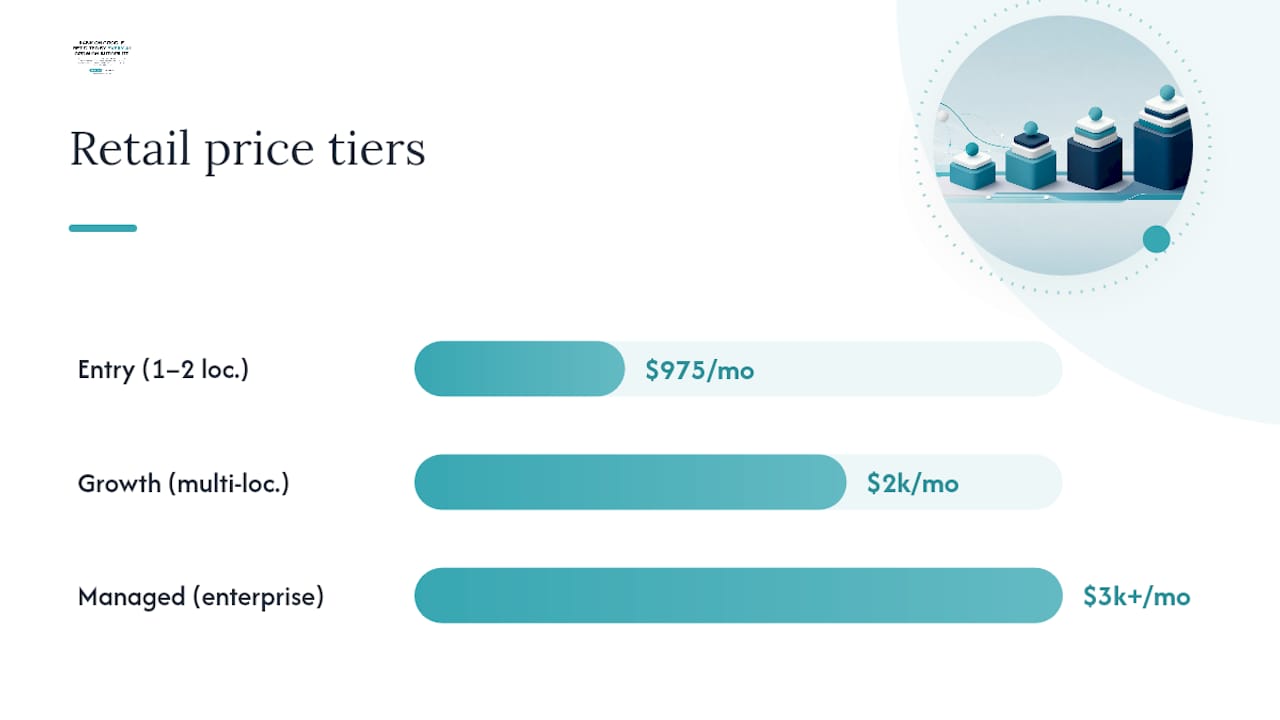
- Entry tier ($750 to $1,200/month retail): One to two locations, monthly technical audit, four to six pieces of content, basic rank tracking. Good fit for a single-location service business testing the waters.
- Growth tier ($1,500 to $2,500/month retail): Multi-location or multi-service coverage, weekly technical checks, ten to fifteen content pieces, AI citation tracking against a defined set of buyer prompts, monthly strategy call.
- Managed/enterprise tier ($3,000+/month retail): Full content cadence, dedicated backlink program, weekly reporting, custom AI visibility dashboards, priority turnaround on technical fixes.
Onboarding timelines matter just as much as pricing, because a vague delivery schedule is the fastest way to lose a new client’s confidence.
- Days 0 to 30: Full technical and AI-visibility audit, competitor benchmark, content calendar built, first batch of content drafted and published.
- Days 31 to 60: Second content wave live, initial backlink placements underway, first AI-citation baseline report delivered.
- Days 61 to 90: Full reporting cadence established, measurable ranking movement on target terms, second AI-citation checkpoint showing trend direction.
Pro Tip: Put the 30/60/90 milestones in the client contract itself, not just an internal deck. Clients who know what “day 45” is supposed to look like rarely churn over impatience.
On contracts, four items are non-negotiable regardless of vendor: a signed NDA, explicit language that all content and IP transfer to you (and your client) on delivery, a defined change-request process so scope creep doesn’t eat your margin, and a fixed monthly reporting date the client can count on.
How Do You Run White-Label AI SEO Inside Your Agency Without Bottlenecks?
Operationally, the goal is simple: deliverables come in from your vendor, get checked, get branded, and go out the door without a founder personally reviewing every line. Getting there requires a repeatable pipeline, not heroics.
Delivery formats should match how your team actually works. Content typically arrives as CMS-ready drafts (WordPress, Webflow, HubSpot) or as staged documents for review before publishing. Reporting works best piped into a dashboard your account managers already check daily, whether that’s a Looker Studio build or a vendor-provided branded portal.
A QA workflow that actually holds up under volume:
- Every piece of content gets a human read-through for factual accuracy before it goes live, no exceptions
- Run a plagiarism check on drafts, even from trusted vendors, since AI models can occasionally produce overlapping phrasing across similar briefs
- Maintain a written style guide your vendor follows, covering tone, banned phrases, and formatting conventions
- Spot-check technical fixes on a sample of pages rather than assuming a bulk audit report is fully accurate
Branding needs to be airtight in both directions. Every report, every content byline, and every dashboard a client sees should carry your agency’s name, not the vendor’s. Confirm this in writing before the first deliverable ships, and check the metadata on PDF reports specifically. It’s a common leak point.
Scaling across multiple locations is where a manual process falls apart fastest. If you’re managing content calendars for a ten-location franchise client by hand in a spreadsheet, you’ll miss deadlines. A multi-location SEO workflow built around templated briefs and automated scheduling keeps location pages consistent without multiplying your team’s workload.
What Are the Red Flags When Choosing a White-Label AI Partner?
Automation introduces failure modes that didn’t exist with manual SEO work, and they’re easy to miss until a client calls angry.
The most common: fabricated facts in AI-drafted content that nobody caught before publishing, thin content that technically hits a word count but says nothing useful, and vague link-building promises that turn out to be a private network in disguise. Vendors that won’t disclose how backlinks are acquired are one of the clearest warning signs in this industry, and agencies that skip this check usually find out the hard way, months later, when a client’s domain takes a ranking hit.
A short vendor-vetting checklist before you sign anything:
- Request a sample deliverable (a full audit and one content piece) before committing
- Get written confirmation that IP and content ownership transfer to you on payment
- Require a signed NDA covering client data and deliverables
- Ask for a live, redacted client report, not a mockup
- Request a sample AI-citation report showing real prompts tested against real results
If a vendor can’t produce a sample deliverable, won’t put IP transfer in writing, describes their link strategy as proprietary and undisclosable, or has no clear human review stage in their process, walk away. These aren’t nitpicks. Third-party vendors that market AI SEO targeting ChatGPT, Perplexity, and Gemini should be able to show sample AI-citation reports on request, and any partner who can’t or won’t isn’t ready to be resold to your clients.
Pro Tip: Test AI-visibility claims yourself before you believe a pitch deck. Ask the vendor’s own AI Overview tool the exact prompts your target client’s buyers would ask, and compare what comes back to what’s in their sample report.
How Stellor Fits an Agency’s White-Label AI SEO Strategy
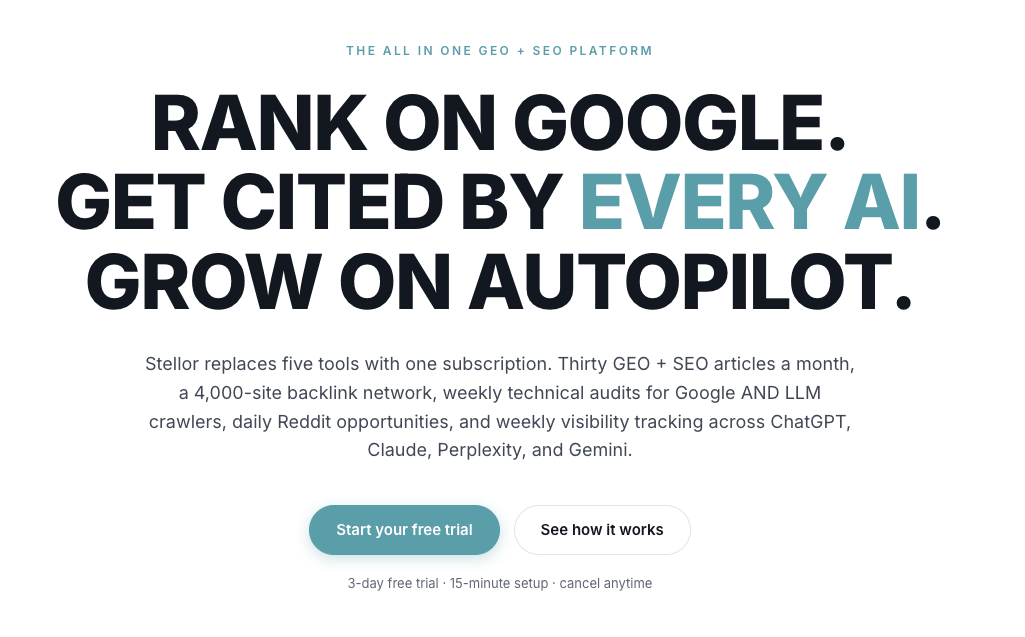
If you’re evaluating vendors against the checklist above, Stellor is worth putting on the shortlist because it’s built as one consolidated system rather than five stitched-together tools. The platform publishes 30 GEO and SEO-optimized articles a month, runs on a 4,000-site backlink network, performs weekly technical audits, surfaces daily Reddit engagement opportunities, and tracks AI visibility across ChatGPT, Claude, Perplexity, and Gemini.
Onboarding is built for exactly the kind of pilot this article recommends. A 15-minute setup captures a client’s services, locations, and brand voice, and Stellor returns a free AI Visibility Audit within 48 hours, including a 90-day content plan showing what publishes in the first 30, 60, and 90 days.
Metrics worth tracking in any pilot, whether you use Stellor or another vendor:
- Ranking movement on a defined set of target keywords
- AI citation rate across a fixed list of buyer prompts (a documented approach industry guides recommend testing over a 30 to 90 day window)
- Lead volume or form submissions tied to organic and AI-referred traffic
- Technical audit score trend week over week
Agencies considering resale should confirm reseller terms and IP ownership directly with any vendor before committing a client’s budget, and Stellor’s structure is designed with agency use in mind from the start, not bolted on afterward. For a look at how the AI visibility side plays out for local service clients specifically, see how AI-driven content and tracking increase visibility for service businesses.
How Should Agencies Position and Market This Service to Clients?
Don’t sell white-label AI SEO as “SEO, but with AI.” That framing undersells it and invites clients to compare you on price alone against every other SEO reseller program. Sell it as visibility across two systems: Google’s results page and the growing set of AI answer engines buyers now consult before they ever type a query into a search bar.
The strongest positioning angle is specificity. Instead of “we’ll improve your rankings,” say “we’ll get you cited when someone asks ChatGPT for the best [service] in [city].” That’s a concrete, testable promise most competing agencies aren’t making yet, because most haven’t built AI citation tracking into their reporting.
Case studies and before/after citation screenshots do more selling than any deck. Show a client the exact prompt a buyer might type, what the AI currently returns, and where their business is missing. That single demonstration usually closes more deals than a full slide presentation on domain authority.
Price anchoring matters too. If a client is used to paying $800 a month for generic SEO, don’t lead with a $2,500 managed tier. Start at the entry tier, prove the AI citation lift within 60 days, then upsell into growth or managed pricing once the results are visible in their own dashboard.
What Technical Integration Challenges Should Agencies Expect?
Embedding AI SEO tools into an existing agency stack rarely breaks cleanly on day one. The most common friction point is CMS access. Vendors need publishing permissions, and agencies juggling WordPress, Webflow, and custom-built client sites need a documented process for granting and revoking that access safely.
Schema and structured data implementation is the second common snag. Many agency websites, especially older client builds, lack the technical foundation to support FAQPage and HowTo schema cleanly, which means a technical cleanup pass often has to happen before AI-readiness work can even start.
llms.txt configuration is newer territory for most agencies, since it didn’t exist as a standard concern two years ago. It governs what AI crawlers can access on a site, and getting it wrong can either block legitimate AI crawlers or expose content an agency didn’t intend to surface.
Dashboard integration is the last piece, and it’s often underestimated. If a vendor’s reporting doesn’t export cleanly into whatever system your account managers already use, you’ll end up manually rebuilding reports every month, which erodes the entire efficiency argument for going white-label in the first place. Test this specific workflow before onboarding a single paying client, not after.
How Do You Educate Clients Who Don’t Understand AI SEO Yet?
Most clients still think of SEO as rankings and traffic. Explaining AI visibility requires a short, concrete analogy rather than a technical lecture: their business now has two front doors, the Google results page and the AI chat window, and both need active work.
The most effective education tool is a live demonstration. Open ChatGPT or Perplexity in a client meeting, type the exact question their buyers ask, and show what comes back. If a competitor gets named and they don’t, that’s a far more persuasive argument than any slide about GEO or AEO terminology.
Keep the vocabulary light in client-facing communication. Internally, your team can talk about AEO, GEO, and llms.txt configuration. Externally, translate that into plain outcomes: “we’re making sure AI recommends you when someone asks” lands better than any acronym.
Monthly reporting is also a teaching moment, not just a status update. Walking a client through their AI citation trend line, month over month, builds the kind of ongoing buy-in that turns a short-term contract into a multi-year relationship.
How Should Agencies Manage Dependency on a Third-Party AI SEO Vendor?
Relying on one vendor for a service you resell to dozens of clients creates concentration risk, and it’s worth planning for before it becomes a problem rather than after.
Start with a written service level agreement that specifies turnaround times, escalation paths, and what happens if the vendor misses a deadline during a critical client launch. Keep documentation of every deliverable and contract term outside the vendor’s own portal, so you’re never locked out of your own records if the relationship ends.
Diversifying isn’t always practical for a small agency, but at minimum, confirm your contract allows you to export all content, reports, and backlink data on request, ideally with no penalty for cancellation. An agency that retains full ownership of past deliverables, even after switching vendors, is in a far stronger negotiating position than one that doesn’t.
Finally, run periodic spot checks rather than assuming vendor quality stays constant. A partner that delivered excellent audits in month one can quietly cut corners by month eight if nobody’s checking. Build a quarterly review into your own internal calendar, separate from the vendor’s own reporting cadence.
Build In-House or Go White-Label? A Quick Decision Checklist
White-label makes sense when you lack in-house content or technical capacity, need to scale fast for new clients, or want to test AI SEO demand before hiring. Building in-house makes more sense only if you already have dedicated SEO staff and enough client volume to keep them fully utilized.
For a pilot, keep it small and time-boxed: one client, 30 to 60 days, a defined set of buyer prompts to test for AI citation, and a fixed content and technical deliverable schedule. Don’t pilot across five clients at once. You’ll lose the ability to isolate what’s actually working.
Success criteria should be decided before the pilot starts, not after. At minimum: measurable ranking movement on target terms, at least one confirmed AI citation gain across your test prompts, and a client who can clearly describe the value they’re getting when you ask them directly. If two of those three show up in 60 days, scale it. If none do, the vendor or the process, not the concept, is the problem.
— Cole
Try Stellor’s Agency-Ready AI SEO Platform
Most white-label options make you choose between a real service and a manageable price. Stellor is built to skip that trade-off. Instead of stitching together separate vendors for content, backlinks, audits, and AI visibility tracking, a single subscription replaces what typically requires multiple separate tools, including a content engine that publishes articles monthly and weekly technical audits calibrated for both Google and AI crawlers.
For agencies specifically, the appeal is speed to proof. A 15-minute setup captures a client’s services and brand voice, and Stellor returns a free AI Visibility Audit within 48 hours, complete with a 90-day content plan you can hand directly to a prospective client as part of your pitch. The product overview covers reseller structure and what’s included at each tier in more detail, and reviewing recent platform updates is a fast way to see what’s shipped recently.
The trial removes the usual risk of testing a new vendor: three days free, no credit card required. Run the audit on one client this week, compare the AI citation baseline against what you’re currently delivering, and decide from there whether it earns a spot in your resale lineup.
Sources
Technical claims in this article draw on official documentation and industry guides worth bookmarking. Google Search Central publishes the authoritative guidance on indexing, structured data, and technical SEO fundamentals that still apply whether you’re optimizing for Google’s results page or an AI crawler. Schema.org documents the structured data vocabulary, including FAQPage and HowTo types, that make content easier for both search engines and AI answer engines to parse and cite.
For broader context on where SEO and AI visibility are heading, the Nectar Blog’s rundown of 2025 SEO trends is a useful outside perspective on how quickly buyer behavior has shifted toward AI-assisted research. Industry explainers on white-label SEO packaging, referenced throughout this piece, are also worth revisiting when negotiating vendor contracts.
- White Label AI SEO Packages Built for Scalable Agency Growth | Dintellects
- What Is White Label SEO? The Secret To Help Agencies Grow
- Schema
FAQ
Is SEO dead now that AI answer engines exist?
No. Google still drives billions of searches daily, and ranking well remains valuable. What’s changed is that AI answer engines have added a second visibility channel agencies now need to track and optimize for alongside traditional rankings.
What is white-label SEO?
White-label SEO is a service model where one company performs the SEO work (audits, content, technical fixes, reporting) and another company, usually an agency, sells it to clients under its own brand name. The client never knows a third-party vendor did the underlying work.
What are white-label AI platforms?
They’re software or service providers that combine AI-assisted SEO production (content, audits, technical checks) with reseller terms, letting agencies rebrand the output and sell it to their own clients. Most bundle content, technical fixes, backlink work, and AI citation tracking into tiered packages.
Can you actually do SEO with AI?
Yes, for research, drafting, and monitoring at scale, but not as a fully autonomous process. Vendors and practitioners consistently recommend keeping human review in place for strategy and quality control, since AI can move fast on the wrong assumption just as easily as the right one.
How much should agencies charge for white-label AI SEO?
Most agencies mark up wholesale vendor pricing two to three times for retail pricing, landing entry-tier packages around $750 to $1,200 a month and managed tiers at $3,000 or more depending on scope.
How long does a white-label AI SEO pilot need to run?
A 30 to 60 day window is usually enough to see initial technical fixes, a first content wave, and an early AI citation baseline, with a fuller trend visible by day 90.