

TL;DR:
- Procedure page optimization involves structuring and configuring pages to rank for high-intent queries and convert visitors. Success depends on precise keyword intent mapping, schema markup, technical health, and ongoing measurement of performance. Prioritizing intent accuracy and structured data enhances rankings and AI citations, making optimization efforts more effective.
Procedure page optimization is the process of structuring, writing, and technically configuring a dedicated service or procedure page so it ranks for high-intent queries, earns rich results, and converts visitors into leads. Done right, it pulls in buyers who already know what they want, not casual browsers. Start by running a quick keyword intent check on your top procedure page right now — it takes under ten minutes and usually reveals the first gap.
Table of Contents
- How to optimize a procedure page: step-by-step workflow
- Your one-page checklist and a before/after content outline
- Tools and templates that speed up the work
- How long does procedure page optimization take?
- How to measure whether your optimization worked
- Key Takeaways
- The part most marketers skip
- Trystellor handles the heavy lifting so you don’t have to
- Useful sources
- FAQ
How to optimize a procedure page: step-by-step workflow
This sequence works whether you’re optimizing a single page or building a cluster of fifty.
- Map keyword intent. Identify the primary query (e.g., “tankless water heater installation cost”), supporting long-tail variants, and the buyer’s stage. Use Google Search Console’s query report and a tool like Semrush or Ahrefs to confirm search volume and intent.
- Structure the content. Lead with the procedure name and a one-paragraph summary. Follow with a numbered step sequence, a cost or timeline section, provider credentials, FAQs specific to that procedure, and a before-and-after gallery where relevant. Aim for at least 1,000 words of substantive content.
- Write the on-page elements. Title tag: 50–60 characters, procedure name + location or qualifier. Meta description: 140–155 characters, include a benefit and a CTA. H1 matches the title intent. Use H2s for major sections (What It Involves, Cost, Recovery, FAQs).
- Add schema markup. For most procedure pages,
Serviceschema is the right base type. Medical procedures can useMedicalProcedure. Home services often benefit fromHowTowhen the page walks through steps. AddFAQPageschema for the FAQ block. Reference schema.org for property definitions and Google Search Central for testing guidance. - Fix technical signals. Run a technical SEO audit covering page speed, mobile layout, HTTPS, clean URL structure, and internal linking. Compress images and add descriptive alt text.
- Add conversion elements. Include a visible CTA above the fold, provider credentials or certifications, financing options if relevant, and a realistic timeline so buyers know what to expect.
- Build internal links. Link from your main services page to each procedure page, and cross-link related procedures. For multi-city businesses, local SEO strategies recommend creating city-specific variants with local landmarks, testimonials, and city-specific FAQs.
Schema snippet example (Service + FAQPage):
{
  "@context": "https://schema.org",
  "@type": "Service",
  "name": "Tankless Water Heater Installation",
  "provider": { "@type": "LocalBusiness", "name": "Your Business" },
  "areaServed": "Chicago, IL",
  "mainEntityOfPage": {
    "@type": "FAQPage",
    "mainEntity": [{
      "@type": "Question",
      "name": "How long does installation take?",
      "acceptedAnswer": { "@type": "Answer", "text": "Most installs take 3–5 hours." }
    }]
  }
}
Pro Tip: Prioritize schema and intent mapping first. A page with correct schema and the right keyword intent will outperform a beautifully written page with no structured data every time.
Your one-page checklist and a before/after content outline
Use this checklist before publishing any procedure page:
- [ ] Dedicated URL per procedure (no shared pages)
- [ ] Primary keyword in title tag, H1, and first 100 words
- [ ] substantive content
- [ ] Numbered step sequence or “What It Involves” section
- [ ] FAQs with
FAQPageschema - [ ] Before-and-after gallery with compressed images and descriptive alt text
- [ ] Provider credentials or certifications visible
- [ ] Clear CTA above the fold
- [ ]
ServiceorMedicalProcedureschema validated in Google’s Rich Results Test - [ ] Fast mobile page speed
- [ ] Internal links from parent service page and related procedures
Before (weak outline):
- H1: “Our Services”
- One paragraph describing the procedure
- Generic contact form
After (optimized outline):
- H1: “Tankless Water Heater Installation in Chicago”
- Intro paragraph with primary keyword
- H2: “What the Installation Involves” (numbered steps)
- H2: “Cost and Timeline”
- H2: “Why Choose Us” (credentials, certifications)
- H2: “Frequently Asked Questions” (with FAQPage schema)
- Before-and-after photo gallery (compressed, alt-tagged)
- CTA: “Get a Free Installation Quote”
For med spa procedure pages, this structure maps directly to high-converting layouts with recovery timelines and gallery sections.
Tools and templates that speed up the work
| Category | Recommended Tools | What They Do |
|---|---|---|
| Keyword research | Google Search Console, Semrush, Ahrefs | Map query intent and volume |
| Schema validation | Google Rich Results Test, Schema Markup Validator | Confirm structured data is error-free |
| Page speed | Google PageSpeed Insights, GTmetrix | Identify load time issues |
| Image compression | Squoosh, TinyPNG | Reduce file size without quality loss |
| Content planning | Clearscope, Surfer SEO | Align content depth with top-ranking pages |
Title tag template: [Procedure Name] in [City] | [Business Name]
Meta description template: [Procedure Name] from [Business Name] in [City]. [Key benefit]. [CTA].
FAQ template: Three to five questions specific to cost, timeline, recovery, and credentials — each with a one-to-two sentence answer.
For trades businesses managing multiple procedure pages, operational guides on commercial plumbing maintenance show how maintenance schedules and clear process documentation translate directly into trustworthy page content.
How long does procedure page optimization take?
| Phase | Timeline | Typical Cost |
|---|---|---|
| Audit and keyword mapping | In-house and freelance options available | |
| Content build and schema | In-house and freelance options available | |
| Technical fixes | In-house and developer options available | |
| Indexation and initial data | Monitoring phase | |
| Measurable ranking movement | Ongoing phase | |
| Platform subscription available with monthly pricing options |
Pro Tip: The fastest win is almost always fixing schema errors on an existing page that already has impressions. Check Search Console’s “Enhancements” tab — errors there are blocking rich results you’re already close to earning.
How to measure whether your optimization worked
Track these KPIs in Google Search Console and Google Analytics:
- Impressions and clicks for the procedure page’s target query
- Click-through rate (CTR) — a well-optimized title and meta should push CTR above the category average
- Conversions (form fills, calls, bookings) attributed to organic traffic
- Time on page and scroll depth — low engagement signals a content mismatch
- Assisted conversions in GA4 to capture multi-touch paths
For AI citation tracking, run these sample prompts weekly across ChatGPT, Claude, Perplexity, and Gemini:
- “Best [procedure] provider in [city]”
- “How much does [procedure] cost in [city]?”
- “Who offers [procedure] near me?”
- “What should I expect from [procedure]?”
Record whether your business is named, which competitors appear instead, and how the answers change week over week. Trystellor automates this tracking across all four models and delivers a weekly citation report.
Key Takeaways
Procedure page optimization works when you combine correct keyword intent, structured content, valid schema, and consistent technical health — and measure all four.
| Point | Details |
|---|---|
| One page per procedure | Shared pages dilute ranking signals; each procedure needs its own URL and unique content. |
| Schema is non-negotiable | Service, MedicalProcedure, or HowTo schema plus FAQPage markup drives rich results and AI citations. |
| Measure intent-to-conversion | Track impressions, CTR, and conversions together — a gap between any two signals a specific fixable problem. |
| AI citation tracking matters | Query ChatGPT, Claude, Perplexity, and Gemini weekly with buyer prompts to monitor citation performance. |
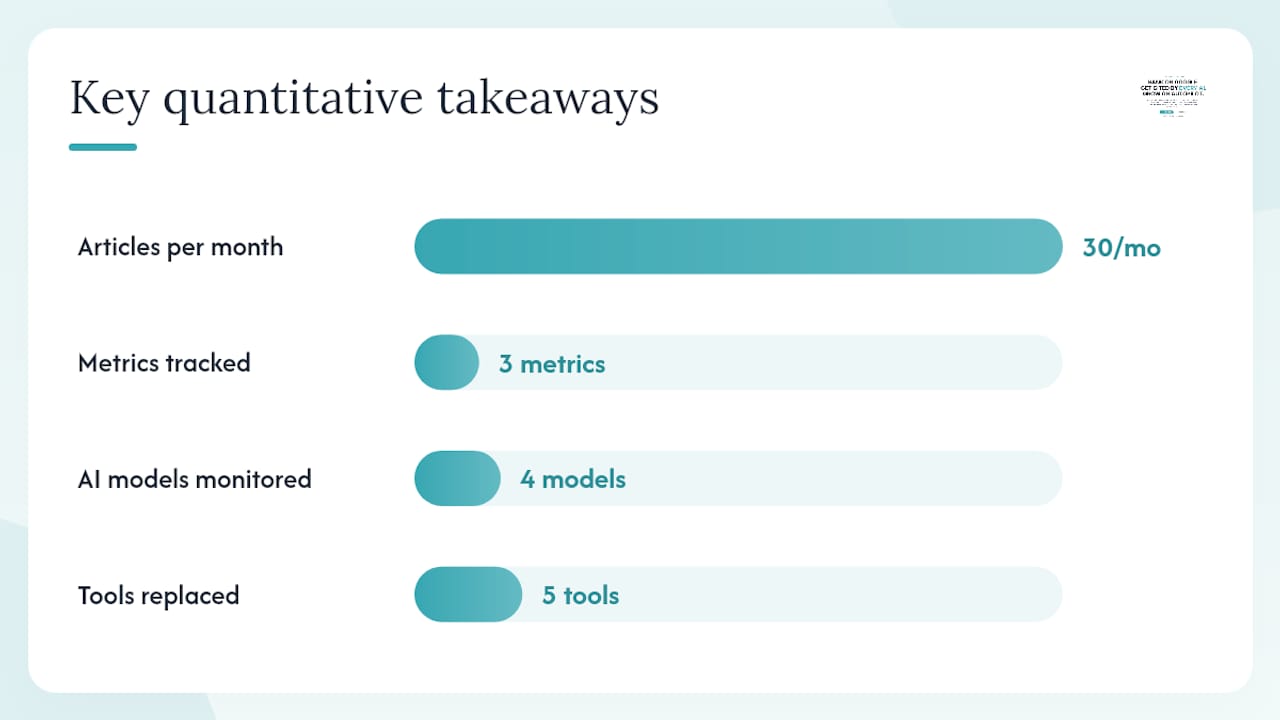
| Trystellor automates the workflow | 30 articles/month, weekly audits, backlink network, and LLM tracking replace five separate tools from $199/mo. |
The part most marketers skip
Most procedure page guides stop at “add schema and write 1,000 words.” That’s the floor, not the ceiling. The real differentiator is intent precision: the gap between a page that ranks for “knee replacement surgery” and one that ranks for “minimally invasive knee replacement recovery time Chicago” is not word count. It’s how specifically the page answers the question a buyer is actually typing.
The second thing most teams underestimate is the compounding effect of AI citation. A procedure page that gets cited by Perplexity or ChatGPT doesn’t just earn one referral. It earns trust signals that feed back into how those models rank sources over time. Schema and structured content are the mechanism, but consistent publishing volume is what builds the citation footprint fast enough to matter within a quarter.
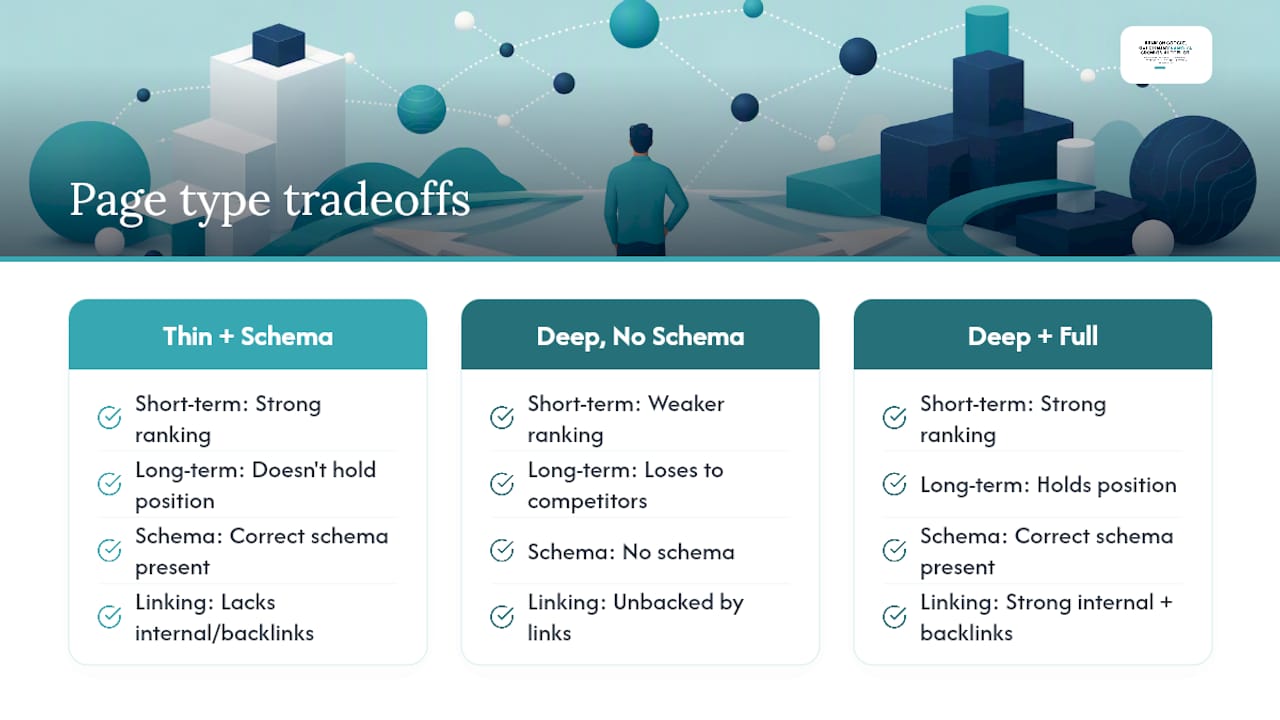
Speed versus depth is a real tradeoff. A thin page with correct schema will outperform a deep page with no schema in the short term. But a deep page with correct schema, strong internal linking, and a backlink profile behind it is what holds position when competitors catch up. Build for both, in that order.
Trystellor handles the heavy lifting so you don’t have to
Thirty procedure pages a month, built to rank on Google and get cited by AI, is a full-time job for most marketing teams. Trystellor delivers that output automatically, starting at $199/month, with no credit card required for the three-day free trial.
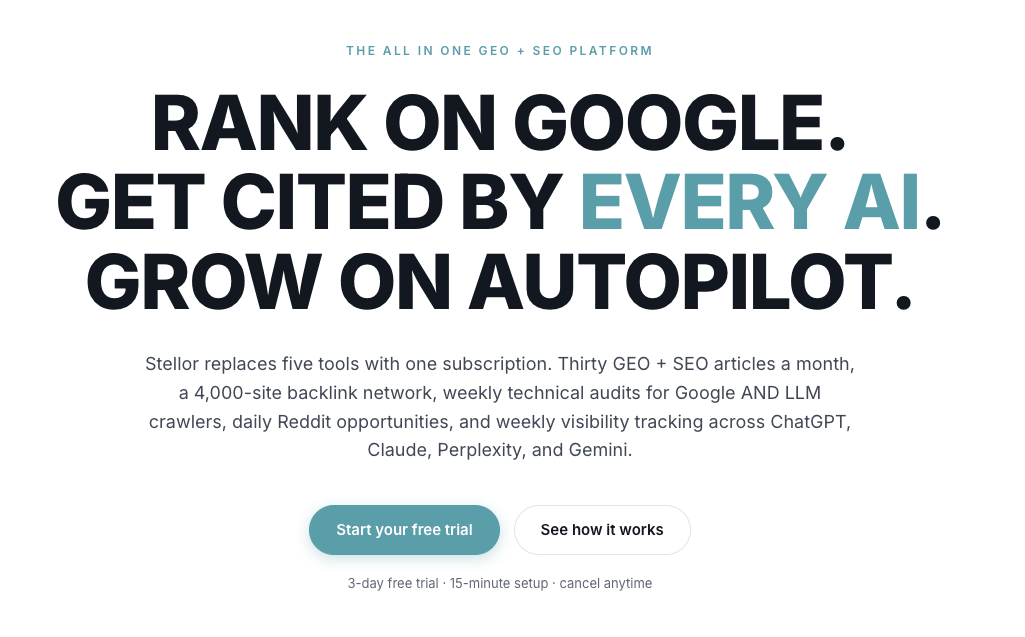
The platform covers every step in this guide: content production with schema, weekly technical audits with one-click fixes, a 4,000-site backlink network, and weekly AI citation reports across ChatGPT, Claude, Perplexity, and Gemini. Onboarding takes 15 minutes. Your free AI Visibility Audit, including a competitor benchmark and a 90-day action plan, arrives within 48 hours.
See exactly what’s included on the Trystellor product page and start your free trial today.
Useful sources
- SEO Strategies for High-Value Cosmetic Procedures | Article Estates
- What is process optimization? | IBM
- Stellor
- Product — Stellor
- essential seo audit checklist for local service businesses en | trystellor.com
- seo strategies local services en | trystellor.com
- seo for med spas local ranking guide for 2026 en | trystellor.com
FAQ
What does procedure page optimization mean?
Procedure page optimization is the process of structuring, writing, and technically configuring a dedicated service or procedure page to rank for high-intent queries, earn rich results, and convert visitors into leads.
How do I start optimizing a procedure page if I’m new to SEO?
Begin with a keyword intent check in Google Search Console to find the exact query your page should target, then add Service or FAQPage schema and confirm it validates in Google’s Rich Results Test.
Is AEO (Answer Engine Optimization) different from standard procedure page SEO?
AEO focuses specifically on getting your content cited by AI models like ChatGPT and Perplexity, while traditional SEO targets Google rankings. For procedure pages, the best practices overlap heavily: structured content, valid schema, and clear answers to buyer questions serve both goals.
What is process optimization in simple terms?
Process optimization means finding the inefficiencies in a workflow and fixing them systematically to get a better outcome with less wasted effort. Applied to web pages, it means auditing what’s broken, fixing it in order of impact, and measuring the result.
How long before a procedure page ranks after optimization?
Initial ranking movement typically appears within a few weeks of publishing an optimized page. Measurable conversion impact usually follows after, depending on domain authority and competition.