

TL;DR:
- Trystellor offers an all-in-one managed GEO solution for beginners, combining content, backlinks, audits, and LLM tracking for $199 per month. Academic studies show that combining citation addition, statistics, and fluency improvements can increase AI visibility by up to 40 percent. For fast results, starting with a free health check and implementing citation and technical fixes can produce measurable growth within 30 days.
For most beginners in the U.S., Trystellor is the strongest single starting point: 30 GEO-optimized articles per month, a 4,000-site backlink network, weekly technical audits, and LLM tracking across ChatGPT, Claude, Perplexity, and Gemini all for $199/month with a 3-day free trial and no credit card required. Academic benchmarks show that combining GEO methods like citation addition, statistics insertion, and fluency optimization can lift position-adjusted AI visibility by up to 30–40%. If you need enterprise analytics or already live inside Semrush, there are solid alternatives below.
Quick shortlist by use case:
- Best managed platform for SMBs: Trystellor ($199/mo, 3-day free trial)
- Best for enterprise analytics: Profound (deep GA integration, enterprise pricing)
- Best for existing Semrush users: Semrush AI Visibility Toolkit (add-on to current plan)
- Best free first step: Run a free AI visibility health check before committing to any paid tool
- Best for e-commerce brands: Goodie AI (SKU-level visibility reporting)
Table of Contents
- How we evaluated these generative engine optimization tools
- The top generative engine optimization tools for beginners: full comparison
- How to choose the right GEO tool for your situation
- Your 30–90 day plan to start winning AI citations
- Which GEO tool fits your business type?
- Security and data privacy considerations for GEO tools
- Key Takeaways
- The case for managed GEO over DIY monitoring
- Trystellor: the beginner’s shortcut to AI visibility
- Useful sources
- FAQ
How we evaluated these generative engine optimization tools
Picking the right generative AI optimization tool is harder than it looks. Coverage claims vary wildly, pricing ranges from free to $500+ per month, and “AI visibility” means something different to every vendor. Here is the framework used to build this list.
Evaluation criteria and approximate weights:
- AI visibility coverage (25%): Does the tool actually query ChatGPT, Claude, Perplexity, and Gemini, or just one or two? Coverage breadth is the single biggest differentiator.
- Reporting and attribution (20%): Can it distinguish a “source citation” (your URL is cited) from a general brand mention? That distinction determines whether you can act on the data.
- Beginner friendliness and onboarding time (15%): How long before a first-time user sees a meaningful report? Tools requiring developer setup or a 2-week onboarding call scored lower.
- Integrations (15%): Does it connect to Google Analytics, Search Console, or your CMS? Standalone tools create reporting blind spots.
- Pricing and ROI (15%): Entry-level cost, trial availability, and what you actually get at the base tier.
- Support and managed services (10%): Is there a human to call? Does the vendor offer done-for-you options or only self-serve docs?
Data sources: Live prompt checks across ChatGPT, Claude, Perplexity, and Gemini using 15 representative buyer queries per vertical; vendor trial testing; public tool documentation; practitioner guides from Backlinko; and published academic benchmarks from the ACM SIGKDD GEO-bench study.
Practical testing steps: Each tool was tested for prompt sampling (10–20 prompts per tool), citation capture (source citation vs. brand mention), and time-to-first-result. Tools that could not produce a usable report within 48 hours of signup scored lower on beginner friendliness.
Pro Tip: Use 10–20 representative prompts that mirror how your actual buyers ask questions. “Best [service] in [city]” and “recommend a [product category] under $X” are more useful than generic informational queries. A small, high-quality prompt set gives repeatable signals without runaway testing costs.
Limitations: Generative engines are black boxes. Results vary by vertical, query phrasing, and the day the prompt is run. No tool can guarantee citation placement, and all visibility scores are approximations based on sampled outputs.
The top generative engine optimization tools for beginners: full comparison
The table below covers all 28 tools on this list. Profiles for the most beginner-relevant options follow.
| Tool | Best for | Core features | Beginner friendliness | Entry price / trial | Support model |
|---|---|---|---|---|---|
| Trystellor | SMBs, local service businesses | AI visibility tracking, content engine (30 articles/mo), 4,000-site backlinks, weekly audits, Reddit opps, LLM tracking | 15-min setup, 48-hr audit | $199/mo, 3-day free trial (no card) | Managed / done-for-you |
| Profound | Enterprise analytics teams | Deep citation analytics, GA integration, conversion attribution | Moderate; enterprise onboarding | Enterprise pricing | Enterprise support |
| Semrush AI Visibility Toolkit | Existing Semrush users | AI-mode rank tracking, prompt triggers, large SEO database | Easy for Semrush users | Add-on to Semrush plan | Self-serve + docs |
| BrightEdge Generative Parser | Enterprise Google AI Overviews | Google-specific generative parsing, enterprise reporting | Complex; enterprise setup | Enterprise pricing | Enterprise support |
| AthenaHQ | Content teams, semantic scoring | Content depth scoring, action center, GEO/SEO bridge | Moderate | Not publicly listed | Self-serve |
| Writesonic / Writesonic GEO | Small teams, content + monitoring | AI content creation, citation gap detection, recommendations | Easy | Tiered plans; free trial available | Self-serve + chat |
| Otterly AI | SMBs, lean marketing teams | Mention monitoring, sentiment analysis, simple dashboards | Very easy | Budget-friendly tiers | Self-serve |
| Peec AI | Clean analytics teams | Source citation vs. mention scoring, straightforward reports | Easy | Not publicly listed | Self-serve |
| Goodie AI | E-commerce / DTC brands | SKU-level and product-level visibility reporting | Moderate | Not publicly listed | Self-serve |
| ZipTie.Dev | Technical / developer teams | Unlinked mention discovery, prompt automation | Low (developer-first) | Not publicly listed | Community / docs |
| Ahrefs Brand Radar | Ahrefs users, backlink-focused teams | Brand citation tracking, cited domain integration | Easy for Ahrefs users | Add-on to Ahrefs plan | Self-serve |
| Gumshoe.AI | Conversational monitoring | Multi-turn conversation mapping, hallucination flagging | Moderate | Not publicly listed | Self-serve |
| GetCito | Agencies, multi-LLM monitoring | Prompt-based checks across ChatGPT, Claude, others | Easy | Not publicly listed | Self-serve |
| KIVA | Content planning at scale | Query clustering, AI-ready outline generation | Moderate | Not publicly listed | Self-serve |
| Prerender.io | JS-heavy sites | Static HTML snapshots for AI crawler access | Easy for devs | Tiered plans | Self-serve + docs |
| Yotpo Discover | E-commerce brands | Product discovery, AI-driven recommendations | Moderate | Not publicly listed | Managed |
| InLinks | Content teams, entity SEO | Entity mapping, internal linking, schema | Moderate | Tiered plans | Self-serve |
| KAI Footprint | Brand monitoring | AI footprint tracking, mention analytics | Moderate | Not publicly listed | Self-serve |
| Addlly AI | Content teams | AI content generation, GEO-ready drafts | Easy | Tiered plans | Self-serve |
| SE Visible | Visibility analytics | AI search visibility scoring | Moderate | Not publicly listed | Self-serve |
| Rankscale AI | Agencies, rank tracking | AI rank tracking, prompt monitoring | Moderate | Not publicly listed | Self-serve |
| Evertune | Brand consistency teams | Brand tone monitoring, AI output consistency | Moderate | Not publicly listed | Self-serve |
| Semrush AIO | Semrush ecosystem users | Unified AI + SEO reporting | Easy for Semrush users | Bundled with Semrush | Self-serve |
| Authoritas | Agencies, enterprise SEO | Rank tracking, AI visibility, reporting | Moderate | Not publicly listed | Self-serve + support |
| Rankability | Content optimization | Content scoring, GEO recommendations | Easy | Tiered plans | Self-serve |
| Surfer SEO | Content writers, on-page SEO | Content scoring, NLP optimization, SERP analysis | Very easy | Tiered plans; free trial | Self-serve + chat |
| Morningscore | SMBs, gamified SEO | SEO health scoring, task-based interface | Very easy | Tiered plans; free trial | Self-serve |
| Semrush | Full SEO suites | Keyword research, backlinks, site audit, AI features | Moderate | Tiered plans; free trial | Self-serve + support |
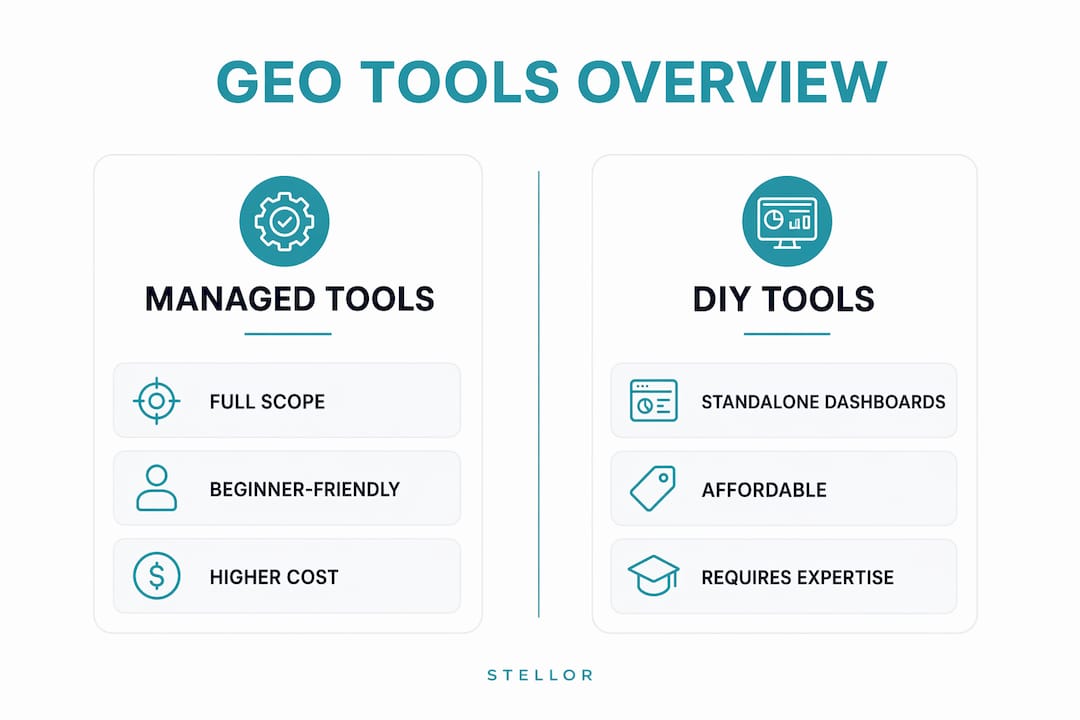
Trystellor: the managed option for beginners
Trystellor is the only tool on this list that handles content production, backlinks, technical audits, community monitoring, and LLM tracking under one subscription. For a beginner who does not want to stitch together five separate tools, that matters. The 15-minute onboarding captures your services, locations, and brand voice; a free AI Visibility Audit lands within 48 hours and covers 25 buyer prompts, a competitor benchmark, a technical site report, and a 90-day action plan. Pricing starts at $199/month, and you keep all published content even if you cancel.
Pros: Fully managed, no developer needed; broadest execution scope (content + backlinks + audits + Reddit + LLM tracking); fastest path to measurable AI citations for non-technical users. Cons: Less granular raw analytics than Profound; not the right fit if you only want a monitoring dashboard without content execution.
Profound: deep analytics for data-driven teams
Profound is built for enterprises that need to tie AI citations directly to traffic and revenue. Its Google Analytics integration lets teams attribute conversions to specific AI-engine citations, which no other tool on this list does as cleanly. The tradeoff is cost and complexity: onboarding takes longer, and pricing is enterprise-tier.

Pros: Best-in-class citation-to-conversion attribution; strong GA integration; detailed source vs. mention classification. Cons: Enterprise pricing puts it out of reach for most beginners; steeper learning curve.
Otterly AI and Peec AI: affordable monitors for lean teams
Otterly AI is one of the most beginner-friendly standalone monitors available. Its dashboards are clean, sentiment analysis is built in, and budget tiers make it accessible for small marketing teams that just want to know when and where their brand appears in AI outputs. Peec AI takes a slightly more analytical angle, separating “source citations” (your URL is referenced) from general visibility mentions, which gives content teams a cleaner signal for what is actually working.
Surfer SEO and Morningscore: familiar on-ramps
Both Surfer SEO and Morningscore score very high on beginner friendliness. Surfer’s content editor is one of the most widely used on-page optimization tools in the market, and its NLP scoring gives writers clear targets. Morningscore’s gamified task interface makes SEO feel less like a spreadsheet exercise. Neither is a pure GEO tool, but both are solid starting points for beginners who want to build the content quality that GEO visibility depends on.

Tools worth knowing: the rest of the field
Writesonic GEO combines AI content generation with citation gap detection, making it useful for small teams that want one tool for both writing and monitoring. AthenaHQ’s content depth scoring is genuinely useful for content teams that want semantic guidance. KIVA automates query clustering and outline generation, which saves hours on content planning. Prerender.io solves a specific technical problem: if your site is JavaScript-heavy, AI crawlers may never see your content, and Prerender’s static snapshots fix that. For e-commerce teams, Goodie AI’s SKU-level reporting and Yotpo Discover’s product discovery features address use cases no general GEO tool covers well. ZipTie.Dev, Gumshoe.AI, GetCito, Rankscale AI, SE Visible, KAI Footprint, Evertune, Addlly AI, Authoritas, Rankability, InLinks, Ahrefs Brand Radar, Semrush, BrightEdge, and the Semrush AIO and AI Visibility Toolkit round out the field, each serving a specific niche from developer-first prompt automation to enterprise-grade rank tracking.
How to choose the right GEO tool for your situation
The GEO tool market ranges from free validators to enterprise platforms starting around $499/month. Before you spend anything, work through this checklist.
Decision checklist:
- Define your primary use case. Are you monitoring brand mentions, producing citation-ready content, fixing technical crawlability, or all three? A monitoring-only tool will not help if your content is the problem.
- Confirm AI engine coverage. Ask the vendor exactly which engines they query: ChatGPT, Claude, Perplexity, Gemini, or a subset. Coverage claims are often the biggest gap between tools.
- Check reporting fidelity. Can the tool distinguish a source citation (your URL is cited) from a general brand mention? That distinction determines whether you can act on the data.
- Map integration needs. Does it connect to Google Analytics, Search Console, or your CMS? A tool that cannot feed data into your existing stack creates a reporting silo.
- Set a budget band. Free validators exist for initial checks. SMB-facing tools run $29–$300/month. Enterprise platforms start around $499/month and up.
- Assess your internal skillset. If you do not have a developer or a dedicated SEO analyst, a managed platform will produce results faster than a self-serve dashboard.
Questions to ask vendors during a trial:
- What AI engines do you query, and how often?
- Can you show me a sample report distinguishing source citations from brand mentions?
- How do you handle unlinked mentions?
- What is your SLA for audit delivery?
- What integrations do you support out of the box?
Red flags to watch for:
- No trial period or sample report available before purchase
- Opaque citation methodology (“we use proprietary AI scoring” with no explanation)
- No integration with Google Analytics or Search Console
- Onboarding requires a multi-week enterprise kickoff before you see any data
- Coverage limited to one AI engine presented as “full AI visibility”
Quick scoring rubric (rate each dimension 1–5 during your trial):
| Dimension | Your score (1–5) |
|---|---|
| Citation vs. | mention clarity |
Any tool scoring below 3 on AI engine coverage or citation clarity is a poor fit regardless of price.
Your 30–90 day plan to start winning AI citations
Getting cited by AI engines is not a one-week project, but you can see measurable movement in 30 days if you prioritize the right activities.
Days 1–7: Audit and baseline
- Run a free AI visibility health check to see where you currently stand across major engines.
- Build a prompt set of 10–20 queries your buyers actually use. Include location-specific and category-specific variants.
- Record your baseline: which prompts mention you, which cite your URL, and which ignore you entirely.
- Run a technical audit. Check schema markup, llms.txt configuration, page speed, and mobile responsiveness. AI crawlers cannot cite pages they cannot read.
Days 8–21: Quick content fixes
- Add credible citations and statistics to your top 5 pages. Academic GEO research shows that combining quotation addition and statistics addition produces some of the strongest visibility gains with minimal content changes.
- Add FAQ schema to service and product pages. Structured data helps AI engines extract and cite specific answers.
- Fix any crawlability issues surfaced in the audit. If your site is JavaScript-rendered, implement static snapshots via a tool like Prerender.io.
Pro Tip: Pair “Citation Addition” (linking to credible external sources within your content) with “Statistics Addition” (embedding relevant data points) on the same page. Research shows this combination outperforms either tactic alone, often by a meaningful margin.
Days 22–45: Content production and community
- Publish at least 4–6 new GEO-optimized pages targeting specific buyer queries. Service pages, comparison guides, and FAQ hubs tend to earn citations faster than general blog posts.
- Identify 3–5 high-intent Reddit threads where your category is discussed. Contribute genuinely. Community presence in the channels AI models quote is a real visibility signal, not just a traffic tactic.
- Set up your llms.txt file if you have not already. This signals to AI crawlers which pages are most authoritative on your site.
Days 46–90: Measure and iterate
- Re-run your 10–20 prompt set and compare citation rates to your baseline.
- Track position-adjusted word count: are your pages appearing earlier in AI responses?
- Identify which content types earned the most citations and double down on that format.
- Review your backlink profile. Authority signals still influence which sources AI engines trust and cite.
Expected early wins: citation rate improvement on 2–4 prompts within 30 days; broader mention coverage across engines by day 60; measurable traffic uplift from AI referrals by day 90. For a deeper look at how AI search affects local discovery, the mechanics are worth understanding before you build your prompt set.
Which GEO tool fits your business type?
Not every tool fits every buyer. Here is how the field breaks down by business type.
SMBs and local service businesses need a tool that produces results without requiring a dedicated analyst. Trystellor is the clearest fit: managed content production, backlinks, and LLM tracking in one subscription means you are not coordinating five vendors. Otterly AI and Morningscore are good self-serve alternatives if budget is the primary constraint. For practical implementation examples, the guide on harnessing AI for local SEO visibility walks through the tactics that move the needle fastest for service businesses.
Agencies managing multiple clients need multi-client dashboards, white-label reporting, and prompt monitoring across several LLMs. GetCito, Rankscale AI, and Authoritas are built with agency workflows in mind. Trystellor also supports agency reseller accounts for teams that want to offer managed GEO as a service.
Enterprise teams running large content operations need the depth of Profound or BrightEdge Generative Parser. Profound’s citation-to-conversion attribution is genuinely enterprise-grade. BrightEdge’s parser is purpose-built for Google AI Overviews at scale. Semrush AI Visibility Toolkit and Semrush AIO are strong choices for enterprises already invested in the Semrush ecosystem.
E-commerce and DTC brands have a specific problem: general GEO tools track brand mentions, but product-level visibility is what drives purchases. Goodie AI’s SKU-level reporting fills that gap. Yotpo Discover adds AI-driven product discovery on top of its existing review and loyalty infrastructure. For Shopify-based stores, the AI tools for Shopify SEO roundup covers complementary tools worth pairing with a GEO monitor.
Security and data privacy considerations for GEO tools
GEO tools query live AI engines using prompts that often include your brand name, competitor names, and sometimes customer-facing language. Before you sign up, ask these questions.
Data handling: Does the tool store your prompt queries and the AI responses it captures? If so, where, and for how long? Some tools log every prompt and response for benchmarking purposes, which means your competitive intelligence is sitting on a third-party server.
API key security: Tools that integrate with Google Analytics or Search Console require OAuth access. Confirm the vendor uses read-only scopes and does not request write permissions unless the feature explicitly requires it.
Content ownership: For tools that generate or publish content on your behalf, confirm you retain full ownership of all published assets. Trystellor’s terms explicitly state that customers keep all content produced, even after cancellation.
Regulated industries: Healthcare, legal, and financial services teams need to confirm that any AI-generated content goes through a human review workflow before publication. Trystellor supports review workflows for regulated industries. Most self-serve monitoring tools do not offer this.
Vendor SOC 2 status: Enterprise buyers should ask whether the vendor holds SOC 2 Type II certification. For SMBs, at minimum confirm the vendor uses encrypted data transmission and does not sell query data to third parties.
The schema.org structured data standards are publicly documented and vendor-neutral. Implementing them correctly is a privacy-safe way to improve AI crawlability without sharing any sensitive data with a third-party tool.
Key Takeaways
The most effective approach to generative engine optimization combines managed content execution, technical fixes, and LLM tracking from day one, with Trystellor covering all three for U.S. beginners at $199/month.
| Point | Details |
|---|---|
| GEO visibility gains are measurable | Combining citation, statistics, and fluency optimizations can lift AI visibility by up to 30–40% on benchmark tests. |
| Coverage breadth is the key differentiator | Confirm a tool queries ChatGPT, Claude, Perplexity, and Gemini before committing to any paid plan. |
| Start with a free health check | Run a free AI visibility check first to establish a baseline before spending on a paid platform. |
| Beginners need execution, not just monitoring | Tools that combine content production with tracking produce faster results than dashboards alone. |
| Trystellor for U.S. beginners | At $199/mo with a 3-day free trial, Trystellor covers content, backlinks, audits, and LLM tracking in one subscription. |
The case for managed GEO over DIY monitoring
Most GEO tool roundups treat every option as equivalent: pick a dashboard, watch your citations, adjust your content. That framing misses the real bottleneck for most beginners. Monitoring tells you where you are not showing up. It does not fix the problem.
The businesses that move fastest in AI search are the ones publishing consistent, citation-ready content at volume, building genuine authority signals through backlinks and community presence, and keeping their technical foundations clean enough for AI crawlers to actually read the pages. A monitoring dashboard alone does none of that. It just tells you the score.
That is why the managed model matters for beginners specifically. You do not need to become an expert in schema markup, llms.txt configuration, and prompt engineering simultaneously. You need a system that handles the execution while you focus on your actual business. The self-serve tools on this list are genuinely useful, but they require a level of ongoing attention that most small teams cannot sustain.
The one caveat: if you are an enterprise team with dedicated analysts, Profound’s attribution depth or BrightEdge’s Google-specific parsing may justify the added complexity. But for the vast majority of U.S. marketers starting out with GEO, the managed approach produces results faster with less risk of stalling on setup.
Trystellor: the beginner’s shortcut to AI visibility
Most beginners spend weeks comparing tools and months waiting for results. Trystellor cuts both timelines. For $199/month, you get 30 GEO and SEO-optimized articles published to your CMS every month, a 4,000-site backlink network building authority on your behalf, weekly technical audits covering both Google and AI crawler requirements, daily Reddit opportunities surfaced for your category, and LLM tracking across ChatGPT, Claude, Perplexity, and Gemini. Setup takes 15 minutes. Your free AI Visibility Audit, covering 25 buyer prompts and a full competitor benchmark, arrives within 48 hours.
In the first 30 days, you get your audit, your first batch of published articles, and your initial citation baseline. By day 90, most customers see measurable citation growth across multiple AI engines and a compounding content library that keeps working without ongoing manual effort. No credit card is required for the trial, and you keep everything published even if you cancel.
Start your 3-day free trial at the Trystellor product page and see exactly where you stand in AI search before you spend a dollar.
Useful sources
- GEO: Generative Engine Optimization, ACM SIGKDD 2024 — The foundational academic study on GEO methods, including the GEO-bench benchmark showing 30–40% visibility improvements from combined tactics.
- Multi-Factor Brand-Recognition Audit for AI Answer Engines, arXiv — Open instrument and protocol for measuring generative visibility; source for quotation and statistics addition findings.
- Generative Engine Optimization, Wikipedia — Overview of GEO terminology, including AEO, LLMO, and AI SEO, and Google’s 2026 documentation on generative features.
- Generative Engine Optimization: How to Win in AI Search, Backlinko — Practitioner guide covering reputation signals, unlinked mentions, and community presence as GEO tactics.
- Best GEO Tools for Generative Engine Optimization in 2026, Tripledart — Tool survey covering pricing ranges, feature comparisons, and free validator options across the GEO market.
- schema.org — Authoritative reference for structured data standards that improve AI crawler readability.
- Trystellor product page — Full feature list, pricing, and trial details for the Trystellor GEO + SEO platform.
- AI search changing local business discovery, Trystellor blog — Explains how AI search engines surface local businesses and where GEO fits into a local marketing strategy.
- Measurable SEO results for local service businesses, Trystellor blog — Measurement and attribution guidance for tracking GEO and SEO performance together.
FAQ
What is generative engine optimization and how does it differ from SEO?
Generative engine optimization (GEO) is the practice of making your content more likely to be cited or quoted by AI answer engines like ChatGPT, Claude, Perplexity, and Gemini. Traditional SEO targets Google’s ranked blue-link results; GEO targets the AI-generated summaries that increasingly appear before those links.
Which GEO tool is best for beginners with no technical background?
Trystellor is the strongest choice for non-technical beginners: 15-minute setup, a free 48-hour AI Visibility Audit, and fully managed content production and LLM tracking starting at $199/month with a 3-day free trial.
How long does it take to see results from GEO optimization?
Most businesses see measurable citation rate improvement on 2–4 prompts within the first 30 days when combining technical fixes, citation-ready content, and community presence. Broader traffic uplift from AI referrals typically appears by day 90.
Do GEO tools cover all major AI engines or just one?
Coverage varies significantly. Some tools query only one or two engines. Before committing, confirm the tool actively monitors ChatGPT, Claude, Perplexity, and Gemini. Tools that cover only one engine give an incomplete picture of your AI visibility.
What is the difference between a source citation and a brand mention in GEO?
A source citation means an AI engine referenced your specific URL as a source. A brand mention means your name appeared in the response without a link. Source citations carry more authority and are harder to earn; tools like Peec AI and Profound explicitly separate the two metrics.
How much do GEO tools typically cost?
Free validators exist for initial checks. SMB-facing tools generally run $29–$300/month. Enterprise platforms start around $499/month and up. Trystellor’s entry tier is $199/month and includes content production, backlinks, and LLM tracking, replacing what would otherwise require multiple separate subscriptions.