

TL;DR:
- You can take control of your SEO without an agency or a large budget by following a clear process and using free tools. Focusing on technical health, matching content to search intent, and monitoring key metrics over time leads to sustainable search visibility. Regular, disciplined efforts in technical fixes, content optimization, and off-page signals yield long-term results for small businesses.
If you want to take control of your own SEO, you do not need an agency or a five-figure budget. You need a clear process, a few free tools, and the discipline to work through it consistently. Search engine optimization (SEO) is the practice of making your website visible to people who are actively searching for what you sell. This guide breaks that practice into concrete phases you can manage yourself, from fixing the technical foundation to measuring results in Google Search Console.
Table of Contents
- Key Takeaways
- Take control of your own SEO: what to do first
- How to execute your DIY SEO strategy step by step
- How to monitor your SEO progress
- Common mistakes that stall DIY SEO results
- What results to expect and when
- My honest take on DIY SEO for small businesses
- How Trystellor can support your SEO management
- FAQ
Key Takeaways
| Point | Details |
|---|---|
| Start with technical health | Fix crawl and indexing issues before creating new content or chasing rankings. |
| Match content to search intent | Write pages around what your customers actually search for, not what you assume they want. |
| Monitor the right metrics | Track clicks, impressions, CTR, and average position in Google Search Console weekly. |
| Avoid common beginner traps | Keyword stuffing, vague titles, and ignoring off-page signals are the fastest ways to stall progress. |
| SEO compounds over time | Consistent effort over months outperforms any one-time optimization sprint every time. |
Take control of your own SEO: what to do first
Before you write a single new page or chase a single keyword, you need the right tools and a realistic starting point. Think of this as the plumbing behind the walls of your digital presence. If the pipes are broken, nothing you install on top will work properly.
The tools you actually need:
| Tool | Main function | Cost |
|---|---|---|
| Google Search Console | Crawl status, indexing, clicks, impressions, CTR | Free |
| Google Keyword Planner | Search volume and keyword ideas | Free |
| Ubersuggest (free tier) | Competitor keyword gaps, basic site audit | Free |
| Google Analytics 4 | Traffic sources, user behavior, conversions | Free |
| Schema.org markup validator | Structured data testing | Free |
Start by verifying that Google can actually find and read your pages. Open Google Search Console, submit your sitemap, and check the Coverage report for any crawl errors or excluded pages. A page Google cannot crawl is a page that cannot rank, no matter how good the content is. For a full walkthrough of what to fix first, the SEO audit checklist from Trystellor covers every technical check in order.
Set measurable goals before moving forward. “Rank higher” is not a goal. “Appear on page one for ‘emergency plumber Austin’ within 90 days” is.
Pro Tip: Connect Google Search Console to your domain property, not just the URL prefix. The domain property captures all subdomains and protocol variants, giving you a complete picture of your site’s search performance from day one.
How to execute your DIY SEO strategy step by step
Effective DIY SEO treats the process as distinct phases: fix crawl and indexing first, then align content with customer searches, then improve site structure, then earn external authority, then measure everything. Skipping ahead creates problems you cannot diagnose.
Here is the sequence that produces results:
- Confirm crawlability. In Google Search Console, use the URL Inspection tool on your five most important pages. If they are not indexed, fix the issue before anything else.
- Research keywords by intent. Use Google Keyword Planner to find what your customers search for. Group queries by intent: informational (how does X work), navigational (brand name searches), and transactional (hire X near me). Your money pages target transactional queries.
- Audit and update existing content. Find pages you already have that target the right queries but are underperforming. Rewriting a weak existing page is almost always faster than publishing a new one.
- Create new pages around gaps. If you have no page targeting a high-value transactional query, build one. Each page needs a unique, descriptive title that contains the primary keyword naturally. Vague titles like “Services” do nothing for rankings or click-through rates.
- Build internal links. Link from high-traffic pages to the pages you want to rank. This signals to Google which pages matter most and helps users find related content. For a deeper look at local SEO fundamentals, including how internal linking applies to service area pages, Trystellor has a practical guide worth bookmarking.
- Earn off-page signals. You cannot control who links to you, but you can influence reviews and mentions by asking satisfied customers for Google reviews, submitting your business to reputable directories, and creating content others want to reference.
Pro Tip: Sort your Search Console queries by impressions, then look for pages ranking between positions 8 and 15. These are your fastest wins. A stronger title tag and a more specific meta description can move those pages onto page one without a single new backlink.
Here is how each SEO phase maps to its objective and tools:
| Phase | Objective | Primary tools |
|---|---|---|
| Technical foundation | Pages crawled and indexed correctly | Google Search Console, site audit tool |
| Keyword targeting | Match content to real buyer searches | Google Keyword Planner, Ubersuggest |
| Content optimization | Pages that satisfy intent and rank | Google Docs, CMS editor |
| On-page SEO | Unique titles, internal links, clean structure | CMS, schema.org validator |
| Off-page influence | Reviews, citations, editorial links | Google Business Profile, email outreach |
| Measurement | Identify what is working and what to fix | Google Search Console, Google Analytics 4 |
How to monitor your SEO progress
Google Search Console is the central tool for anyone who wants to manage their own SEO. The Performance report shows four core metrics: clicks (users who visited your site from search), impressions (how often your pages appeared in results), CTR (the percentage of impressions that turned into clicks), and average position (your ranking trend over time). Understanding these four metrics is what separates business owners who improve from those who guess.

Use filters aggressively. Break down performance by query, by page, by device, and by date range. Comparing the last 28 days against the same period three months ago tells you whether your changes are working. Google Search Console’s AI-powered configuration feature now lets you describe the analysis you want in plain language, which saves significant time setting up custom reports.
Key metrics to watch every week:
- Clicks: The most direct measure of SEO-driven traffic. A flat or falling trend after publishing new content means something is wrong with title, intent alignment, or indexing.
- Impressions: Rising impressions with flat clicks usually means your titles are not compelling enough to earn the click.
- CTR by query: If a query generates hundreds of impressions but a CTR below 2%, rewrite the page title and meta description to better match the searcher’s likely intent.
- Average position trends: A position moving from 14 to 8 over 60 days is a signal to push harder on that page. Add internal links to it and refresh the content.
- Index coverage errors: Check this monthly. Newly broken pages or accidentally blocked content can quietly destroy traffic you have already earned.
For more on interpreting key SEO metrics in a business context, Trystellor’s guide walks through what each number actually means for local service companies.
Pro Tip: Export your Search Console data to a Google Sheet monthly and keep a running log. Patterns are invisible in a dashboard. They become obvious in a spreadsheet with 12 months of rows.
Common mistakes that stall DIY SEO results
Most self-managed SEO efforts do not fail because of missing knowledge. They fail because of repeating a small set of avoidable errors. Recognize these before they cost you months of progress.
- Optimizing for rank instead of intent. A page ranking number three for a query that does not match what the searcher actually wants will have terrible engagement signals. Focus on user intent and conversion, not just position.
- Keyword stuffing. Repeating a phrase twelve times in 500 words does not help rankings. It hurts them. Use the primary keyword naturally and support it with related terms.
- Duplicate or vague titles. Two pages with the same title tag confuse Google and split your authority. Every page gets one unique, descriptive title.
- Ignoring off-page signals. Your Google Business Profile, the consistency of your name and address across directories, and the velocity of your reviews all feed local rankings. Neglecting them caps what on-page work can achieve.
- Chasing AI-specific hacks. Google’s 2026 guidance confirms that foundational SEO, not niche AI tricks, remains the most reliable path to visibility. Quality content and technical health still outperform any shortcut.
- Neglecting broken links. A 404 error on a page that used to earn traffic is a silent leak. Audit for broken links quarterly using a free crawler.
Pro Tip: Keep your SEO work sustainable by batching tasks. Dedicate one hour per week to Search Console analysis, one session per month to content updates, and one quarterly review to technical audits. Consistency beats intensity.
What results to expect and when
SEO does not produce overnight results. Understanding the actual timeline keeps you from abandoning a strategy that is working.
Here is what a realistic progression looks like for a small business starting from scratch or from a weak baseline:
- Weeks 1 to 4: Technical fixes indexed, Search Console set up, first keyword-targeted pages live. No meaningful ranking movement yet.
- Months 2 to 3: Google starts crawling updated content more frequently. Some pages enter rankings between positions 15 and 30 for target queries.
- Months 3 to 6: Pages with strong on-page SEO and growing internal link equity begin moving toward page one. Impressions rise noticeably. First conversions from organic traffic appear.
- Month 6 and beyond: Compounding effect kicks in. Each new page adds to topical authority. SEO progress accelerates with regular audits and consistent content updates.
The businesses that see the best long-term results treat SEO the same way they treat bookkeeping: a regular, non-negotiable business process, not a project with an end date.
Pro Tip: Celebrate small wins. Screenshot your first page-one ranking. Note the first month organic traffic surpasses a round number. These markers keep you motivated through the slow middle period that discourages most business owners.
My honest take on DIY SEO for small businesses
I have watched hundreds of small business owners approach SEO one of two ways. The first group treats it like a mystery, outsources everything, and never builds a real understanding of what is driving results or what to fix when traffic drops. The second group starts with the basics, stays patient, and compounds their knowledge over 12 months until they have a genuine competitive asset.
In my experience, the single biggest mistake newcomers make is skipping the technical foundation to go straight to content. They publish ten new blog posts on a site Google cannot crawl properly and wonder why nothing moves. Fix the crawl issues first. Understanding keyword targeting for local businesses matters, but only after Google can actually read your pages.
The other thing I have learned is that SEO control is not binary. You fully control your on-page decisions: your titles, your content, your internal links, your technical setup. You influence but do not control off-page signals like backlinks and reviews. Most beginners confuse what they can act on directly with what they can only nudge. That distinction changes your entire approach to prioritizing time.
My honest advice: spend your first 90 days entirely on things you control. Get the technical foundation right. Write pages that match real buyer intent. Build a clear internal linking structure. Only then start investing energy in outreach and link building. The compound returns on that sequence are real, and AI-assisted SEO tools can accelerate each phase once the foundation is solid.
— Cole
How Trystellor can support your SEO management
Managing SEO yourself is absolutely achievable, and the process in this article gives you a real foundation. But there is a point where manual audits, content production, and backlink tracking across five separate free tools starts consuming hours you do not have.
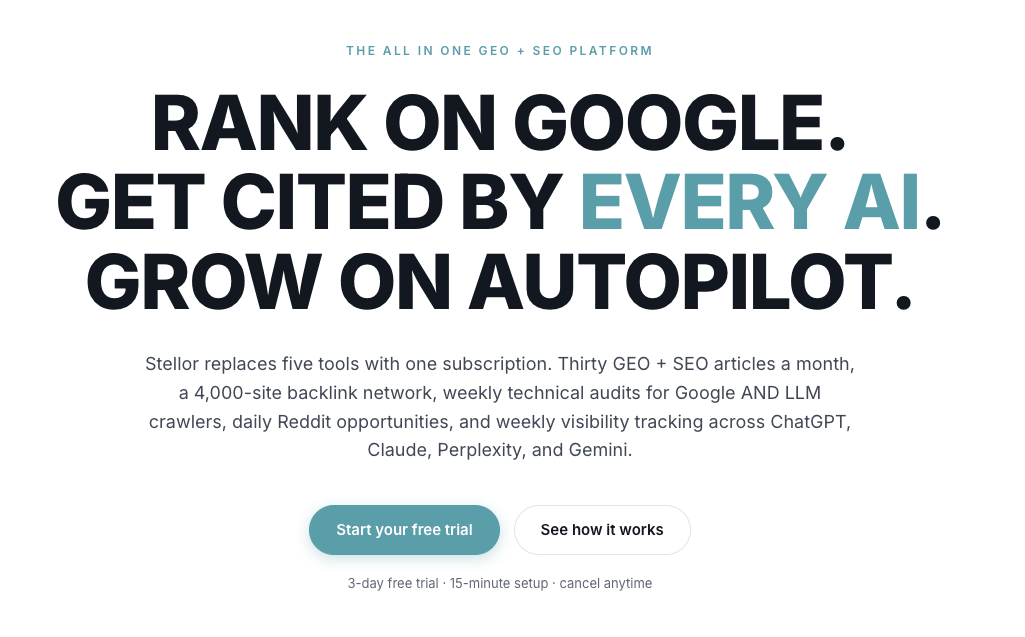
That is where Stellor’s GEO + SEO platform fits in. For $199 per month, Trystellor replaces five separate subscriptions: a content tool, a backlink service, a technical auditor, a community engagement workflow, and an AI visibility tracker. The platform publishes 30 optimized articles per month to your CMS, runs weekly technical audits with one-click fixes, manages a 4,000-site backlink network, and tracks your citations across ChatGPT, Claude, Perplexity, and Gemini every week. A three-day free trial requires no credit card. You keep all content produced even if you cancel. Visit trystellor.com to see the free AI Visibility Audit that maps exactly where you stand today.
FAQ
How long does DIY SEO take to show results?
Most small businesses see initial ranking movement within 2 to 3 months and meaningful organic traffic growth by month 6, provided technical issues are resolved and content is consistently updated.
What is the most important free tool for managing your own SEO?
Google Search Console is the most valuable free tool available. It shows you which queries trigger your pages, your click-through rates, and any crawl or indexing errors that need fixing.
How do I find the right keywords without paid tools?
Use Google Keyword Planner to identify search volume and keyword ideas for free. Focus on transactional queries that match buyer intent, such as “hire” or “near me” phrases, rather than purely informational terms.
Does Google still reward foundational SEO over AI-specific tactics?
Yes. Google’s 2026 guidance confirms that quality content and core ranking factors remain the most reliable path to visibility, making foundational SEO best practices more important than chasing AI-specific tricks.
How often should I audit my website’s SEO?
Run a technical audit quarterly and review your Google Search Console Performance report at least once per week. Monthly content updates on your most important pages will compound results faster than infrequent large overhauls.