

Structured data for AI means organizing your content and records into machine-readable formats, such as JSON-LD, Schema.org types, and clean tabular fields, so AI systems can verify facts and cite them with confidence. Instead of an AI model guessing at meaning inside a paragraph, it reads explicit, labeled facts: this is a Product, this is its price, this is the Organization that sells it. The quickest win: run your top pages through the Schema or Google’s Rich Results Test, then set an AI data schema on your core analytics reports in Power BI so Copilot knows which fields to trust.
Three things to do this week:
- Audit your five highest-traffic pages for existing schema gaps.
- Add
sameAslinks connecting your entities to established knowledge graphs. - Set an AI data schema in Power BI to flag priority fields for Copilot.
A platform like Stellor builds this markup automatically across every page it publishes, which matters because manual schema work rarely survives a site redesign.
Key Takeaways
Structured data works because it converts ambiguous content into verifiable facts that AI systems can confidently retrieve, cite, and act on.
| Point | Details |
|---|---|
| Define your data types | Structured sources need the least cleanup and deliver the fastest AI wins; unstructured data needs extraction pipelines first. |
| Choose JSON-LD for web pages | Google and most AI crawlers prefer JSON-LD because it stays separate from visible HTML. |
| Build a schema checklist | Audit, map, implement, validate, version, and monitor on a quarterly cycle. |
| Set an AI data schema in Power BI | Flagging priority fields for Copilot reduces ambiguous or incorrect answers. |
| Watch for content/markup mismatches | Parity between visible text and JSON-LD is what keeps AI systems trusting your source. |
| Automate the ongoing work | Stellor builds schema into every published page and runs weekly audits to catch drift automatically. |
Table of Contents
- How Do Structured, Semi-Structured, and Unstructured Data Differ?
- Which Formats and Standards Should You Use?
- Why Does Structured Data Improve AI Answers?
- How Do You Implement Structured Data for AI Readiness?
- What Are the Biggest Structured Data Risks?
- Where Is Structured Data Headed for AI Search?
- What Does an Enterprise Power BI Workflow Look Like?
- A Decision-Maker’s Take on Where to Start
- How Stellor Keeps Your Structured Data AI-Ready
- Sources
- FAQ
How Do Structured, Semi-Structured, and Unstructured Data Differ?
Structured data lives in a fixed schema: rows, columns, defined types. Think relational database tables or a product feed with price, sku, and availability locked into place. Semi-structured data, like JSON or XML documents, carries some organization but flexible fields. Unstructured data is everything else: customer emails, call transcripts, support tickets, PDFs.
Each type demands different effort. Structured sources need the least preprocessing and deliver the fastest time-to-value for AI projects like retrieval-augmented generation (RAG) or knowledge graphs. Unstructured data requires extraction pipelines before an AI system can use it reliably.
| Data Type | Preprocessing Effort | Best AI Use Cases |
|---|---|---|
| Structured (tables, schema) | Low | Analytics, product Q&A, fast RAG |
| Semi-structured (JSON, XML) | Medium | API integrations, catalog sync |
| Unstructured (text, audio) | High | Sentiment analysis, summarization |
Real-world examples worth prioritizing first:
- Relational rows: order history, inventory counts, customer records.
- JSON documents: API responses, configuration data, event logs.
- Unstructured text: support transcripts, contracts, marketing copy.
Clean the structured sources first. They’re the fastest path to measurable AI accuracy gains.
Which Formats and Standards Should You Use?
For web pages, JSON-LD is the standard Google and most AI crawlers prefer, mainly because it sits separate from your visible HTML and won’t break your page layout. Microdata and RDFa embed tags directly into HTML elements, which works but gets messy to maintain at scale. For entity modeling, Schema.org remains the authoritative vocabulary, covering everything from Organization to FAQPage to Product.
Enterprise AI systems need more than web markup, though. They need native table ingestion, which is why relational and tabular formats matter just as much for internal analytics as JSON-LD does for public pages.
| Format | Best Use Case | Why It Matters for AI |
|---|---|---|
| JSON-LD | Web pages, product pages | Google’s preferred format; easy to validate |
| Microdata/RDFa | Legacy CMS integrations | Works inline but harder to maintain |
| Relational/tabular | Internal analytics, BI tools | Enables native reasoning over rows and columns |
Google’s own Structured Data Markup Helper is a fast way to generate initial JSON-LD for pages that don’t have any yet, and it’s worth running through Google Search Central guidance before you scale a template across hundreds of pages.
Why Does Structured Data Improve AI Answers?
Structured data gives AI models verifiable facts to ground on, which cuts down on hallucinated or vague answers. When a model has to infer a product’s price from a paragraph of marketing copy, it guesses. When that price sits in a labeled Product schema field, the model states it with confidence.
AI use cases that benefit most:
- Retrieval-augmented generation (RAG) systems pulling facts for chat answers.
- AI Overviews and generative search summaries.
- Knowledge graphs connecting entities across a website or dataset.
- High-confidence Q&A and voice assistant responses.
- E-commerce product comparisons and specification lookups.
Picture two versions of the same RAG pipeline. One retrieves a paragraph describing a service plan; the model has to parse pricing, duration, and inclusions from prose, and it sometimes gets one wrong. The other retrieves a structured Offer object with price, priceValidUntil, and availability already labeled. The second version answers faster and more accurately, every time. That reliability is exactly what wpengine’s research points to when it links well-structured schema to stronger inclusion in AI Overviews. Structured data also reinforces the trust signals search engines and AI systems weigh under E-E-A-T, since explicit entity relationships back up the expertise your content claims.
How Do You Implement Structured Data for AI Readiness?
Start by inventorying your highest-value pages and analytics tables, then map each one to a Schema.org type. Use JSON-LD for anything public-facing, and build canonical entity links using sameAs so your data connects to broader knowledge graphs instead of sitting in isolated fragments.
- Audit existing pages and tables for missing or outdated markup.
- Map fields to the closest Schema.org type (
Product,LocalBusiness,FAQPage, etc.). - Implement JSON-LD on public pages, keeping markup consistent with visible content.
- Validate every template using Schema Markup Validator before publishing.
- Version your schema so changes are tracked and reversible.
- Monitor AI citation rates and schedule a schema audit every quarter.
For internal analytics, Microsoft’s Prep data for AI workflow in Power BI lets you set an AI data schema, telling Copilot exactly which fields to prioritize. That single step reduces the ambiguity that causes Copilot to misread a report.
Pro Tip: Prioritize clean numeric and date fields before anything else. Ambiguous dates and inconsistent number formats cause more AI misreads than missing text ever does.
Ownership matters here. Schema delivery works best as a shared responsibility between SEO, data engineering, and product teams, with a clear SLA (say, 48 hours) for fixing broken markup once it’s flagged.
What Are the Biggest Structured Data Risks?
The main risks are schema drift, stale markup, privacy exposure, and mismatches between what a page says and what its JSON-LD claims. That last one is quietly the most damaging: AI crawlers that catch a contradiction between visible content and markup tend to flag the whole source as unreliable, even when the code is technically valid.
- Schema drift (markup falls out of sync with page changes) → catch it with automated tests in your CI/CD pipeline.
- Stale schema (outdated prices, hours, or offers) → fix with scheduled quarterly audits.
- Privacy exposure (PII leaking into schema fields) → mitigate with governance rules and PII filters; treat this as a standing compliance requirement, not a one-time check.
- Content/markup mismatch → run parity checks so visible text and JSON-LD always agree.
Build these checks into your publishing workflow, not as an afterthought after launch.
Where Is Structured Data Headed for AI Search?
The next wave favors AI-native table processing, schema-first engineering, and integrated knowledge graphs over ad hoc markup patched onto existing pages.
- Native table LLMs that reason directly over rows and columns instead of flattening them into text.
- Schema-first APIs that generate structured output by default.
- AI data schemas built into BI tools beyond Power BI, standardizing how models read enterprise reports.
- Growing emphasis on entity graphs and cross-source verification.
Budget for a schema engineering role or a data-governance remit in the next year. Gartner’s research found that organizations investing early in data foundations are far more likely to see their AI initiatives succeed, and that gap only widens as AI-native tooling matures.
What Does an Enterprise Power BI Workflow Look Like?
Structured, AI-ready data shortens the distance between a question and a correct answer, which is exactly what Microsoft’s Power BI documentation and Forbes analyst coverage both point to when they describe table-native AI as the next major enterprise frontier.
A workable rollout looks like this:
- Prep data for AI: simplify your schema, removing redundant or ambiguous fields.
- Publish a semantic model: define relationships between tables clearly.
- Test Copilot queries: run real business questions against the model and check accuracy.
- Monitor and iterate: track where Copilot still guesses, and refine the schema.
Done well, this sequence produces faster Copilot answers, fewer clarifying follow-up queries, and a measurable improvement in how confidently your data gets cited internally, a pattern that mirrors what happens externally when structured data drives AI Overview inclusion.
A Decision-Maker’s Take on Where to Start
Don’t try to fix your entire site at once. Pilot structured data on a modest set of high-conversion pages plus an analytics table, set a reasonable KPI period for AI citation frequency and error reduction, then expand from there. Assign a single owner, ideally a Head of Data or Head of Product, to run schema delivery and quarterly audits. If you want a faster read on where you currently stand, an AI visibility audit will show you the gap before you commit engineering time.

How Stellor Keeps Your Structured Data AI-Ready
Stellor is the automated alternative to hiring a schema consultant every quarter. It builds JSON-LD into every page it publishes, runs weekly technical audits that catch drift before it costs you AI visibility, and tracks whether ChatGPT, Claude, Perplexity, and Gemini actually cite your business.
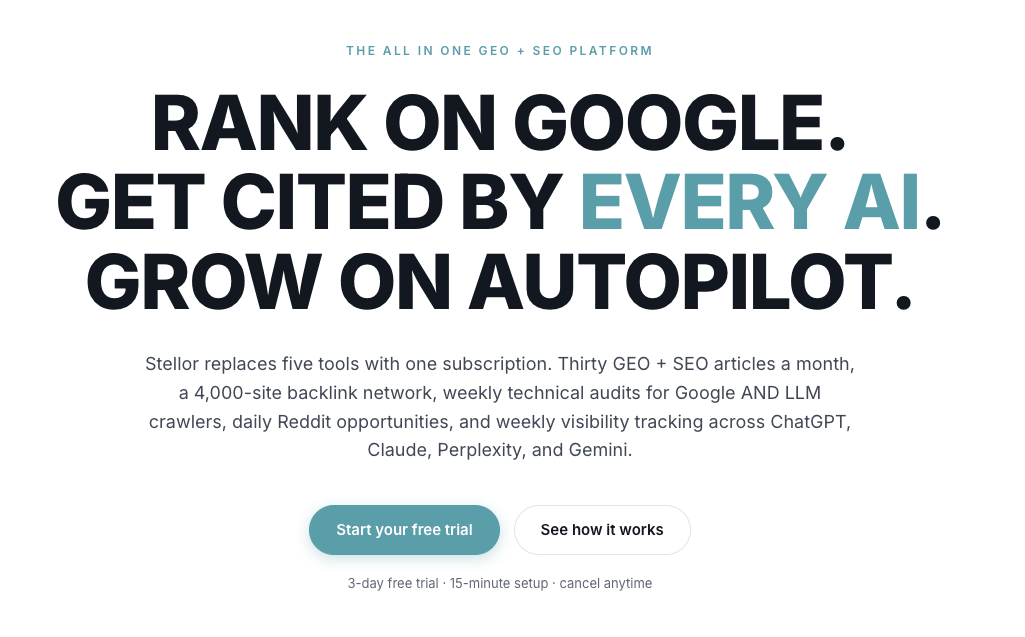
The platform publishes 30 GEO and SEO-optimized articles a month, each one built with the schema, internal linking, and llms.txt configuration, which make a page legible to AI crawlers, not just Googlebot. That content gets backed by a 4,000-site backlink network, and every week you get a report on where your business shows up (or doesn’t) across major AI answer engines. If you’re managing structured data manually across dozens of local service pages, that audit cadence alone replaces hours of manual checking. Start a 3-day free trial, no card required, and see your current AI citation status within 48 hours.
Sources
FAQ
Can you give me an example of structured data?
A product page with price, sku, and availability marked up in JSON-LD is a common example, as is a spreadsheet row with fixed columns for date, amount, and customer ID.
Does ChatGPT use unstructured data?
Yes. ChatGPT and similar models train on large volumes of unstructured text, but they perform more reliably when the content they retrieve at query time includes structured, labeled facts.
What are three types of structured data?
Relational database tables, JSON-LD schema markup on web pages, and spreadsheet or CSV data with fixed columns are three common types.
Can AI work with unstructured data?
AI systems can process unstructured data like emails or transcripts, but they need extraction pipelines to convert it into usable facts, which takes more time and effort than working with data that’s already structured.
How often should I audit my structured data?
Run a full schema audit every quarter, and validate any new template immediately after launch using tools like the Schema Markup Validator.
Can Stellor generate structured data automatically?
Yes. Stellor builds JSON-LD schema into every article it publishes and includes weekly audits that flag drift or missing fields, which removes the manual maintenance most teams struggle to keep up with.