

A silo structure groups related pages under one hub page with tightly linked supporting pages, and the direct result is clearer crawl paths, stronger local topical authority, and better odds of showing up in AI answer engines. We recommend building a hub, writing focused supporting pages, and wiring deliberate internal links between them, following the structured-data guidance in Schema. Platforms like Stellor can scale this once the model works.
TL;DR:
- Building a few well-structured silos with a clear hub page and supporting pages ensures better topical authority and AI answer engine visibility.
- The most effective silo type depends on your business, with service silos best for few core services, location silos for multiple areas, and combined silos for multiple services across many locations.
- Supporting pages must be unique and detailed, targeting specific questions or local facts, with internal links deliberately designed to reinforce the silo’s theme.
- Maintaining silos requires regular audits of internal links, schema markup, and keyword targeting, with tools like Stellor automating content, backlink, and AI citation management.
- Starting small with two or three silos, focusing on depth and quality, is more sustainable for small teams than trying to build many thin pages at once.
Table of Contents
- What is a silo structure and why does it matter for local SEO and AI?
- Silo types: service, location, or combined?
- How to build or refactor your silo structure step by step
- Copyable templates: service silos, location silos, and schema snippets
- Common silo mistakes and how to fix them
- Measuring and maintaining your silo structure
- How Stellor supports silo structures at scale
- Small-team priorities and a realistic 90-day roadmap
- A managed option for teams that want repeatable silo output
- FAQ
- Sources
What is a silo structure and why does it matter for local SEO and AI?
A silo is a content hierarchy built around one topic. At the top sits a hub page: something like “Plumbing Services in [your city]” or “Emergency HVAC Repair.” Below it sit supporting pages, each answering one specific query: a single service, a single neighborhood, a single use case. The hub links down to every support page, each support page links back up to the hub, and nothing outside the silo gets linked in without a reason.

This is different from a simple category page. A category page is a list. A silo is a closed loop of topical signal: every page inside it reinforces the same theme for both Google and the crawlers behind ChatGPT, Claude, Perplexity, and Gemini. Search Engine Land’s analysis of local content silos argues that single-site, multi-location businesses need this structure specifically to isolate local signals, so a backlink pointing to your Austin page strengthens Austin rankings instead of bleeding authority across every city you serve.
The hub page carries specific signals that supporting pages don’t need to repeat:
- A clear H1 and opening paragraph that states the service and location in plain words.
- A URL that matches the hierarchy, such as
/plumbing/as the hub and/plumbing/drain-cleaning/underneath it. - Schema markup identifying the business type, address, and service area.
- Internal links to every supporting page in the silo, visible in the main content, not buried in a footer.
Supporting pages do the opposite job: they go deep on one query instead of covering everything shallowly. A supporting page for “drain cleaning in [neighborhood]” should answer that query completely, link back to the hub once, and avoid competing with sibling pages for the same keyword.
The newer piece is FAQ clustering. When you build an FAQ section answering the exact questions buyers type into ChatGPT or ask Claude, and wire that cluster into the silo with internal links, you raise the odds that an AI answer engine quotes your page instead of a competitor’s. This is prompt mapping: start from what people actually ask an AI, not what you assume they search on Google.
Silo types: service, location, or combined?
Choosing the wrong model is the most common reason a silo underperforms before it’s even published. Match the structure to your business shape, not to a template you found online.
- Pick a service silo when you offer a short list of services and each one deserves real depth. A single-location electrician with five core services (panel upgrades, rewiring, lighting, EV charger installs, inspections) builds one hub per service, with supporting pages for sub-tasks, brands, or specific problems under each.
- Pick a location silo when you operate in many physical areas and local intent drives the business. A regional pest control company serving fifteen towns builds a master locations page as the top-level hub, then one city hub per town, each linking to a handful of locally relevant supporting pages.
- Combine both when you have multiple services across multiple locations, but structure the combination carefully to avoid duplicate content. A roofing company serving six cities with four service lines should not generate twenty-four near-identical pages. Build city hubs that each link to service pages written with genuinely different local facts: permit rules, climate factors, common roof types in that area, or named neighborhoods.
The combined model is where most sites break. Destinali’s guide to building local content silos recommends starting with two to three silos you can realistically maintain rather than launching dozens of thin pages that all say the same thing with a city name swapped in. Depth in a handful of silos beats breadth across many. A multi-location business can also lean on dedicated guidance for managing SEO across multiple locations to sequence the rollout instead of publishing everything at once.
How to build or refactor your silo structure step by step
This is the order we’d follow whether you’re starting from nothing or untangling a site that’s grown messy over several years.
- Audit your existing URLs. Build a spreadsheet with four columns: URL, target keyword, search intent, and current ranking position. Pull this from Google Search Console and a crawler like Screaming Frog. This becomes your map of what already exists and what’s missing.
- Pick two to three silos to start. Resist the urge to restructure the entire site in one pass. Destinali’s guidance on starting narrow and building depth over time holds up in practice: a business that nails two silos this quarter can maintain them, where one that half-builds eight silos usually abandons most of them.
- Build the hub page first. Every hub needs a descriptive title tag, an H1 that states the service and area, a first paragraph that answers the core question directly, LocalBusiness schema, a canonical tag pointing to itself, and visible links to every planned supporting page.
- Write supporting pages one query at a time. Each page should target one specific question or service variation, run long enough to answer it completely (most well-performing local pages land somewhere between 600 and 1,200 words, though the right length depends on the query’s complexity), and include a fact unique to that page: a local landmark, a permit requirement, a price range specific to that service.
- Wire the internal links deliberately. The hub links to every support page. Every support page links back to the hub once, using descriptive anchor text like “drain cleaning services” or “Austin plumbing repairs” rather than “click here” or “learn more.” Cross-hub links (between, say, your plumbing hub and your HVAC hub) should be rare and intentional, not automatic.
- Submit for indexing and check AI discoverability. Add new URLs to your XML sitemap, submit the sitemap in Search Console, and confirm your robots.txt isn’t blocking the new paths. If you maintain an llms.txt file, list the new hub and supporting pages so AI crawlers can find them without guessing.
Pro Tip: Build your hub page and at least three supporting pages before you publish anything live. A half-finished silo signals thin content to both Google and an AI crawler evaluating your site’s depth.
A few rules make the difference between a silo that holds together and one that quietly falls apart within a few months.
On word counts and uniqueness: a location page that’s 80% identical to its sibling pages, with only the city name changed, reads as duplicate content to Google and gives an AI model nothing distinct to quote. Every location or service page needs at least one fact that couldn’t be copy-pasted onto a different page: a specific neighborhood served, a local code requirement, a price range that reflects real local costs.
On anchor text: descriptive two-to-five word phrases outperform generic ones every time. “Commercial roof inspections” tells both the crawler and the reader what’s on the other end of the link. “Learn more” tells them nothing.
On indexing timeline: new pages inside an established silo tend to get crawled faster than standalone pages because the hub is already indexed and links down to them directly. If you’re refactoring an existing site rather than starting fresh, Destinali’s guidance is worth following closely: keep hub URLs stable wherever possible, use 301 redirects for any pages you merge or retire, update internal links before you publish structural changes, and roll out new supporting pages in small batches so you can watch for ranking drops before you’ve committed to the whole plan.
If your business runs Google Business Profile listings alongside your silo, matching the categories and service areas listed there to your hub pages closes a gap a lot of sites leave open. Our guide to setting up Google Business Profile walks through that alignment in more detail.
Copyable templates: service silos, location silos, and schema snippets
Templates save you from reinventing a structure that’s already well understood. Here’s how the two core models translate into an actual site map.
A service silo for a five-service electrician might look like /electrical-services/ as the hub, with /electrical-services/panel-upgrades/, /electrical-services/ev-charger-installation/, and /electrical-services/lighting/ underneath it as supporting pages, each linking back to the hub and nowhere else outside the silo.
A location silo for a regional business typically starts with a master /locations/ page, then a city hub like /locations/denver/, with supporting pages such as /locations/denver/pest-inspection/ and /locations/denver/termite-treatment/ nested beneath it.
The combined model nests both: /locations/denver/electrical/panel-upgrades/. This gets long fast, so most sites are better served keeping the hierarchy to three levels deep and using subfolders rather than subdomains. Subfolders keep domain authority consolidated on one root domain; subdomains split it and create a harder crawl relationship for both Google and AI crawlers to interpret.
| Silo model | Hub page example | Supporting page example | Best for |
|---|---|---|---|
| Service silo | /electrical-services/ | /electrical-services/panel-upgrades/ | Single location, several distinct services |
| Location silo | /locations/denver/ | /locations/denver/pest-inspection/ | Multiple cities, narrow service list |
| Combined silo | /locations/denver/electrical/ | /locations/denver/electrical/panel-upgrades/ | Multiple cities and multiple services |
For the schema layer, a location page needs a LocalBusiness block identifying the name, address, telephone, and service area, structured per Schema.org’s LocalBusiness specification, placed in the page’s head or injected via your CMS’s structured data field. Our own examples of LocalBusiness schema for local businesses show working snippets you can adapt directly rather than building from scratch.
Common silo mistakes and how to fix them
Most broken silos fail in one of four predictable ways.
- Templated location pages with no unique content. If every city page reads the same with a find-and-replace city name, rewrite each one with a specific local fact: a neighborhood name, a climate detail, a permit rule. Our auto shop Google Business Profile guide shows what genuinely unique local content looks like in practice for a service business.
- Random cross-silo linking. Links added without a reason, usually from an old “related posts” widget, dilute topical signal by pulling authority sideways instead of up and down the silo. Audit your internal links quarterly and remove any that don’t serve the reader or reinforce the silo’s theme.
- Canonical and redirect confusion. When you merge or retire a page, use a 301 redirect to the surviving URL, never a canonical tag pointing somewhere unrelated. Canonicals tell search engines “this is the real version of a near-duplicate page.” Redirects tell them “this page moved.” Mixing the two up is a common cause of pages dropping out of the index entirely.
- Selective cross-hub links done wrong. Botify’s analysis of the hub-and-spoke model makes the case that rigid silo isolation can backfire, and that a measured link between two authoritative hub pages lets domain authority flow without diluting either hub’s topical focus. The fix isn’t zero cross-linking. It’s intentional, infrequent cross-linking between hubs that genuinely relate.
Pro Tip: Before touching your link structure, export a full internal link report with a crawler. Fix the worst offenders first, usually orphaned pages and random sidebar links, rather than rebuilding the entire site’s linking at once.
Measuring and maintaining your silo structure
A silo isn’t a one-time project. Check these numbers on a consistent schedule, because a silo that worked in January can quietly decay by summer if nobody’s watching it.
- Local organic clicks and impressions per hub and supporting page, pulled from Search Console, filtered by landing page.
- Map pack visibility for your target queries, tracked through Google Business Profile insights or a rank tracker that monitors map results separately from organic.
- LLM citation frequency for the specific prompts you’ve mapped into your FAQ clusters, checked by manually querying ChatGPT, Claude, Perplexity, and Gemini with the exact phrases your buyers would use.
- Bounce rate and time on page for hub pages specifically, since a hub that readers bounce from fast usually means the supporting links aren’t answering the question the hub promised.
Widespread adoption of Schema.org’s structured data standards across millions of domains reflects how foundational clear markup has become for helping crawlers interpret a local business page correctly, which is part of why a hub page without schema tends to underperform an identical one with it.
Run a quarterly review: re-crawl the site, check for orphaned pages, re-test structured data with a validator, and re-run your mapped AI prompts to see whether citations have shifted toward a competitor. A local SEO audit checklist built for service businesses gives you a repeatable list to work through each quarter rather than relying on memory.
How Stellor supports silo structures at scale
Building two or three silos by hand is manageable for a small team. Maintaining a dozen silos across multiple cities and services, while also tracking whether four different AI models are citing you instead of a competitor, is a different workload entirely. That’s the gap Stellor is built to close.
- Thirty GEO and SEO-optimized articles published monthly, including the service pages, location pages, FAQ hubs, and comparison content a growing silo structure needs to stay fed with new supporting pages.
- A 4,000-site backlink network that strengthens the authority signals each silo depends on, without manual outreach.
- Weekly technical audits covering eleven checks, including schema completeness and internal linking depth, the exact issues that cause silos to quietly degrade.
- A Reddit module that surfaces high-intent threads in real time, building the kind of community presence that AI answer engines draw on when generating recommendations.
- Weekly LLM visibility tracking across ChatGPT, Claude, Perplexity, and Gemini, reporting exactly which prompts cite your business and which cite a competitor instead.
For a team already stretched across service delivery and marketing, this turns silo maintenance from a recurring manual chore into a tracked, reported process.
Small-team priorities and a realistic 90-day roadmap
If you’re building this yourself, sequence it. Month one: pick one silo, build the hub, and write three supporting pages with genuinely unique local facts. Month two: add schema, fix your internal linking, and submit everything for indexing. Month three: start your first backlink push and map your FAQ cluster to real prompts people ask an AI.
The highest-leverage tasks are the cheapest ones: unique local facts on every page, complete schema, and three deliberate internal links per page. Skip the templated shortcuts.
A platform starts to make sense once you’re running more than two or three silos, operating across multiple locations, or trying to track AI citations across four different models by hand. At that point, the manual version of this work stops scaling.
— Cole
A managed option for teams that want repeatable silo output
Building silos by hand works, but keeping them fed with new content, backlinks, and audits month after month is where most small teams run out of hours. We built Stellor to take that recurring workload off your plate: thirty GEO and SEO articles published to your CMS every month, a 4,000-site backlink network running in the background, and weekly technical audits plus AI visibility tracking across ChatGPT, Claude, Perplexity, and Gemini, all for one flat $199 monthly subscription instead of five separate tools or vendors.
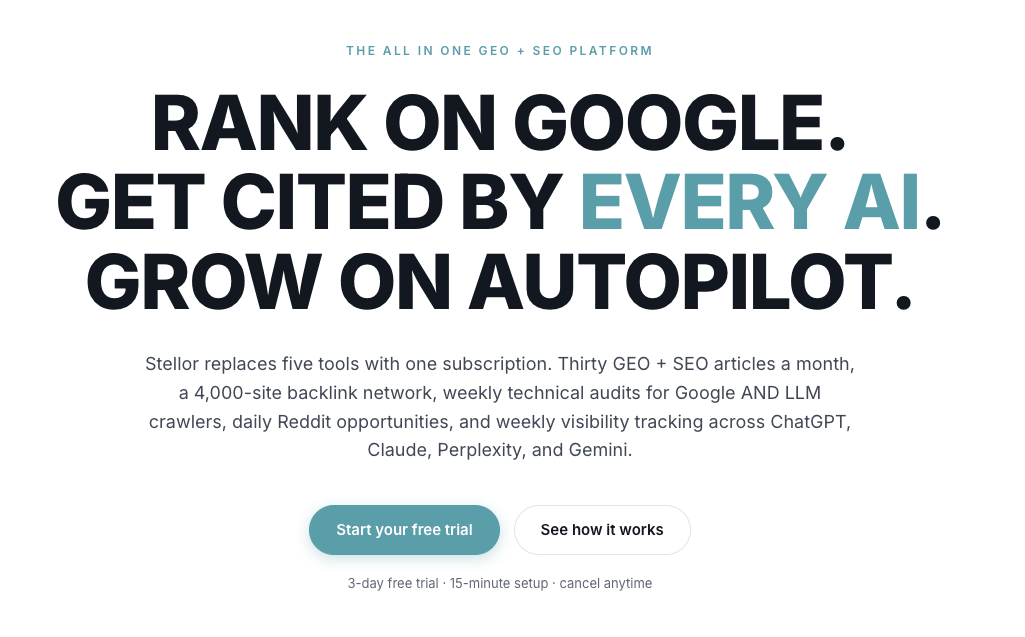
- Content volume: thirty silo-ready pages a month, built around your actual services and locations.
- Backlink channel: a 4,000-site network reinforcing each silo’s authority without manual outreach.
- Visibility reporting: weekly audits plus LLM citation tracking, so you know exactly where each silo stands.
If you’d rather see your current AI citation status before committing to anything, start with a three-day free trial, no card required, and get a clear read on where your silos stand today.
For home service businesses looking for a broader marketing partner alongside silo work, Leapify Media’s local SEO blueprint for contractors is a solid resource worth reviewing too.
FAQ
What is silo structure in SEO?
A silo structure is a way of organizing a website so that related pages, usually a hub page and several supporting pages, are tightly linked to each other and loosely linked elsewhere. This isolates topical signals so that each silo builds its own authority for a specific service or location rather than spreading that authority thin across the whole site.
Is SEO dead now with AI?
No. Traditional search still drives the majority of how people find local businesses, and the same structural signals, like schema markup and internal linking, that help Google understand a page also help AI crawlers used by ChatGPT, Claude, Perplexity, and Gemini understand and cite it. What’s changed is that a well-built silo now needs to serve two audiences: search engines and AI answer engines.
What is the 80/20 rule in SEO?
In the context of silos, this generally means focusing your effort on the twenty percent of pages, typically your hub pages and highest-intent supporting pages, that drive most of your traffic and rankings. Rather than spreading thin content across dozens of pages, build fewer pages with real depth, which matches the guidance to start with two or three well-maintained silos instead of many thin ones.
What will local SEO look like in 2026?
Local SEO in 2026 increasingly depends on being cited by AI answer engines in addition to ranking in traditional Google results and the map pack. Businesses that map real buyer prompts into FAQ clusters, maintain clean schema markup, and keep their silo structures free of duplicate content are better positioned to show up in both.
How many silos should a small business start with?
Most small and mid-sized businesses should start with two to three silos they can realistically maintain rather than launching many thin ones at once. Depth and consistency in a handful of silos tends to outperform breadth across dozens of underdeveloped pages.