

Service page SEO means building a standalone page for each service you sell, mapped to a focused keyword cluster, and structuring it so both Google and AI answer engines can read, trust, and cite it. The single highest-leverage move is skipping the vague “Services” catchall page and giving every core offering its own page targeting a specific long-tail term. Do that, add Service schema, and link it into a hub-and-spoke content cluster, and the rest of the checklist follows.
TL;DR:
- Focusing on specific long-tail keywords and map supporting topics as spokes improves ranking chances over broad categories or vague terms.
- Incorporating clear call-to-actions, proof elements, and detailed process descriptions on each service page enhances conversions and builds trust.
- Ensuring mobile speed, schema markup, and descriptive images are in place is crucial for search visibility and AI answerability.
- Regular monitoring of impressions, click-through rates, and testing one variable at a time keep service pages continuously optimized.
- Automation platforms like Stellor can efficiently produce and maintain multiple SEO-optimized pages at scale, especially for multi-location businesses.
Table of Contents
- What Service Page SEO Actually Requires
- How to Pick Focus Keywords and Supporting Clusters
- On-Page SEO Checklist You Can Apply Today
- Copy and Proof Placement That Actually Converts
- Technical SEO and Schema That Search Engines and AI Can Actually Read
- Building Topical Authority With Hub-and-Spoke Linking
- KPIs and a Testing Cadence That Keeps Pages Improving
- When Automation Makes Sense for Service Page Production
- Priorities and Traps Worth Avoiding
- A Faster Path to Consistent Service Pages
- Sources
- FAQ
What Service Page SEO Actually Requires
A service page is a dedicated page built around one thing you sell, written to answer three questions at once: what the service is, how you deliver it, and why this business over the next one. That last part is where most service pages fail. They read like brochures instead of answers.
The pages that rank explain what the service is, how it’s delivered, who it’s for, and back all of it with proof, according to Search Engine Land’s breakdown of high-performing service pages. Notice what’s missing from that list: keyword density, word count targets, or any of the mechanical stuff SEO guides obsess over. Structure and proof beat stuffing.
Here’s the anatomy that shows up again and again on pages that convert as well as they rank.
- Hero section with a clear outcome and a CTA above the fold. State the result the customer gets, not the process. “Get your drain cleared today” beats “Professional Drainage Services.”
- A short value proposition and scannable benefits, three to five bullets max, each tied to a customer outcome rather than a feature.
- A process or workflow section that walks through what happens after someone hires you. This is where trust gets built. Vague pages skip this; ranking pages don’t.
- Proof: case snippets, review excerpts, before/after specifics. A single sentence like “Replaced a failing sewer line in Denver in under six hours” does more work than a five-star badge.
- Contact and quote options placed as micro-CTAs, not just one big button at the bottom. Repeat the ask after the benefits section and again after the proof section.
- Meta title, meta description, and URL that match the keyword pattern you’re targeting, not a generic “Our Services” slug.
Top-ranking pages tend to include detailed process descriptions rather than shallow marketing copy, and that depth is what signals topical authority to search engines, per SEMRocket’s analysis of organic service page performance. Depth here doesn’t mean padding. It means specificity: named steps, named materials, named timeframes.
Users scan web pages rather than read them top to bottom, and clear headings with short paragraphs measurably improve comprehension, according to Nielsen Norman Group’s research on how people read online. Build your page for a scanner, not a reader, and the conversion rate takes care of itself.
How to Pick Focus Keywords and Supporting Clusters
Guessing at keywords is the fastest way to waste a service page. Here’s a workflow that gets you a target you can realistically rank for, instead of one every competitor in your metro area is already chasing.
- Start with seed terms tied to the service itself, not your brand name. “Emergency water heater replacement” beats “water heater services.”
- Layer in outcome or industry modifiers instead of chasing head terms. Experts recommend “service + outcome” or “service + industry” combinations, like “commercial HVAC maintenance for restaurants,” because these convert better and face far less competition than broad category terms, per SEMRocket’s keyword modifier guidance.
- Check keyword difficulty against your domain’s actual authority. A new site chasing a KD of 60+ is wasting a page. Pull your Google Search Console impressions for related queries first. You often already have data pointing you toward realistic targets.
- Run a competitor SERP scan for your shortlist. If the top five results are all national directories or Fortune 500 sites, that term isn’t winnable yet. Move down the specificity ladder until you find a gap.
- Map 4 to 8 supporting long-tail topics as spokes around your chosen hub keyword. These become blog posts or FAQ sections that link back to the main service page and reinforce it topically.
A plumbing business selling drain cleaning might pick “same-day drain cleaning” as the hub and build spokes around “signs you need drain cleaning,” “drain cleaning cost,” and “drain cleaning vs. hydro jetting.” Every spoke funnels authority and traffic back to one page instead of scattering it. If you serve a specific vertical, this guide to SEO for plumbers walks through exactly this kind of cluster in practice.
On-Page SEO Checklist You Can Apply Today
Once you’ve picked the keyword, execution is mechanical. Miss any of these and you’re leaving ranking signal on the table for no reason.
- Focus keyword in the title tag, ideally in the first half, followed by a location or differentiator if relevant.
- Focus keyword in the H1, matched naturally, not force-fit.
- Focus keyword in the first 100 words of body copy, in a sentence that reads naturally, not bolted on.
- Keyword or a tight variant in the URL slug. Short, readable, hyphenated. “/drain-cleaning” not “/services/id-4471.”
- Meta description under 155 characters that states the outcome and includes a soft call to action. This drives click-through rate more than it drives ranking.
- Heading hierarchy that mirrors how someone would ask about the service out loud. H2s for major sections, H3s for sub-points within them.
- Descriptive alt text on every image, written for a person, not a keyword string. “Technician clearing a residential sewer line” beats “drain-cleaning-service-1.jpg.”
- Open Graph tags set explicitly so the page doesn’t default to a generic title and description when shared or previewed by a crawler.
Pro Tip: Write your meta description like an ad headline, not a summary. You’re not describing the page to Google, you’re pitching a click to a human who’s comparing five results at once.
Copy and Proof Placement That Actually Converts
Order matters more than length. Lead with the outcome, follow with the process, close with proof. Pages that flip this order and lead with company history or a wall of credentials lose visitors before they reach the CTA.

There’s no single correct word count. A simple, well-understood service like window cleaning might need 400 words done well. A complex B2B service, like managed IT support, often needs 1,200 words or more to cover scope, pricing tiers, and process in enough depth to earn trust. Expand when the buying decision is complex or expensive; stay lean when it isn’t.
Short case snippets embedded inline work better than a separate testimonials page nobody visits. One sentence, placed right after a relevant benefit claim, does more persuasive work than a five-paragraph case study buried in a portfolio tab.
- Use bullets for scanability, but never more than two bullet blocks in a row without breaking to prose or an image.
- Add toggles or accordions for FAQs, keeping the visible page shorter while still ranking for long-tail question terms.
- Include at least one visual proof element: a before/after photo, a process diagram, or a short embedded video.
- Test more than one CTA type, not just “Get a Quote.” Try “Check Availability,” “See Pricing,” or “Book a Free Inspection” depending on the service.
- Add a micro-conversion option for visitors not ready to buy, like a downloadable checklist or a text-to-call button.
Treating your service page as an active marketing asset, not a static brochure, is the mindset shift that separates pages that generate leads from pages that just exist, according to Rank Math’s guidance on service page conversion.
Technical SEO and Schema That Search Engines and AI Can Actually Read
A beautifully written page that loads slowly on a phone won’t rank, and it won’t convert either. A large share of U.S. website traffic now comes from mobile devices, which makes mobile-first design a baseline requirement for any service page, not an optional upgrade, per Statista’s data on U.S. mobile traffic share.
- Run a mobile speed check and fix render-blocking scripts before touching anything else on the page.
- Add Service schema using the markup structure documented at Schema, and nest it inside LocalBusiness schema when the service is tied to a physical location or service area, a step OnCrawl recommends for maximizing rich result eligibility.
- Add FAQ schema only when there’s a genuine, visible Q&A section on the page. Markup that describes content the visitor can’t actually see gets ignored or penalized by search engines and AI crawlers alike, since successful implementations keep the schema and the visible copy tightly synced.
- Set a clean canonical tag if the same service is reachable through more than one URL path.
- Check color contrast and text legibility, since accessible design choices directly affect how long visitors stay engaged with the page, per Adobe XD’s accessibility guidance.
Google’s own Search Central documentation on page experience confirms speed and mobile usability sit inside its core ranking systems, not as a side consideration.
Building Topical Authority With Hub-and-Spoke Linking
Your service page is the hub. Everything else you publish about that service should be a spoke that links back to it. A hub-and-spoke model paired with internal linking builds topical relevance faster than isolated pages ever will, according to Rank Math’s cluster methodology.
- Pick 4 to 8 spoke topics per hub, drawn from the supporting keywords you mapped during research.
- Vary your anchor text. Don’t link every spoke back with the identical phrase. Rotate between the service name, the outcome, and a natural phrase variant.
- Place links in three places: primary navigation for the hub itself, in-body contextual links within spoke content, and a “related services” widget near the page footer.
- Check Search Console’s internal linking report quarterly to confirm the hub page is accumulating internal link equity, not just the spokes linking to each other.
A local SEO guide for service businesses shows how this cluster structure plays out when location pages get added into the mix alongside service hubs.
KPIs and a Testing Cadence That Keeps Pages Improving
Publishing a service page isn’t the finish line. It’s the starting point for a measurement loop.
- Track four numbers monthly: impressions, click-through rate, total clicks, and on-page conversion rate. Impressions without clicks means a ranking problem is masking a CTR problem.
- Pull Google Search Console’s performance report filtered to your service page URL and sort by impressions descending, CTR ascending. That’s your priority list of quick wins.
- Test one variable at a time. Rewrite the meta title and description first since that’s the cheapest, fastest test with the clearest signal.
- Test the hero CTA next. Swap the button copy or its position and measure conversion rate over at least two to four weeks of comparable traffic.
- Test content length last. Try a condensed version against the original if bounce rate is high and dwell time is short, since that combination often signals the page is longer than the buying decision requires.
- Refresh instead of rebuild when rankings are stable but stale. Rebuild only when the page structure itself is the problem, not the content inside it.
An SEO audit checklist for local service businesses covers the technical side of this measurement loop in more depth if broader site health is also in question.
When Automation Makes Sense for Service Page Production
Manual page-by-page work is fine at one or two services. It stops scaling once you’re covering ten services across five locations, and that’s usually the point where a managed platform starts paying for itself instead of costing time.
- Automation earns its place when you need consistent output, not occasional bursts, because search engines reward publishing cadence over sporadic effort.
- Stellor publishes 30 GEO and SEO-optimized pages per month, including service, location, comparison, and FAQ pages, each built with the schema and internal linking structure this guide covers.
- Weekly technical audits and AI visibility tracking across ChatGPT, Claude, Perplexity, and Gemini catch the kind of schema mismatches and mobile issues that quietly tank rankings between manual reviews.
- The trade-off is real: automation trades some hands-on control for scale and consistency. That’s the right trade for a growing multi-location business; it’s the wrong one for a single-location shop with one core service and plenty of time to polish it by hand.
Priorities and Traps Worth Avoiding
If you only do four things: pick one focus keyword, build the hub page around it, write two to four spoke pieces, and add Service schema. That sequence, in that order, beats almost any other use of your time this month.
The traps are predictable. Vague keywords like “professional services” that nobody actually searches. Thin copy that skips the process section entirely. Pages with zero proof, no case snippet, no review excerpt, nothing specific. Fix the fastest wins first: rewrite the title and meta description, add one unmistakable CTA above the fold, and add Service schema even if nothing else changes this week. Small, specific fixes compound faster than a full rebuild you never get around to finishing.
— Cole
A Faster Path to Consistent Service Pages
Building one great service page by hand is a weekend project. Building twelve, each with the right schema, internal links, and AI-readable structure, and keeping them all current, is a part-time job most small teams don’t have room for. Stellor replaces that workload with a $199 monthly platform that publishes 30 GEO and SEO-optimized pages a month, backed by 4,000-site backlink network and weekly technical audits.
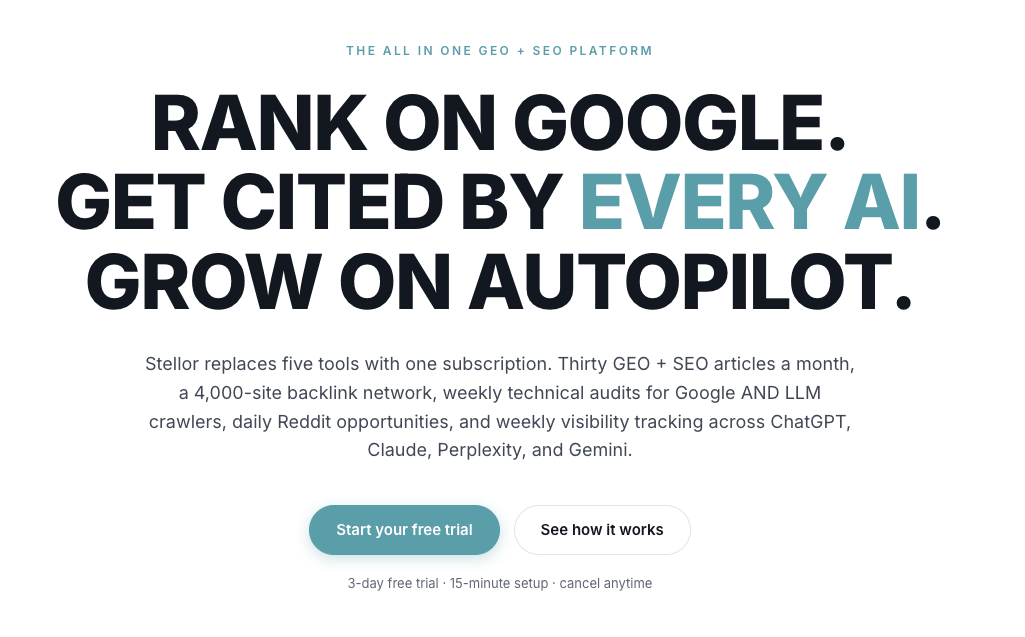
What makes it different from hiring a handful of specialists is the tracking layer. The platform checks weekly how ChatGPT, Claude, Perplexity, and Gemini answer the exact questions buyers ask, so you know whether your service pages are getting cited by AI, not just ranked on page one of Google. For a business with several services and locations, that’s the difference between guessing and knowing where the next lead is coming from. Start the 3-day free trial, no card required, and see what your current service pages look like to an AI answer engine before you write another word.
Sources
- Statista — Share of website traffic from mobile devices (U.S.)
- How to create service pages that rank and convert — Search Engine Land
- Service Page SEO: Transform Any Service Page Into a Lead Magnet — Rank Math
- Getting your service webpages to rank — OnCrawl
FAQ
What Are Service Pages in SEO?
A service page is a dedicated page built around one specific offering, optimized to rank for a focused keyword and to convert the visitor into a lead. It differs from a general “Services” overview page because it targets one intent instead of several at once.
How Do I Rank a Service Page?
Map the page to a specific long-tail keyword instead of a broad head term, cover what the service is, how it’s delivered, and who it’s for, and back it with proof, schema, and internal links from supporting content, per Search Engine Land’s ranking framework. Consistent publishing cadence and clean technical execution close the gap once the content itself is solid, which is exactly the coverage a platform like Stellor is built to maintain.
What Are the 4 Types of SEO?
The four main types are on-page SEO (content and HTML elements), off-page SEO (backlinks and external signals), technical SEO (speed, crawlability, schema), and local SEO (Google Business Profile and location-based signals). Service page SEO draws on all four at once.
What Is the 80/20 Rule for SEO?
Chasing minor technical tweaks before nailing keyword focus and page structure is a common way teams waste that ratio.
Do I Need Schema Markup on Every Service Page?
Yes, Service schema should go on every service page, nested inside LocalBusiness schema when the business serves a defined area, according to OnCrawl’s schema guidance. Add FAQ schema only when there’s a visible FAQ section on the page itself.