TL;DR:
- SEO leverages long-term authority building to generate qualified, high-converting organic leads that continue to grow over time. In 2026, effective SEO must optimize for Google rankings, AI Overviews, and AI answer engines simultaneously, requiring structured content and citations. Measuring SEO success depends on integrated analysis of search, engagement, and revenue data rather than traffic alone.
SEO is defined as the process of optimizing your online presence to increase organic search visibility, drive qualified traffic, and fuel scalable business growth. As a growth lever, it works by compounding authority over time, meaning the rankings and trust you build today continue generating leads and revenue months or years from now. For small to medium businesses, SEO as a growth strategy is one of the few marketing channels where your investment appreciates rather than expires.
The numbers make the case clearly. Organic leads close at 14.6%, compared to just 1.7% for outbound channels like cold email or paid ads. That gap reflects a fundamental truth: people who find you through search are already looking for what you sell. Tools like Google Search Console, Google Analytics 4, and platforms like Trystellor give you the data and infrastructure to turn that intent into measurable revenue.

What is SEO as a growth lever, and how does it work?
SEO, formally known as Search Engine Optimization, is the practice of improving your website’s content, structure, and authority so that search engines rank it higher for queries your buyers are already typing. The “growth lever” framing, while informal, captures something the standard definition misses: SEO is not a one-time fix. It is a compounding system.
Here is how the mechanics translate into business growth:
- Higher rankings generate more qualified clicks. Position 1 on a clean SERP earns roughly 39.8% CTR, meaning nearly four in ten searchers click your result. Moving from page two to position one can multiply your monthly traffic without spending a dollar more on ads.
- Organic traffic builds domain authority over time. Every piece of well-optimized content, every quality backlink, and every technical improvement adds to a cumulative trust score that search engines use to rank your entire site, not just individual pages.
- SEO reduces customer acquisition cost. Unlike paid search, where traffic stops the moment you pause a campaign, organic rankings continue delivering visitors. The cost per lead drops steadily as your content library matures.
- Technical SEO removes friction. Page speed, mobile responsiveness, structured data, and clean internal linking all signal to Google that your site is trustworthy. These factors also directly affect user experience, which affects conversion rates.
- Content optimization captures demand at every stage. A well-structured SEO program covers informational queries (“how does X work”), comparison queries (“X vs. Y”), and transactional queries (“hire X near me”), guiding buyers from awareness to decision.
Pro Tip: Before creating new content, run your existing pages through Google Search Console. Pages with high impressions but low CTR are your fastest wins. Rewriting their title tags and meta descriptions often produces ranking improvements within weeks, not months.
The comparison with paid channels is worth stating plainly. Paid ads deliver immediate traffic but require continuous spend. SEO requires upfront investment in content and technical work, but the returns compound. For most SMBs operating with limited marketing budgets, SEO’s long-term cost efficiency makes it the more durable growth channel.
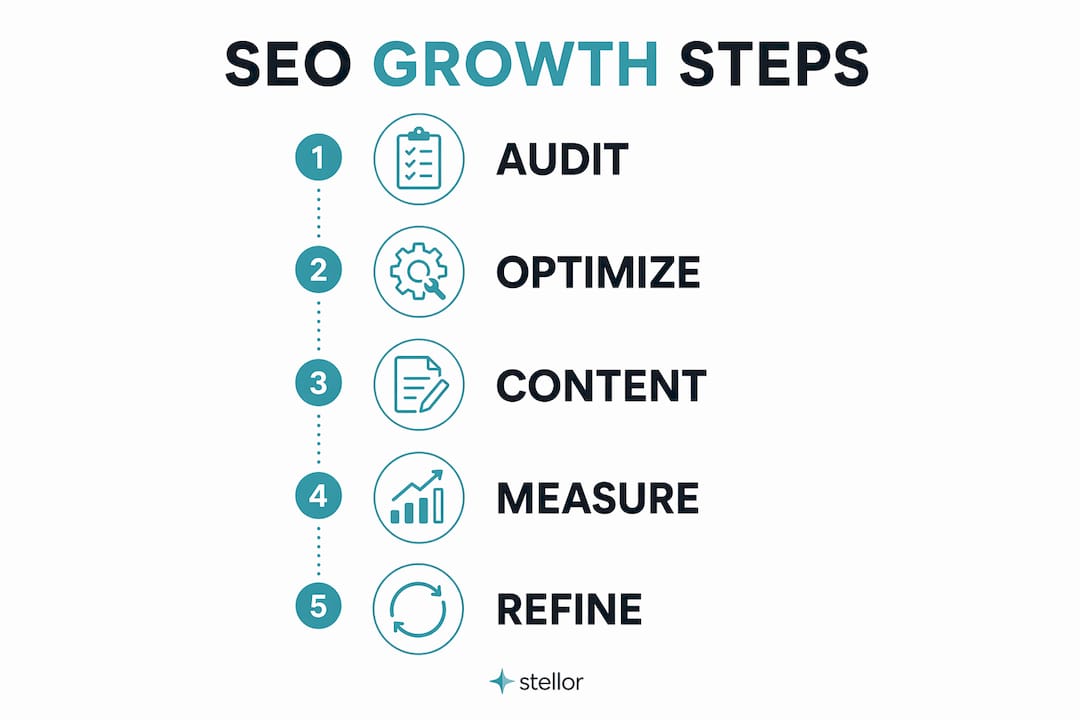
How has AI search changed SEO effectiveness in 2026?
Traditional SEO was built around one goal: rank in the ten blue links on a Google results page. That model still matters, but it no longer tells the whole story.
| Factor | Traditional SEO | SEO in the 2026 AI era |
|---|---|---|
| Primary goal | Rank in organic results | Rank AND get cited by AI answer engines |
| Click behavior | Most clicks go to top organic results | ~60% of searches end without a click due to AI Overviews and featured snippets |
| CTR at position 1 | ~39.8% on a clean SERP | Drops to 5%–19% when an AI Overview appears |
| Content format | Keyword-optimized pages | Answer-first formatting with structured data and unique proof points |
| Visibility channels | Google organic results | Google, ChatGPT, Perplexity, Claude, Gemini |
| Brand role | Helpful but not critical | Brand recognition drives 26% of AI Mode overrides |
The shift is significant. AI Overviews now appear on a large share of commercial queries, and when they do, click-through rates on organic results fall sharply. AI Mode, Google’s conversational search interface, replaces the traditional SERP entirely with a generated response, citing sources it deems authoritative.
This is where Answer Engine Optimization (AEO) and Generative Engine Optimization (GEO) enter the picture. SEO alone no longer guarantees visibility. AEO focuses on structuring content so AI systems extract and display it as a direct answer. GEO focuses on earning citations inside AI-generated responses from ChatGPT, Perplexity, Claude, and Gemini. Both require the same foundation as traditional SEO, including quality content, technical health, and authority, but they add layers: schema markup, answer-first paragraph structure, llms.txt configuration, and first-hand data that AI crawlers can quote with confidence.
Pro Tip: Format your most important pages with a direct answer in the first two sentences, followed by supporting detail. This structure serves both Google’s featured snippet algorithm and the summarization logic used by AI answer engines.
The practical takeaway for SMBs is that using SEO for growth in 2026 means optimizing for three surfaces at once: traditional Google rankings, AI Overviews, and AI answer engines. Businesses that treat these as separate problems will struggle. Those that build a unified content and authority strategy will compound visibility across all three.
How do you measure SEO’s impact on business growth?
Measurement is where most SMB SEO programs break down. Traffic numbers look good in reports but tell you nothing about revenue. The fix is treating Google Search Console, GA4, and paid search data as one integrated system rather than three separate tools.
Here is a practical measurement framework:
- Start with Google Search Console. Filter for queries with high impressions but low CTR. These are pages Google already considers relevant but users are not clicking. Improving title tags and meta descriptions on these pages is the highest-leverage SEO task you can do this week.
- Use GA4 to connect traffic to revenue. Set up conversion events for form submissions, phone calls, and purchases. Then segment organic traffic in GA4 to see which pages and queries are actually generating leads, not just visits.
- Test organic queries with paid campaigns. If Search Console shows a query driving impressions but no conversions, run a small Google Ads campaign on that exact keyword. If the paid version converts, you have proof the organic version is worth optimizing. If it does not convert, you have saved yourself months of wasted SEO effort.
- Build a feedback loop between channels. Integrated measurement using Search Console, GA4, and Ads data creates a system where each channel informs the others, reducing wasted spend and focusing effort on queries with proven commercial value.
- Set realistic timelines. Reaching the top 10 typically takes 12 or more months for competitive queries. Clients who expect results in three months are measuring the wrong things. Track impressions, CTR improvements, and conversion rate changes in the first six months. Rankings follow.
Pro Tip: Never optimize for traffic volume alone. A page that drives 200 qualified visitors who convert at 10% is worth more than a page driving 2,000 visitors who bounce immediately. GA4’s conversion segmentation makes this comparison straightforward.
The businesses that get the most from SEO are the ones that close the loop between search data and sales data. That discipline separates SEO as a genuine growth lever from SEO as a vanity metric exercise.
Practical SEO growth tactics for small to medium businesses
The most effective SEO growth tactics for SMBs in 2026 are not about publishing more content. They are about making the right content perform better.
Improving top-performing pages by 20% yields more growth than adding many new pages. That means refreshing outdated statistics, adding original data, improving internal linking, and restructuring content for answer-first formatting. Your best pages already have authority. Give them the content quality to match.
Here is a prioritized tactics table for SMBs:
| Tactic | Why it works in 2026 | Difficulty |
|---|---|---|
| Refresh top-ranking pages | Existing authority compounds faster than new pages can build | Low |
| Optimize title tags and meta descriptions | Directly improves CTR on AI-compressed SERPs | Low |
| Add FAQ schema markup | Increases eligibility for featured snippets and AI citations | Medium |
| Target long-tail queries | Less affected by AI Overviews, higher purchase intent | Medium |
| Build brand recognition signals | 26% of AI Mode users override rankings based on brand familiarity | Medium |
| Publish first-hand data and case studies | AI crawlers cite unique proof points over generic content | High |
Long-tail queries deserve special attention. A query like “best HVAC contractor for older homes in Phoenix” is far less likely to trigger an AI Overview than “HVAC contractor.” The specificity that makes long-tail queries lower volume also makes them higher intent and more resistant to zero-click behavior.
Schema markup is the plumbing behind the walls of your digital presence. Adding FAQ schema, review schema, and local business schema does not guarantee a featured snippet, but it makes your content legible to both Google’s algorithms and the AI crawlers used by ChatGPT and Perplexity. For local service businesses, this structured data layer is one of the fastest paths to appearing in AI-generated recommendations.
Key takeaways
SEO drives sustainable business growth by compounding organic authority over time, and in 2026, that authority must extend across Google, AI Overviews, and AI answer engines like ChatGPT and Perplexity to remain effective.
| Point | Details |
|---|---|
| SEO closes leads at 14.6% | Organic search delivers far higher-quality leads than outbound channels, making it a cost-efficient growth channel. |
| AI search reshapes click behavior | With ~60% of searches ending without a click, SMBs must optimize for AI citations alongside traditional rankings. |
| Measurement drives ROI | Treating Google Search Console, GA4, and paid Ads as one integrated system prevents wasted spend and focuses effort on converting queries. |
| Refresh before you publish | Improving existing top pages by 20% generates more growth than creating new content from scratch. |
| Brand recognition is now a ranking factor | 26% of AI Mode users override AI-suggested rankings based on brand familiarity, making brand-building an SEO tactic. |
Why I think most SMBs are solving the wrong SEO problem
After working with dozens of small and medium businesses on their search strategies, the pattern I see most often is this: owners invest in SEO, wait three months, see modest results, and conclude that SEO does not work for their industry. The real problem is almost never the industry. It is the measurement framework.
Most SMB SEO programs track rankings and traffic. Neither metric tells you whether SEO is growing your business. I have seen businesses with declining traffic and growing revenue because they stopped chasing volume and started optimizing for conversion. I have also seen businesses with impressive traffic numbers that could not attribute a single dollar of revenue to organic search.
The second mistake I see consistently is treating SEO as a standalone channel. In 2026, that approach leaves significant visibility on the table. The businesses winning in AI-augmented search are the ones producing content that is genuinely quotable: original data, clear answers, structured formatting, and a recognizable brand voice. Generic content optimized for keywords alone does not get cited by ChatGPT or Perplexity. It barely gets clicked on Google anymore.
The good news is that the bar for doing this well is not as high as it sounds. You do not need a massive content team. You need a clear strategy, the right measurement tools, and a platform that handles the technical execution while you focus on the business. That is exactly what platforms like Trystellor are built to do. The SMBs I have seen grow fastest with SEO are not the ones spending the most. They are the ones measuring the right things and staying consistent over 12 to 18 months.
— Cole
How Trystellor automates your SEO and AI growth strategy
If this article has made one thing clear, it is that modern SEO requires more moving parts than most SMBs can manage manually.
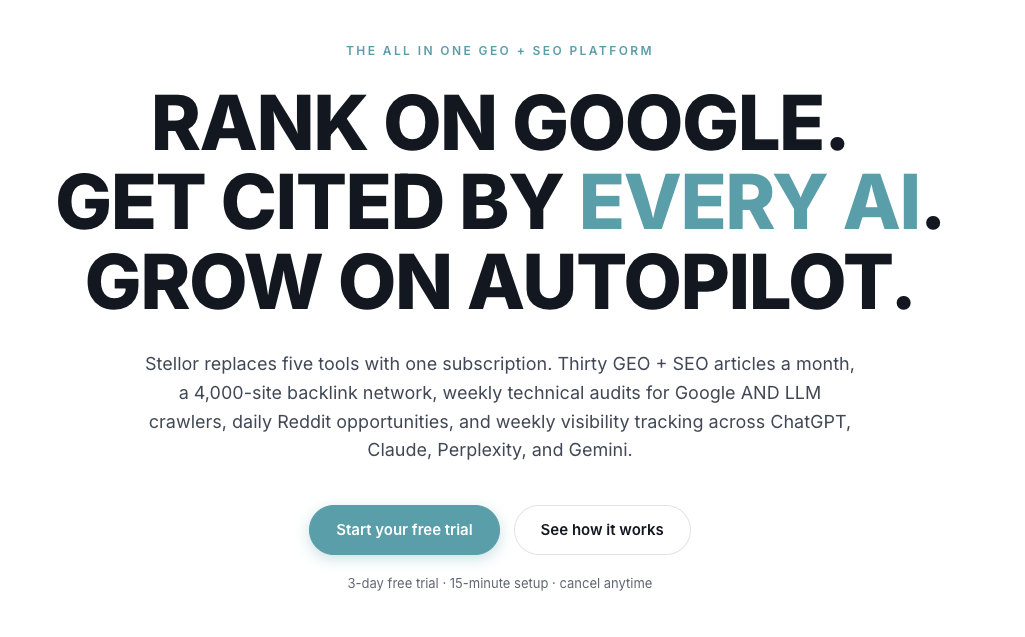
Trystellor replaces five separate tools with one platform at $199 per month. It publishes 30 GEO and SEO-optimized articles to your CMS every month, builds authority through a 4,000-site backlink network, runs weekly technical audits, surfaces daily Reddit opportunities, and tracks your citations across ChatGPT, Claude, Perplexity, and Gemini every week. You can see the full feature breakdown on the Stellor product page. Setup takes 15 minutes, and a free AI Visibility Audit lands in your account within 48 hours. No credit card required for the three-day trial.
FAQ
What is SEO as a growth lever?
SEO as a growth lever means using search engine optimization to systematically increase organic visibility, drive qualified traffic, and generate compounding business growth over time. Unlike paid advertising, the authority and rankings SEO builds continue delivering returns long after the initial investment.
How long does SEO take to drive measurable growth?
Reaching top 10 rankings typically takes 12 or more months for competitive queries. However, CTR improvements from optimized title tags and meta descriptions can show results within weeks.
Does SEO still work with AI Overviews on Google?
SEO remains effective, but the strategy must expand. When AI Overviews appear, position 1 CTR drops to 5%–19%, so businesses need to optimize for AI citations through AEO and GEO practices alongside traditional rankings.
What is the difference between SEO, AEO, and GEO?
SEO targets traditional Google rankings. Answer Engine Optimization (AEO) structures content to be extracted as direct answers in featured snippets and AI Overviews. Generative Engine Optimization (GEO) focuses on earning citations inside AI-generated responses from tools like ChatGPT, Perplexity, and Gemini. All three layers are now required for full search visibility.
How do I measure whether SEO is actually growing my business?
Connect Google Search Console, GA4, and Google Ads into one reporting system. Track conversion events in GA4 by traffic source, test high-impression organic queries with small paid campaigns to validate commercial intent, and measure revenue attributed to organic traffic rather than rankings or traffic volume alone.