

Roofing blog content builds topical authority, creates long-tail local ranking opportunities, and converts searchers into verified leads when it targets the right clusters. A high-performing roofing blog publishes city-specific, intent-matched posts on insurance claims, storm response, and materials, then instruments every visit for verified lead attribution. The three immediate effects you can expect from a well-executed content strategy are:
- Topical authority: Clustered posts on storm damage, insurance claims, and local materials signal to Google that your site is the definitive local resource, pushing you up in the local map pack.
- Long-tail local rankings: City-named posts like “hail damage roof repair in [City]” capture high-intent searches that broad service pages miss entirely.
- Conversion on storm and insurance queries: Roofing content marketing research shows that insurance-claim and storm-response pages convert at materially higher rates than generic roofing posts.
Your local lead generation strategy for roofers depends on this content infrastructure more than almost any other single factor. Run a PageSpeed Insights diagnostic on your existing blog pages before you publish another word, and verify your pages are indexed in Google Search Console.
Key Takeaways
Roofing blog content builds rankings and generates verified leads when it targets insurance-claim and storm-response clusters first, structures every post for EEAT and AI citation, and instruments all traffic for verified lead attribution.
| Point | Details |
|---|---|
| Prioritize insurance and storm clusters | These convert at materially higher rates than generic posts; publish them before and immediately after weather events. |
| Structure posts for AI citation | Use FAQ schema, named author bylines, and a direct answer in the first 100 words to earn AI engine citations. |
| Instrument before you publish | Set up UTM parameters, call tracking, and spam filtering before a post goes live so attribution data is clean from day one. |
| Expect 90 days for early signals | Initial impressions appear within 30 days; verified calls and map pack movement typically follow by month 6. |
| Trystellor automates the full stack | Trystellor publishes 30 targeted articles per month, manages backlinks, and tracks LLM citations for $199/month with a 3-day free trial. |
Table of Contents
- How does roofing blog content actually influence your rankings?
- Which roofing blog post types actually move the needle?
- How do you pick roofing blog topics that attract buyers, not browsers?
- What does a correctly structured roofing post look like?
- Technical and UX factors that let blog posts rank and convert
- How do you amplify roofing blog posts to earn links and local signals?
- How do you turn roofing blog traffic into verified leads?
- What timeline and publishing cadence should you expect?
- Common blogging mistakes that hurt roofing rankings and conversions
- How does roofing blog content earn AI citations and EEAT signals?
- Why roofers should prioritize insurance and storm clusters above everything else
- Trystellor automates the roofing content strategy described above
- Sources
- FAQ
How does roofing blog content actually influence your rankings?
Blog content influences your rankings through five concrete mechanisms: topical authority, freshness signals, internal linking depth, local keyword coverage, and user engagement. Understanding which of these matters most for a local roofing business changes how you plan every post.
Topical authority through content clusters
Google rewards sites that cover a topic thoroughly, not sites that publish one generic page. When you build a cluster of posts around “roof insurance claims in [City],” each page reinforces the others. Your pillar page on insurance claims earns authority from the supporting posts, and the supporting posts rank for long-tail queries the pillar never would. This cluster-to-pillar architecture is the plumbing behind the walls of your digital presence. Generic posts about “how roofs work” do almost nothing for a local roofer; city-named storm and insurance pages do a great deal.
Freshness and storm-response windows
Google’s freshness algorithm rewards recently updated content for time-sensitive queries. When a hailstorm hits your market, a city-specific storm-response page published within 48 hours can rank in the top three results for that event before any national roofing brand reacts. That ranking window is often short, but the leads it generates are among the highest-intent you will ever see. Timing your content calendar around storm season, not just keyword volume, is a structural advantage most roofers miss.
Engagement signals and mobile traffic
Dwell time and scroll depth tell Google that your content answers the query. Pages with original photos, short drone walkthrough videos, and a clear answer in the first paragraph hold visitors longer than stock-image pages. Statista data on mobile traffic share confirms that a large majority of web traffic now comes from mobile devices, which means your blog pages must load fast and display cleanly on a phone. Slow, cluttered pages bleed engagement signals regardless of how well the content is written.

BrightLocal’s local consumer review research also shows that reviews and local signals influence which results people actually click, reinforcing why your Google Business Profile should be updated every time you publish a new blog post. The GBP update creates a second discovery surface for the same content.
Which roofing blog post types actually move the needle?
Not all roofing content performs equally. The clusters below are ranked by their SEO-to-lead economics, based on roofing content marketing benchmarks. Publish in this priority order when resources are limited.
-
Insurance-claim pages. These convert at the highest rate of any roofing content cluster. A homeowner searching “does insurance cover hail damage roof [City]” is already in buying mode. Example titles: “How to File a Roof Insurance Claim in Austin After a Hailstorm” and “What Your Adjuster Looks for on a Storm-Damaged Roof in Dallas.” Publish these before storm season and update them after every major weather event.
-
Storm-response and city-event pages. Publish within 48 hours of a named storm or hail event in your market. Example: “[City] Hail Storm June 2026: What Homeowners Need to Know About Roof Damage.” These pages have a short ranking window but generate calls immediately.
-
Materials stance pages. Take a position. “Why We Use GAF Timberline HDZ Shingles in [City]” outperforms “Types of Roofing Materials” because it answers a real decision-stage question and builds EEAT (Experience, Expertise, Authoritativeness, Trustworthiness). Homeowners comparing contractors want to know what you recommend and why.
-
Neighborhood project pages. Document completed jobs by neighborhood or zip code with original photos and a short project summary. “Roof Replacement in Westlake Hills, Austin: Before and After” ranks for hyper-local queries and builds trust faster than any testimonial page.
-
How-to and repair posts for urgent searches. “How to Tell If Your Roof Has Hail Damage” and “Temporary Roof Repair After a Storm” capture searchers in the research phase. They convert at lower rates than insurance pages, but they build topical authority and feed your cluster.
| Content cluster | Conversion rate vs. generic posts | Best publish timing |
|---|---|---|
| Insurance-claim pages | Materially higher | Pre-season + post-storm |
| Storm-response pages | High, short window | Within 48 hrs of event |
| Materials stance pages | Moderate-high | Evergreen, update annually |
| Neighborhood project pages | Moderate | After project completion |
| How-to / repair posts | Lower, authority-building | Evergreen |
Hedged, templated content (“there are many types of roofing materials to consider”) fails because it takes no position and answers no specific question. Homeowners and Google both reward specificity.
How do you pick roofing blog topics that attract buyers, not browsers?
The goal is to target queries from homeowners who are ready to call, not people doing casual research. A repeatable topic-selection process keeps your content calendar focused on revenue-generating posts.
-
Map intent first. Before checking search volume, ask: “Is this query from someone who needs a roofer now, or someone who is curious?” Insurance, storm damage, and cost-estimate queries are high-intent. “History of roofing materials” is not.
-
Check volume and competition. Use Google Search Console to see which queries your site already appears for, then identify gaps. For new topics, a keyword research tool helps you confirm that real search volume exists before you invest in a post.
-
Localize every topic. A generic post about hail damage competes nationally. “Hail damage roof repair in [City]” competes locally, where your site has a realistic chance of winning. Add the city name, neighborhood, or zip code to every high-intent topic.
-
Prioritize by conversion potential. If you can only publish four posts this month, publish two insurance-claim pages and two storm-response pages. They generate verified leads faster than any other cluster.
-
Validate with a worked example. Raw query: “does insurance pay for roof replacement.” Intent label: decision-stage, high-intent. Page concept: “Does Homeowners Insurance Cover Full Roof Replacement in [City]? A Roofer’s Guide.” That single page can rank for dozens of related queries and drive direct calls.
For a broader view of how local SEO for service businesses applies to this process, the same intent-mapping logic applies across every service category.
What does a correctly structured roofing post look like?
A correctly structured roofing post gives Google and AI answer engines a clear answer in the first paragraph, gives homeowners a reason to call, and gives your site an internal linking path to your highest-value service pages. Every element below earns its place.
- Title tag pattern:
[City] + [Query] + Roofer | [Brand]. Example: “Austin Hail Damage Roof Repair | Smith Roofing.” Keep it under 60 characters. - First 100 words: Answer the query directly. If the post is about insurance claims, state in sentence one whether insurance typically covers the damage type and what the homeowner should do next.
- H2/H3 structure: Map each H2 to a sub-question the searcher has. “Does insurance cover hail damage?” as an H2 captures a People Also Ask query and earns featured-snippet placement.
- Original photos and video: Use your own job-site photos and a short drone walkthrough. Pages with original media hold visitors longer than stock-image pages, according to roofing blog strategy research.
- Schema markup: Add FAQ schema to posts with Q&A sections and HowTo schema to repair guides. Both improve AI citation rates and can generate rich results in Google.
- Internal linking: Each post should link to its cluster pillar (e.g., your main insurance claims service page) and to one related blog post. Use descriptive anchor text that names the destination topic.
Pro Tip: Add a named author byline with a one-line credential (“Licensed roofing contractor, 12 years in [City]”) and a publication date to every post. Google’s EEAT guidelines reward first-hand experience signals, and dated project pages with contractor attribution outperform anonymous posts in competitive local markets.
Technical and UX factors that let blog posts rank and convert
Technical signals remove ranking roadblocks. Your content can be excellent and still fail to rank if the page loads slowly, breaks on mobile, or isn’t crawlable. These are the checks that matter most for roofing blogs.
- PageSpeed score: Run every new post through PageSpeed Insights before publishing. A score below 50 on mobile is a ranking liability, especially for image-heavy project pages.
- Mobile responsiveness: With mobile devices accounting for a large share of web traffic, a post that renders poorly on a phone loses both rankings and calls. Test on an actual device, not just a browser emulator.
- Image optimization: Compress job-site photos to under 200KB without visible quality loss. Use descriptive alt text that includes the city and damage type: “hail damage roof repair Austin TX before photo.”
- Structured data integrity: Validate FAQ and HowTo schema with Google’s Rich Results Test after every post. Broken schema is invisible to you but blocks rich results.
- Canonicalization: If you publish city variants of the same post (Austin, Dallas, Houston), use canonical tags or unique content to prevent duplicate-content penalties.
- Crawl budget: A large library of thin, templated city pages can waste crawl budget. Consolidate or noindex pages with fewer than 300 words of unique content.
For hosting, a CDN (content delivery network) reduces load time for large image galleries and drone video embeds. Lazy-loading images below the fold is a quick win that improves Core Web Vitals scores without a developer.
How do you amplify roofing blog posts to earn links and local signals?
Publishing a post is the start, not the finish. Promotion turns a well-written page into a discoverable ranking asset by building the off-page signals Google uses to gauge authority.
-
Update your Google Business Profile. Every time you publish a post, add a GBP update linking to it. Google Business Profile updates are a direct local ranking signal and create a second discovery surface for your content.
-
Pitch local news and neighborhood blogs. A storm-response page with original photos is a legitimate news story for a local outlet. Subject line example: “[City] Roofer Documents Hail Damage Across [Neighborhood] — Photos + What Homeowners Should Do.” A single local news link carries more local authority than dozens of generic directory citations.
-
Post in neighborhood Facebook groups. Share project pages and storm-response posts in relevant community groups. Keep the framing helpful, not promotional: “We just finished a job in Westlake Hills and documented the hail damage patterns we saw — might be useful for neighbors checking their roofs.”
-
Engage targeted Reddit threads. Homeowners ask roofing questions on r/HomeImprovement and local city subreddits constantly. Genuine, helpful replies that reference your content earn traffic and build the community signals that AI answer engines increasingly cite. Trystellor’s Reddit module identifies these threads in real time and drafts reply suggestions for your review.
-
Exchange content with trade partners. Insurance adjusters, gutter companies, and HVAC contractors serve the same homeowners. A mutual content exchange (they link to your storm-damage guide, you link to their claims process page) builds relevant local links without cold outreach.
-
Use a vetted backlink network. For local SEO link building at scale, a managed backlink network through vetted publishers builds authority faster than manual outreach alone.
One firm warning: syndicated, templated content published across multiple city subdomains without unique substance triggers duplicate-content penalties. Every city page needs at least one unique data point, photo, or project reference.
How do you turn roofing blog traffic into verified leads?
Measure verified, in-market leads, not raw form fills. A form submission from a homeowner with a real damage claim is worth tracking. A spam submission or a casual inquiry from someone two states away is not.
-
Place CTAs at the right points in the post. For insurance-claim pages, the primary CTA is “Get a Free Insurance Estimate Review” placed after the first answer section and again at the bottom. For storm-response pages, use “Schedule a Free Roof Inspection.” Both CTAs should link directly to a dedicated landing page, not your homepage.
-
Set up UTM parameters before publishing. Tag every blog post link with a UTM source and campaign so you can see in Google Analytics exactly which posts drive form fills and calls.
-
Add phone call tracking. Use a call-tracking number on blog pages that is different from your main business line. This lets you attribute calls directly to specific posts in your CRM.
-
Filter spam from form submissions. Add a honeypot field or use reCAPTCHA on your contact forms. Unfiltered form data inflates your lead count and distorts your cost-per-lead calculations.
-
Verify phone leads. An OTP (one-time password) verification step on your callback request form filters out fake numbers and confirms the lead is a real homeowner.
-
Validate attribution with a paid test. Before relying on organic attribution data, run a small paid local search ad to the same landing page. If the paid ad generates verified calls and the organic post does not, the problem is the post’s CTA, not the tracking setup.
For a deeper look at measuring SEO results for local service businesses, the same verified-lead framework applies across every content type.
What timeline and publishing cadence should you expect?
Content is an infrastructure play. Expect early ranking signals around the 90-day mark and dominant local rankings in 6–12 months for competitive markets. Publishing one post per month will not compound fast enough to matter. The cadence that moves rankings is four to eight posts per month, with at least half targeting your highest-converting clusters.
| Timeline | What moves | Metric to watch |
|---|---|---|
| Days 1–30 | Indexing, initial impressions | Search Console impressions |
| Days 30–90 | Impression growth, first clicks | Impressions, CTR, organic clicks |
| Months 3–6 | Ranking improvements, form fills | Organic clicks, form submissions |
| Months 6–12 | Verified calls, map pack presence | Verified calls, conversion rate by cluster |
| Month 12+ | Compounding authority, AI citations | All KPIs, LLM citation presence |
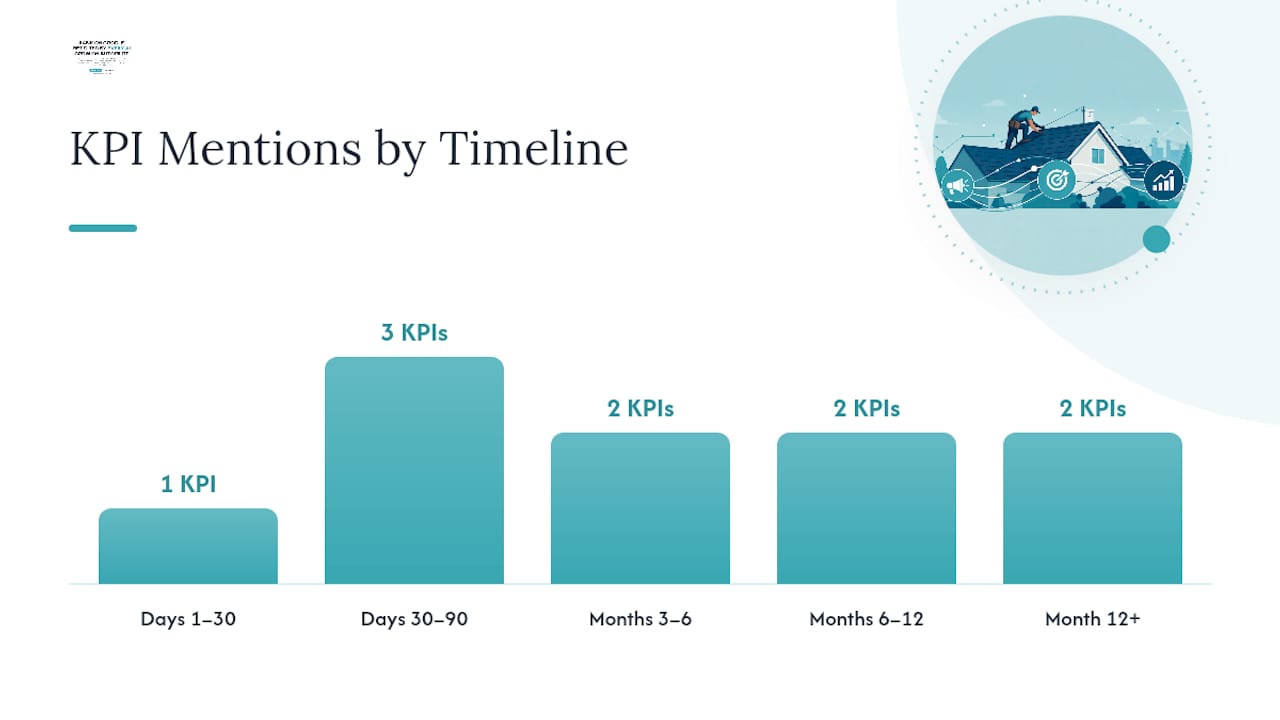
Fast wins come from storm-response pages published within 48 hours of a weather event and insurance-claim pages targeting queries with low local competition. Long-term wins come from neighborhood project pages and materials stance pages that accumulate links and engagement over time.
Your monthly measurement checklist: impressions per post, CTR, organic clicks, form fills, verified calls, and conversion rate by content cluster. Track these in Google Search Console and your CRM side by side. A post with high impressions and low CTR needs a better title tag. A post with high clicks and zero calls needs a better CTA or a more specific local qualifier.
Roofing content and operations resources from Catalyst for the Trades reinforce that content calendars planned ahead of storm season consistently outperform reactive publishing.
Common blogging mistakes that hurt roofing rankings and conversions
Typical errors are templated content, hedged positions, thin generic posts, and missing tracking. Each one is fixable, but only if you recognize it first.
Avoid these:
- Duplicate city templates. Publishing the same post 30 times with only the city name swapped is a duplicate-content penalty waiting to happen. Each city page needs unique photos, project references, or local data.
- Stock photos only. A page with no original images signals to Google and to homeowners that you have no real local presence. Original job-site photos are a ranking signal and a trust signal.
- No local identifiers. A post titled “How to File a Roof Insurance Claim” competes nationally. “How to File a Roof Insurance Claim in [City]” competes locally, where you can win.
- No author attribution. Anonymous posts score lower on EEAT. Add a named contractor byline to every post.
- Untracked phone calls. If you are not tracking calls from blog pages separately, you have no idea which posts generate revenue.
- City-spam title tags. Stuffing five city names into a title tag (“Austin Dallas Houston Roof Repair”) triggers over-optimization penalties. One city per page, one clear query per title.
Red flags in analytics: A post with zero impressions after 60 days is either not indexed or targeting a query with no search volume. A post with clicks but zero conversions has a CTA or trust problem.
How does roofing blog content earn AI citations and EEAT signals?
AI visibility depends on clear EEAT signals, structured data, and content that AI answer engines can quote directly. ChatGPT, Perplexity, Claude, and Gemini all favor content with named authors, specific local examples, FAQ schema, and short direct answers in the first paragraph.
Pro Tip: For insurance-claim pages specifically, publish contractor-authored posts with concrete line-item examples: “A typical Austin hail damage claim includes $800–$1,200 for decking repair, $3,500–$6,000 for shingle replacement, and $400–$600 for flashing.” That level of specificity is exactly what AI engines quote when a homeowner asks about insurance costs.
Your AI readiness checklist:
- FAQ schema on every Q&A post. Validate with Google’s Rich Results Test. FAQ schema increases the chance of appearing in AI Overviews and featured snippets.
- Named author with credentials. A byline reading “Written by [Name], Licensed Roofing Contractor, [City]” satisfies EEAT and gives AI engines a citable authority signal.
- Original photos and video. AI crawlers index image alt text and video transcripts. Descriptive alt text with city and damage type increases citation likelihood.
- llms.txt configuration. A properly configured llms.txt file tells AI crawlers which pages to prioritize. This is the equivalent of robots.txt for LLM indexing.
- Short-answer snippets in the first 100 words. AI engines pull from the opening paragraph. If your answer is buried in paragraph six, it will not be cited.
- Community signals. Reddit threads that reference your content or your business name increase AI citation rates, particularly in ChatGPT responses.
For weekly LLM checks, query ChatGPT, Perplexity, and Claude with prompts like “best roofer in [City] for hail damage” and “how to file a roof insurance claim in [City].” Record whether your business or content is cited. Run these checks weekly for the first 12 weeks after launching a new cluster, then monthly. For a deeper look at how AI visibility for local service businesses works in practice, the same citation-readiness framework applies across every service category.
Why roofers should prioritize insurance and storm clusters above everything else
The conventional SEO advice for roofers is to “publish consistently and cover all topics.” That advice is not wrong, but it buries the most important decision: which cluster you start with determines how fast you see revenue from content. Insurance-claim and storm-response pages are the only roofing content clusters where the searcher is already past the research phase. They have damage, they need a contractor, and they are searching for someone they can trust with a claim. Every other cluster, including how-to posts and materials guides, serves a searcher who may be months away from hiring anyone.
The five-pillar roofing SEO framework from Elevarus makes this point clearly: measure on cost-per-verified-lead, not rankings. A page that ranks third for “types of roofing shingles” generates almost no verified leads. A page that ranks fifth for “hail damage roof insurance claim [City]” generates calls the same week it ranks. Prioritize accordingly, and treat everything else as authority-building infrastructure that supports your top two clusters.
Trystellor automates the roofing content strategy described above
Trystellor publishes 30 GEO and SEO-optimized articles per month to your CMS, runs a 4,000-site backlink network, delivers weekly technical audits, and tracks your citation presence across ChatGPT, Claude, Perplexity, and Gemini, all for $199 per month.

For roofing businesses specifically, Trystellor’s content engine targets the clusters that matter most:
- City-named storm and insurance-claim pages, published on a calendar timed to storm season
- Materials stance pages and neighborhood project pages with schema markup built in
- llms.txt and FAQ/HowTo schema automation so every post is AI-citation-ready from day one
- Reddit opportunity identification so your content reaches the community threads AI engines actually quote
The platform replaces five separate vendor subscriptions (content, backlinks, audits, Reddit engagement, and LLM tracking) with one managed system. You keep all content even if you cancel. There is no credit card required to start.
Start your 3-day free trial at Trystellor and get a free AI Visibility Audit within 48 hours, including your current citation status across 25 buyer prompts and a 90-day content plan built around your market’s highest-converting roofing clusters. You can also explore how roofing service data drives new contracts to see how data-driven content approaches translate into signed jobs.
Sources
- Google Business Profile help — Google Support
- PageSpeed Insights
- Google Search Console
- Statista — Share of website traffic coming from mobile devices
- Roofing Content Marketing in 2026 — PipelineOn
FAQ
How long does roofing blog content take to rank?
Early impressions typically appear within 30 days of indexing. Verified calls and map pack movement usually follow by month 6, with dominant local rankings building over 6–12 months for competitive markets.
What roofing blog topics generate the most leads?
Insurance-claim pages and storm-response pages convert at the highest rates because they target homeowners who already have damage and need a contractor. Prioritize these clusters before evergreen how-to content.
How often should a roofing company publish blog posts?
Four to eight posts per month is the cadence that compounds fast enough to shift rankings. Publishing fewer than two posts per month rarely builds the topical authority needed to compete in local search.
Does roofing blog content help with AI search results?
Yes. AI answer engines like ChatGPT and Perplexity cite roofing content that includes FAQ schema, named author credentials, direct answers in the first paragraph, and original local media. An llms.txt configuration tells AI crawlers which pages to prioritize.
What is the 25% rule for roofing?
Coverage decisions vary by policy and insurer, so homeowners should always get a written contractor assessment before filing a claim.