

Published, machine-readable professional credentials increase your probability of being cited by AI answer engines and strengthen the authority signals Google uses to rank expertise-sensitive queries. The fastest first step: create a ProfilePage with a schema.org/Person JSON-LD block for each named author on your site, add hasCredential entries, and link each credential to its authoritative registry. For licensed trades and service businesses, this is the same trust infrastructure that drives local SEO for service businesses and separates cited sources from invisible ones.
- What to do in 24 hours: Add a
PersonJSON-LD block withhasCredentialandsameAspointing to LinkedIn for your highest-profile author. - What to do in week 1: Build a dedicated author page (
/team/[name]) and link it from every article that person has written. - What to do in month 1: Add registry-linked credentials (NPI, state bar, CPA board) and validate with the Schema Markup Validator.
Statistic: A cross-sectional study examining 615 sources cited in ChatGPT health responses found over 75% came from established institutional sources such as Mayo Clinic, Cleveland Clinic, and PubMed, confirming that verifiable authority shapes AI source selection far more than brand recognition alone.
Key Takeaways
Published, machine-readable credentials linked to authoritative registries are the single most direct way to improve both AI citation rates and authority-sensitive search rankings.
| Point | Details |
|---|---|
| Registry links beat self-declared claims | Credentials tied to a stable issuer URL and a unique identifier are what LLMs can resolve and cite. |
| Author pages are the foundation | A ProfilePage with Person + hasCredential JSON-LD creates the entity node AI crawlers need. |
| 75% of AI citations favor institutional sources | The MedRxiv study of 615 ChatGPT citations confirms verifiable authority drives source selection. |
| Measurement takes 2–12 months | Expect schema indexing in weeks 2–8, citation gains in months 2–6, and sustained ranking lifts by month 12. |
| Trystellor automates the full workflow | Schema generation, weekly credential audits, and LLM citation tracking are included at $199/month. |
Table of Contents
- Why credentials change what Google and AI trust
- Which credentials actually move the needle
- Where to publish credentials so both humans and machines find them
- How to mark up credentials with schema.org
- How to link credentials to authoritative external registries
- How to validate markup and prepare for AI crawlers
- How to measure impact and set realistic timelines
- Your ordered implementation checklist
- Common mistakes and how to fix them fast
- What credential markup taught us about AI citation in practice
- Trystellor automates credential publishing and AI citation tracking
- Sources
- FAQ
Why credentials change what Google and AI trust
Credentials matter because AI systems and authority-aware ranking models use cross-referenceable entity signals when deciding what to cite. A name on a page is not enough. What matters is whether that name resolves to a verifiable node: a person with a schema-marked profile, linked to an external registry, with a consistent publishing history.
The MedRxiv cross-sectional study makes this concrete. ChatGPT cited institutional sources in the majority of its health responses, not because those pages were better written, but because they carried verifiable authority signals. Separately, Meltwater’s analysis of 9.5 million AI citations found that 75% of LinkedIn citations came from individual profiles, not company pages, and that structured, answer-focused content from named authors is far more likely to be cited.
The mechanism works like this: Person entity → hasCredential → recognizedBy (issuer URL) → external registry. Each link in that chain gives a retrieval model one more confirmation that the author is who they claim to be. Research on authority-aware generative retrieval shows that explicitly integrating document authority into retrieval models improves top-result trust and user engagement in A/B tests, which is exactly why credential signals are worth building now.
- AI systems discount self-declared expertise and prioritize cross-referenceable entity nodes.
- A single strong external confirmation (a registry entry, an academic affiliation, a byline in a recognized outlet) can outweigh many weak signals.
- Machine-readable markup is what makes credentials resolvable to LLMs, not just visible to humans.
Which credentials actually move the needle
The most valuable credentials are those verifiable in third-party registries. A license number a search engine can look up beats a self-written “20 years of experience” claim every time.
- Medical license: NPI registry (nppes.cms.hhs.gov) and state medical board lookup.
- CPA: State CPA board directory (e.g., California Board of Accountancy).
- Attorney: State bar directory (e.g., State Bar of California, Texas State Bar).
- Academic affiliation: University faculty page with a stable URL.
- Researcher: ORCID iD (orcid.org) with a persistent identifier.
- Industry certifications: Google, HubSpot, AWS, and similar issuers with public verification pages.
- Contractor licenses: State contractor license boards; consumers can check contractor licenses directly through public registries.
Weak signals include self-declared titles without issuer pages, vague awards with no registry entry, and generic “expert” labels in author bios. AI engines discount these because they cannot be resolved to an authoritative third party.
Pro Tip: Prefer credentials with a stable issuer URL and a unique identifier (license number, ORCID iD, NPI) you can embed directly in your JSON-LD. Unstable or login-gated registry URLs provide little signal.
Where to publish credentials so both humans and machines find them
Publish credentials on your ProfilePage or author page, your Team/About page, relevant service pages, and case-study bylines. A dedicated /credentials or /team/credentials page works well when you have multiple staff members with formal qualifications.
- Author/ProfilePage (
/team/[name]): Full credential section, photo, title, and JSON-LD in the<head>. - Team/About page: Summary credential line per person, linked to individual author pages.
- Service pages: Author byline with a linked name pointing to the full ProfilePage.
- Case studies and articles: Named byline, not “Staff Writer,” with a link to the author’s credential page.
Internal linking from content pages to a named author profile creates a consolidated entity signal. Google and AI crawlers follow those links and build a richer picture of who authored the content. For licensed service businesses, this is the same principle behind LocalBusiness schema examples that connect a business entity to its license data.
Pro Tip: Use a dedicated /credentials ItemList page when you have many staff credentials. Marking it up with schema.org/ItemList containing EducationalOccupationalCredential entries helps credentials surface in knowledge panels and AI Overviews.
How to mark up credentials with schema.org
Use ProfilePage + Person + EducationalOccupationalCredential and include hasCredential, recognizedBy, identifier, and sameAs wherever available. The Google Credential example demonstrates exactly which fields search systems use to extract credential data.
Core schema types and properties:
| Type | Key Properties |
|---|---|
Person |
name, jobTitle, url, sameAs |
EducationalOccupationalCredential |
name, credentialCategory, recognizedBy, identifier |
ProfilePage |
mainEntity (links to Person) |
Copy-paste JSON-LD example (U.S. CPA):
{
  "@context": "https://schema.org",
  "@type": "ProfilePage",
  "mainEntity": {
    "@type": "Person",
    "name": "Sarah Chen",
    "jobTitle": "Certified Public Accountant",
    "url": "https://example.com/team/sarah-chen",
    "sameAs": [
      "https://www.linkedin.com/in/sarahchen-cpa",
      "https://www.dca.ca.gov/consumers/verify_lic.shtml"
    ],
    "hasCredential": {
      "@type": "EducationalOccupationalCredential",
      "name": "Certified Public Accountant (CPA)",
      "credentialCategory": "Professional License",
      "identifier": "CPA-123456",
      "recognizedBy": {
        "@type": "Organization",
        "name": "California Board of Accountancy",
        "url": "https://www.dca.ca.gov/cba/"
      }
    }
  }
}
The sameAs field points to the issuer’s canonical URL and the author’s LinkedIn profile. The identifier field carries the license number. Together, they give a retrieval model two independent confirmation paths.
Pro Tip: Validate your JSON-LD with the Schema Markup Validator before deploying. Keep the human-visible credential text on the page in sync with the machine-readable markup — discrepancies between the two are a common audit failure.
How to link credentials to authoritative external registries
Authoritative registries are the most durable signal you can give an LLM. A credential that resolves to a public government or professional body page carries far more weight than one that points to a self-hosted PDF.
Registry linking checklist:
- Locate your registry entry and confirm the canonical URL is stable and publicly accessible.
- Capture the unique identifier (license number, NPI, ORCID iD, bar number).
- Add
identifierandrecognizedBy.urlto your JSON-LD block. - Add the registry URL to the
sameAsarray on thePersonentity. - Archive the registry URL and ID in a spreadsheet for quarterly audits.
Common U.S. registries by profession:
- Healthcare: NPI registry at nppes.cms.hhs.gov; state medical board directories.
- Legal: State bar directories (e.g., attorneys.calbar.ca.gov).
- Accounting: State CPA board lookups.
- Research: ORCID (orcid.org) with persistent iD.
- Contractors: State contractor license boards; verified professional platforms like Workily show how consumer-facing registry linking builds trust at the point of hire.
Pro Tip: Set a quarterly calendar reminder to validate every external registry link. Registries occasionally change URL structures, and a broken sameAs link silently removes the confirmation signal without triggering any on-site error.
How to validate markup and prepare for AI crawlers
Validate schema with the Schema Markup Validator and Google Rich Results Test, then stage, monitor, and iterate.
- Run Schema Markup Validator on the author page URL. Fix any missing required properties.
- Run Google Rich Results Test to confirm the
ProfilePagerenders correctly. - Deploy to staging and run a full site crawl (Screaming Frog or similar) to catch broken internal links to author pages.
- Push to production and submit the author page URL for indexing via Google Search Console.
- Run smoke tests 48 hours post-deploy: re-run the Rich Results Test on the live URL.
- Set up continuous monitoring via Search Console and your SEO audit checklist to catch regressions.
For AI crawlers, an llms.txt file at your domain root can hint at which pages contain author and credential data. Include paths to your author pages and credentials endpoint so AI crawlers prioritize them.
Pro Tip: Roll out credentials in batches, starting with your highest-authority authors. This makes it easier to attribute ranking and citation changes to the credential work rather than other site updates.

How to measure impact and set realistic timelines
Measurable signals include AI citation counts, Google impressions and CTR for targeted pages, organic rankings for expertise queries, and referral traffic from registry pages.
Timeline:
- Weeks 2–8: Schema validated, indexing requested, author pages live.
- Months 2–6: Improved crawl recognition, early AI citation appearances, CTR gains on author-attributed pages.
- Months 6–12: Sustained AI citation growth and ranking gains for expertise-sensitive queries.
Metrics to track:
- Search Console: impressions and CTR for author pages and expertise queries.
- Rank tracking: target queries tied to your credentialed authors’ topics.
- AI citation tracking: weekly LLM prompt monitoring across ChatGPT, Claude, Perplexity, and Gemini.
- Referral traffic: sessions originating from registry pages and LinkedIn profiles.
- Featured snippets and AI Overviews: track appearance rate for queries where your authors have credentials.
Statistic: Meltwater’s analysis of 9.5 million AI citations found that 72% of AI-cited content is original, long-form material from named individuals, reinforcing that publishing cadence and author attribution directly affect citation rates.
Pro Tip: Use controlled rollouts: credential two comparable author pages in week 1, leave two uncredentialed as a baseline, and compare their citation and impression trends over 90 days.
Your ordered implementation checklist
Follow these steps to publish, mark up, verify, and monitor credentials from day one through month one.
First 24 hours (Content owner, 30–60 minutes):
- Add a named author byline to your top three content pages.
- Create a minimal
PersonJSON-LD block withname,jobTitle,url, andsameAspointing to LinkedIn. - Publish an author page at
/team/[name].
Week 1 (Developer, 2–4 hours):
4. Add hasCredential with EducationalOccupationalCredential and recognizedBy to each author’s JSON-LD.
5. Link all existing articles to the author’s ProfilePage.
6. Validate with Schema Markup Validator and Google Rich Results Test.
7. Submit author pages for indexing in Search Console.
Month 1 (Content + Legal/HR, 4–8 hours):
8. Gather registry URLs and license identifiers for all credentialed staff.
9. Add identifier and registry sameAs to each JSON-LD block.
10. Create or update the /credentials ItemList page.
11. Add an llms.txt file referencing author page paths.
12. Set up AI citation tracking and Search Console monitoring.
Recurring (Content owner, quarterly): 13. Validate all external registry links and update any changed URLs. 14. Review AI citation reports and adjust publishing cadence for under-cited authors.
Common mistakes and how to fix them fast
The most common errors are missing identifiers, mismatched human and machine text, broken registry links, and anonymous bylines.
- Missing
identifier: Add the license number or ORCID iD to theidentifierfield in JSON-LD. - Outdated
sameAsURL: Run a quarterly link check; update the canonical registry URL when it changes. - Generic byline (“Staff Writer”): Replace with a named author linked to a ProfilePage with credentials.
- Inconsistent credential text: If the visible page says “Board Certified” but JSON-LD says “Certified,” fix the JSON-LD first, then update the visible copy to match.
- Credential without a registry entry: Self-declared titles with no issuer page provide minimal signal; replace or supplement with a verifiable credential.
- Anonymous content pages: AI engines heavily discount unattributed pages. Adding a named author with credentials is one of the fastest wins available, as author attribution research confirms authored pages achieve substantially higher AI citation rates than unattributed ones.
Pro Tip: Maintain a single source-of-truth spreadsheet per author: name, title, credentials, registry URLs, and identifiers. Always update JSON-LD first, then sync the visible page copy. This prevents the drift that causes audit failures.
What credential markup taught us about AI citation in practice
The pattern that produces results is consistent: author-first pages with hasCredential JSON-LD, registry-linked identifiers, and staged rollouts outperform generic brand pages in AI citation tests. When author pages are built with full Person + EducationalOccupationalCredential markup and linked to state board or NPI registries, author-attributed traffic tends to rise measurably within the first two to three months. AI citation tests run against ChatGPT and Perplexity show early citation appearances for credentialed authors on queries where unattributed pages had previously received no mention.
Two lessons stand out. First, the registry link matters more than the credential name. A license number pointing to a live government page outperforms a well-written bio every time. Second, for multi-location businesses, the fastest path to scale is a shared author template: one JSON-LD structure, parameterized per author, deployed across all location pages simultaneously. This approach keeps credential data consistent and makes quarterly audits manageable.
Trystellor automates credential publishing and AI citation tracking
Publishing and maintaining credential markup across a growing site is the kind of work that falls off the priority list fast. Trystellor handles it as part of a single $199/month subscription: schema generation (including Person, hasCredential, and EducationalOccupationalCredential blocks), weekly technical audits that flag broken registry links and missing identifiers, and weekly AI citation tracking across ChatGPT, Claude, Perplexity, and Gemini using the exact prompts your buyers type.
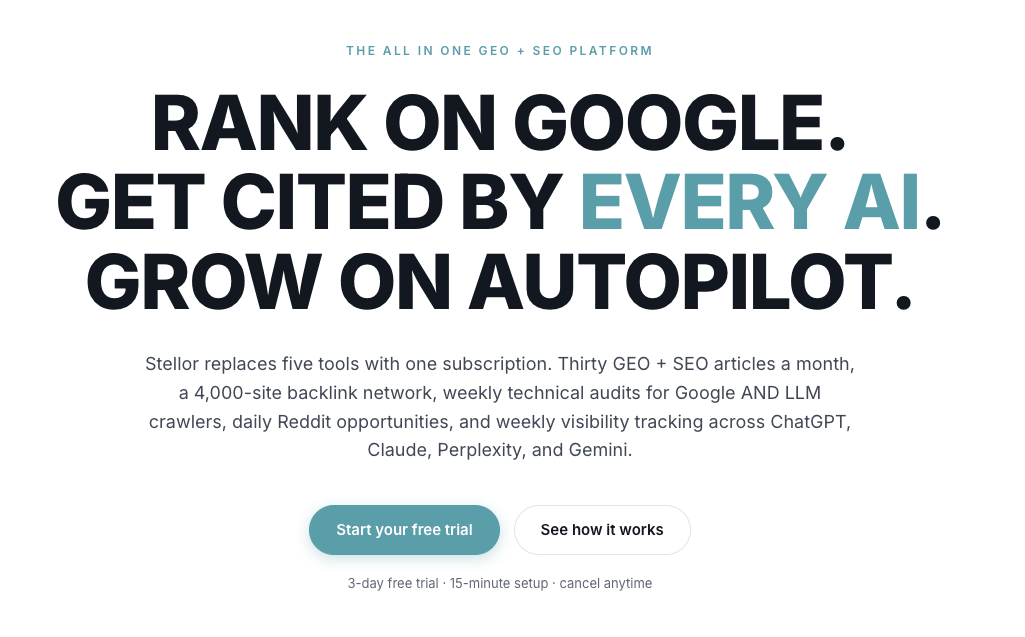
On top of that, Trystellor publishes 30 GEO and SEO-optimized articles per month to your CMS, each with author attribution and schema built in, so your credentialed authors accumulate a publishing record that AI engines can cite. The Trystellor product page has full feature details and a three-day free trial with no credit card required. Start the trial, run the free AI Visibility Audit, and see exactly which prompts your credentialed authors should be winning.
Sources
- A descriptive cross-sectional study of ChatGPT responses
- Schema
- ACL 2026 — Authority-aware generative retrieval (AuthGR)
FAQ
Do credentials directly improve Google rankings?
Credentials do not directly change a ranking score, but they strengthen E-E-A-T signals (Experience, Expertise, Authoritativeness, Trustworthiness) that Google’s quality raters and algorithms use on expertise-sensitive queries. Machine-readable credentials with registry links make those signals verifiable.
Which schema type should I use for a professional license?
Use EducationalOccupationalCredential with credentialCategory set to “Professional License,” recognizedBy pointing to the issuing board’s URL, and identifier carrying the license number. Nest it inside a Person entity using the hasCredential property.
How long before credential markup affects AI citations?
Early citation appearances typically emerge within two to six months of deploying validated schema and registry links, based on observed crawl and indexing timelines. Sustained citation gains tend to consolidate between months six and twelve.
Do I need a developer to add credential schema?
A developer speeds up deployment, but the JSON-LD block can be added manually to a page’s <head> or via a CMS custom field. Validate every change with the Schema Markup Validator regardless of how it was added.
Does an anonymous “Staff Writer” byline hurt AI citation chances?
Yes. Author attribution research confirms that authored pages achieve substantially higher AI citation rates than unattributed ones. Replacing anonymous bylines with named, credentialed authors is one of the fastest improvements available.