

Content depth improves rankings by giving search engines and AI answer engines the semantic completeness they need to trust a page as an authoritative source. Industry correlation analyses consistently show that pages ranking on the first page of Google tend to cover their topics more thoroughly than lower-ranked pages — but the driver is coverage, not word count. Expect early on-page signals (crawl frequency, engagement shifts) within 4–12 weeks of a depth upgrade; clearer ranking moves typically follow at 8–16 weeks, depending on your site’s existing authority and the competitiveness of the target queries.
The role of content depth in ranking improvements is also expanding beyond traditional search. AI Overviews in Google, along with ChatGPT, Perplexity, and Claude, preferentially cite pages that map entities, attributes, and relationships clearly — the same structural qualities that define semantic depth. Understanding how AI search is changing local business discovery makes clear why this matters: the same depth signals that win Google rankings are now the admission ticket to AI-generated answers.
For a practical foundation on measurable SEO results and how to track them, the measurement section below gives you a repeatable audit framework. If you work in local services, the GEO + SEO approach for home service businesses shows how depth applies at the market level.
Key Takeaways
Semantic depth — not word count — is the primary driver of durable ranking improvements and AI citation likelihood, and the most effective path to building it is a coordinated cluster of entity-mapped, schema-marked, interlinked pages.
| Point | Details |
|---|---|
| Depth beats length | Semantic completeness (entities, attributes, relationships) drives rankings; word count alone is not a ranking signal per Google’s guidance. |
| Timelines are predictable | Early engagement signals appear in 4–12 weeks; ranking moves typically follow at 8–16 weeks depending on site authority. |
| Measurement requires a baseline | Set a cohort of pages in positions 8–20, record Search Console and GA4 baselines, and track at 30/60/90-day intervals. |
| Clusters outperform single pages | A pillar linked to subtopic and FAQ pages satisfies AI query fan-out and builds topical authority faster than one long page. |
| Trystellor automates the cadence | Trystellor publishes 30 depth-optimized articles monthly with schema, backlinks, and LLM tracking built in, starting at $199/month. |
Table of Contents
- What does content depth actually mean (and how is it different from word count)?
- What the data actually shows about length, rankings, and common myths
- How content depth improves ranking: the mechanisms that actually matter
- How to measure content depth with the right tools and checks
- Step-by-step workflow to add semantic depth without bloating content
- How to run experiments and what timelines to expect
- Common mistakes when pursuing content depth and how to fix them
- How a GEO + AI visibility platform operationalizes content depth
- The rules I actually follow when upgrading content depth
- Trystellor makes content depth repeatable at scale
- Sources
- FAQ
What does content depth actually mean (and how is it different from word count)?
Content depth, often called semantic depth, refers to how completely a page covers its topic — the entities it names, the attributes it describes, the relationships it explains, and the follow-up questions it answers. MarketMuse defines topical depth as the degree to which a page answers both primary and secondary user questions, not the raw number of words it uses to do so.
The distinction matters because length and depth are not the same thing. A 3,000-word page that repeats the same three points in slightly different phrasing is shallow. A 900-word page that names the relevant entities, explains their relationships, cites supporting data, and addresses the most common follow-up questions can be genuinely deep. Google’s own guidance is explicit: word count is not a ranking signal, and teams should focus on answering user needs rather than hitting a target length.
Here is what depth actually looks like in practice:
- Named entities: specific people, places, tools, standards, and concepts — not generic references
- Attributes: properties and characteristics of those entities (a tool’s pricing model, a technique’s limitations)
- Relationships: how entities connect to each other (which tools support which workflows, which standards govern which processes)
- Subtopic coverage: the supporting questions a user would naturally ask after reading the primary answer
- Structured schema: markup that makes entity relationships machine-readable
- Internal cluster links: connections to related pages that extend the topical map
- Original data or examples: specific, verifiable details that generic content omits
Pro Tip: Run a three-point rapid audit to separate depth from padding. First, scan for named entities — if the page uses mostly generic nouns (“tools,” “strategies,” “platforms”), it is shallow. Second, check for unique data or examples — a page that could have been written without any domain knowledge is thin. Third, list the top three follow-up questions a reader would have after finishing the page — if the page leaves all three unanswered, it has a depth gap worth filling.
What the data actually shows about length, rankings, and common myths
The correlation between longer pages and higher rankings for informational queries is real and well-documented. Search Engine Land’s analysis of content length and SEO confirms the pattern but is careful to note that length is not a direct causal factor — comprehensive coverage of a topic often requires more words, which is why the correlation exists.
Reading a correlation study correctly requires checking four things. First, look at the sample: does it cover your query type and industry, or is it dominated by one vertical? Second, identify confounders: do the longer pages also have stronger backlink profiles, higher domain authority, or better internal linking? Third, check topical context: informational queries reward depth far more than navigational or transactional ones. Fourth, apply the Pearson correlation coefficient test mentally — a strong correlation between length and position does not establish that adding words caused the ranking.
The causal chain that actually explains the correlation looks like this:
| What correlation studies show | What the causal mechanism likely is |
|---|---|
| Longer pages rank higher for informational queries | Comprehensive coverage satisfies more user questions, reducing pogo-sticking |
| Top-ranked pages tend to cover more subtopics | Subtopic coverage builds topical authority across a cluster |
| Pages with more words earn more backlinks | Detailed, citable content attracts links; length is incidental |
| Higher word counts correlate with lower bounce rates | Depth keeps users engaged; padding does the opposite |
The practical myth-busters follow directly from this. “Add words to rank” is wrong — adding filler increases bounce rate and dilutes entity density. “Cover missing subtopics to rank” is right — filling genuine gaps in your topic map addresses the actual mechanism. The Digital Codex data-driven guide frames it cleanly: write to completeness, not to hit an arbitrary word count.
How content depth improves ranking: the mechanisms that actually matter
Semantic depth works through several distinct pathways, and understanding each one lets you prioritize the right actions for your situation.
- Topical authority: When a site covers a topic cluster thoroughly — pillar page, subtopic pages, FAQ pages, schema — search engines assign higher authority to the domain for that topic. A single deep page helps; a coordinated cluster compounds.
- Entity coverage and relationships: Semantic depth in SEO establishes that mapping entities, their attributes, and their relationships is a baseline requirement for modern visibility. Pages that name and connect relevant entities are more likely to be selected as AI Overview sources.
- Structured data and schema: Schema markup translates entity relationships into a machine-readable format. FAQ schema, HowTo schema, and Article schema each increase the probability that a page’s content is extracted for featured snippets and AI-generated answers.
- Internal linking and cluster design: A pillar page linked to subtopic pages, which in turn link to FAQ pages and back to the pillar, creates a navigable topical map. This structure distributes authority and signals to crawlers that the site owns the topic.
- User engagement signals: Deep, well-structured content reduces bounce rate, increases scroll depth, and extends session duration. These behavioral signals correlate with ranking stability, though Google has not confirmed them as direct ranking inputs.
- Backlink potential: Specific, citable content earns links. A page that names a technique, provides original data, or answers a question no competitor has addressed gives other publishers a reason to reference it.
- AI and LLM retrievability: AI answer engines synthesize multiple sources and prefer semantically rich, structured pages. Pages with strong entity coverage and clear subtopic structure are more likely to be cited in AI Overviews and generative responses.
The “query fan-out” dynamic is worth understanding specifically for AI Overviews. When a user asks a broad question, the AI expands it into multiple sub-queries and retrieves sources for each. A cluster of deep, interlinked pages covering a topic from multiple angles is far more likely to supply answers to several of those sub-queries than a single long page trying to cover everything. The flow looks like this:
Pillar page (defines the topic, links to subtopics) → Subtopic pages (answer specific sub-queries, link back to pillar) → FAQ pages (capture long-tail and conversational queries) → AI citation (the cluster satisfies multiple sub-queries in the fan-out).
Schema and explicit entity mapping accelerate this process. When a page’s structured data names the entities it covers and their relationships, AI crawlers can parse and quote it without needing to infer context from surrounding prose. For AI-driven local service visibility, this is the difference between being cited and being invisible.

How to measure content depth with the right tools and checks
Measurement is where most teams lose discipline. They upgrade content, wait, and then attribute any ranking change to the upgrade — without a baseline or a control group. Here is a practical toolkit and a repeatable audit process.
Tools and what each contributes:
- MarketMuse: content scoring based on topic modeling; identifies entity and subtopic gaps relative to top-ranked pages
- Clearscope: term and entity coverage grading; shows which semantically related terms your page is missing
- Surfer: on-page optimization scoring with NLP-based term frequency analysis; useful for quick gap identification
- BrightEdge: enterprise-level query discovery and organic performance tracking; connects content changes to ranking and traffic outcomes
- Google Search Console: query-level data showing which terms a page ranks for, at what position, and with what CTR — the ground truth for baseline and tracking
- GA4: session duration, scroll depth, pages-per-session, and bounce rate — the engagement signals that reflect whether depth is actually serving users
Five audit checks you can run in one hour:
- Pull your target page’s content score in MarketMuse or Clearscope and compare it to the average score of the top three ranking pages.
- List every named entity on your page and compare against the entities named on the top-ranked competitor page — gaps are depth opportunities.
- Check internal-link depth: how many clicks from the homepage does your page sit? Pages more than three clicks deep often underperform despite strong content.
- Verify schema presence using Google’s Rich Results Test — missing FAQ or Article schema is a quick fix with measurable extractability impact.
- Pull GA4 scroll depth and average engagement time for the page. If users are leaving before the 50% scroll mark, the content structure (not just the depth) needs work.
Setting a baseline for cohort tracking:
Select a cohort of 10–20 pages in positions 8–20 for your target queries. Record current average position, impressions, clicks, and CTR from Google Search Console. Note the engagement baseline from GA4. Set tracking windows at 30, 60, and 90 days. Do not mix pages that received backlinks or technical changes during the test window — isolate the depth variable.
Content scores from tools like MarketMuse and Clearscope are useful starting points, but they measure term frequency, not genuine answer completeness. Combine tool scores with human editorial judgment: review your sales team’s most common objections and your support team’s most frequent questions. Those are the subtopics tools miss because they do not appear in competitor content either. For content optimization across different business types, the same principle applies — real user questions outperform algorithmically derived term lists.
Step-by-step workflow to add semantic depth without bloating content
The goal is to add what is missing, not to add more. Every step below is oriented toward that principle.
- Select your highest-opportunity pillar. Target pages currently ranking in positions 8–20 that already have some backlinks and relevant query impressions. These pages have traction — depth upgrades give them the final push.
- Audit the existing cluster. Map every page in the cluster: the pillar, subtopic pages, FAQ pages, and any thin supporting content. Identify orphan pages (no internal links pointing to them) and duplicate-intent pages (two pages targeting the same query).
- Map entities and attributes. List every entity your topic requires — tools, techniques, standards, named concepts, people, organizations. For each entity, note which attributes matter to your reader (pricing, limitations, use cases, relationships to other entities).
- Create missing subtopic pages or expand existing sections. If a subtopic has no dedicated page and the query volume justifies one, create it. If the subtopic is minor, add a section to the pillar. Do not create a page for every entity — only where the user’s question is distinct enough to warrant its own URL.
- Merge thin pages when necessary. Two pages targeting the same intent with fewer than 500 words each are almost always better as one consolidated page. Use a 301 redirect from the merged URL and update all internal links.
- Add schema and internal links. Add FAQ schema to any page with a Q&A section. Add Article schema with
dateModifiedto signal freshness. Link the pillar to each subtopic and each subtopic back to the pillar, using descriptive anchor text that names the subtopic concept. - Publish with a change log and update
dateModified. Search engines treat adateModifiedupdate as a signal to recrawl. A visible “last updated” note also reassures readers that the content is current.
Prioritization rules: Expand when a page has existing backlinks and is ranking in positions 8–15 — it is close enough that depth alone can move it. Merge when two pages split authority for the same query. Delete when a page has no backlinks, no impressions, and no realistic path to ranking.
Pro Tip: Answer the user’s primary question in the first paragraph of every section, then add the supporting depth below it. This structure serves both featured snippet extraction and readers who skim. Use H2 and H3 headings as micro-answers — a reader who only reads the headings should still understand the page’s core argument.
Internal linking cadence: connect pillar to sub-pillar with anchor text naming the subtopic concept; connect sub-pillar to FAQ pages with anchor text naming the specific question; connect FAQ pages back to the pillar with anchor text naming the broader topic. Stop adding depth when the topic is complete — not when you hit a word count.
How to run experiments and what timelines to expect
A reliable depth experiment follows a simple protocol. Select a cohort of pages in positions 8–20. Implement depth changes on half the cohort and hold the other half as a control. Track both groups for 8–16 weeks using Google Search Console and GA4. Do not make other significant changes (backlink campaigns, technical overhauls) to the test pages during the window — you need to isolate the depth variable.
Expected timeline by signal type:
| Action | Expected signal | Typical timing |
|---|---|---|
| Publish depth upgrade | Recrawl by Googlebot | 1–2 weeks |
| Recrawl complete | Impressions shift (new queries appear) | 2–4 weeks |
| Engagement improves | Bounce rate drops, scroll depth increases | 3–6 weeks |
| Topical authority builds | Average position improves for cluster queries | 6–12 weeks |
| Backlinks acquired | Domain authority signal strengthens | 8–16+ weeks |
| AI citation uptake | Page cited in AI Overviews or LLM responses | 8–20 weeks |
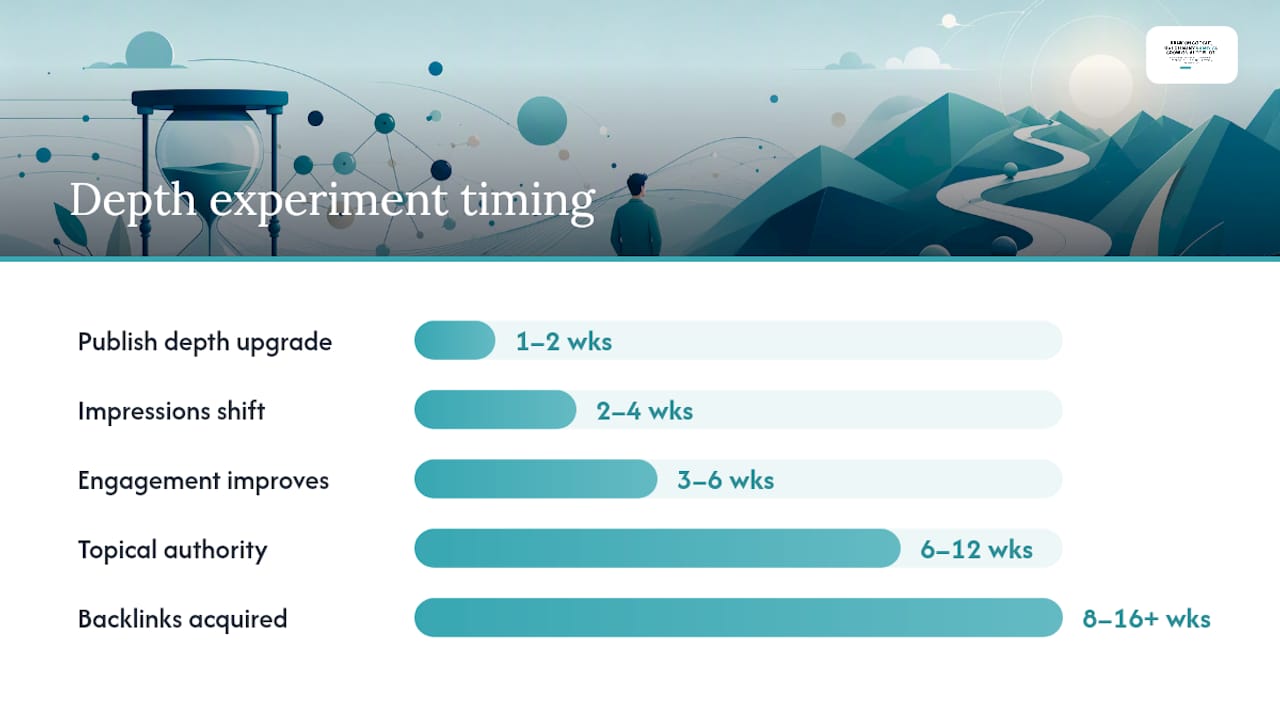
KPIs to monitor throughout the test: impressions, clicks, CTR, average position (all from Google Search Console), pages-per-session and scroll depth (GA4), organic backlinks acquired (Ahrefs or similar), and AI citation occurrences if you have LLM tracking in place.
On statistical significance: a cohort of 10–20 pages over 12–16 weeks gives you enough signal to draw directional conclusions. Smaller cohorts or shorter windows produce noise, not insight. The correlation between content depth and ranking improvements is well-established in industry analyses, but your own site’s data is the only reliable guide to the magnitude of the effect in your specific vertical and authority tier.
Common mistakes when pursuing content depth and how to fix them
Most depth projects fail not because the strategy is wrong but because execution drifts toward the wrong proxy metric. Here are the red flags to watch for:
- Word-count fixation: Adding sentences that restate existing points. Fix: audit every paragraph for whether it adds a new entity, attribute, or answer — delete anything that does not.
- Padding with generic examples: Replacing specific, named examples with vague descriptions (“a major e-commerce platform,” “a leading SaaS company”). Fix: name the entity or cut the example.
- Unanswered follow-up questions: The page answers the primary query but leaves the three most obvious follow-ups unaddressed. Fix: run the three-point audit from the definition section above before publishing.
- Messy internal linking: Subtopic pages with no links back to the pillar, or pillar pages that link to subtopics inconsistently. Fix: audit internal links with Screaming Frog or Ahrefs and enforce the pillar-to-subtopic-to-FAQ linking pattern.
- Missing schema: FAQ sections with no FAQ schema, articles with no
dateModified. Fix: add schema in one session using Google’s Structured Data Markup Helper and validate with the Rich Results Test. - Orphan subpages: Subtopic pages created during a cluster build that received no internal links. Fix: add at least two internal links to every new page before publishing.
- Ignoring content freshness: Deep pages that were accurate two years ago but now reference outdated tools, statistics, or standards. Fix: set a calendar reminder to review high-traffic depth pages every six months.
The readability rule is simple: break deep content into scannable sections with clear H2 and H3 headings, use a short summary sentence at the top of each section, and add visuals (diagrams, tables, annotated screenshots) where a visual explanation is faster than prose. Depth and readability are not in conflict — a well-structured deep page is easier to read than a shallow one, because the reader always knows where they are in the topic.
How a GEO + AI visibility platform operationalizes content depth
The operational challenge with content depth is consistency. A single upgraded pillar is useful; a coordinated monthly cadence of 30 GEO and SEO-optimized articles, each built around specific buyer queries with schema markup and internal linking, is what compounds into measurable topical authority.
Trystellor runs this cadence for its customers. The platform publishes 30 articles per month to each customer’s CMS, covering service pages, location pages, comparison guides, FAQ hubs, and educational long-form. Each article includes schema markup, internal linking structure, and llms.txt configuration — the technical layer that makes pages legible to both Googlebot and the crawlers used by ChatGPT, Claude, Perplexity, and Gemini.
The depth workflow Trystellor runs looks like this:
- Week 1–2: Free AI Visibility Audit delivered within 48 hours of onboarding — covers AI citation status across 25 buyer prompts, competitor benchmarks, technical site report, backlink profile, and a custom 90-day action plan.
- Ongoing monthly: 30 articles published, each targeting a specific query cluster with entity mapping, schema, and internal links built in.
- Weekly: Technical audits across 11 factors (schema completeness, llms.txt readiness, page speed, mobile responsiveness, internal linking depth, and more) with one-click fixes surfaced in the dashboard.
- Ongoing: 4,000-site backlink network delivering authority signals that reinforce the content’s depth signals.
- Daily: Reddit opportunity module identifying high-intent threads where the customer’s presence increases LLM citation likelihood.
- Weekly: LLM visibility tracking across ChatGPT, Claude, Perplexity, and Gemini — reporting which buyer prompts the customer wins and which competitors are cited instead.
For teams building local SEO for service businesses, this cadence is particularly effective because local topical authority compounds faster than national authority — the query universe is smaller and the competition is thinner. Within a 90-day window, customers combining depth-optimized content with backlinks and weekly technical audits typically see measurable improvements in impressions and average position for their prioritized query clusters, along with early AI citation uptake for the prompts their buyers use most.
The rules I actually follow when upgrading content depth
The conventional advice on content depth is to “be comprehensive.” That is true but not useful. Here are the rules that actually change outcomes.
Answer first, then expand. The primary question goes in the first sentence of the page and the first sentence of each section. Everything after that is supporting depth. This structure serves featured snippets, AI extraction, and impatient readers simultaneously.
Map entities before writing. Before adding a word to a page, list every entity the topic requires. If the page is missing three entities that the top-ranked competitor covers, those are the additions that matter. Writing without an entity map produces padding.
Prioritize pages with existing traction. A page in position 12 with 200 monthly impressions and two referring domains will respond to a depth upgrade faster than a page with no impressions and no links. Depth amplifies existing signals; it does not create them from nothing.
Treat intent differences as depth differences. Informational queries need full subtopic coverage, entity mapping, and FAQ sections. Transactional pages need focused supporting content — trust signals, comparison tables, schema — not long-form narrative. Applying informational-page depth to a transactional page buries the conversion path.
Pro Tip: Use jump links and section summaries to make deep pages scannable. A reader who can navigate directly to the section they need is more likely to stay, engage, and return — which is the behavioral signal that reinforces the ranking the depth earned.
The SEO trends shaping 2025 and beyond confirm what practitioners already see: AI-driven search rewards the same structural qualities that have always defined good content — specificity, entity coverage, and genuine answer completeness. The difference now is that the audience includes both human readers and LLM crawlers, and both groups penalize padding in their own way.
Trystellor makes content depth repeatable at scale
Executing a depth strategy manually — auditing clusters, mapping entities, writing 30 articles a month, adding schema, building backlinks, tracking AI citations — is a full-time job for a small team. Most businesses do not have that capacity.
Trystellor bundles every component of this workflow into one $199/month subscription. The platform replaces five separate vendor relationships: a content production tool, a backlink service, a technical SEO auditor, a community engagement workflow, and an AI visibility tracker. You get 30 GEO and SEO-optimized articles per month, a 4,000-site backlink network, weekly technical audits across 11 factors, a Reddit opportunity module for LLM citation influence, and weekly LLM visibility tracking across ChatGPT, Claude, Perplexity, and Gemini.
The same steps described in this guide can be done manually. Trystellor bundles them for teams who need scale and automation without the coordination overhead. Start with a free AI Visibility Audit — no credit card required, delivered within 48 hours, yours to keep regardless. See what Trystellor covers and start the three-day free trial.
Sources
- Creating helpful content — Google Search Central
- Semantic depth in SEO: Go beyond keywords to rank higher
- What is Content Depth? - Blog - MarketMuse
- Content Length & Depth: The Data-Driven Guide | Digital Codex
FAQ
What does content depth mean in SEO?
Content depth refers to how completely a page covers its topic — the entities it names, the attributes it explains, the relationships it maps, and the follow-up questions it answers. It is distinct from word count: a short page can be deep, and a long page can be shallow.
What is the 80/20 rule in SEO?
In SEO practice, the 80/20 principle suggests that roughly 20% of your pages drive the majority of your organic traffic and authority. Applying it to content depth means prioritizing depth upgrades on that high-performing 20% — particularly pages already ranking in positions 8–20 — before expanding the rest of the cluster.
What type of content most effectively improves SEO ranking?
Informational content with strong entity coverage, clear subtopic structure, FAQ schema, and internal links to a coordinated cluster consistently performs best for ranking improvements. Google’s helpful content guidance confirms that content satisfying user needs comprehensively outperforms content optimized primarily for word count or keyword density.
How do you improve content clarity and depth at the same time?
Answer the primary question first in each section, then add supporting depth below it. Use H2 and H3 headings as micro-answers, add jump links for navigation, and include visuals where a diagram or table communicates faster than prose. Depth and clarity reinforce each other when the structure is clear.
Does content depth help with AI Overview citations?
Yes. Semantic depth — entity mapping, structured schema, and subtopic coverage — is a key factor in whether AI Overviews and generative results cite a page. A coordinated cluster of interlinked, schema-marked pages satisfies the query fan-out that AI systems use when generating answers, making citation far more likely than a single long page can achieve alone.