

Content automation is the operating layer that lets a solo operator publish consistently, capture AI citations, and reclaim hours every week without adding headcount. It works by replacing repetitive manual steps across the content lifecycle with software triggers, AI drafting, and workflow rules, while keeping your judgment on the decisions that actually shape your brand. Trystellor is the integrated option built for exactly this, combining GEO + SEO content publishing, backlink distribution, and LLM tracking in one subscription. For technical standards that govern how automated content gets read by search engines, Google Search Central is the authoritative reference.
Three immediate gains solos should expect:
- Time recovered: Automated drafting and scheduling typically cuts production cycle time significantly, per industry ROI analysis.
- Steadier publish cadence: A governed automation loop produces consistent output even during your busiest client weeks.
- Multi-surface distribution: One piece of content reaches your CMS, social scheduler, and email list without manual copy-paste.
Key Takeaways
Content automation is the operating infrastructure that lets a solo operator publish consistently, lower CAC, and get cited by AI answer engines without adding headcount.
| Point | Details |
|---|---|
| Start with one loop | Wire the idea-to-publish workflow first; add repurpose and refresh workflows once it is stable. |
| Expect 40–60% time savings | Industry analyses show production cycle time drops by 40–60% with end-to-end AI content automation. |
| Governance is non-negotiable | A named editor, a prompt library, and clear publishing thresholds prevent brand damage from auto-published errors. |
| Measure three layers | Track time recovered, publish cadence, and content-influenced CAC to connect automation to revenue. |
| Trystellor consolidates the stack | At $199/month, Trystellor replaces five tools with integrated content publishing, backlinks, audits, and LLM tracking. |
Table of Contents
- What content automation actually is (and how it differs from content marketing automation)
- Why automation matters for your solo business growth
- Where to apply automation across the content lifecycle
- Three workflows solos can wire up this week
- Guardrails that protect your brand while you scale
- How to choose the right tools for your solo stack
- Your 30/60/90 day implementation roadmap
- What most solos get wrong about content automation
- Trystellor gives solos a complete automation stack at $199/month
- Sources
- FAQ
What content automation actually is (and how it differs from content marketing automation)
Content automation is the use of software, AI, and workflow rules to plan, create, approve, publish, distribute, and optimize content across its full lifecycle. The focus is asset production and governance, not campaign management.
Content marketing automation, by contrast, handles distribution and nurture: email sequences, ad retargeting, lead scoring. The two overlap at the distribution stage but serve different functions.
| Dimension | Content automation | Content marketing automation |
|---|---|---|
| Primary focus | Asset production and governance | Campaign distribution and nurture |
| Typical tools | CMS-integrated content hubs, AI drafting agents | Campaign orchestration platforms, email platforms |
| Human role | Named editor approval before publish | Campaign strategy and audience segmentation |
| Output | Published pages, articles, schema-marked assets | Emails, ads, triggered sequences |
Think of content automation as the plumbing behind your publishing operation. Content marketing automation is the faucet the audience sees.
Why automation matters for your solo business growth
Automation materially reduces production cycle time and lowers customer acquisition cost (CAC) when paired with targeted distribution. That is the core claim, and the numbers back it up.
Production time reduction of 40–60% is a consistent finding in enterprise AI content automation analyses, with faster campaign launches and higher content throughput reported across measured implementations.
Consider a solo service operator who spent 12 hours a week writing, formatting, and scheduling content. With one automated loop handling research briefs, first drafts, and social distribution, that drops to roughly 5 hours. Those 7 hours go toward a paid offer, a new service tier, or client delivery. CAC falls because organic content compounds without proportional labor cost. A rough formula: if your current content spend (time × hourly rate + tools) divided by new clients acquired equals your content CAC, automation reduces the numerator while the denominator grows with consistent publishing.
Track these metrics to see it working:
- Publish cadence (articles per month, actual vs. target)
- Time-to-publish per asset (from brief to live)
- Content-influenced CAC (new clients who touched a content asset before converting)
- Marketing-influenced revenue (pipeline attributed to organic content)
For measurable SEO results, connect your content output directly to a reporting dashboard from day one.
Where to apply automation across the content lifecycle
The five stages where automation adds the most value are research and ideation, drafting, optimization, distribution, and measurement. HubSpot’s content automation guide maps these stages to programmatic governance, SEO checks, and cross-channel distribution, which is the right mental model for solos.

| Stage | Automation function | Business impact |
|---|---|---|
| Research & ideation | Keyword clustering, topic gap analysis, brief generation | Faster topic selection; briefs ready before you open a doc |
| Drafting | AI-assisted first draft from brief | Cuts drafting time by half or more; human edits for voice |
| Optimization | Auto-generated meta descriptions, alt text, schema markup | Consistent technical SEO without manual checks |
| Distribution | Scheduled CMS publish, social post, email digest trigger | One publish action reaches all channels simultaneously |
| Measurement | Automated rank tracking, AI citation monitoring, weekly report | Visibility into what is working without manual data pulls |
Pro Tip: Template the low-risk, high-frequency outputs first: meta descriptions, image alt text, and summary blurbs. These are safe to automate immediately. Never auto-publish primary sales copy, legal language, or claims without a named editor reviewing the final draft.
Distribution and measurement are often where AI-driven automation multiplies organic results fastest across platforms, because consistent cross-channel presence compounds authority signals over time.
Three workflows solos can wire up this week
For most solo operators, the idea-to-publish workflow delivers the fastest measurable ROI. Start there, then add the others once the first loop is stable.
Workflow 1: Idea to publish (fastest ROI)
- Set a weekly trigger: keyword report flags a new topic gap.
- Automation generates a structured brief (title, outline, target keyword, internal links).
- AI drafting agent produces a first draft aligned to your brand voice prompt library.
- Named editor (you) reviews, edits for accuracy and tone, approves.
- CMS-integrated content hub publishes with schema markup and internal links auto-applied.
- Distribution trigger fires: social post and email digest scheduled.
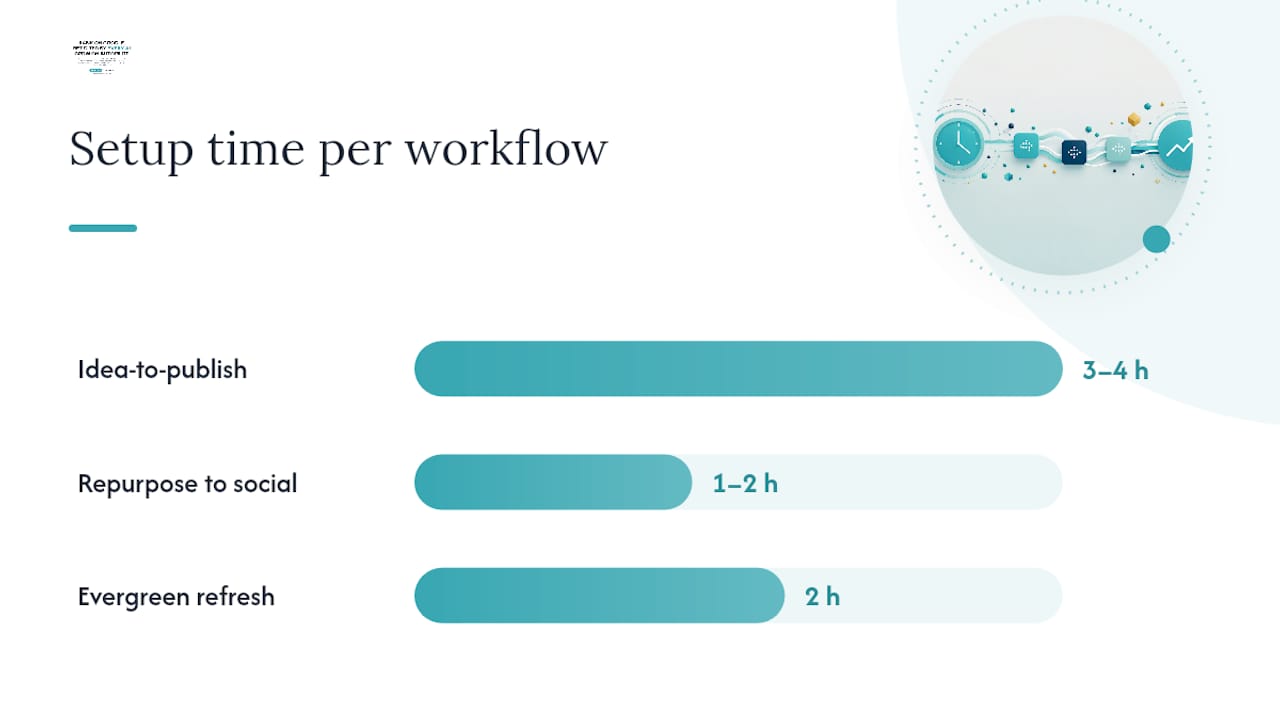
Setup time: roughly 3–4 hours. Expected weekly savings: 5–7 hours. Integrations needed: CMS with publishing API, AI drafting agent, social scheduler.
Workflow 2: Repurpose to social
- Trigger: new article published in CMS.
- Automation extracts three key quotes and generates platform-specific social copy.
- Named editor spot-checks tone, approves or edits.
- Scheduler publishes across platforms over the following week.
Setup time: 1–2 hours. Weekly savings: 2–3 hours. Integrations needed: CMS webhook, social scheduler.
Workflow 3: Evergreen content refresh
- Monthly trigger: rank tracking flags articles that have dropped more than five positions.
- Automation pulls current SERP data and generates an update brief.
- Named editor rewrites the flagged sections, approves.
- CMS republishes with updated date and schema.
Setup time: 2 hours. Monthly savings: 3–4 hours. Integrations needed: rank tracker, CMS API.
Trystellor fits into this stack at the content publishing and AI-visibility layer: it handles the 30 GEO/SEO-optimized articles per month, schema markup, and weekly LLM citation tracking, so Workflow 1 is effectively pre-built for you.
According to the solo founder scaling playbook, automating before hiring generally outperforms early hiring. Run automations on repeatable tasks and bring in a contractor only when patterns are stable.
Guardrails that protect your brand while you scale
Governance prevents the main risk of automation: reputational damage from incorrect or off-tone content published without review. Adobe’s content automation framework puts it plainly: strategy and final approvals stay human, and routine tasks get automated.
A practical governance checklist for solos:
- Named editor rule: Every asset requires one named human to approve before publish. For solos, that is you, or a trusted contractor for lower-stakes content.
- Prompt library: Maintain a documented set of brand voice prompts, tone guidelines, and off-limits topics. Review and update it monthly.
- Publishing thresholds: Define what can auto-publish (social reposts, meta descriptions) vs. what requires approval (new articles, sales pages, any claim with a number).
- Red flags for rollback: Factual errors, legal claims, pricing statements, or any content that references a competitor by name should trigger immediate unpublish and review.
- Approval workflow: Trigger → AI draft → named editor review (target: under 30 minutes) → publish.
For legal or compliance-sensitive content, consult a qualified professional and refer to Google Search Central’s quality guidelines before publishing automated assets in regulated categories.
How to choose the right tools for your solo stack
Choose tools that prioritize CMS integration, ease of setup, and human-approval gates. A tool that requires a developer to configure is a tool you will not maintain. Wiring content automation into your CMS and CRM connects assets directly to pipeline and revenue outcomes, which is what makes the investment measurable.
Must-have capabilities for a solo stack:
- CMS publishing API (direct publish, no manual upload)
- Workflow rules with approval gates
- LLM visibility tracking (are you being cited by ChatGPT, Claude, Perplexity, Gemini?)
- Schema markup automation
- Backlink or distribution hooks
Budget bands for solo operators:
| Band | Monthly spend | What you typically get |
|---|---|---|
| Basic | $50–$150 | AI drafting tool + social scheduler + basic rank tracker |
| Grow | $150–$300 | Integrated content platform + schema automation + some LLM tracking |
| Scale | $300+ | Full-stack: content, backlinks, technical audits, AI citation monitoring |
Trystellor’s product sits in the Grow-to-Scale band at $199/month. It replaces five separate subscriptions: content production, backlink outreach, technical SEO auditing, Reddit community engagement, and LLM visibility tracking. For a solo operator, that consolidation removes the integration gaps that make disconnected tools hard to maintain. The local SEO tactics Trystellor applies to each article are built into the publishing workflow, not bolted on afterward.
A practical solo stack with well-wired automations can replicate many functions of a larger team on a modest monthly budget.
Your 30/60/90 day implementation roadmap
By day 90, you should have one full automated loop running, a weekly reporting dashboard live, and a maintained prompt library. That is the minimum viable automation operation for a solo.
Days 1–30: Audit and wire one loop
- Complete a technical SEO and content audit to identify your highest-frequency manual tasks.
- Document your brand voice in a prompt library (tone, off-limits topics, formatting rules).
- Wire Workflow 1 (idea to publish) with a named editor approval gate.
- Set baseline KPIs: current publish cadence, time-to-publish, and content-influenced CAC.
Days 31–60: Expand and instrument
- Add Workflow 2 (repurpose to social) once Workflow 1 is stable.
- Connect your CMS to a rank tracker and LLM citation monitor.
- Build a simple weekly report: publish cadence, top-performing articles, AI citation count.
- Review your prompt library and update based on the first month’s output quality.
Days 61–90: Optimize and measure
- Add Workflow 3 (evergreen refresh) for articles showing rank decline.
- Calculate content CAC: total content spend divided by new clients who touched a content asset.
- Apply the 10-repetition rule: if a task has repeated more than 10 times in your workflow, automate it. If it has not, keep it manual.
- Decide whether to add a part-time contractor for content review, or keep the founder in the loop.
What most solos get wrong about content automation
The most common error is automating before your processes are stable. Solos often wire up an AI drafting agent before they have a documented brand voice, a named editor rule, or even a clear content calendar. The result is a flood of off-tone drafts that take longer to fix than they would have taken to write manually.
The fix is straightforward: document first, automate second. A one-page prompt library and a simple approval checklist are enough to make automation safe. One governed loop, running reliably for 30 days, is worth more than five half-wired workflows that require constant intervention.
For solos who want the audit, the prompt library setup, and the first automated loop handled for them, Trystellor’s 48-hour AI Visibility Audit is the fastest way to see where you stand and what to automate first.
Trystellor gives solos a complete automation stack at $199/month
Trystellor is the practical choice for solo operators who need integrated content automation without managing five separate tools. It publishes 30 GEO/SEO-optimized articles per month directly to your CMS, runs weekly technical and LLM visibility audits, manages a 4,000-site backlink network, and tracks your citations across ChatGPT, Claude, Perplexity, and Gemini, all from one dashboard.
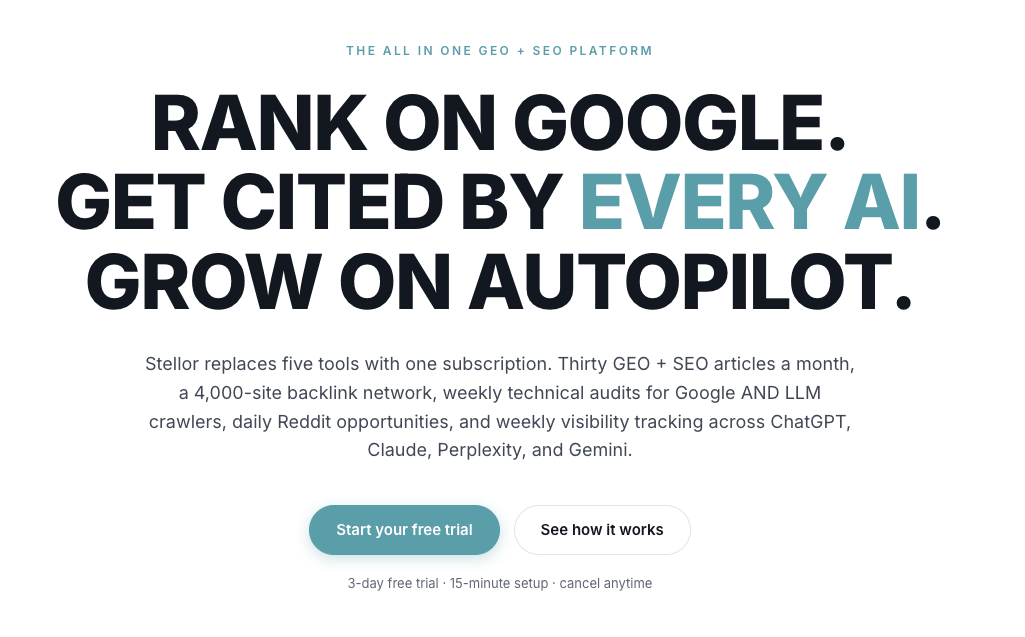
Setup takes 15 minutes. Within 48 hours, you receive a free AI Visibility Audit covering your current citation status across 25 buyer prompts, a competitor benchmark, a full technical site report, and a custom 90-day content plan. Pricing starts at $199/month with a 3-day free trial and no credit card required. You keep all published content even if you cancel.
See the full product or start your free trial at Trystellor today.
Sources
The resources below cover the core concepts in this article and are worth bookmarking as you build your automation stack.
- What Is Content Automation and How It Drives B2B Growth - MakeAutomation
- The Solo Founder Scaling Playbook: How One Person Can Build What Used to Take Twenty - Vikas Malpani
- Content automation: How to use it to scale your website + example workflows - HubSpot
- What is content automation marketing - Adobe Business
FAQ
What is the role of content automation in solo business growth?
Content automation handles the repetitive production steps across the content lifecycle, freeing a solo operator to publish consistently without proportional time investment. The direct result is a lower content CAC and compounding organic authority over time.
How much time can a solo operator realistically save with content automation?
For a solo spending 12 hours a week on content, that translates to roughly 5–7 hours recovered per week.
What should a solo automate first?
Start with low-risk, high-frequency tasks: meta descriptions, image alt text, social reposts, and first-draft generation from a structured brief. Keep primary sales copy, legal language, and any factual claims under named editor review before publishing.
How does Trystellor fit into a solo content automation stack?
Trystellor publishes 30 GEO/SEO-optimized articles per month to your CMS, manages backlink distribution, runs weekly technical audits, and tracks your AI citations across ChatGPT, Claude, Perplexity, and Gemini, replacing five separate tool subscriptions at $199/month.
When should a solo operator hire instead of automating more?
Apply the 10-repetition rule: if a task has repeated more than 10 times in your workflow and still requires significant judgment, consider a contractor. If it is rule-based and repeatable, automate it first.