
Chemical-guide pages are the highest-leverage local content a pool-service business can publish. They capture buyer intent at the exact moment someone searches for a service, feed structured answers to AI engines like ChatGPT, Claude, Perplexity, and Gemini, and carry the local signals that push your service pages up the Google Maps pack. The role of chemical guide content in pool SEO comes down to three things: buyer-ready intent phrasing, schema-structured FAQs that AI systems can extract, and unique local signals mined from your own reviews and call logs. Start by publishing one template guide and linking it directly to your nearest service or location page.
- Buyer intent: Guides answer “which sanitizer works for my pool type?” not “how do chemicals work.”
- Structured data + schema: FAQPage and Service schema make answers machine-readable for Google and AI crawlers.
- Local signals: Review callouts, city-specific intros, and geo meta tags separate your page from generic content.
Key Takeaways
Chemical-guide pages built with FAQPage schema, consistent local signals, and hub-and-spoke internal linking are the most direct path to local map pack rankings and AI citations for pool-service businesses.
| Point | Details |
|---|---|
| Publish structured guides | One template guide per core service, plus four localized variants for your top service areas in the first 90 days — eight to twelve pages total. |
| Add FAQPage schema | Mark up every Q&A block; it is the highest-impact schema type for AI extraction. |
| Build hub-and-spoke links | Every guide links back to the core service page with consistent, descriptive anchor text. |
| Track AI citations weekly | Query ChatGPT, Claude, Perplexity, and Gemini; target a first citation within 60–120 days. |
| Use Trystellor for scale | Trystellor publishes 30 GEO + SEO articles per month and automates schema, audits, and LLM tracking. |
Table of Contents
- How chemical guide content shapes your pool-service SEO
- How to build a topic cluster that lifts your service pages
- What technical setup makes your guides AI-citable?
- How to mine reviews and calls for AI-friendly Q&A
- How many guides to publish and how often
- What KPIs prove your chemical guides are working?
- What you should never publish on a chemical guide page
- Why structured programs outperform one-off blog posts
- Trystellor implements this playbook for you
- Sources
- FAQ
How chemical guide content shapes your pool-service SEO
A well-built chemical guide is not a blog post. It is a localized, buyer-focused asset engineered to rank on Google, appear in the local map pack, and get cited when a homeowner or property manager asks ChatGPT for a pool-service recommendation in your city.
On-page elements every guide must include
- Localized headline: “Pool Chemical Service in [City, State] — What Owners Need to Know”
- Buyer intent lead: Two sentences naming your service and service area before any product detail
- Benefits block: Three to five short bullets on why professional chemical balancing beats DIY
- Product/spec table: List product names, application types, and safety classifications — no dosing instructions
- Safety links: Link directly to the manufacturer’s Safety Data Sheet (SDS) and the EPA’s pool chemical guidance so the page is useful without being instructional
- FAQ block: Five to eight questions pulled from real customer reviews and call transcripts
- Service CTA: A clear “Book a Tech” button or inline link to your service booking page
For schema, apply FAQPage to the Q&A block, Service to the main page, and LocalBusiness in the site-wide header. A Product schema is acceptable for named products when you list specs only. Place all schema in the <head> or as a JSON-LD block immediately before </body>.
Pro Tip: Keep your safety and compliance language identical across your website, Google Business Profile, and any third-party directory listings. Conflicting language across platforms reduces AI confidence in your answers and can suppress citation.
How to build a topic cluster that lifts your service pages
The hub-and-spoke model is the most direct path to topical authority for pool-service businesses. Your core service page is the hub. Chemical guides, troubleshooting pages, and location pages are the spokes. Every spoke links back to the hub with consistent anchor text like “pool chemical service in [City].” According to WordStream’s topic-cluster research, a hub-and-spoke structure signals comprehensive coverage to search engines and increases the probability that the hub page ranks for broad queries.
- Hub: Core service page (“Pool Chemical Service — [City]”)
- Spokes: One chemical guide per service type (salt systems, chlorine, algae treatment), one per top service area, troubleshooting pages, and seasonal guides
- Anchor text rule: Use three to five word descriptive phrases; never “read more” or “click here”
- Related guides block: Add a “Related Guides” section at the bottom of every spoke with two to three internal links back to the hub and to sibling spokes
- Localization: Write a unique 80–100 word intro for each service-area variant referencing local landmarks, water conditions, or seasonal patterns; this prevents duplicate content flags while keeping templates efficient
For a practical example of how local ranking clusters work across service verticals, the same hub-and-spoke logic applies whether you are a plumber or a pool-service company.
What technical setup makes your guides AI-citable?
Technical signals raise AI confidence and make pages citable. Without them, even well-written guides get ignored by ChatGPT, Perplexity, and Gemini in favor of pages that are easier to parse.
- FAQPage schema: Mark up every Q&A block; this is the single highest-impact schema type for AI extraction
- Service schema: Tie the guide to a named service and service area
- LocalBusiness schema: Include NAP (name, address, phone) consistently across every page
- llms.txt: Create a plain-text file at
yourdomain.com/llms.txtlisting the explicit paths you want AI crawlers to index; Trystellor automates this as part of its weekly technical audits - Canonical tags: Point all service-area variants to the most complete guide to avoid fragmenting AI signals across thin pages
- Mobile-first, fast load: Target a Time to First Byte under 2 seconds; slow pages are deprioritized by both Google and AI crawlers
- Schema placement: JSON-LD blocks before
</body>are preferred by Google Search Central and are the format AI crawlers parse most reliably
Pro Tip: Place your FAQPage schema directly below the visible FAQ section, not in the site-wide footer. Google’s structured data extractor and AI crawlers match schema position to visible content; mismatches reduce extraction confidence.
How to mine reviews and calls for AI-friendly Q&A
AI-driven local features prioritize consistent, FAQ-style answers mined from reviews, social comments, and call logs. Your customers are already writing your best content — you just need a system to capture it.
Workflow:
- Export Google reviews, Facebook comments, and call-intent tags weekly
- Cluster recurring questions by topic (sanitizer type, water clarity, equipment compatibility)
- Prioritize by frequency and buyer intent, not by technical complexity
- Draft concise answers of 40–80 words each — short enough for AI extraction, specific enough to be useful
- Publish answers in the FAQ block and mirror the same wording in your Google Business Profile Q&A section
Example question clusters worth building guides around: “What type of sanitizer works best for a salt-water pool?” or “How do I know if my pool needs a chemical service call?” These are buyer-intent questions, not dosing instructions. The pool chemical controllers resource from Unique Companies illustrates the kind of consumer questions that surface repeatedly and can anchor your FAQ structure.
Pro Tip: Tag every inbound call by question type. After 30 days, the five most common tags become your first five FAQ entries. Consistency between your call script answers and your published FAQ is what AI engines reward.
How many guides to publish and how often
Scale and cadence matter more than most pool-service owners expect. One guide does not build authority. A structured publishing program does.
- First 90 days: Publish one template guide per core service (chlorine, salt, algae, water clarity) plus four localized variants for your top service areas — eight to twelve pages total
- Ongoing cadence: Two to four new or refreshed guides per month for in-house teams; Trystellor publishes thirty GEO + SEO-optimized articles per month, which compresses a year of manual publishing into a single quarter
- Localization checklist: Unique local intro (80–100 words), localized review callout, geo meta tags, canonical pointing to the master guide
- Quarterly audit: Flag guides with no ranking movement after 90 days, check FAQ consistency across your website and Google Business Profile, and merge or retire thin micro-variants
- Staffing model: One template per service type, one local writer for city variants, one editor for compliance review before publish
What KPIs prove your chemical guides are working?
Measure both traditional SEO metrics and AI-specific citation signals. Tracking only one gives you half the picture.
Primary KPIs:
- Local pack ranking for core service + city queries (target: top 3 within 90 days of publishing)
- Organic leads attributed to guide URLs (tracked via UTM parameters and Google Search Console)
- AI citation count across ChatGPT, Claude, Perplexity, and Gemini for prioritized buyer questions
- Google Maps feature appearances (local pack, AI Overviews, Ask Maps)
- Click-through rate on guide pages from Search Console
Tracking workflow: Take a baseline snapshot before publishing. Run weekly LLM visibility checks by querying ChatGPT, Claude, Perplexity, and Gemini with your target buyer prompts (“best pool chemical service in [City]”). Cross-reference with Google Search Console and Maps data monthly. For measurable SEO results at this cadence, Trystellor’s weekly audits and LLM tracking automate the query-and-report cycle, cutting time-to-first-citation significantly.
Baseline goal: A new guide targeting a specific service-area query should achieve its first AI citation within 60–120 days when schema, FAQ consistency, and internal linking are all in place.
What you should never publish on a chemical guide page
Content boundaries protect your business and your readers. Pool chemicals carry real safety risks, and publishing prescriptive dosing instructions exposes you to liability and conflicts with EPA guidance.
Do:
- Link to the manufacturer’s SDS for every product you name
- Link to EPA pool chemical safety resources for general safety context
- Include a one-line disclaimer: “For specific chemical dosing and safety guidance, consult a certified pool technician or refer to the manufacturer’s Safety Data Sheet.”
- Route complex or urgent inquiries to a licensed technician via your service CTA
Don’t:
- Publish specific dosing amounts, ratios, or mixing instructions
- Make medical claims about chemical exposure
- Present your guide as a substitute for professional service
Structure safety information as links and references, not instructions. A guide that says “our techs handle chemical balancing safely — here’s what that involves” is both useful and compliant. One that says “add X ounces of Y per 10,000 gallons” is a liability.
Why structured programs outperform one-off blog posts
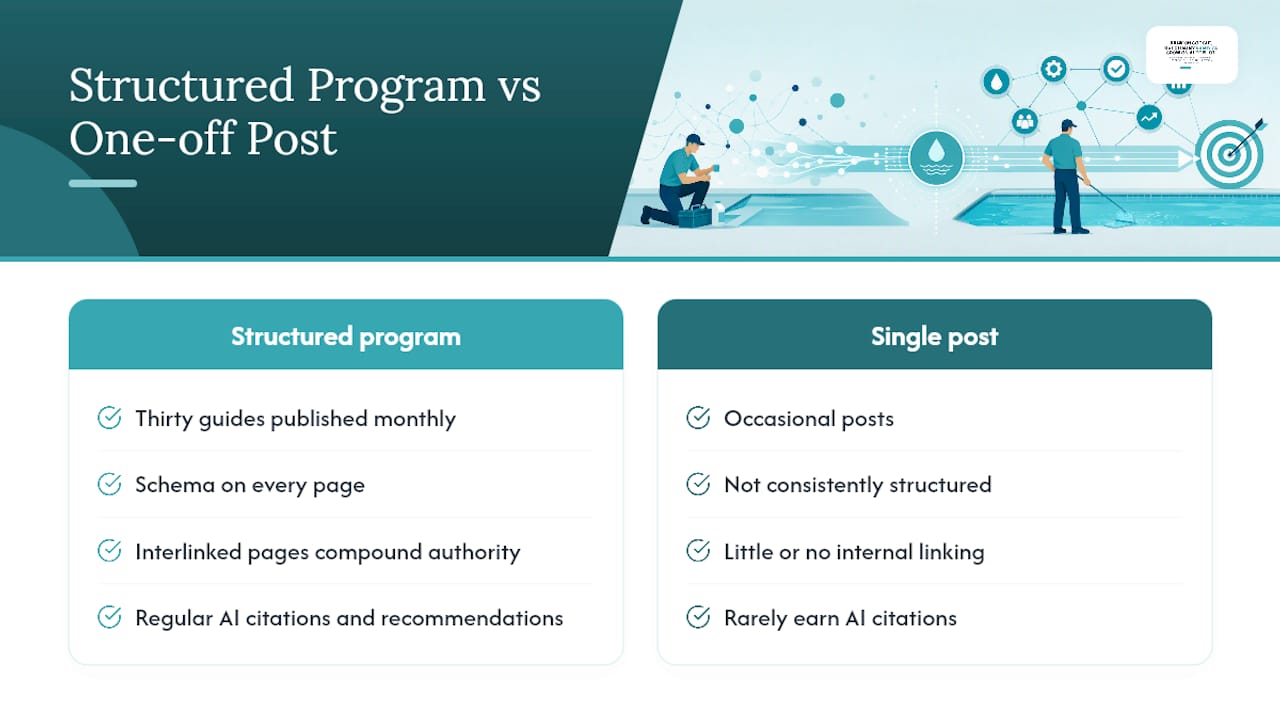
Single blog posts rarely move rankings or earn AI citations. The pool-service businesses winning local map packs and AI recommendations are publishing consistently, structuring every page with schema, and building internal links that compound authority over time.
The pattern is clear: one guide earns a citation occasionally. Thirty structured, interlinked guides published monthly build the topical footprint that makes AI engines treat your domain as the authoritative source for pool-service questions in your market. Trystellor’s 4,000-site backlink network reinforces that authority signal externally, while weekly technical audits keep schema, llms.txt, and canonical tags clean. LLM tracking across ChatGPT, Claude, Perplexity, and Gemini turns AI visibility from a guessing game into a weekly performance metric.
Trystellor implements this playbook for you
Most pool-service businesses have the content strategy right but lack the publishing volume and technical infrastructure to execute it consistently. Trystellor closes that gap at $199/month, replacing what would otherwise require a content agency, a link-building service, a technical SEO auditor, and an AI visibility tracker running separately.
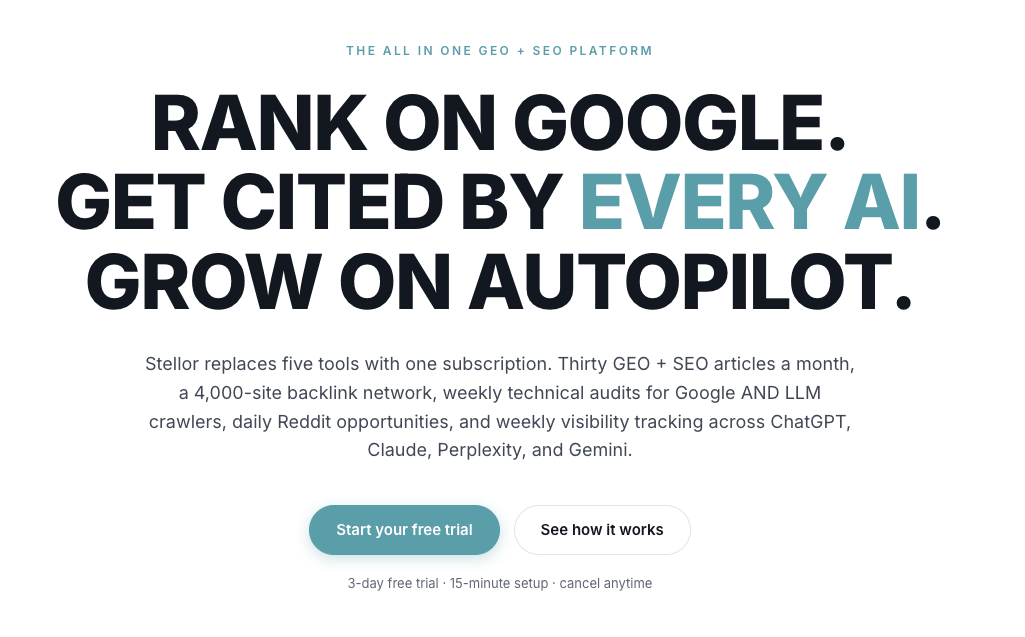
The Trystellor product maps directly to this checklist: automated publishing of 30 GEO + SEO articles per month (including chemical guides, location pages, and FAQ hubs), schema and llms.txt automation, backlink distribution across a 4,000-site network, and weekly LLM visibility tracking across ChatGPT, Claude, Perplexity, and Gemini. Onboarding takes fifteen minutes. Within 48 hours, you receive a free AI Visibility Audit covering 25 buyer prompts, a competitor benchmark, and a 90-day content plan. The audit is yours to keep regardless. Start your three-day free trial at Trystellor — no credit card required.
Sources
These resources support the implementation steps in this guide:
- Topic Clusters for Local SEO: Types, Tips & Examples | WordStream
FAQ
What makes a chemical guide page different from a regular blog post?
A chemical guide page is structured around buyer intent, local signals, and schema markup that AI engines can extract. A blog post typically lacks FAQPage schema, geo-specific content, and direct links to a service CTA.
Which schema types matter most for pool-service chemical guides?
FAQPage schema on the Q&A block and Service schema on the main page are the two highest-impact types. LocalBusiness schema in the site-wide header completes the signal set that both Google and AI crawlers look for.
How long does it take to get a first AI citation from a new guide?
With schema, FAQ consistency, and internal linking in place, a first AI citation typically arrives within 60–120 days of publishing. Trystellor’s weekly LLM tracking across ChatGPT, Claude, Perplexity, and Gemini shows exactly when and where citations appear.
Can I publish chemical guides for multiple service areas without duplicate content penalties?
Yes, if each variant has a unique local intro (80–100 words), localized review callouts, and a canonical tag pointing to the master guide. Thin variants with no unique content will be flagged; the canonical rule prevents them from fragmenting your authority.
Should chemical guides include dosing instructions?
No. Link to the manufacturer’s SDS and EPA safety resources instead, and include a one-line disclaimer directing readers to a certified pool technician for dosing guidance. Prescriptive dosing instructions create liability and are outside the scope of a service-business content page.