

Pest control SEO is the practice of ranking your business in Google’s local map pack and organic results for searches like “termite treatment near me” or “exterminator in city].” The fastest path to results is optimizing your Google Business Profile, generating reviews on a steady cadence, and publishing at least one dedicated city-service page. GBP changes can move visibility within weeks. Organic city rankings typically take 3 to 6 months, with full compounding value arriving between 6 and 12 months. [Stellor automates the content and technical work behind that timeline.
TL;DR:
- Prioritize optimizing your Google Business Profile with accurate categories, high-quality photos, and automated review requests to capture around 44% of local search clicks instantly.
- Build dedicated, locally-specific service and city pages around targeted keywords, describing local pests, seasonal factors, and including clear calls to action for better organic rankings.
- Maintain a fast, mobile-friendly website with schema markup, regularly audit site speed, and ensure NAP consistency across directories to avoid technical barriers blocking ranking improvements.
- Focus on acquiring at least 50 reviews from satisfied customers and pursue relevant local backlinks to boost off-page authority and visibility.
- Use seasonal content planning and combine paid advertising with organic SEO, tracking leads separately to optimize marketing spend and shorten the time to generate booked jobs.
Table of Contents
- What Is Pest Control SEO and Where Should You Start?
- Building Service Pages and Location Pages That Actually Rank
- Technical SEO Basics That Block Rankings Without You Noticing
- Off-Page Signals: Reviews, Citations, and the Links That Matter
- Seasonal Content Planning for Pest Cycles
- The KPIs That Prove SEO Is Turning Into Booked Jobs
- Choosing Between an SEO Partner and Running It Yourself
- How Stellor Maps to the Pest Control SEO Playbook
- Utilizing Social Media and Local Community Engagement to Enhance SEO
- Local PPC Strategies Complementing SEO Efforts
- Tracking and Optimizing for Voice Search in Local Pest Control Queries
- Quick Wins and Common Mistakes I See in the Field
- Get the Playbook Running Without Doing It All Yourself
- Sources
- FAQ
What Is Pest Control SEO and Where Should You Start?
Pest control SEO breaks into four components: local SEO (your Google Business Profile), on-page SEO (service and location pages), off-page SEO (reviews and backlinks), and technical SEO (site speed, mobile, structured data). Housecall Pro’s framework for pest control SEO treats all four as interdependent. Skip one and the others underperform.
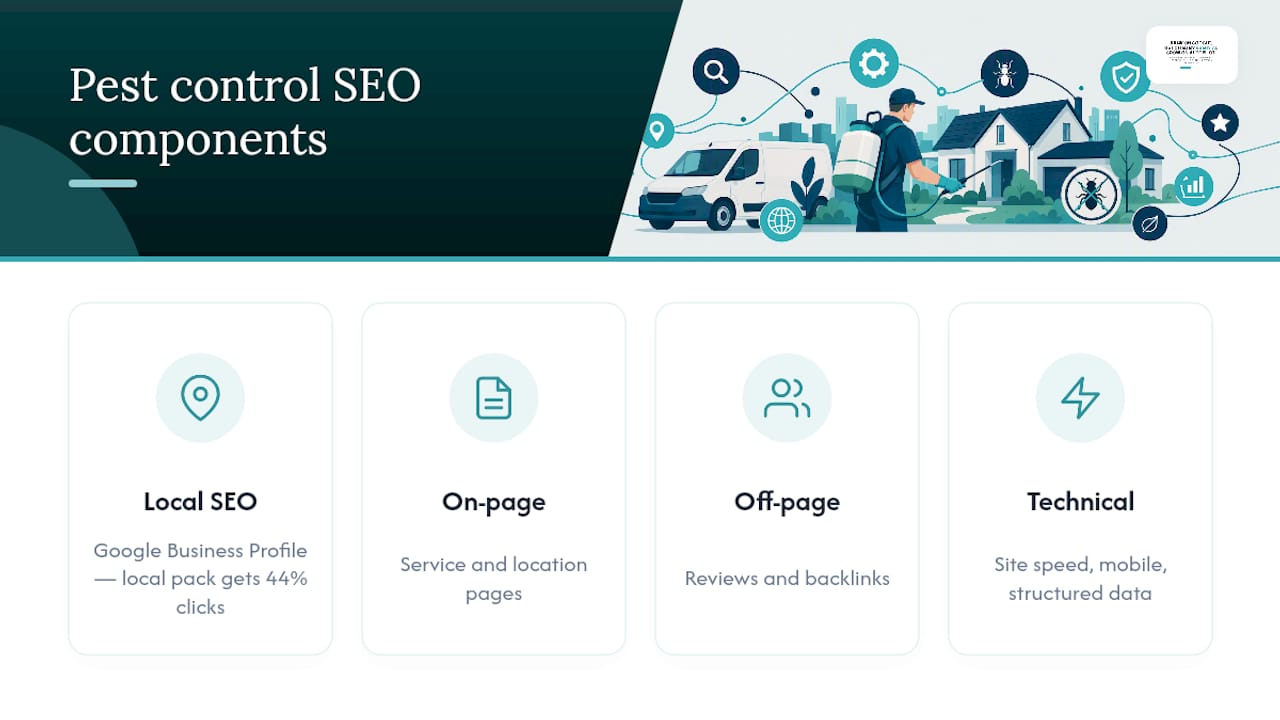
Here’s why GBP comes first. Local pack results capture roughly 44% of clicks for local-intent searches, which means a searcher typing “bed bug exterminator” often never scrolls to organic listings. Your map pack ranking decides whether you get the call before your website even matters.
Optimize your Google Business Profile the right way
Start with categories. Choose the most specific primary category available (Pest Control Service, not just Home Services), then add secondary categories for termite, rodent, or wildlife specialties if you offer them. Set your service area precisely. Overextending into cities you don’t actually service creates ranking dilution and wastes technician drive time on jobs outside your radius.
Beyond setup, three ongoing habits separate profiles that rank from ones that stall:
- Post real photos of technicians, trucks, and completed jobs. Stock photos hurt conversion and make you look interchangeable with every other listing.
- Publish GBP Posts tied to active service offers or seasonal pest activity, and keep attributes (licensed, insured, free estimates) current.
- Automate a review request after every completed job. PipelineOn’s research found businesses with 50+ Google reviews generate substantially more leads than those with only a handful.
Run this quick audit monthly:
- Confirm your name, address, and phone number (NAP) match exactly across your website and profile.
- Verify hours are accurate, including holiday hours during peak treatment seasons.
- Test your booking link and messaging response time from a phone, not a desktop.
- Check that your primary category still matches your top revenue service.
Building Service Pages and Location Pages That Actually Rank
A single “service area” page listing ten cities in a bulleted footer will not win map-pack traffic for any of them. Google rewards specificity. A dedicated page for “termite inspection in [city]” outperforms a generic page every time, because it can speak directly to local pest pressure, neighborhood housing stock, and season-specific risk.
Build each page around this structure:
- Put the target keyword in the title tag, the H1, and the first 100 words. Don’t force it; write the sentence naturally and let the keyword land where it belongs.
- Open with the problem the searcher has right now: symptoms of an infestation, what a technician will do on-site, and how long treatment typically takes.
- Add pricing cues, even a range, since pest control searchers convert faster when cost uncertainty is removed early.
- Close with a clear call to action and a visible phone number, ideally click-to-call on mobile.
- Include alt text on every image that describes the pest, location, or service shown, not just “IMG_4021.jpg.”
Avoid that by rotating in real local detail: the pests common to that specific neighborhood, seasonal timing unique to that climate zone, and a testimonial from a customer in that city if you have one. Stellor’s local SEO guide covers templates that keep pages unique without rewriting from scratch every time.
Technical SEO Basics That Block Rankings Without You Noticing
A fast, mobile-friendly site is table stakes. Google’s Core Web Vitals measure loading speed, interactivity, and visual stability, and a slow site quietly bleeds both rankings and conversions before a visitor ever reads a word.
Fix these first:
- Compress images before upload rather than relying on plugins to do it after the fact.
- Choose hosting built for speed, not the cheapest shared plan you can find.
- Make phone numbers tap-to-call on every page, not just the contact page.
- Add LocalBusiness and Service schema markup so Google understands what you offer and where, plus FAQ schema on service pages to earn rich snippets.
- For multi-location or franchise sites, check Google Search Console monthly for duplicate content flags and crawl errors, since near-identical city pages are the most common cause.
Pro Tip: Run your top five city pages through PageSpeed Insights quarterly. A page that loaded fine six months ago can slow down after a redesign, a new tracking pixel, or a bloated image library nobody cleaned up.
The full SEO audit checklist walks through each of these in more depth if you want a repeatable process rather than a one-time fix.
Off-Page Signals: Reviews, Citations, and the Links That Matter
Reviews are the single strongest off-site trust signal for local intent searches, more influential than almost any backlink you could build. PipelineOn’s benchmarks recommend targeting 50 or more reviews as a threshold where lead volume noticeably shifts, and the businesses that hit that number consistently are the ones who systemize the ask instead of hoping customers remember.
A few off-page moves that compound without risk:
- Audit your NAP consistency across major directories (Yelp, Angi, BBB, Nextdoor) quarterly, since a mismatched phone number on even one directory can confuse local ranking signals.
- Pursue backlinks from local news coverage, chamber of commerce listings, and pest control trade associations. These carry real topical relevance.
- Sponsor a local event or youth sports team; it’s a legitimate, natural link and a community touchpoint at once.
- Avoid private blog networks and bulk-purchased links entirely. They violate Google’s guidelines and put your entire domain at risk for a manual action.
Seasonal Content Planning for Pest Cycles
Publish seasonal content 1 to 3 months ahead of peak search demand, not the week pests actually show up. By the time a homeowner is searching “termite swarm treatment,” the businesses already ranking published that page months earlier.
Build a simple six-month cadence:
- January to February: publish termite inspection and prevention content ahead of spring swarm season.
- March to April: cover ant and rodent entry points as weather warms and pests move indoors less.
- May to June: mosquito and tick prevention content timed to outdoor season kickoff.
- July to August: wasp and hornet nest removal, plus GBP Posts promoting same-day service.
- September: rodent-proofing content as temperatures drop and rodents seek shelter.
- October to December: holiday pest prevention (pantry pests, seasonal rodent influx) and year-end review requests.
Repurpose each piece across your blog, relevant city-service pages, and GBP Posts so one piece of research does triple duty. Getjobber’s marketing guide confirms this timing approach directly, noting that organic SEO traction builds over 6 to 12 months while seasonal content needs a head start to catch that curve at the right moment.
The KPIs That Prove SEO Is Turning Into Booked Jobs
Track four numbers weekly: phone calls, form leads, booked jobs, and cost per lead (CPL). Anything short of booked jobs is a vanity metric dressed up as progress.
Organic SEO cost-per-lead for pest control businesses commonly settles within a moderate range once a site matures, compared to consistently higher costs for paid channels, according to PipelineOn’s benchmarks.
Set up call tracking with unique numbers per channel, and tag every campaign with UTM parameters so a lead’s source doesn’t get lost. Separate emergency conversions (same-day bed bug or wasp calls) from preventive ones (quarterly service contracts), since they close at different rates and different values. Expect GBP metrics to shift within weeks; expect organic rankings to take months. A weekly dashboard tying published pages and review counts to inbound call volume, outlined in Stellor’s guide to measurable SEO results, keeps this honest instead of anecdotal.
Choosing Between an SEO Partner and Running It Yourself
Weigh four factors before deciding: how much bandwidth your team actually has, your monthly budget, whether you’ll own the content and links you’re paying for, and how fast you need to move on speed-to-lead.
If you go with a vendor, ask these five questions before signing anything:
- How many pieces of content do you publish per month, and who owns them if we cancel?
- Where do your backlinks come from, specifically, and can you name the network?
- Who manages our Google Business Profile day to day, and how often?
- What’s your reporting cadence, and does it tie to calls and booked jobs, not just rankings?
- Can you show a sample deliverable before we commit?
Walk away from anyone promising guaranteed rankings. Nobody controls Google’s algorithm, and that promise is a red flag every time. Same goes for vendors who won’t name their link sources or who report only keyword position with no connection to actual phone calls.
For operators managing more than a handful of locations, manually producing unique city pages, monitoring backlinks, and running technical audits becomes a full-time job on its own. That’s where an automated GEO+SEO platform earns its cost. It’s the same reasoning behind how SEO drives real growth for local service businesses at scale.
How Stellor Maps to the Pest Control SEO Playbook
Everything above takes real hours: writing city pages, chasing reviews, auditing schema, tracking whether AI answer engines even mention your business. Stellor was built to run that whole stack instead of asking you to stitch five vendors together.
- 30 GEO and SEO-optimized articles published monthly, including service and location pages built around the exact structure covered above.
- A 4,000-site backlink network that builds off-page authority without manual outreach.
- Weekly technical audits checking schema, speed, and mobile readiness automatically.
- LLM visibility tracking across ChatGPT, Claude, Perplexity, and Gemini, so you know if AI tools are recommending you or a competitor when someone asks for pest control near them.
Onboarding takes about 15 minutes and produces a free AI Visibility Audit within 48 hours, including a 90-day action plan showing what publishes in the first 30, 60, and 90 days.
The businesses that move fastest on local pest control SEO are the ones that treat GBP, reviews, and city pages as one connected system rather than three separate tasks handled by three different people.
Full details live on the Stellor product page.
Utilizing Social Media and Local Community Engagement to Enhance SEO
Social media doesn’t directly move your Google ranking, but it does something almost as valuable: it feeds the signals that do. A Facebook page active in local community groups, answering neighbor questions about carpenter ants or rat sightings, builds the kind of local reputation that turns into reviews, referrals, and eventually links from neighborhood blogs or community Facebook pages.
Join local Nextdoor and Facebook community groups in every city you service, not to sell, but to answer real questions when pest issues come up. That visibility builds trust long before someone searches Google.
Share the same seasonal content you’re publishing on your blog: a post about termite swarm season timed to March, a mosquito prevention checklist before summer. This gives that content a second life and drives direct traffic back to the page you built to rank.
Sponsor or participate in local events: a community cleanup, a youth sports team, a farmers market booth. These generate real photos for your GBP profile, natural conversation in local groups, and occasionally a mention on a local news site or community blog, which counts as a legitimate backlink.
None of this replaces the core SEO work. Think of it as the amplifier that makes your GBP profile and location pages more visible to the humans who eventually leave the reviews and share the links that move your rankings.
Local PPC Strategies Complementing SEO Efforts
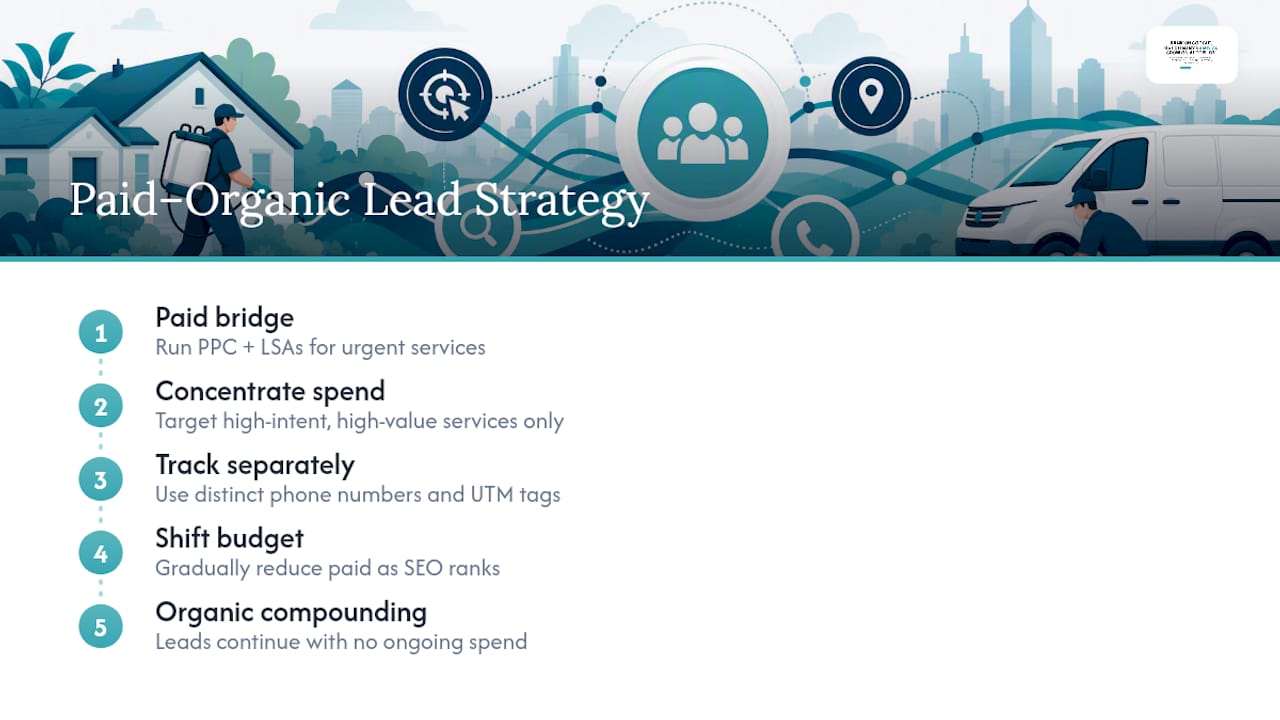
Paid search and Google Local Services Ads (LSAs) fill the gap while your organic SEO builds. LSAs, in particular, are useful for immediate leads since they show at the very top of results with a “Google Guaranteed” badge, which pest control searchers trust for urgent issues like active infestations.
Run PPC and LSAs on your highest-intent, highest-value services: termite inspections, bed bug treatment, same-day wasp removal. These are searches where someone is ready to book now, not researching for later. Avoid spreading paid budget thin across every service you offer; concentrate it where urgency and ticket size justify the cost per click.
The strategic relationship between paid and organic matters more than most operators realize. Organic SEO compounds and keeps producing leads with no ongoing spend once a page ranks, while paid channels stop the moment budget runs out. Many pest control operators use PPC and LSAs to cover demand during the months organic rankings are still building, then gradually shift budget away from paid channels as organic traction takes over. Treat paid media as a bridge, not a permanent floor under your lead volume.
Track PPC and organic leads separately using distinct phone numbers and UTM tags. Without that separation, you can’t tell which channel is actually earning its cost per lead, and you risk over-crediting paid spend for leads organic SEO would have generated anyway.
Tracking and Optimizing for Voice Search in Local Pest Control Queries
Voice search queries skew conversational and question-based: “who’s the best exterminator near me” or “how much does termite treatment cost.” Optimizing for these means writing content that answers direct questions in plain language, not just stuffing in keyword phrases.
FAQ sections on your service pages do double duty here. Structure them around the exact phrasing a homeowner would speak aloud, then mark them up with FAQ schema so Google and voice assistants can pull that answer directly. A question like “How long does termite treatment take?” answered in two clear sentences is far more likely to get read aloud by a smart speaker than a paragraph buried in marketing language.
Local intent matters even more in voice search, since most spoken queries include “near me” or a city name implicitly. This is another reason dedicated city-service pages outperform generic ones. Voice assistants pull from local pack data heavily, so the same GBP optimization that wins map-pack visibility also improves your odds of being the answer read aloud.
Keep your GBP Q&A section filled out proactively, since Google sometimes sources voice answers directly from it. Answer the five questions customers ask most (pricing, availability, service area, pet safety, treatment duration) before a stranger has to ask them publicly.
Quick Wins and Common Mistakes I See in the Field
Three moves pay off almost immediately: audit your GBP categories and photos this week, set up an automated review request after every job, and publish one fully built-out city-service page instead of five thin ones.
The recurring mistakes are just as consistent: stock photography on GBP profiles, location pages that swap only the city name, and slow response times that lose emergency jobs to a competitor who called back first. When resources are tight, fix response time first. A ranking without a fast callback is a wasted click.
— Cole
Get the Playbook Running Without Doing It All Yourself
Everything in this guide is doable in-house if you have the hours: writing unique city pages, chasing review requests, auditing schema weekly, checking whether ChatGPT or Perplexity even know your business exists. Most pest control owners don’t have those hours, which is exactly the gap Stellor was built to close.
In the first 30 to 90 days, Stellor publishes GEO and SEO-optimized service and location pages at a pace of 30 per month, connects your site to a 4,000-site backlink network, and runs weekly technical audits so schema and speed issues get caught before they cost you rankings. You also get weekly reports on whether ChatGPT, Claude, Perplexity, and Gemini are citing your business when someone asks about pest control recommendations nearby.
Every new account starts with a free AI Visibility Audit delivered within 48 hours, plus a 3-day free trial with no card required. If you’ve got a lean in-house team and the bandwidth to write and maintain dozens of pages yourself, DIY or a specialized local agency can still work. If you’re trying to scale past a handful of locations without hiring a content team, check out the Stellor product page and start the trial.
Sources
- Pest Control SEO Guide
- Pest Control Marketing 2026: 11-Channel Playbook to $10M
- Pest control marketing strategies
FAQ
What Is the Highest Paid Pest Control Company?
Public rankings vary by revenue and market, and no single source consistently names one “highest paid” company. What’s clear is that the largest national pest control brands invest heavily in both local SEO and paid channels to maintain visibility across thousands of service areas.
Will Pest Control Be Replaced by AI?
No. Physical pest treatment requires hands-on inspection and application that AI cannot perform. AI is changing how customers find pest control businesses, though, since answer engines like ChatGPT and Perplexity increasingly recommend specific companies, which makes AI visibility tracking a growing part of pest control marketing.
What Is the 80/20 Rule in SEO?
For pest control businesses, that means prioritizing GBP and city-service pages over broader content before chasing every possible keyword.
What Are the Three C’s of Pest Control?
Definitions vary across the industry, but a common framing centers on correct identification, control method, and consistent follow-up, ensuring a pest is properly diagnosed, treated with the right approach, and monitored afterward. This isn’t a fixed industry standard, so treat it as a general operating principle rather than a formal rule.
How Long Does Pest Control SEO Take to Show Results?
Google Business Profile improvements can shift visibility within weeks, while organic city-page rankings typically take 3 to 6 months to gain traction and 6 to 12 months to compound fully. Reviews and citations build trust signals continuously in the background throughout that period.