

Organization schema is a structured data format, built on the Schema, that tells search engines and AI systems the official facts about your business: name, logo, web address, and social profiles. The fastest path to results is JSON-LD placed on your homepage or about page, with name, url, logo, and sameAs filled in first. Google’s own guidance backs this exact approach, and it’s the same starting point schema.org documents for every business type.
TL;DR:
- Using the correct schema subtype, such as LocalBusiness or OnlineStore, unlocks properties like opening hours or return policies that are essential for local SEO and e-commerce listings.
- Proper implementation of Organization schema on the homepage with linked WebSite and consistent @id references ensures better entity recognition for search and AI citation accuracy across multiple pages.
- Regularly auditing and updating core properties like logo URL, social profile links, and contact details prevents schema drift that could undermine brand trust and AI referencing.
- Including key properties such as name, url, logo, sameAs, and contactPoint is sufficient for a solid foundation, with additional details added based on business type and needs.
- Automating schema updates and audits with a dedicated platform helps maintain accuracy, support AI citations, and avoid silent errors that diminish search visibility.
Table of Contents
- What Is Organization Schema and When Do You Need a Subtype?
- Why Does Organization Schema Matter for SEO and AI Citations?
- What Properties Should You Include in Organization JSON-LD?
- How Do You Implement Organization Schema? JSON-LD Patterns and Placement
- How Do You Test and Validate Organization Schema?
- When Should You Use @graph and @id for Multi-Entity Linking?
- How Do You Maintain Organization Schema Over Time?
- How Does Organization Schema Fit Into a Broader AI Visibility Strategy?
- A Simpler Way to Keep Schema Consistent and Track AI Visibility
- Sources
- FAQ
What Is Organization Schema and When Do You Need a Subtype?
Organization sits near the top of the schema.org hierarchy. It’s the generic entity type for any company, nonprofit, or institution, and every more specific business type inherits from it. That includes LocalBusiness, OnlineStore, Corporation, NGO, and dozens of others.
Here’s the part people skip: using the plain Organization type when a subtype fits better means you leave properties on the table. Schema.org’s own documentation lists subtypes precisely because each one unlocks fields the generic type doesn’t support. A local HVAC company using Organization instead of LocalBusiness can’t properly declare openingHours or priceRange, both of which feed Google’s local pack and map results.
Pick your type based on how the business actually operates, not how it sounds:
- Use
Organizationfor a corporate entity with no physical storefront customers visit, professional services firms with multiple offices, or as the parent node in a multi-entity setup. - Use
LocalBusiness(or a more specific child likePlumber,Dentist, orAutoRepair) when customers visit a physical location or you serve a defined service area. You can see how this plays out for home service companies in our LocalBusiness schema examples for local businesses. - Use
OnlineStorefor ecommerce businesses that sell primarily through a website, since it supports merchant-specific properties like return policies and shipping details. - Use
Corporationwhen you need to signal a formal legal structure, often relevant for publicly traded companies or larger enterprises with investor-facing pages.
The type you choose also determines which properties Google’s documentation treats as relevant, so get this decision right before you write a single line of JSON-LD. Getting it wrong doesn’t break anything visibly, but it quietly caps what your markup can do.
Why Does Organization Schema Matter for SEO and AI Citations?
Organization schema does two jobs: it helps Google build a cleaner picture of your brand in search results, and it gives AI answer engines a structured, low-ambiguity source to pull from when they’re deciding who to cite.
On the Google side, Google’s structured data documentation confirms that properties like logo and sameAs influence what can appear in knowledge panel signals and brand-related search features. A complete, accurate Organization block doesn’t force a rich result, but it removes the ambiguity that keeps Google from confidently attaching your logo or social profiles to your brand.
On the AI side, the mechanism is entity resolution. ChatGPT, Perplexity, Claude, and Gemini all have to answer an implicit question before they’ll cite you: is this the entity the user is asking about, and is it trustworthy enough to name? A sameAs array linking your official Twitter, LinkedIn, Crunchbase, and Wikipedia profiles gives these systems a way to confirm identity across sources instead of guessing from context clues alone.

Here’s the limit you need to plan around: eligibility isn’t a guarantee. Google explicitly states that structured data only makes a page eligible for enhanced display, and a coherent case for why schema markup pairs necessity with insufficiency shows knowledge panels specifically require a web of off-site authority (Wikipedia, Wikidata, consistent press mentions) that schema alone can’t manufacture. Treat Organization schema as a floor you build on, not a switch you flip.
What Properties Should You Include in Organization JSON-LD?

Most implementations fail not because the code is wrong, but because the property list is either too thin or bloated with fields nobody maintains. Start with what’s non-negotiable, then add situational fields only when your business model actually needs them.
The essential layer covers identity:
@contextand@type(declares the vocabulary and entity type)name(your official business name, matching what appears elsewhere online)url(your canonical homepage, not a subdomain or tracking URL)logo(a stable, absolute image URL, ideally square)sameAs(an array of URLs to your verified social and reference profiles)
Once identity is locked in, administrative properties round out how complete and trustworthy the entity looks:
contactPoint(customer service phone, email, and contact type)addressfor a single location, orlocation(an array ofPlaceobjects) when you operate multiple offices, per Google’s own recommendation on avoiding ambiguitylegalName(useful when your registered name differs from your public brand name)foundingDate(adds a verifiable historical anchor)
Ecommerce and merchant sites add a third layer that most service businesses can skip entirely:
hasMerchantReturnPolicy(declares your return window and conditions at the organization level)shippingDetails(declares default shipping behavior, referenced by individual offers)
Here’s how that breaks down by priority:
| Property | Priority | Why it matters |
|---|---|---|
| name, url, logo | Essential | Core identity fields every implementation needs |
| sameAs | Essential | Links your entity to verified profiles across the web |
| contactPoint | Recommended | Supports customer service and trust signals |
| address / location | Recommended | Required correctly whenever a physical presence exists |
| legalName, foundingDate | Recommended | Adds verifiable, low-maintenance detail |
| hasMerchantReturnPolicy | Situational | Only relevant for ecommerce and merchant listings |
| shippingDetails | Situational | Only relevant for ecommerce and merchant listings |
For multi-location businesses, don’t mix a single address field with a location array on the same entity. Pick one pattern and apply it consistently, since Google’s guidance is explicit that address suits a single location and a location array suits multiple offices. If you’re managing several service areas, our guide on what emergency service SEO looks like for local businesses covers how that identity information ties into location-specific pages.
How Do You Implement Organization Schema? JSON-LD Patterns and Placement
JSON-LD is the format Google recommends for nearly all structured data, and it’s what every pattern below uses. It sits in a <script type="application/ld+json"> tag and doesn’t touch your visible HTML, which makes it easier to maintain than Microdata or RDFa.
Basic Organization pattern
A minimal but complete block looks like this:
{
  "@context": "https://schema.org",
  "@type": "Organization",
  "name": "Acme Home Services",
  "url": "https://www.example.com",
  "logo": "https://www.example.com/logo.png",
  "sameAs": [
    "https://www.linkedin.com/company/acme",
    "https://www.facebook.com/acmehomeservices",
    "https://twitter.com/acmehomeservices"
  ],
  "contactPoint": {
    "@type": "ContactPoint",
    "telephone": "+1-555-010-2000",
    "contactType": "customer service"
  }
}
This alone satisfies the essential layer and gives Google a clean signal to disambiguate your brand.
Organization + WebSite via @graph
Once you’re publishing schema across multiple pages, connect Organization to WebSite so Google reads them as one linked node instead of two disconnected fragments:
{
  "@context": "https://schema.org",
  "@graph": [
    {
      "@type": "Organization",
      "@id": "https://www.example.com/#organization",
      "name": "Acme Home Services",
      "url": "https://www.example.com",
      "logo": "https://www.example.com/logo.png",
      "sameAs": ["https://www.linkedin.com/company/acme"]
    },
    {
      "@type": "WebSite",
      "@id": "https://www.example.com/#website",
      "url": "https://www.example.com",
      "name": "Acme Home Services",
      "publisher": { "@id": "https://www.example.com/#organization" }
    }
  ]
}
This pattern lets any other page on the site reference https://www.example.com/#organization by @id instead of repeating the full Organization block, which keeps your markup lean and consistent.
OnlineStore with merchant policy reference
Ecommerce sites should declare return and shipping policy once at the organization or store level, then reference it from individual offers rather than duplicating the policy on every product page. This is the pattern Google recommends for merchant listing structured data, and it prevents a policy update from requiring edits across hundreds of product pages.
Where to place it
Follow this sequence when deploying:
- Add the base Organization block to your homepage first. This is the page Google checks most reliably for brand-level entity data.
- Mirror the same
@idreference on your about page if it carries additional trust signals like founding story or leadership bios. - For site-wide consistency, inject the WebSite and Organization graph into your global header or footer template so every page shares the same
@idreferences. - If you’re using Google Tag Manager, be cautious: GTM-injected JSON-LD can render after the initial page load, and some crawlers may not execute the JavaScript needed to see it. A server-side or template-level include is more reliable for critical Organization data.
- Keep fragment
@idvalues (like#organizationand#website) identical across every page that references them, since a typo breaks the link silently with no error message.
For businesses managing this across multiple service pages, the pattern used in our SEO for roofers local lead generation guide shows how Organization identity data stays consistent even as location and service pages multiply.
How Do You Test and Validate Organization Schema?
A markup block that looks correct in your editor can still fail silently in production. Run through this sequence every time you deploy or update Organization schema:
- Lint locally first. Check your JSON for syntax errors before it ever touches a live URL. A single missing comma breaks the entire block.
- Test on staging. Confirm the schema renders in the page source, not just in your CMS preview, since some templating systems strip script tags unexpectedly.
- Run the Rich Results Test. This is Google’s own tool and reflects what Google actually reads for feature eligibility, which is narrower than general schema validity. Google’s documentation confirms this is the authoritative check for eligibility, not the Schema.org Validator.
- Run the Schema.org Validator (validator.schema.org) for a broader syntax check. It catches structural errors the Rich Results Test won’t always flag, since it validates against the full vocabulary rather than just Google’s supported features.
- Re-check production after deploy. Caching layers and CDNs sometimes serve an older version of a page even after your CMS shows the update live.
Most failures trace back to a short list of causes: a logo URL that returns a 404, a fragment @id that doesn’t match between the Organization and WebSite blocks, or a sameAs link pointing to a suspended or renamed social profile. Broken sameAs targets are easy to miss because they don’t throw a validation error. The link just quietly stops being trustworthy.
Pro Tip: Set a recurring calendar reminder to re-run the Rich Results Test any time you change your logo file, rename a social account, or migrate domains. Schema doesn’t update itself when the underlying facts change.
Re-test any time you touch your global header template, since that’s usually where site-wide Organization markup lives and where one bad edit can break every page at once. Our SEO audit checklist for local service businesses includes schema validation as a recurring line item worth tracking alongside other technical checks.
When Should You Use @graph and @id for Multi-Entity Linking?
The @graph and @id pattern matters most once your site has more than a homepage carrying Organization data. Without it, every page that mentions your brand risks publishing a slightly different, disconnected version of the same entity, which weakens rather than strengthens entity recognition.
The core technique: give your Organization a stable fragment identifier, like https://www.example.com/#organization, and reference that exact string anywhere else it needs to appear, whether that’s a WebSite’s publisher field or an Article’s author field.
- Set
WebSite.publisherto the Organization’s@idrather than repeating the full Organization object. - Set
Article.publisheron blog posts to the same@idso every piece of content ties back to one canonical entity node. - Never duplicate the full Organization block across multiple pages if a fragment reference will do. Duplication is how schema drifts out of sync over time.
Publishing Organization and WebSite together in a single
@grapharray, with WebSite.publisher pointing to the Organization’s@id, gives Google a stable node identity to attach every other page’s schema to. Per-page schemas can reference that one node without duplicating the full Organization data anywhere else.
This matters more for AI citation than most people assume. When an LLM crawler pulls content from multiple pages on your domain, a consistent @id structure signals that every page is talking about the same verified entity rather than several loosely related ones. That’s a meaningfully stronger signal than schema scattered inconsistently across a site.
The warning here is real: don’t over-engineer this. Adding a dozen interconnected entities for a five-page brochure site creates maintenance overhead with no proportional benefit. Reserve @graph linking for sites with real content volume: blogs, multiple service pages, or a product catalog where the connections actually reflect meaningful structure.
How Do You Maintain Organization Schema Over Time?
Schema decays the same way any unmaintained data does. A phone number changes, a social account gets rebranded, a logo file gets replaced during a site redesign, and nobody remembers the JSON-LD block still points to the old version.
Build these habits in from the start:
- Store core Organization values (name, logo URL,
sameAslinks) as CMS variables or template fields rather than hardcoding them into a static script tag on every page. One update point beats a dozen. - Assign a single owner for schema accuracy, typically whoever owns the CMS or the marketing operations function, so updates don’t fall through the cracks between departments.
- Set a quarterly audit cadence to check that logo URLs still resolve, social links haven’t been renamed, and contact details still match your live Google Business Profile.
- Watch for staging-domain leaks: schema pushed to a staging site with staging URLs (like
staging.example.com) sometimes goes live unedited during a deploy, pointing search engines and AI crawlers at a domain that doesn’t exist publicly. - Cross-check your Organization schema against your Google Business Profile listing. Mismatched addresses or phone numbers between the two create exactly the ambiguity Organization schema is supposed to resolve.
Google’s structured data guidelines are direct about this trade-off: a lean, accurate property set outperforms a sprawling one that quickly goes stale. Add properties you can actually keep current, not every field the vocabulary allows.
Pro Tip: Keep a simple internal changelog of every schema update, even a shared doc with dates and what changed. When something breaks six months later, you’ll know exactly what to check first.
How Does Organization Schema Fit Into a Broader AI Visibility Strategy?
Manual schema management works fine until your site grows past a handful of pages, and then it becomes exactly the kind of maintenance task that quietly slips. A published logo URL that 404s for three months, a sameAs link to a rebranded Twitter handle nobody caught: these are small errors with a compounding cost, since every AI crawler that hits your site in that window sees a slightly less trustworthy version of your brand.
That’s the gap an automated content and audit workflow closes. Weekly technical audits catch schema drift before it accumulates, and a steady publishing cadence gives your Organization data more pages to consistently reinforce, rather than one lonely homepage block doing all the work. Stellor runs both: weekly audits alongside 30 GEO-optimized articles published monthly, each one carrying consistent structured data and internal linking back to the same brand entity.
The real question isn’t whether to automate. It’s whether your team has the bandwidth to re-check sameAs links and logo URLs every quarter across every page that carries them, on top of tracking whether ChatGPT, Claude, Perplexity, and Gemini are actually citing your business when they answer buyer questions.
A Simpler Way to Keep Schema Consistent and Track AI Visibility
There are other ways to handle this: a developer who updates JSON-LD by hand each quarter, an agency that audits your site once a year, or a plugin that generates basic schema but never checks whether it still resolves. Each works, until the team managing it gets busy and the audit slips a cycle.
One system replaces that patchwork: automated schema publication across every page produced, weekly technical audits that catch a broken logo URL or a stale sameAs link before it costs visibility, and weekly tracking of whether ChatGPT, Claude, Perplexity, and Gemini are actually citing your business by name. This combines multiple roles into one subscription.
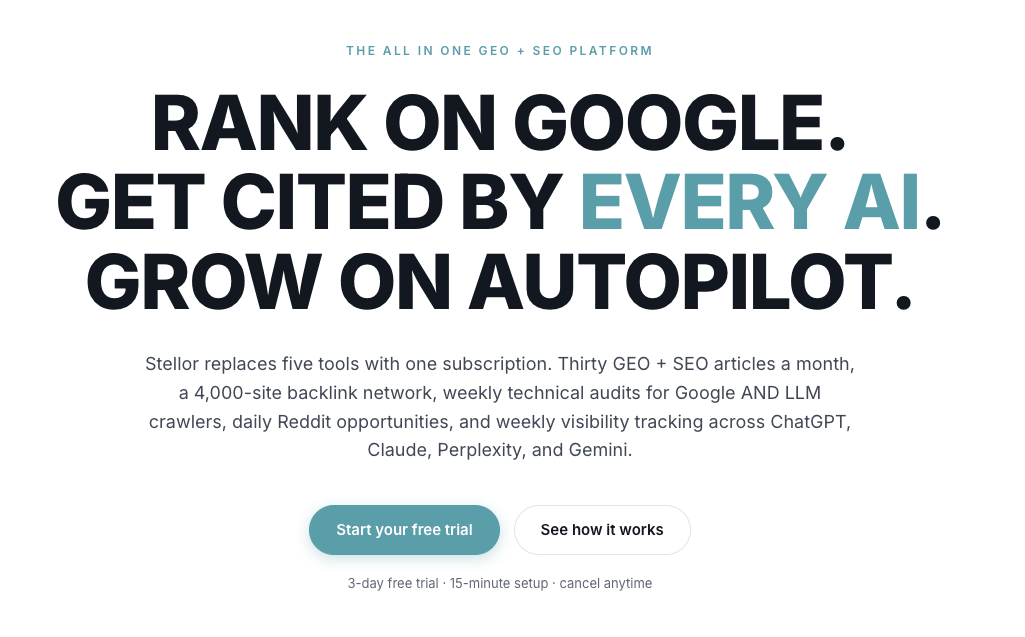
Instead of guessing whether your Organization markup is still accurate six months after launch, Stellor’s product platform runs the audit for you and flags what needs fixing, on a fixed weekly schedule. Start with the 3-day free trial, no card required, and get an initial visibility audit that shows exactly where your current schema and AI citation status stand today.
Sources
- Organization Schema Markup | Google Search Central | Documentation | Google for Developers
- Schema
- Organization Schema Explained: Benefits & How to Use
FAQ
What is Organization schema in SEO?
Organization schema is structured data, based on the schema.org Organization type, that tells search engines your business’s official name, logo, URL, and social profiles. It helps Google and AI answer engines confirm your identity as a specific, verifiable entity rather than guessing from unstructured page content.
Does schema markup improve SEO?
Structured data improves how search engines understand and display your content, but Google is explicit that it makes a page eligible for enhanced features rather than guaranteeing them. Accurate Organization schema strengthens entity recognition and brand disambiguation, which supports both traditional SEO and AI citation reliability, even without a direct ranking boost.
Should Organization schema be on every page?
The core Organization block belongs on your homepage or about page, since that’s where Google looks for authoritative brand-level data. For other pages, reference the same entity by its @id rather than duplicating the full block, which keeps every page connected to one consistent node instead of scattering slightly different versions across your site.
What is an organizational schema, generally speaking?
In schema.org terms, an organizational schema is a structured description of a business or institution using defined properties like name, url, logo, and sameAs. It’s the parent type for more specific business categories like LocalBusiness, OnlineStore, and Corporation, each of which adds properties suited to that particular business model.
Which properties matter most for a new Organization schema implementation?
Start with name, url, logo, and sameAs, since these cover core identity and are what Google’s documentation treats as the foundation. Add contactPoint, address or location, and foundingDate once the essentials are live and validated.
How do I know if my Organization schema is working correctly?
Run your page through Google’s Rich Results Test to confirm eligibility for enhanced display, then cross-check with validator.schema.org for broader syntax validation. Beyond validation, monitor whether your brand shows up consistently in Google’s knowledge panel and whether AI tools like ChatGPT or Perplexity cite your business accurately when relevant questions come up.