

Three moves determine whether AI engines recommend you: publish answer-first pages that solve decision-stage questions, own a narrow niche instead of chasing broad coaching terms, and collect visible third-party proof like reviews and podcast mentions. Coaches with a broader authority footprint get mentioned 3 to 5 times more often in AI recommendations than those without one. Schema.org structured data and a properly configured llms.txt file round out the technical side, but content and proof do the heavy lifting.
Here’s what to prioritize this week:
- Answer-first content: Write pages that open with a direct answer to a specific hiring question, not a warm introduction.
- Niche framing: Narrow your positioning so AI models can match you to a specific query instead of a generic one.
- Third-party proof: Get named on review sites, podcasts, and articles you don’t control.
Run a quick test right now: ask ChatGPT or Perplexity “who is a good [your niche] coach for [your ideal client]?” If your name doesn’t show up, the 30-day plan later in this article tells you exactly where to start. Platforms like Stellor automate most of this if you’d rather not do it by hand.
Key Takeaways
AI discoverability for coaches depends on answer-first content, narrow niche positioning, third-party proof, and clean technical structure working together, not any single tactic alone.
| Point | Details |
|---|---|
| Lead with the answer | Put the direct answer in the first sentence under every heading, not the setup. |
| Own a narrow niche | Broad positioning gets outcompeted; specific client types get cited by name. |
| Build third-party proof | Review-site citations are the top trust signal cited by 45% of buyers in AI answers. |
| Add core schema types | Person, ProfessionalService, and FAQPage markup make your site machine-readable. |
| Track share of model | Run the same 10 prompts monthly across LLMs and log who gets named. |
| Consider Stellor for scale | Stellor automates the content, backlink, audit, and LLM-tracking work described here. |
Table of Contents
- Why AI Discoverability Matters for Coaches (and How It Differs From SEO)
- What Prompts Should Coaches Target for AI Visibility?
- Content Structure and Writing Rules That Increase AI Citations
- Which Schema Markup and Bot Rules Should Coaches Add?
- Which Third-Party Signals Do AI Engines Trust Most?
- How Do You Measure and Audit AI Visibility?
- How Should Coaches Distribute Content for Maximum AI Reach?
- What Does a 30/60/90-Day AI Discoverability Plan Look Like?
- How Stellor Handles GEO and AI Visibility for Coaches
- Editorial Take: What Coaches Get Wrong About AI Visibility
- Get AI Discoverability Without Doing It All Yourself
- Sources
- FAQ
Why AI Discoverability Matters for Coaches (and How It Differs From SEO)
Generative engine optimization, or GEO, is the practice of getting AI tools like ChatGPT, Claude, Perplexity, and Gemini to name you when someone asks for a recommendation. Traditional SEO chases a ranking position on a results page. GEO chases a citation inside a generated answer, and those are two different games with different scoreboards.
Classic SEO rewards keyword-matched pages that climb toward position one. AI answer engines work differently: they extract short, self-contained passages from across the web, synthesize them into an answer, and cite the sources they trust most. A page can sit on page three of Google and still get pulled into an AI Overview if the passage answers the question cleanly. Ahrefs’ analysis of AI citations backs this up: a meaningful share of pages cited by AI engines don’t rank in the organic top ten at all.
That changes the incentive structure for coaches. You’re no longer optimizing purely for rank. You’re optimizing to be quotable.
The trust layer matters more than most coaches realize. G2’s research found that 45% of buyers name citations from review sites as the single most confidence-inspiring signal inside an AI-generated answer, and coaches with a broader authority footprint (reviews, podcasts, press mentions) get named 3 to 5 times more often than those relying on their own site alone. AI models are pattern-matching for corroboration, not just keyword density. If nobody else on the internet is talking about you, the model has less reason to trust what you say about yourself.
Discovery is also fragmenting beyond search boxes and social feeds. Gartner has projected meaningful shifts in how consumers use social platforms for discovery, which reinforces why coaches can’t rely on one channel. A coach showing up in ChatGPT answers, on a podcast transcript, and in a Google snippet is playing three boards at once instead of one.
What Prompts Should Coaches Target for AI Visibility?
The prompts that actually drive AI recommendations aren’t the broad terms you’d type into Google. They’re decision-stage questions: “should I hire a leadership coach or a consultant for a first-time manager?” or “is a business coach worth it for a solo consultant under $200k revenue?” These are the exact phrases a buyer types into ChatGPT when they’re close to hiring, and they’re wildly underserved on most coaching websites.
Finding them takes three moves:
- Survey your last 10 clients on the exact phrasing they used before booking a discovery call. Most coaches assume they know; the actual wording usually surprises them.
- Review discovery-call transcripts for recurring objections and comparisons (“I was also considering therapy,” “I wasn’t sure if I needed a coach or just an accountability partner”).
- Run the prompts yourself across ChatGPT, Claude, and Perplexity to see who currently gets cited, then identify the gap your content can fill.
Once you have a list, adapt them into page templates. A “should I hire a leadership coach or a consultant?” prompt becomes a dedicated comparison page. “How much does executive coaching cost for a mid-level manager?” becomes a pricing transparency page most coaches are too nervous to publish. “Is life coaching legit or a waste of money?” becomes an objection-handling FAQ page that AI models love citing because it’s structured as a direct question and answer.
Publish these as dedicated “should I” pages, niche service pages built around a specific client type (not “executive coaching” but “executive coaching for first-time VPs in tech”), and a consolidated FAQ hub that groups related objections together. The Turnkey Coach GEO framework documents similar tactics: narrow specificity beats broad positioning almost every time an AI model has to choose who to name.
Pro Tip: Keep a running document of every question a prospect asks on a discovery call before they book. That list is your entire content calendar for the next six months, and it’s already validated by real buyer language.
Content Structure and Writing Rules That Increase AI Citations
Structure decides whether an AI model can lift your content cleanly or skips past it. The rule that matters most: put the direct answer in the first sentence under every heading, before any context or setup.
Industry guidance on AI visibility for coaches converges on a simple standard: each section of your content should stand alone. That means a reader (or a model) who only sees that one block should get the full claim, the evidence, and a concrete example without needing anything above or below it. Coachilly’s research on AI visibility for coaches recommends adding a one-sentence summary immediately after each heading and defining any specialized term the first time it appears, rather than assuming the reader (or the model) already knows it.
Here’s what that looks like in practice:
- Open every H2 or H3 with the answer, not a lead-in sentence.
- Define entities at first mention (“a discovery call, the initial free consultation coaches use to assess fit” rather than assuming the reader knows the term).
- Skip rhetorical questions and narrative flourishes inside body paragraphs. They read fine to humans but confuse extraction models trying to isolate a clean claim.
- When you write a list, introduce it with a sentence that states what follows and, where useful, how many items are coming.
A block of text that mixes a claim, a rhetorical hook, and three tangents in one paragraph is nearly impossible for an extraction model to cleanly lift. Isolate the claim. State the evidence. Give one example. Stop.
Case studies and client scenarios are some of the most citable content a coach can publish, but only if they’re structured for extraction. A vague “I helped a client grow their business” paragraph gives a model nothing to quote. A structured version, “A mid-level operations manager increased their team retention by addressing three specific communication gaps over 12 weeks,” gives the model a concrete, quotable fact. Name the role, the specific problem, the approximate timeline, and the outcome. You don’t need invented statistics to do this well; you need specificity about what actually happened.
If you’ve given talks, run webinars, or recorded client sessions with permission, that footage is under-used content. Upload it to YouTube with a clear, descriptive title (not “Coaching Session 4” but “How to Handle a Direct Report Who Won’t Take Feedback”), add timestamps for each subtopic, and include the full transcript in the video description or as a companion blog post. Video transcripts are disproportionately useful to AI models because they contain natural, conversational answers to real questions, formatted in a way that’s easy to extract.

Pro Tip: Before publishing any page, read only the first sentence under each heading out loud. If that one sentence doesn’t answer the heading’s implied question, rewrite it before touching anything else on the page.
Which Schema Markup and Bot Rules Should Coaches Add?
Three structured data types cover most of what a coaching business needs, and none of them require a developer to implement correctly. Schema defines Person, ProfessionalService, and FAQPage as the markup types most relevant to a solo coaching practice, and each one gives AI crawlers a direct signal about who you are and what you offer.
Here’s the practical checklist:
- Add Person schema to your about page and author bio, including your credentials, years of practice, and areas of specialization. This is what lets a model attribute advice to a real, named individual rather than an anonymous page.
- Add ProfessionalService schema to your homepage or services page, listing your coaching category, service area, and pricing structure if you publish it.
- Add FAQPage schema to every FAQ section on your site. LinkedIn’s own guidance on optimizing owned content for AI discovery specifically recommends FAQPage markup as one of the highest-leverage structural changes a site can make.
- Create an llms.txt file at your site root listing which AI crawlers you welcome, similar in spirit to a robots.txt file but aimed at language models. Include entries for GPTBot, ClaudeBot, and PerplexityBot.
- Check your robots.txt to confirm you’re not accidentally blocking these same crawlers. Many WordPress security plugins block them by default without the site owner realizing it.
Two more details matter more than most coaches assume. First, display a visible “last updated” date on your key pages. AI engines weight freshness, and a page with no visible date signals staleness even if you updated the content last week. Second, avoid hiding key content behind tabs, accordions, or JavaScript-heavy interactions that don’t render in a basic crawl. Hidden content is often invisible content as far as an extraction model is concerned. A technical SEO audit that checks specifically for AI crawlability catches most of these issues in one pass.
Which Third-Party Signals Do AI Engines Trust Most?
Reviews, podcast mentions, and editorial features move the needle on AI citation more than almost anything you publish on your own domain. That’s because AI models treat self-published claims as unverified and third-party mentions as corroboration. G2’s research is blunt about this: 45% of buyers say review-site citations are the single most trust-building element inside an AI-generated answer.
The tactical playbook is straightforward, even if it takes consistent effort:
- Request structured reviews on platforms with schema-marked review data, not just testimonials buried on your own site.
- Convert every podcast interview or guest appearance into a YouTube upload with a full transcript, since transcripts give models a searchable, quotable text version of what you said.
- Pitch guest articles to niche publications in your coaching category rather than broad business sites; a mention on a leadership-specific outlet carries more topical weight than a generic business blog.
- Display third-party mentions on your own site with clear source attribution, something like “featured on [Publication Name]” with the publication named explicitly, not just a logo. Models parsing your page need the text, not just an image, to register the mention.
None of this replaces owned content. It reinforces it. A well-structured answer-first page paired with three external mentions naming you by name and niche is a fundamentally stronger citation candidate than either piece alone.
How Do You Measure and Audit AI Visibility?
Run the same set of buyer prompts across multiple LLMs on a fixed schedule and log who gets named. This builds what practitioners call a “share of model” metric: a simple record of how often you appear, who’s beating you, and which content pieces are worth doubling down on.
Start with a list of prompts modeled on real buyer language, not generic search terms:
- “Best [your niche] coach for [specific client type]”
- “Should I hire a coach or a consultant for [specific problem]?”
- “Is [your coaching category] worth the cost?”
- “How do I choose between [coaching approach A] and [coaching approach B]?”
- “Top-rated [your niche] coach with client results”
- “What does a [your niche] coaching program typically cost?”
- “Alternatives to therapy for [specific challenge]”
- “How long does [your coaching category] typically take to show results?”
- “Best coach for [specific industry or role]”
- “Who specializes in [your specific methodology]?”
Run each one monthly across ChatGPT, Claude, Perplexity, and Gemini, and log the results in a simple tracking sheet.
| Field to Log | What to Watch For |
|---|---|
| Prompt tested | Exact wording, kept consistent month over month |
| Coaches named | Who appears, in what order, how often it’s you |
| Source cited | Which page or platform the model pulled from |
| Change vs. last month | New entrants, dropped mentions, shifting order |
Google Search Console’s Generative AI performance report adds a second data point, showing which of your pages are surfacing inside AI Overviews and AI Mode. It’s a genuinely useful signal, though it’s still early: coverage is inconsistent and it won’t show every AI surface your content reaches. Treat it as a directional check, not a complete audit, and pair it with the manual prompt log above.
How Should Coaches Distribute Content for Maximum AI Reach?
Owned content only works as citation material if it actually gets into the places AI models pull from, which means distribution isn’t optional. Repurposing a single talk or client story across formats multiplies your chances of being the source a model quotes.
Build a simple repurposing checklist for every talk, webinar, or client session you’re allowed to share:
- Upload the raw video to YouTube with a clear, question-based title and full transcript.
- Pull three to five standalone quotes and publish them as short LinkedIn posts with context.
- Turn the core insight into a dedicated blog page structured with the answer-first rules covered earlier.
- Look for a relevant subreddit or online community where the topic naturally fits, and contribute a genuine answer rather than a promotional link. ChatGPT increasingly cites Reddit threads when generating service recommendations, which makes authentic community participation a legitimate discovery channel.
Set a weekly cadence rather than trying to do everything at once: one podcast pitch, one community contribution, one piece of repurposed video content. If you’re a video-first coach, prioritize the YouTube and transcript pipeline. If you’re a written-first coach, prioritize guest articles and structured FAQ pages instead. Growth infrastructure partners like Leapify Media can help service businesses build out this kind of distribution system if the weekly cadence is more than you can sustain solo.
Pro Tip: Pick one repurposing format and run it consistently for eight weeks before adding a second. Half-finished distribution across five channels beats none of them; a single channel done well beats a half-finished spread across five.
What Does a 30/60/90-Day AI Discoverability Plan Look Like?
A tight, sequenced plan turns everything above into something you can actually execute without a marketing team.
Days 0 to 30: Fix the technical basics first. Add Person and ProfessionalService schema, create your llms.txt file, and confirm robots.txt isn’t blocking GPTBot or ClaudeBot. Publish one answer-first page targeting a specific decision-stage prompt. Upload one YouTube clip with a full transcript.
Days 31 to 60: Shift toward proof and volume. Secure two to three third-party mentions, a podcast guest slot, or a guest article in a niche publication. Publish two more answer-first pages covering different prompts from your research. Add FAQPage schema to your existing FAQ content and audit any pages missing structured data.
Days 61 to 90: Measure and refine. Run your 10-prompt LLM audit across ChatGPT, Claude, Perplexity, and Gemini, and log the results in your tracking sheet. Double down on whichever content format is already getting cited, and cut what isn’t working. If the manual workload has become more than you can sustain solo, this is the point to evaluate an operational partner that can scale the publishing and outreach cadence for you.
How Stellor Handles GEO and AI Visibility for Coaches
Everything in the 90-day plan above is exactly what Stellor automates for coaches who’d rather scale the work than do it by hand. The platform runs the content, technical, and measurement layers as one connected system instead of five disconnected tools.
What that looks like in practice:
- **30 GEO and SEO-optimized articles published monthly, including the answer-first pages, niche service pages, and FAQ hubs this article recommends.
- A 4,000-site backlink network that builds the authority footprint AI models weigh when deciding who to cite.
- Weekly technical audits covering schema completeness, llms.txt configuration, and the crawlability issues that block AI extraction.
- A Reddit engagement module that identifies relevant threads and drafts genuine, non-spammy replies.
- LLM visibility tracking that runs your buyer prompts across ChatGPT, Claude, Perplexity, and Gemini every week and reports exactly who’s getting cited.
New customers get a free AI Visibility Audit within 48 hours of signup, covering current citation status across 25 buyer prompts, a competitor benchmark, and a 90-day publishing plan. Compared to DIY, the tradeoff is time versus cost: building this manually is achievable but slow, while a managed platform compresses months of prompt research and content production into a weekly cadence you can actually track.
Editorial Take: What Coaches Get Wrong About AI Visibility
Most coaches treat AI visibility as an SEO add-on, something to bolt onto the existing content calendar. That’s backwards. The research points to a different priority order: third-party proof and niche specificity matter more than volume of content, and most coaches have the ratio inverted. They publish broad, self-focused pages and collect almost no external corroboration.
The conventional advice, “just write more blog posts,” undersells how much AI models lean on corroboration over self-published claims. A coach with ten reviews and one podcast mention will often out-cite a coach with fifty blog posts and zero external proof. That’s uncomfortable for anyone who’s spent years grinding out content alone.
If you’re starting from zero, prioritize in this order: fix the technical basics so you’re crawlable, publish two or three genuinely answer-first pages around your sharpest niche, then spend the bulk of your remaining effort on proof, reviews, podcasts, one solid guest article. Content production without a corroboration strategy is half a plan.
Get AI Discoverability Without Doing It All Yourself
If you’ve read this far, you’ve seen how much ground a real GEO strategy covers: content structure, schema, third-party outreach, and weekly measurement, all running at once. Doing that manually as a solo coach usually means picking two of the four and letting the rest slide.
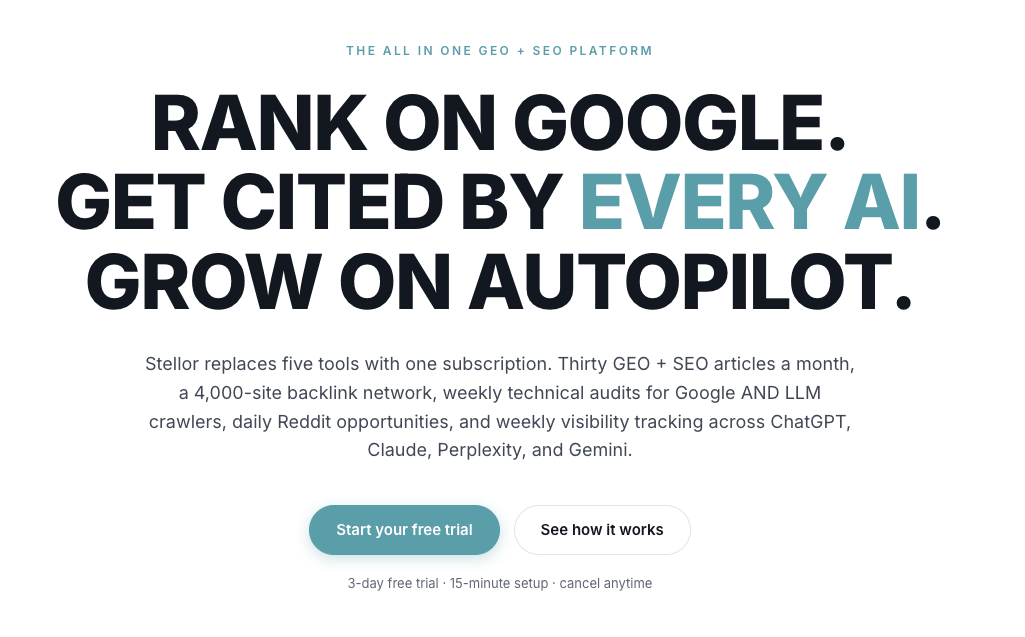
Stellor replaces that patchwork with one $199-per-month subscription that runs all of it together: 30 answer-first articles published monthly, a 4,000-site backlink network building your authority footprint, weekly technical audits catching schema and crawlability gaps, a Reddit module earning you organic mentions, and LLM tracking that tells you exactly which of your buyer prompts you’re winning and losing. It’s built to do in a quarter what a solo coach doing this by hand might take a year to piece together.
Start with the free AI Visibility Audit and see your current citation status across real buyer prompts before you commit to anything. The trial runs three days, no credit card required, and you keep the audit even if you decide the platform isn’t for you.
Sources
FAQ
What Is the 30% Rule in AI?
There’s no single, universally agreed-upon “30% rule” in AI content strategy specific to coaching visibility; definitions vary depending on the source. If you’ve seen it referenced elsewhere, treat it as informal guidance rather than an established standard, and focus instead on the answer-first and self-contained-section rules covered in this article.
What Is the Best AI Tool for Coaching Visibility?
There’s no single best tool, since coaches need visibility across ChatGPT, Claude, Perplexity, and Gemini simultaneously, not just one. Platforms like Stellor are built specifically to track and improve presence across all four at once rather than optimizing for a single model.
Can ChatGPT Be My Life Coach?
ChatGPT can offer general guidance and reflective prompts, but it isn’t a substitute for a trained coach who understands your specific history, accountability needs, and goals. Most coaches position AI as a discovery channel their prospects use to find a human coach, not as a replacement for one.
How Much Does an AI Coach Cost?
Pricing for AI-assisted coaching tools and platforms varies widely by feature set and isn’t standardized industry-wide. For AI visibility and discoverability platforms specifically, Stellor starts at $199 per month with a three-day free trial and no credit card required.
How Is AI Discoverability Different From Regular SEO for Coaches?
Traditional SEO optimizes for ranking position on a search results page, while AI discoverability (GEO) optimizes for being cited inside a generated answer, which can happen even without a top-ten ranking. Both matter, but they reward different content structures and proof signals.
Do I Need a Developer to Add Schema Markup?
No. Person, ProfessionalService, and FAQPage schema, as defined by schema.org, can typically be added through a WordPress plugin or website builder’s structured data settings without custom code.