

Winning “near me” searches comes down to one combination: a fully verified Google Business Profile, steady review velocity, and a real location page for every place you serve. Distance is fixed and you cannot change it, so the entire game is prominence and relevance. This week, verify your profile, audit your NAP across directories, and post one geotagged photo of your storefront or crew.
TL;DR:
- Verifying and completing your Google Business Profile, fixing NAP consistency, and publishing one unique location page are essential steps to improve local relevance and prominence.
- Consistently requesting reviews at a rate of about one per week enhances your prominence signal more effectively than occasional large review pushes.
- Implementing proper schema markup, geotagged photos, and accurate business information on location pages helps search engines and AI tools better understand and rank your business.
- Tracking local rankings through geo-grid testing and monitoring key metrics like calls, directions, and profile views over at least six to eight weeks provides measurable proof of SEO efforts.
- Building real community backlinks, offline citations, and maintaining active engagement online supports both Google and AI recommendation visibility beyond basic profile optimization.
Table of Contents
- What Are the Six Quick Wins for Near Me SEO?
- How Do You Optimize Google Business Profile for Near Me Queries?
- What Belongs on a Local Landing Page for Near Me Rankings?
- How Do You Get More Reviews Without Burning Out Your Team?
- How Do You Fix Citations and Build Local Links That Matter?
- How Do You Track Near Me Rankings and Prove ROI?
- What Advanced Tactics Improve AI Visibility for Local Businesses?
- Where the Conventional Local SEO Advice Falls Short
- How Stellor Handles Near Me SEO Without the Agency Juggling Act
- Sources
- FAQ
What Are the Six Quick Wins for Near Me SEO?
Google ranks the local pack on three factors: relevance, distance, and prominence, according to its own local ranking guidance. You cannot touch distance. You can absolutely move the other two, and you can do it faster than most business owners assume. Here are the six moves that produce visible change inside a month.
- Verify and complete your Google Business Profile. Fill every field. Choose the most precise primary category available, not the broadest one. “Emergency plumber” beats “plumber” if that is genuinely your specialty.
- Correct NAP everywhere it appears. Name, address, and phone number need to match exactly across your website, Yelp, Apple Maps, and the top ten directories in your industry. Duplicate listings confuse Google and split your prominence signals.
- Publish or rebuild one unique location page per site you serve. Generic city pages with swapped-out place names get ignored, or worse, filtered as doorway pages.
- Start a review request workflow. One steady ask per completed job beats a single push for fifty reviews in one week. Velocity matters as much as volume.
- Earn three to five local backlinks. Chamber of commerce listings, sponsorship pages, and a mention in local press outrank a stack of generic directory submissions.
- Set a baseline with geo-grid tracking. Record your current GBP metrics (views, calls, direction requests) before you touch anything, so you can prove what worked.
None of these require a developer or an agency retainer to start. A local SEO audit checklist can help you baseline where you stand before you commit a full week to execution. The order matters less than consistency. Businesses that treat this as a quarterly project instead of a weekly habit lose ground to competitors who never stop working the list.
How Do You Optimize Google Business Profile for Near Me Queries?
Verification is the gate. An unverified profile rarely shows up in the map pack regardless of how complete the rest of the listing looks, and Google flags unverified locations as lower trust by default. Verification now happens by phone, email, video, or postcard depending on your business type and history. Video verification has sped this up considerably for service-area businesses that used to wait two to three weeks for a postcard.
Once verified, the details you fill in do real work:
- Primary category carries more ranking weight than any other single field. Pick the narrowest accurate option; you can add secondary categories, but the primary one anchors your relevance signal.
- Services list should mirror the actual language customers type into Google, not internal jargon. “Water heater installation” outperforms “plumbing services” for that specific query.
- Business description gets 750 characters. Use them to name your service area towns explicitly rather than repeating your business name.
- Attributes (wheelchair accessible, free Wi-Fi, women-led) feed filtered searches you would otherwise miss entirely.
- Photos should be fresh, geotagged where possible, and updated monthly. Listings with active photo uploads see more engagement than static ones.
- Google Posts and Q&A keep your profile looking active. Seed your own Q&A section with the three questions customers actually ask before you call.
Hours matter more than owners realize. A listing marked “open now” during a real-time search gets a visibility bump that a “closed” listing simply does not get, even if every other signal is identical. If your hours are wrong on a holiday or you forget to update a temporary closure, you lose that slot to a competitor who kept theirs current.
Pro Tip: Set a recurring 15-minute calendar reminder on the first Monday of every month to check GBP hours, photos, and Q&A. Most listings go stale not from neglect but from nobody owning the task.
What Belongs on a Local Landing Page for Near Me Rankings?
A location page earns its rank by proving it describes a real place, not by repeating a template with the city name swapped. Google’s own systems and human quality raters both watch for this pattern, and thin, duplicated location pages are one of the fastest ways to get filtered out of local results entirely.
Every location page needs:
- A full address and embedded map, not just a phone number.
- Hours specific to that location if hours vary by site.
- Testimonials or review snippets from customers at that specific location, not generic company-wide quotes.
- Named staff or a manager photo, when appropriate, to reinforce that a real team operates there.
- A services list scoped to what that location actually offers, since not every branch carries every service.
Consumer behavior backs the effort. A large majority of consumers now use search engines specifically to find local business information before they ever pick up the phone, which means the page has to answer real questions, not just exist for crawlability.
Schema is the part most local pages skip entirely. Implement LocalBusiness markup on every location page, branchOf to connect it to your parent organization if you run multiple sites, and areaServed to spell out the towns or neighborhoods you cover. For images, ImageObject schema lets you attach structured metadata (caption, license, contentUrl) to your photos, and Schema shows exactly which fields search engines and AI crawlers read. Name your files descriptively before upload (austin-tx-storefront-team.jpg, not IMG_4021.jpg), write alt text that describes the actual image, and geotag photos taken on site whenever your camera or phone supports it.
How Do You Get More Reviews Without Burning Out Your Team?
Steady review velocity beats a one-time push every time. A business that earns one review a week for a year builds a stronger prominence signal than one that begs for fifty reviews in a single month and then goes quiet. Google’s own guidance on improving local ranking lists reviews among the clearest prominence signals it can measure, and a steady drip reads as more authentic than a burst.
Build the ask into moments that already happen:
- Send a post-service email or text within two hours of job completion, while the experience is fresh.
- Add a review link to printed or digital receipts.
- Use SMS requests where your state and carrier rules allow it. Response rates on text tend to beat email by a wide margin for service businesses.
- Train your team to mention it verbally at the point of payment. A verbal nudge before the digital ask arrives lifts completion rates.
How you respond matters almost as much as how many you collect. A five-star review deserves a specific reply that names the service performed, not a copy-pasted “thanks!” A neutral three-star review deserves an acknowledgment and a real fix offered. A negative review deserves a calm, factual response with an offer to resolve it offline, because future customers read your responses as closely as the reviews themselves.
Pull your strongest review snippets onto your location pages and into Google Posts. A quote with a name and a service detail does more conversion work than five paragraphs of your own marketing copy.
Pro Tip: Ask for the review before the invoice, not after. Customers who have not yet paid tend to write warmer, faster reviews than ones who already closed the transaction mentally.
How Do You Fix Citations and Build Local Links That Matter?
Citation cleanup starts with an audit, not a guess. Pull your business listing from the top ten directories in your category (Google Business Profile, Yelp, Apple Maps, Bing Places, and the major industry-specific sites for your trade) and compare name, address, and phone number character by character. Shopify’s local SEO guidance names NAP consistency alongside reviews and schema as one of the core levers that actually moves local rankings.
A quick fix checklist:
- Flag every listing where the suite number, abbreviation style, or phone format differs, even slightly.
- Claim and merge duplicate listings before requesting corrections; duplicates split your prominence signal in two.
- Update your website’s footer NAP to match your GBP exactly, since inconsistency between your own site and your profile is a common, overlooked error.
Link building for local prominence looks different from generic outreach. Target your local chamber of commerce directory, a sponsorship or “supported by” page on a youth sports league or community event, your suppliers’ partner pages, and a mention in local press if you have any news angle worth pitching. A managed local SEO strategy can also fold offline visibility into the mix. Yard signs and vehicle wraps still drive branded searches that eventually convert into citations and reviews, a tactic Yardsigns for service providers who want a physical presence to reinforce the digital one.
Judge every link candidate by one question: does a real person in your service area click it? A directory nobody visits adds nothing.
How Do You Track Near Me Rankings and Prove ROI?
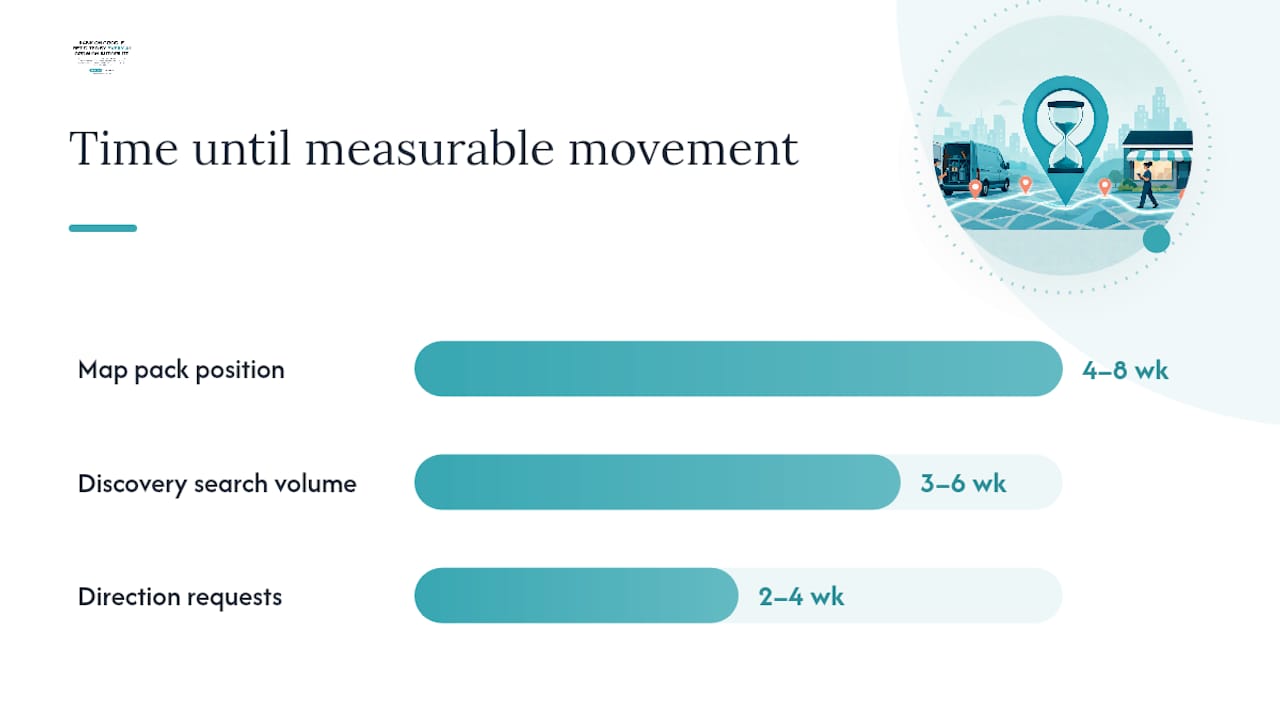
Rankings shift by location even within the same city, which is why a single “we rank #3 for plumber” claim is close to meaningless without knowing where the searcher stood. Geo-grid tracking solves this by querying your target keyword from a grid of points across your service area and mapping where you show up in the pack at each one.
Track these GBP metrics weekly, not monthly:
- Discovery searches (people who found you searching a category or product, not your name)
- Direct searches (people who searched your business name specifically)
- Profile views and website clicks from the listing
- Calls placed directly from the GBP call button
- Direction requests, a strong footfall proxy
| Metric | What it tells you | Realistic timeline for movement |
|---|---|---|
| Map pack position (geo-grid) | Where you actually rank across your service area | 4 to 8 weeks after fixes |
| Discovery search volume | Whether relevance signals are improving | 3 to 6 weeks |
| Direction requests | Real-world footfall interest | 2 to 4 weeks |
| Review count and velocity | Prominence trajectory | Ongoing, cumulative |
Industry research from BrightEdge on local search conversion behavior shows how often local mobile searches lead to a same-day store visit or purchase, which is exactly why direction requests and calls matter more than raw impressions. A real-time tracking dashboard makes the weekly check painless instead of a monthly scramble, and pairing it with a framework for measurable SEO results keeps the whole team focused on calls and bookings instead of vanity rank checks.
Give any single fix six to eight weeks before judging it. Google needs time to recrawl, re-evaluate, and shift trust signals, and a review workflow needs a few weeks just to accumulate enough volume to matter.
What Advanced Tactics Improve AI Visibility for Local Businesses?
Local entity signals now do double duty. They help Google’s local pack and they increasingly shape whether ChatGPT, Claude, Perplexity, or Gemini mention your business when someone asks for a recommendation nearby. An AI answer engine weighs evidence that your business is embedded in its community, not just that it exists on a map.
Build entity authority with:
- Sponsorship or partnership pages that name your business alongside a local event, team, or nonprofit.
- Press mentions or interviews, even small local outlet ones, that use your business name in context.
- Consistent presence in local Reddit threads and community forums where people already ask for recommendations.
- Cross-links between your location pages and community resource pages you genuinely contribute to.
Image strategy deserves more attention than most owners give it. Visual search is a growing entry point, and ImageObject schema lets you attach structured captions, licensing, and content descriptions that both Google Images and AI crawlers can parse. A geotagged photo of your team at a local event, properly tagged with schema, does more entity-building work than a stock photo ever will.
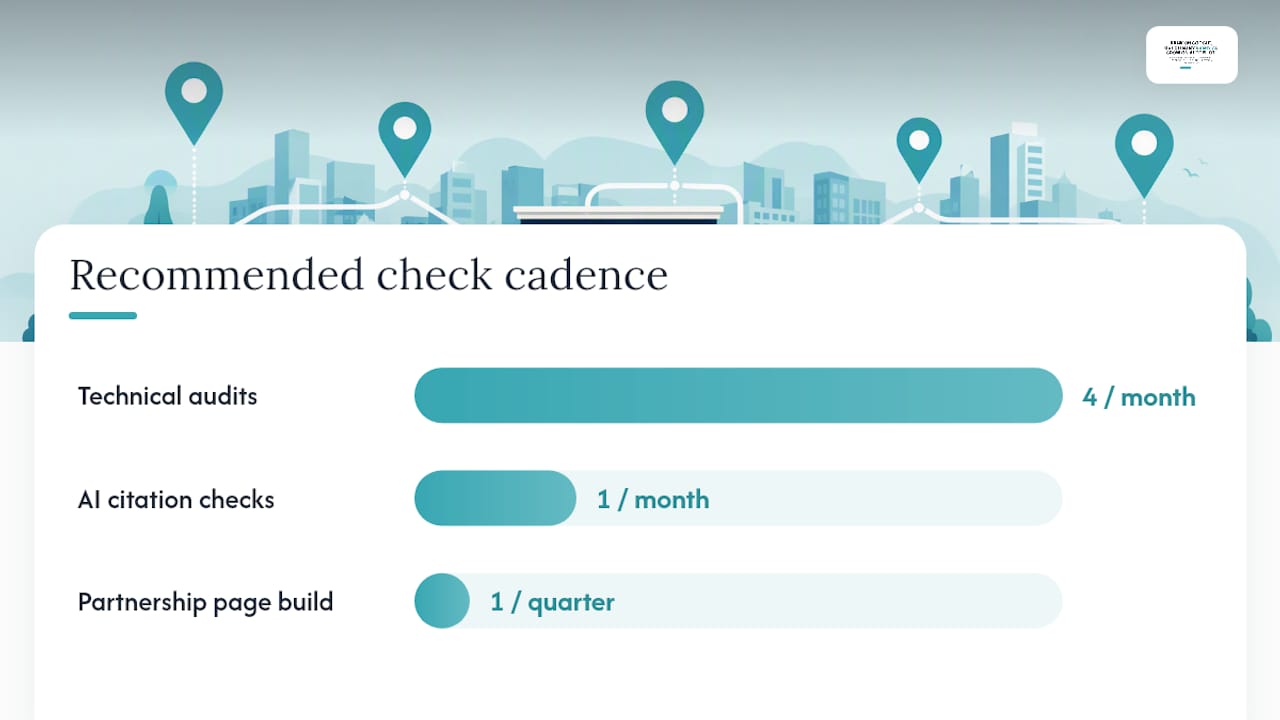
Weekly technical audits matter here too. Structured data errors, broken schema, or a missing areaServed property make your business harder for a crawler, human or AI, to parse accurately. Checking your technical SEO health on a fixed schedule catches these before they cost you visibility.
Measuring AI citation is newer territory than Map Pack tracking, but the principle is the same: ask the actual prompts your customers would type (“best HVAC repair near downtown Austin”) into each AI tool on a regular cadence and log whether you appear. A monthly check, paired with steady community engagement, is a realistic starting cadence for most small teams.
Pro Tip: Pick one local event or partnership per quarter and build a real page around it, complete with schema and photos. One well-built entity page outperforms ten thin ones for both Google and AI visibility.
Where the Conventional Local SEO Advice Falls Short
Most local SEO advice treats Google Business Profile completion as a one-time task and reviews as a numbers game. Both assumptions cost businesses rank. A profile filled out once in 2023 and never touched again drifts stale, and Google notices staleness the same way it notices activity.
The bigger blind spot is entity authority. Owners optimize the map pack and ignore the fact that AI answer engines are already fielding a meaningful share of “best X near me” questions, using different signals than Google’s local pack does. A business with perfect NAP consistency but zero community footprint online will keep losing AI-driven recommendations to a less polished competitor who sponsors the little league team and shows up in local Reddit threads.
Prioritize in this order: verify and complete your profile this week, fix your NAP this month, then build one real local landing page with proper schema before you touch anything else. Reviews and links compound after that foundation is solid, not before it.
— Cole
How Stellor Handles Near Me SEO Without the Agency Juggling Act
A single platform can replace multiple vendors for local search: content writing, link building, technical auditing, review management, and AI visibility tracking, bundled into one subscription. Instead of coordinating five invoices and five logins to keep your location pages fresh, Stellor publishes 30 GEO and SEO-optimized articles a month, including the kind of unique location pages this article just walked through, complete with schema and internal linking already built in.
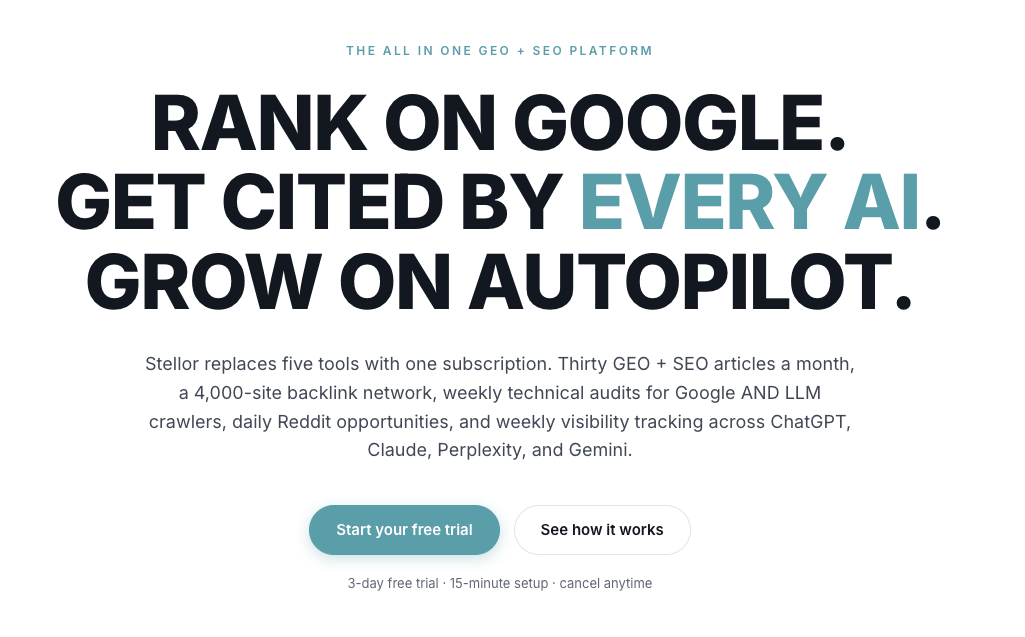
Behind that content sits a 4,000-site backlink network which builds the local prominence signals Google rewards, weekly technical audits that catch schema and NAP errors before they cost you rank, and weekly checks across ChatGPT, Claude, Perplexity, and Gemini so you know exactly when and where your business gets cited for “near me” prompts. Sign up to receive a free AI Visibility Audit covering your current citation status, a competitor benchmark, and a 90-day action plan that you keep. A free trial runs for three days without requiring a credit card. Check the Stellor product page and see what your current near me visibility actually looks like this week.
Sources
- Tips to improve your local ranking on Google
- Schema
- Statista — consumers using search engines to find local business info
FAQ
What Is the Fastest Way to Rank for Near Me Searches?
Complete and verify your Google Business Profile, fix inconsistent NAP data across directories, and publish one unique local landing page. Those three moves address relevance and prominence, the two ranking factors you actually control.
Can I Improve My Distance Ranking Factor?
No. Distance is calculated from the searcher’s location to your verified address and cannot be manipulated legitimately; attempting to fake proximity with a virtual office or rented address violates Google’s guidelines and risks profile suspension. Focus entirely on prominence and relevance instead.
How Many Reviews Do I Need to Rank in the Map Pack?
There is no fixed number, but steady velocity, roughly one new review a week, builds a stronger prominence signal over time than an occasional burst of many reviews followed by silence.
Does Schema Markup Actually Help Local Rankings?
Schema does not directly boost rank, but it makes your business and images easier for search engines and AI crawlers to parse accurately, which supports both relevance signals and eligibility for rich results.
How Long Does Near Me SEO Take to Show Results?
Most geo-grid rank movement appears within 4 to 8 weeks of fixing GBP completeness and NAP consistency, while entity authority and AI citation gains typically build over a longer, ongoing cadence.
Can a Tool Like Stellor Handle Near Me SEO for Me?
Stellor automates the recurring work, GEO-optimized location content, backlink building, technical audits, and AI visibility tracking, that near me SEO requires on an ongoing basis, replacing several separate vendors with one managed platform.