

Multilingual SEO content means building language-targeted pages with correct hreflang tags, sensible URL structure, and metadata translated for each market, not just words swapped out. The single most important move is pairing that technical foundation with translation quality that respects local search intent, then measuring performance in both Google and AI answer engines. Miss either half and you leave visibility on the table in two search worlds at once.
TL;DR:
- Prioritize subfolder URL structures over ccTLDs and subdomains unless you have dedicated resources for each country, as this consolidates authority and simplifies maintenance.
- Ensure hreflang tags are correctly implemented on every page with self-references, and avoid canonical tags pointing to a single version to prevent confusing search engines about language variants.
- Use human-driven transcreation for revenue-critical pages like landing pages and product descriptions, while machine translation suffices for support content with less emphasis on nuance.
- Measure search performance and AI citation rates separately for each language to identify underperforming markets and optimize content and backlinks accordingly.
- Avoid auto-redirects based on user location or browser language; instead, implement visible language switchers and fallbacks to improve user experience and search engine signals.
Table of Contents
- What multilingual SEO is and why it matters
- Plan and prepare: pick languages, research keywords, choose your URL structure
- Technical implementation: hreflang, sitemaps, canonicals, and language metadata
- Content-level best practices: translation quality, metadata, and UX
- Off-page and local E-E-A-T: multilingual backlink strategy
- Measure and iterate: analytics, page experience, and AI visibility
- Expert example: an integrated workflow for multilingual SEO and AI visibility
- Handling duplicate content issues in multilingual contexts
- Management and workflow best practices for multilingual content production
- Common pitfalls and challenges unique to multilingual SEO campaigns
- Case studies or examples of successful multilingual SEO implementations
- International SEO technical considerations beyond hreflang
- Content localization strategies beyond translation
- Strategic perspective: rollout timeline, resourcing, and common blockers
- How Stellor fits into your multilingual SEO plan
- Sources
- FAQ
What multilingual SEO is and why it matters
Multilingual SEO and multiregional SEO get confused constantly, but they solve different problems. Multilingual SEO targets people by the language they search in, regardless of where they live. Multiregional SEO targets people by country or region, sometimes in the same language, like English pages built separately for Canada and Australia. Many businesses need both at once: a French-language site for French speakers everywhere, plus region-specific pricing and shipping pages for France versus Quebec.
The business case is straightforward. A large share of the internet’s content and traffic happens outside English, and Statista’s language data confirms non-English content makes up a substantial portion of the web. If your product page only exists in English, you are invisible to a search population that expects results in their own language. The gap is even wider in AI search: a Weglot analysis of 1.3 million citations found translated sites gain far more visibility in AI Overviews and chatbot answers than untranslated ones, since these engines favor content written in the query’s language.
You should invest in multilingual content when:
- Your analytics show meaningful traffic from non-English browsers or countries you don’t currently target.
- Competitors already rank in the languages your buyers search in.
- Your sales team fields inquiries in languages your website doesn’t support.
- You’re expanding into a new market and want organic visibility before paid budget kicks in.
Plan and prepare: pick languages, research keywords, choose your URL structure
Before writing a single translated page, get three decisions right: which languages to target, what people actually search for in each one, and how your URLs will be structured. Skipping this stage is the most expensive mistake in multilingual SEO, because fixing architecture after launch means redoing links, redirects, and indexed pages.
- Rank languages by business value. Score each candidate language on three factors: existing demand (site traffic, support tickets, sales inquiries), search volume for your core terms in that language, and realistic conversion potential based on where you can actually fulfill orders or deliver services.
- Map search intent per language, not per translation. Native speakers phrase queries differently than a direct translation would suggest. Build keyword clusters from native-language search data and local tools rather than translating your English keyword list word for word.
- Involve a native speaker early. Even strong machine translation misses idioms, formality levels, and regional word choices that change how a query actually gets typed.
- Choose your URL structure before building anything. The three options are ccTLDs (example.fr), subdomains (fr.example.com), and subfolders (example.com/fr/). ccTLDs send the strongest geographic signal but require separate hosting and SEO effort per domain. Subdomains are easier to set up but often get treated as semi-separate sites by search engines. Subfolders consolidate domain authority under one root domain and are the easiest to maintain for most mid-size businesses.
Pro Tip: Default to subfolders unless you have a dedicated team and budget per country: they keep your backlink authority consolidated while still letting you target languages cleanly.
Whichever structure you pick, document it before development starts. Retrofitting URL architecture after Google has indexed hundreds of pages under the wrong pattern is a slow, error-prone fix.
Technical implementation: hreflang, sitemaps, canonicals, and language metadata
Hreflang is the single most commonly misconfigured element in multilingual SEO, and getting it wrong causes the wrong language version to rank, duplicate content warnings, or pages competing against each other in search results. Google’s own guidance on managing multiregional and multilingual sites is unambiguous: use explicit signals rather than hoping Google infers language from content alone.
You can implement hreflang three ways, and you only need one:
- HTML link tags in the page head, one line per language variant, which works well for smaller sites.
- XML sitemap annotations, which scale better for large sites with many language variants.
- HTTP headers, useful for non-HTML files like PDFs.
A few rules matter regardless of method. Every page must list all its language variants, including a self-referencing tag pointing to itself. Add an x-default tag for a fallback page shown to users whose language doesn’t match any variant, typically a language selector or your default market page. Google explicitly recommends against automatically redirecting visitors based on browser language or location settings, since it blocks users (and search crawlers) from reaching the version they actually want, and it breaks the ability to verify hreflang manually.
A live but easy-to-miss failure mode: canonical tags that point to a single “main” version of a page cancel out hreflang signals meant to keep language variants separate. If your French page’s canonical tag points back to the English original, you are telling Google to ignore the French version entirely.
One in four multilingual sites likely misconfigures hreflang or canonicals in some way, based on Google’s own emphasis on this as the most commonly overlooked technical foundation for international sites. Getting it right the first time avoids a slow, quiet loss of visibility that’s hard to diagnose later.
Validate your setup with Google Search Console’s International Targeting report, a hreflang tag checker, and manual spot checks in an incognito browser set to different languages and locations.

Content-level best practices: translation quality, metadata, and UX
Not all translation is equal, and picking the wrong method for the wrong page type costs you rankings and conversions. Machine translation is fast and cheap, useful for support documentation or low-stakes internal content, but a 2025 study surveying 4,217 respondents found many users rate machine translation outputs as average to poor in quality. SEO-focused human translation fixes grammar and keyword targeting but still reads like a translation. Transcreation goes further: it rewrites messaging, examples, and calls to action to fit the local market’s culture and buying habits, and the same research points to higher engagement from this human-centered approach.
Use transcreation for anything that touches revenue: landing pages, product descriptions, and marketing copy. Machine or standard translation is fine for help center articles or archived content where nuance matters less.
Metadata translation is easy to skip and costly when you do. Translate page titles, meta descriptions, image alt text, and structured data into the page’s own language, matching the lang attribute you’ve set. Schema.org’s own guidance recommends using the page’s visible language for structured data so both search engines and AI crawlers match language context correctly, rather than leaving schema in English on a Japanese page.
A few writing habits improve both machine translation quality and AI citation odds:
- Write short, declarative sentences instead of long clauses that translation tools mangle.
- Use consistent terminology for the same concept throughout a page instead of varying it for style.
- Localize examples, currencies, and measurement units rather than translating them literally.
Pro Tip: Keep a glossary of brand and product terms that should never be auto-translated, and share it with every translator or tool you use.
On the UX side, give users a visible language switcher instead of guessing for them, avoid automatic redirects, keep that x-default fallback in place, and adapt date formats, currency symbols, and number formatting to match local conventions.
Off-page and local E-E-A-T: multilingual backlink strategy
Backlinks earned in the wrong language do little for the page they’re supposed to support. A Spanish-language page linked from dozens of English news sites doesn’t build the same trust signal, in Google’s eyes or in an AI model’s training data, as a handful of links from Spanish-language publications actually covering your industry.
Prioritize link quality within the language, not raw volume. A single mention from a respected local trade publication or regional news outlet in the target language carries more weight than a batch of generic directory links translated after the fact. This matters for E-E-A-T signals too: localized author bios, translated case studies with real regional client names, and citations in language-specific media all help both Google and AI answer engines see the content as written for that market, not bolted on.
Practical tactics that tend to perform:
- Pitch translated case studies to industry publications that cover your market in that language.
- Build relationships with local bloggers or journalists who already cover your category.
- Localize author pages so credentials and context make sense to that region’s readers.
- Track inbound links by language in a spreadsheet or your SEO platform, so you can see which language markets are under-linked relative to their content volume.
If you’re producing marketing content across languages, the same discipline applies outside pure SEO. A guide on real estate marketing strategy makes a similar point for a different industry: local relevance in outreach beats broad, translated blasts every time.
Measure and iterate: analytics, page experience, and AI visibility
Multilingual SEO isn’t done at launch. You need language-level visibility into what’s working, and that means splitting your metrics by language, not just by country or aggregate traffic.
- Track impressions, clicks, and average position per language in Google Search Console by filtering the International Targeting and Performance reports by page path or hreflang tag.
- Monitor Core Web Vitals per language template, since a slow-loading font for a language with heavier character sets (Japanese, Arabic) can drag down page experience scores differently than your English template.
- Use privacy-first analytics to segment conversions by language. Matomo’s multilingual SEO guide recommends tracking multilingual performance this way specifically because it avoids the sampling gaps that some analytics platforms introduce on smaller-language segments.
- Run AI-visibility checks by querying ChatGPT, Claude, Perplexity, and Gemini directly in each target language using the exact phrases your buyers would type, then log whether your brand appears and which competitors get cited instead.
Translated pages see substantially higher AI citation rates than untranslated ones, according to Weglot’s analysis of 1.3 million citations, which means AI visibility should be tracked as its own channel, checked weekly, not folded into general SEO reporting.
Expert example: an integrated workflow for multilingual SEO and AI visibility
Manually running every checklist item above, across multiple languages, is a full-time job for more than one person. That’s the gap platform-managed workflows aim to close. Stellor runs a version of this playbook on autopilot for businesses that need scale without hiring a translation and technical SEO team per market.
A realistic workflow looks like this:
- Onboarding captures target languages, services, and brand voice in about fifteen minutes.
- The content engine publishes GEO and SEO-optimized pages monthly, including service, comparison, and FAQ pages, structured for the target language rather than translated after the fact.
- Weekly technical audits check hreflang, schema completeness, and page speed, the same items flagged earlier in this guide as common failure points.
- A backlink network delivers language-relevant authority signals without manual outreach per market.
- Weekly reports show exactly where the brand is cited across ChatGPT, Claude, Perplexity, and Gemini, and which competitors are winning those citations instead.
Teams evaluating whether this fits their situation can start with a free AI Visibility Audit on the Stellor product page, which surfaces current citation status before any commitment.
Handling duplicate content issues in multilingual contexts
Multilingual sites trigger duplicate content flags more often than single-language sites, but the cause is usually structural, not a penalty risk in the way people assume. Google generally understands that a French and German version of the same page serve different audiences. The real problems show up in three specific situations.
First, near-identical content across regional variants of the same language, like US and UK English pages that differ only in currency, confuses hreflang targeting more than it confuses ranking, since Google may just pick one version to show everywhere. Second, machine-translated pages published without human review sometimes render so close to the source language that crawlers treat them as thin duplicates rather than distinct localized content. Third, and most common: canonical tags misconfigured to point every language variant back to a single “main” page, which tells search engines to ignore the very pages you built hreflang to support.
The fix in each case is the same principle: self-referencing canonicals on every language page, paired with correct hreflang annotations that tell Google these are intentionally similar pages meant for different audiences, not accidental copies. Where regional variants truly are near-identical, consider whether you need separate pages at all or whether a single page with clear internal signals about currency and shipping serves both audiences better.
Management and workflow best practices for multilingual content production
Multilingual content production breaks down most often at handoffs, not at the writing stage. A typical failure pattern: a marketing team writes English content, hands it to a translation vendor with no context on search intent, and receives a linguistically correct but SEO-blind page back.
Build the workflow the other way around. Keyword research happens per language before writing starts, not after translation. A style guide and glossary travel with every project, covering brand terms, tone, and formatting conventions like date and currency style. Assign one person, even if it’s not their full-time role, as the language owner responsible for that market’s content quality and technical checks, rather than treating translation as a service ticket with no ownership.
Version control matters more than most teams expect. When the English source page updates, someone needs to flag which language variants are now out of date, ideally through a shared content calendar rather than relying on memory. Batch related pages together (a service line’s pages across all languages, for instance) rather than translating page by page across unrelated topics, since batching keeps terminology and formatting consistent within a topic cluster.
For teams managing more than two or three languages, a dedicated platform or managed service tends to outperform spreadsheet-based tracking, simply because the number of moving pieces (hreflang tags, metadata, backlink profiles, review cycles) grows faster than manual coordination can keep up.
Common pitfalls and challenges unique to multilingual SEO campaigns
The most expensive mistakes in multilingual SEO happen early and stay invisible until traffic reports show the damage. A few recur across nearly every campaign.
Auto-redirecting users based on browser language or IP location is the most persistent one. It feels helpful but blocks users, and search crawlers, from reaching the specific language version they need, and it directly contradicts Google’s stated guidance against automatic redirects tied to user settings.
Treating translation as a one-time project rather than an ongoing process is another. Product pages, pricing, and promotions change constantly in the source language; if translated versions don’t update on the same cadence, you end up with stale or contradictory information live in multiple languages at once.
Skipping native-speaker review to save budget causes subtler damage: content that’s grammatically fine but culturally off, using formal address where informal is expected, or examples that don’t make sense locally.
Finally, measuring only aggregate traffic instead of language-level performance hides which markets are actually working. A campaign can look successful overall while one language variant quietly underperforms for months because nobody split the data.
Case studies or examples of successful multilingual SEO implementations
Publicly documented multilingual SEO wins tend to share the same pattern: technical foundation fixed first, translation quality prioritized over speed, and measurement split by language from day one.
Matomo’s multilingual SEO guide walks through examples where sites that properly implemented hreflang alongside translated metadata saw cleaner indexing and fewer competing-page issues than sites that translated content but left technical signals in place from the English-only version. The consistent thread across documented implementations isn’t a single tactic but the sequencing: get hreflang, canonicals, and URL structure right before scaling translated content volume, not after.
The AI visibility side reinforces the same lesson from a different angle. Weglot’s analysis of 1.3 million AI citations found translated sites earning meaningfully more visibility in AI Overviews and chatbot answers, which suggests the businesses winning AI citations today are the ones that treated translation as core infrastructure rather than an afterthought bolted onto an English-first site.
The practical takeaway for teams starting out: don’t wait for a perfect localization budget before launching a second language. Launch the technical foundation correctly with even a modest first batch of well-translated pages, then expand content volume once you can see the indexing and citation data behave as expected.
International SEO technical considerations beyond hreflang
Hreflang gets most of the attention, but a few other technical decisions shape how well multilingual sites perform, and they get overlooked because they don’t show up in basic SEO checklists.
Server location and hosting setup matter more than many teams assume. A site hosted entirely in one region can load noticeably slower for users on the other side of the world, which affects both user experience and Core Web Vitals scores that feed into ranking. A content delivery network that serves pages from servers closer to each target market reduces this gap without requiring separate hosting per country.
Language-specific XML sitemaps help search engines discover and prioritize crawling of each language section, particularly on larger sites where you want to signal that a newly added language deserves attention. Submitting separate sitemaps per language through Google Search Console makes it easier to spot indexing problems isolated to one market rather than diagnosing site-wide issues.
Character encoding and font rendering deserve a technical check too, especially for languages using non-Latin scripts like Arabic, Chinese, or Russian, where a missing font fallback can render text as broken boxes on some devices. Right-to-left language support (Arabic, Hebrew) requires layout adjustments beyond translation, since navigation, alignment, and reading flow all mirror the standard left-to-right template.
None of these fixes hreflang errors, but skipping them undercuts the technical foundation hreflang is supposed to sit on top of.
Content localization strategies beyond translation
Translation changes the words. Localization changes whether the page makes sense to someone living in that market, and the two are not the same project.
Currency, units of measurement, and date formats are the most visible gap. A price listed without local currency, or a date written in month-day-year format for a market that reads day-month-year, creates friction even when every word is translated correctly.
Cultural references, humor, and examples need local equivalents rather than direct translation. A marketing line built around a US holiday or sports reference means nothing translated literally into a market that doesn’t share that context; the fix is a locally relevant substitute, not a footnote explaining the original joke.
Payment methods and trust signals vary by market too. A checkout page that only offers credit card payment loses conversions in markets where bank transfers or region-specific payment apps are the norm, and displaying trust badges or certifications unfamiliar to the local market does less to reassure buyers than region-appropriate ones would.
Images and visual content carry cultural weight as well. Stock photography, color choices, and even gesture imagery can read differently across markets, and a page that swaps only the text while keeping visuals built for a different audience still feels foreign to the reader it’s supposedly written for.
Strategic perspective: rollout timeline, resourcing, and common blockers
Most teams overbuild the first phase and underbuild everything after it. A pragmatic 90-day rollout looks like: weeks 1 through 3 fixing technical architecture (URL structure, hreflang, canonicals), weeks 4 through 8 publishing a focused set of high-value pages with proper transcreation, and weeks 9 through 12 measuring language-level performance before deciding where to expand next.

The real trade-off isn’t quality versus speed, it’s how much of the coordination burden you’re willing to carry manually. Hiring per-market translators and managing hreflang by hand works at one or two languages; beyond that, platform-managed publishing usually catches errors faster than a stretched internal team can.
The two blockers that stall rollouts most often are hreflang misconfiguration and metadata left untranslated after the visible content was localized. Both are quick to audit and quick to fix once flagged, which is exactly why regular technical checks matter more than a one-time launch review.
— Cole
How Stellor fits into your multilingual SEO plan
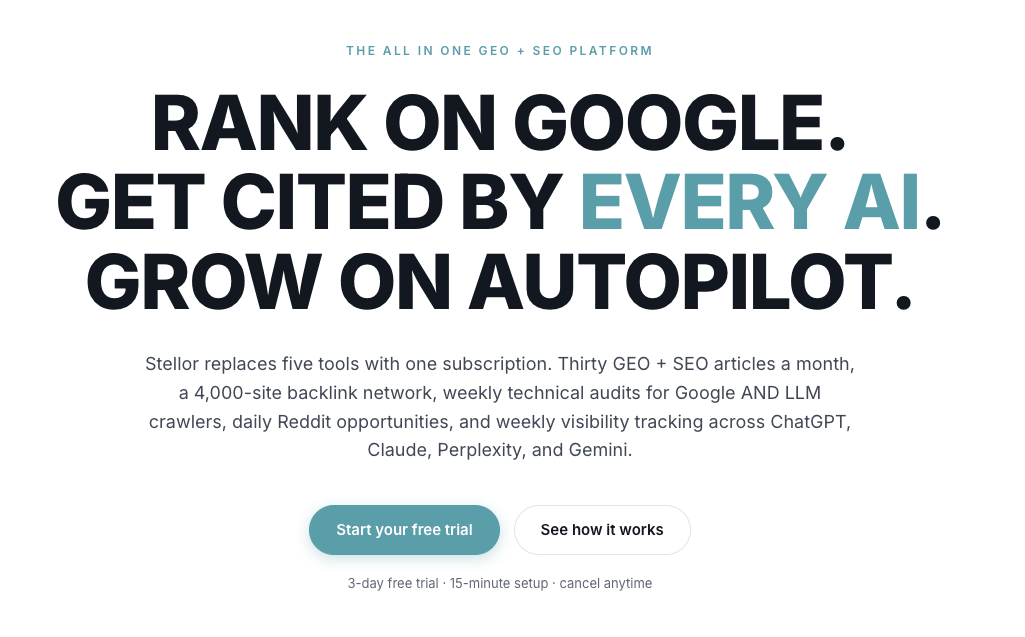
Building and maintaining all of this by hand, across three or four languages, easily turns into a full-time job nobody signed up for. Stellor runs the checklist for you: 30 GEO and SEO-optimized articles published monthly, weekly technical audits that catch hreflang and metadata issues before they cost you rankings, a 4,000-site backlink network, and weekly LLM visibility reports across ChatGPT, Claude, Perplexity, and Gemini so you can see exactly where you’re being cited and where competitors are winning instead.
What you get before committing to anything:
- A free AI Visibility Audit within 48 hours of setup, showing current citation status across your target markets.
- A 3-day free trial, no card required.
- All content and reports remain yours even if you cancel.
Start with the Stellor product page to see current plan details and request your audit.
Sources
- Managing multi-regional and multilingual sites - Google Search Central
- Most common languages on the internet - Statista
- Does AI Favor Translated Content? (+1.3 Million Citations Analyzed) - Weglot
FAQ
What’s the difference between multilingual and multiregional SEO?
Multilingual SEO targets people by the language they search in, wherever they live, while multiregional SEO targets specific countries or regions, sometimes in the same language. Many international businesses need both: a Spanish-language site for Spanish speakers globally, plus separate pricing pages for Spain versus Mexico.
Do I need hreflang tags if I only have two languages?
Yes. Hreflang tells search engines which language and regional variant to show which users, and skipping it even with just two languages risks the wrong version ranking or the two pages competing against each other, exactly the issue Google’s guidance addresses directly.
Should I use machine translation or hire human translators?
It depends on the page. Machine translation works for low-stakes support content, but a 2025 study found many users rate machine translation quality as average to poor, so revenue-driving pages like product and landing pages need human transcreation instead.
How often should I check AI visibility across languages?
Check weekly, since AI answer engines update their sources and citations continuously and translated pages see substantially higher citation rates than untranslated ones according to Weglot’s citation analysis. Tools like Stellor automate this by querying ChatGPT, Claude, Perplexity, and Gemini on a weekly cadence.
What’s the most common mistake in multilingual SEO?
Auto-redirecting visitors based on browser language or location, which blocks users and crawlers from reaching the specific page they need and directly contradicts Google’s published guidance on the topic. A visible language switcher and an x-default fallback page solve this without guessing.