

Local SEO, meaning a fully built Google Business Profile, one revenue-focused service page, and steady review velocity, will most reliably cut your cost per lead compared to paid ads alone. Fix your Google Business Profile this week, publish one strong location page for your best-margin service, and start requesting reviews after every job. Expect map-pack movement within 2 to 4 weeks and real lead volume by month three.
TL;DR:
- Local SEO efforts, such as fully optimizing your Google Business Profile and publishing one service page, can produce map-pack movement within 2 to 4 weeks.
- Investing in organic ranking services is significantly more cost-effective than paying $40 to $150 per lead from marketplaces, especially over time as it reduces per-job costs.
- Service and location pages must feature unique local content, customer testimonials, and schema markup to compete effectively in search rankings.
- Regularly publishing at least two to four targeted content posts per month, including cost guides and checklists, boosts inbound leads more than infrequent posting.
- Steady review acquisition at a rate of 8 to 10 reviews monthly in mid-sized markets enhances local pack ranking more than total review count.
Table of Contents
- Why Moving Company SEO Beats Paying for Every Lead
- How Do You Optimize Google Business Profile for a Moving Company?
- What Should a Moving Company’s Service and Location Pages Include?
- What Content Should a Moving Company Publish Each Month?
- How Do You Get More Reviews for a Moving Company?
- Which Technical Fixes Actually Move Moving Company Rankings?
- How Do You Build Local Citations and Links for a Moving Business?
- What KPIs Should Moving Companies Track and When Should You Expect Results?
- What Does a 48-Hour AI Visibility Audit Look Like for a Moving Company?
- An Owner’s Take: What to Prioritize First
- Get Your Moving Company’s Free AI Visibility Audit
- Where to Go Next for Moving Company SEO
- Sources
- FAQ
Why Moving Company SEO Beats Paying for Every Lead
Paid leads from lead-gen marketplaces often cost $40 to $150 each before you’ve booked a single job, and you’re bidding against every other mover in your metro for the same homeowner. Organic visibility doesn’t work that way. Once a service page or Google Business Profile ranks, it keeps generating calls without a per-lead invoice.
Search engine optimization for relocation services pays off across three surfaces at once: the local map pack, your organic website listings, and increasingly, AI Overviews and chatbot answers that pull from the same signals Google rewards. A fully optimized Google Business Profile can account for 30 to 50 percent of inbound lead volume for movers in competitive metro areas, which makes it the single highest-leverage asset most companies underuse.
The math that matters: if your average paid lead costs $80 and closes at 15%, you’re spending roughly $530 per booked job. A well-built service page that ranks organically costs nothing per click once it’s live. That gap compounds every month it stays ranked.
This is the core case for moving company SEO: it’s not a marketing nicety, it’s a structural cost advantage that widens the longer you invest in it.
How Do You Optimize Google Business Profile for a Moving Company?
Your Google Business Profile is the first thing a stressed-out homeowner sees when they search “movers near me,” and most moving companies leave it half-finished. Here’s the order of operations:
- Set your primary category to “Moving Company” and add secondary categories like “Packing Service” or “Storage Facility” if you offer them.
- Fill out every service line item (local moves, long-distance, packing, storage, piano moving) with pricing notes where you can.
- Upload 15 to 20 real photos: trucks with your logo visible, crews in branded uniforms, before/after packing shots. Stock photos hurt more than they help.
- List your service area accurately, especially if you cover a metro plus surrounding suburbs.
- Turn on messaging so mobile searchers can text a question instead of calling.
- Post weekly with seasonal offers, completed job photos, or moving tips to keep the profile active.
- Build a review-request workflow targeting a minimum of 8 to 10 new reviews per month for mid-size markets, more if you’re competing in a major metro.
Pro Tip: Add your USDOT and MC number directly into your GBP description and services section if you handle interstate moves. It reads as a small detail, but it answers the trust question before a customer has to ask it.
The goal isn’t a complete profile for its own sake. Every field, photo, and post should funnel a browsing homeowner toward requesting a quote, not just admiring your five-star rating.
What Should a Moving Company’s Service and Location Pages Include?
Ranking for more than one city means building more than one page, but copying the same template with a city name swapped in is the fastest way to suppress your own rankings. Service-area pages need unique local content and LocalBusiness schema to hold their position, not a find-and-replace job.
Start with a keyword matrix: cross service type (local moving, long-distance, office relocation, piano moving, storage) against geography (city, metro, key suburbs). Prioritize by revenue per job, not raw search volume. Long-distance move keywords can generate 3 to 5 times more revenue per job than a local studio-apartment move, so a lower-volume long-distance page can outearn a high-traffic local one.
Each service or location page needs:
- A unique opening paragraph that names the neighborhood, common building types (walk-ups, high-rises, gated communities), and local challenges like parking permits or elevator reservations.
- At least one customer testimonial specific to that area.
- Your USDOT and MC number, license details, and insurance coverage stated plainly.
- A clear call-to-action: instant quote form, click-to-call number, or booking calendar.
- LocalBusiness and Service schema markup so search engines and AI crawlers can parse what you offer where.
Only spin up a separate page for a neighborhood or suburb if it has genuine search demand and enough local detail to justify a standalone page. If you can’t write three original paragraphs about how that neighborhood is different, fold it into your main city page instead.
What Content Should a Moving Company Publish Each Month?
The pages that convert planners into booked jobs aren’t generic blog filler. They’re cost guides (“How Much Does It Cost to Move a 2-Bedroom Apartment in [City]?”), moving checklists, packing how-tos, and comparison pages that answer “how to choose a moving company” for someone doing exactly that research right now.
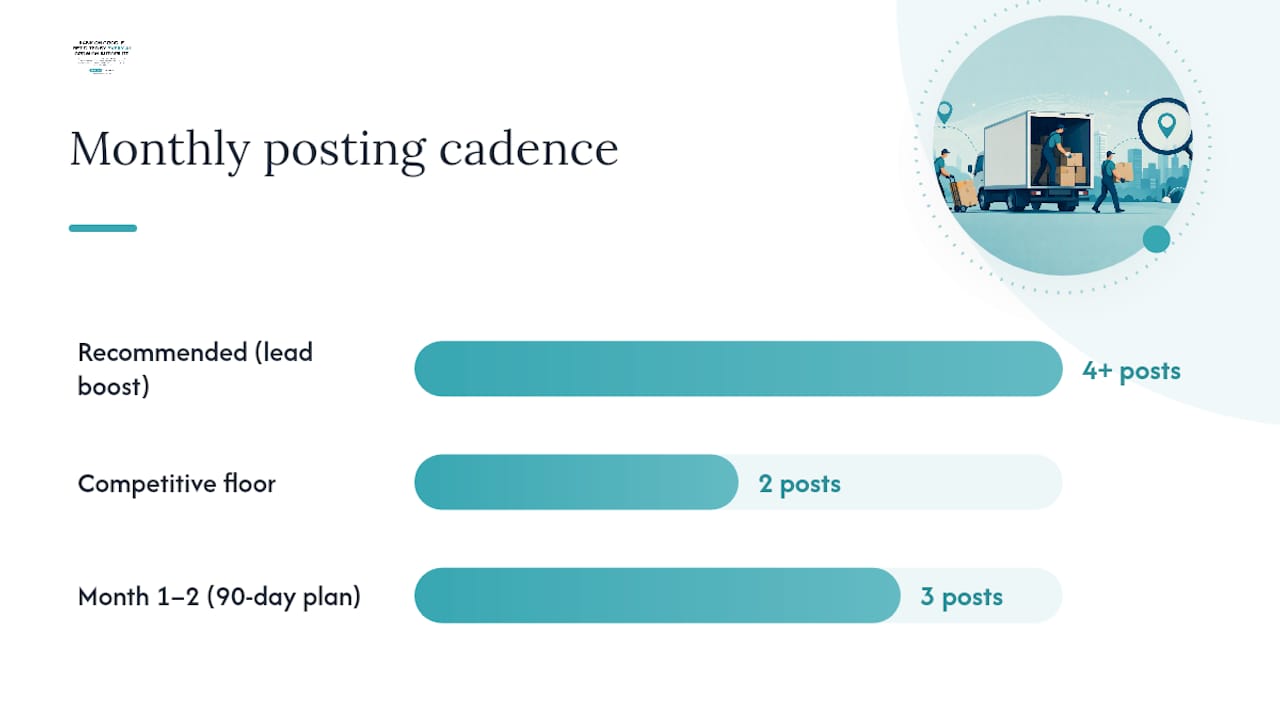
Cadence matters more than most owners assume. Moving companies that publish four or more posts a month generate meaningfully more inbound leads than those publishing less, and two posts a month is roughly the floor for a local market to stay competitive at all.
A simple 90-day calendar:
- Month 1: Publish your two highest-revenue service/location page pairs, plus one cost-guide post for your most-searched service.
- Month 2: Add a packing checklist, a “how to choose a mover” comparison guide, and a seasonal post tied to your local peak moving window.
- Month 3: Fill in secondary suburbs and specialty services (piano moving, senior relocation, corporate moves), and repurpose your top-performing post into a downloadable checklist or short video.
Pro Tip: Repurpose one cost-guide post into a 60-second video answering the same question. Video doesn’t just help on YouTube, it gives AI Overviews and Google’s video carousel another way to surface your business.
How Do You Get More Reviews for a Moving Company?
Review velocity, the pace of new reviews landing each month, is a stronger local-pack signal than your total review count. A company with 40 reviews and steady monthly growth will often outrank a competitor sitting on 200 reviews that stopped growing two years ago.
- Send a review request text or email within 2 hours of job completion, while the experience is still fresh.
- Automate the ask through your CRM so no crew forgets to trigger it manually.
- Target 8 to 10 new reviews per month in mid-size markets, 15 or more if you’re competing in a major metro against a dozen established movers.
- Respond to every review, positive or negative, within 48 hours.
- On a negative review, acknowledge the specific issue, state what you did or will do about it, and take the resolution offline. That response is often read by more prospects than the original complaint.
Moving companies that integrate review capture and automated follow-up into their CRM report up to 50 percent higher close rates on paid leads, which means this workflow pays off even outside your organic rankings.
Which Technical Fixes Actually Move Moving Company Rankings?
Technical SEO is the plumbing behind your digital presence. Nobody sees it directly, but when it’s broken, nothing else works right.
- Run a Core Web Vitals check and fix any page loading slower than 2.5 seconds, especially on mobile, where most quote requests originate.
- Confirm your site passes Google’s mobile-friendly requirements per Google Search Central’s guidelines.
- Add LocalBusiness schema site-wide and Service schema on every service page, with
areaServedproperties listing your actual coverage. - Mark up your USDOT and MC numbers in structured data if you run interstate moves. This detail is both a conversion factor and a trust signal that customers actively check before booking.
- Check for broken internal links, missing alt text, and duplicate title tags across your service pages.
A well-structured SEO audit checklist for local service businesses can catch most of this in one pass rather than piecemeal fixes over months. According to Schema, LocalBusiness markup is what lets search engines confidently match your listing to a searcher’s location intent, which matters even more as AI answer engines start summarizing local results directly.
How Do You Build Local Citations and Links for a Moving Business?
Citation consistency and inbound links are the third pillar of local SEO for moving companies, right alongside your Google Business Profile and your content. Start with a name, address, and phone number (NAP) audit across Yelp, Angi, Thumbtack, the Better Business Bureau, and any industry-specific directories like the American Moving and Storage Association. Inconsistent NAP data across even a handful of these listings confuses Google’s confidence in your location.
- Audit and correct NAP data on your top 20 citation sources first, then work down the list.
- Pitch local news outlets and community blogs for stories on neighborhood growth, local business features, or charity moves you’ve supported.
- Partner with real estate agents for referral links and joint content, since their audience is your exact customer at the exact right moment.
- Pursue “best movers in [city]” roundup placements from local publications and lifestyle sites.
Third-party roundups matter for more than referral traffic now. They increasingly feed the recommendation systems that AI tools use when someone asks ChatGPT or Perplexity to recommend a mover, which means a single well-placed roundup mention can pay off in channels you can’t directly optimize. For structured outreach tactics, a guide on local SEO link building strategies walks through pitch templates that work for service businesses specifically.
What KPIs Should Moving Companies Track and When Should You Expect Results?
Track what ties directly to booked revenue, not just traffic. Vanity metrics like page views don’t pay the crew.
- Calls, form submissions, and estimate requests, tagged by source in your CRM so you know exactly which page or profile generated each lead.
- Google Business Profile insights: calls, direction requests, and website clicks from the profile itself.
- Google Search Console for ranking movement, click-through rate, and which queries are gaining or losing position.
- Lead-to-book conversion rate by source, so you can tell whether organic leads close better than paid ones (they usually do).
Most companies see measurable ranking movement within 60 to 90 days of completing GBP optimization, citation cleanup, and launching a review workflow. Full compounding value, where organic traffic consistently outproduces paid channels, typically shows up between month 6 and month 18. Local Services Ads can fill the gap for immediate volume while your organic rankings build.
What Does a 48-Hour AI Visibility Audit Look Like for a Moving Company?
A focused audit gives you a prioritized starting point instead of a guessing game. Here’s what a useful one covers within 48 hours of setup:
- Current Google Business Profile completeness and category accuracy
- Whether your business is being cited when someone asks ChatGPT, Claude, Perplexity, or Gemini for a mover in your market, and which competitors are showing up instead
- Backlink gaps compared to the top three ranking movers in your metro
- Reddit threads where local moving recommendations are being requested right now
- A technical site health check covering speed, mobile usability, and schema completeness
From there, a realistic 90-day plan looks like: weeks 1 to 2 for GBP and technical fixes, weeks 3 to 6 for your first batch of service and location pages, weeks 7 to 10 for citation cleanup and review workflow automation, and weeks 11 to 13 for outreach and roundup pitches. Companies that follow this sequence tend to see their first map-pack movement in the early weeks and their first organic-driven bookings by the end of month two.
An Owner’s Take: What to Prioritize First
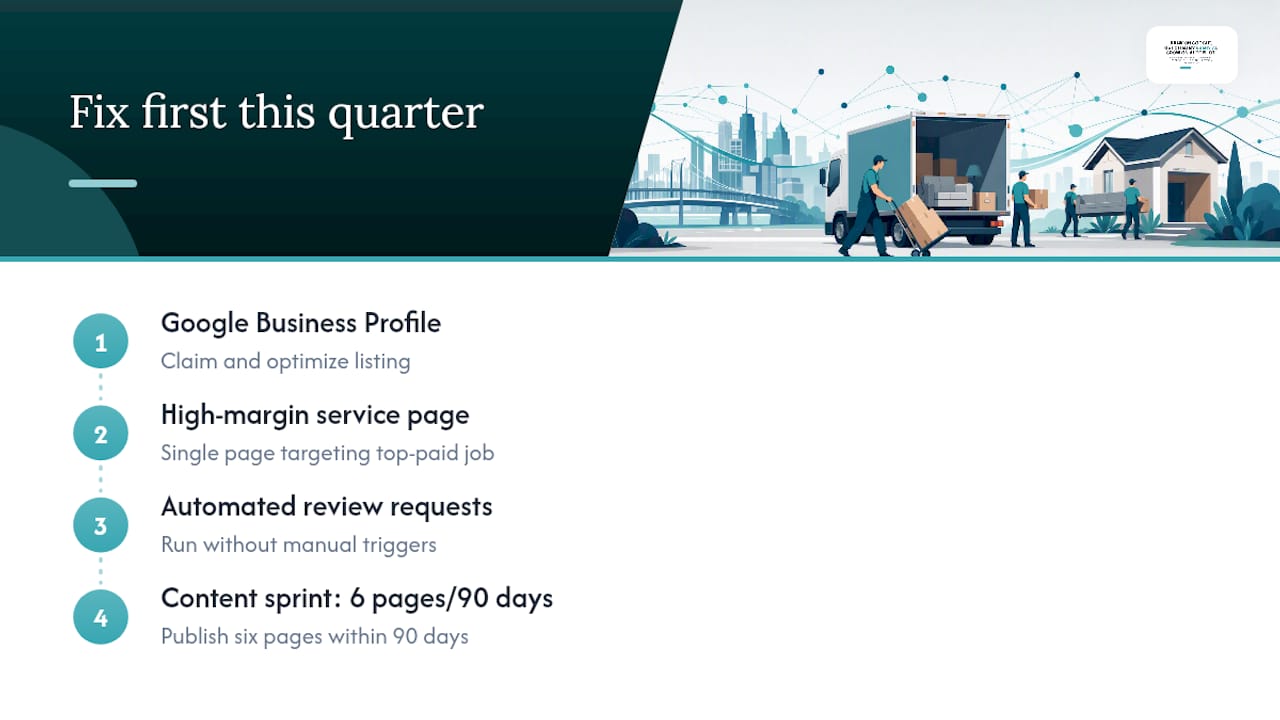
If you only fix four things this quarter, fix these: your Google Business Profile, one service page built around your highest-margin job type, a review-request system that runs without you remembering to trigger it, and a content sprint of at least six pages in 90 days. Everything else is optimization on top of a foundation that either exists or doesn’t.
Hiring in-house makes sense once you’re generating enough job volume to justify a dedicated marketer. Below that threshold, outsourcing usually wins, but watch for agencies that can’t explain their content cadence or won’t show you a keyword matrix tied to revenue per job. If they can’t answer “why this page, why now,” that’s a red flag.
One more thing: if you run interstate moves, your USDOT and MC numbers belong on every page that mentions long-distance service, not buried on a single compliance page nobody reads.
— Cole
Get Your Moving Company’s Free AI Visibility Audit
Most moving companies patch together a content writer, a link-building service, a technical auditor, and separate tools just to see where they stand with AI search. Trystellor replaces that whole stack for $199 a month.

You get 30 GEO and SEO-optimized articles published to your site every month, covering exactly the service and location pages this guide walks through. A 4,000-site backlink network builds the authority signals your citations and outreach work is chasing. Weekly technical audits catch the Core Web Vitals and schema issues before they cost you rankings, and weekly LLM visibility tracking across ChatGPT, Claude, Perplexity, and Gemini shows you whether AI tools are recommending your business or a competitor down the street.
Start a 3-day free trial, no card required, and get a free AI Visibility Audit within 48 hours on the Stellor product page.
Where to Go Next for Moving Company SEO
For technical grounding, Google Search Central’s mobile-friendly guidelines and schema.org’s LocalBusiness documentation are the primary sources worth bookmarking. BrightLocal’s research on review velocity is worth revisiting every time you update your review workflow.
Inside Trystellor’s own library, the Google Business Profile guide breaks down every field mentioned above in more depth, while the plumber local ranking guide and roofer lead generation guide show the same playbook applied to other appointment-based service businesses. For automated follow-up specifics, this CRM workflow guide covers the mechanics in more detail.
Sources
- 10 Moving Company Marketing Strategies That Actually Work | SmartMoving
- SEO for Moving Companies: The Complete Step-by-Step Guide | VirtualEstimate
FAQ
How Long Does Moving Company SEO Take to Work?
Expect map-pack movement within 2 to 4 weeks of a full Google Business Profile optimization, measurable ranking gains within 60 to 90 days, and compounding organic growth between 6 and 18 months.
What’s the Fastest SEO Win for a New Moving Company?
Completing your Google Business Profile, including categories, services, photos, and your USDOT/MC number, is the single fastest lever, since a fully optimized profile can drive 30 to 50 percent of inbound leads in competitive metros.
How Many Reviews Should a Moving Company Get Per Month?
Aim for 8 to 10 new reviews per month in mid-size markets and 15 or more in major metros, since review velocity matters more for local-pack ranking than your total review count.
Should Movers Use Paid Ads or SEO?
Both, at different stages: Local Services Ads deliver immediate lead volume while your organic rankings build, and SEO becomes the lower-cost channel once your pages and profile mature.
Do I Need Separate Pages for Every Suburb I Serve?
Only if you can write genuinely unique local content for that suburb; otherwise fold it into your main city page, since duplicated templates with swapped city names tend to suppress rankings rather than help them.
Can Trystellor Help a Moving Company With SEO and AI Visibility?
Yes. Trystellor publishes 30 GEO and SEO-optimized articles monthly, manages a 4,000-site backlink network, runs weekly technical audits, and tracks your visibility across ChatGPT, Claude, Perplexity, and Gemini for $199 a month.