

Long-form content still drives rankings, topical authority, and AI citations, but only when it matches search intent and is structured for both readers and language models. The gains are concrete: more long-tail keyword rankings, a higher chance of getting quoted in an AI Overview or a ChatGPT answer, and stronger backlink potential than a thin 600-word post can ever generate. The rest of this guide shows you how to plan, structure, and promote long-form content that earns both, including how Trystellor builds this into a repeatable production system.
TL;DR:
- Long-form content should be tailored to search intent and topic complexity, typically exceeding 1,500 words when necessary to cover subtopics thoroughly.
- Depth and structure are key for ranking in both SEO and AI, with well-organized paragraphs, strategic internal links, and clear signals increasing the chance of citation by AI models.
- Using formats like pillar guides, original research, detailed how-to guides, case studies, and structured video transcripts maximizes backlinks and AI visibility.
- Effective planning involves creating a cluster map, citing original data sources, and applying schema markup to improve search and AI indexing.
- Ongoing promotion, regular updates, and tracking key metrics like traffic, rankings, AI citations, and backlinks are essential for maintaining long-form content performance.
Table of Contents
- What Is Long-Form Content and When Should You Choose It?
- Why Long-Form Content Ranks: The SEO and AI Mechanics
- Long-Form Formats and Real Examples That Rank
- How to Plan and Outline a Long-Form Article
- Writing and On-Page Optimization Checklist for Google and AI
- Promotion and Citation Strategy: Earning Backlinks and AI Visibility
- How to Measure, Maintain, and Refresh Long-Form Content
- How Stellor Puts Long-Form and AI Visibility Into Practice
- Author Perspective: Trade-Offs, Timelines, and Realistic ROI
- How Trystellor Scales Long-Form Production Without Five Vendors
- Sources
- FAQ
What Is Long-Form Content and When Should You Choose It?
Long-form content typically runs 1,500 words or more, though the real threshold depends on what the topic demands, not a number you copy from a competitor’s post. Yoast is direct about this: word count itself is not a ranking factor. What matters is whether the page has enough depth to cover a topic completely, support internal links, and read clearly. A 3,000-word article padded with restated points ranks worse than a tight 1,200-word piece that actually answers the question.
The real decision variable is search intent, not length. A query like “what is schema markup” might need 800 words and a clear definition. A query like “how to build an SEO content strategy” needs cluster mapping, examples, and a workflow, which naturally runs longer. Match the length to how many subtopics a reader genuinely needs resolved before they can act.
Topic complexity is the second variable. Some subjects have a handful of moving parts. Others, like technical SEO audits or AI visibility tracking, have a dozen interdependent factors that shortchange the reader if you compress them into a listicle.
Long-form works especially well for:
- Pillar guides that need to rank for a broad head term plus dozens of related long-tail queries
- Comparison content where readers are weighing multiple options and need every angle covered
- How-to guides with sequential steps, each requiring context, caveats, or troubleshooting
- Research or data-backed reports where the value comes from original analysis, not opinion
- Case studies that need enough narrative and evidence to be credible
Short-form still wins for straightforward definitional queries, product pages, and anything where the reader wants a fast answer and an exit. The mistake most teams make is applying one length standard to every page on the site instead of letting intent decide.
Why Long-Form Content Ranks: The SEO and AI Mechanics
Long-form content ranks for more reasons than “Google likes long pages.” It works because depth lets one page capture dozens of related queries instead of one. A 2,500-word guide on content strategy can rank for the head term plus twenty or thirty variations, from “content cluster mapping” to “how often should you refresh a blog post,” because it naturally contains the vocabulary and subtopics those searches target.
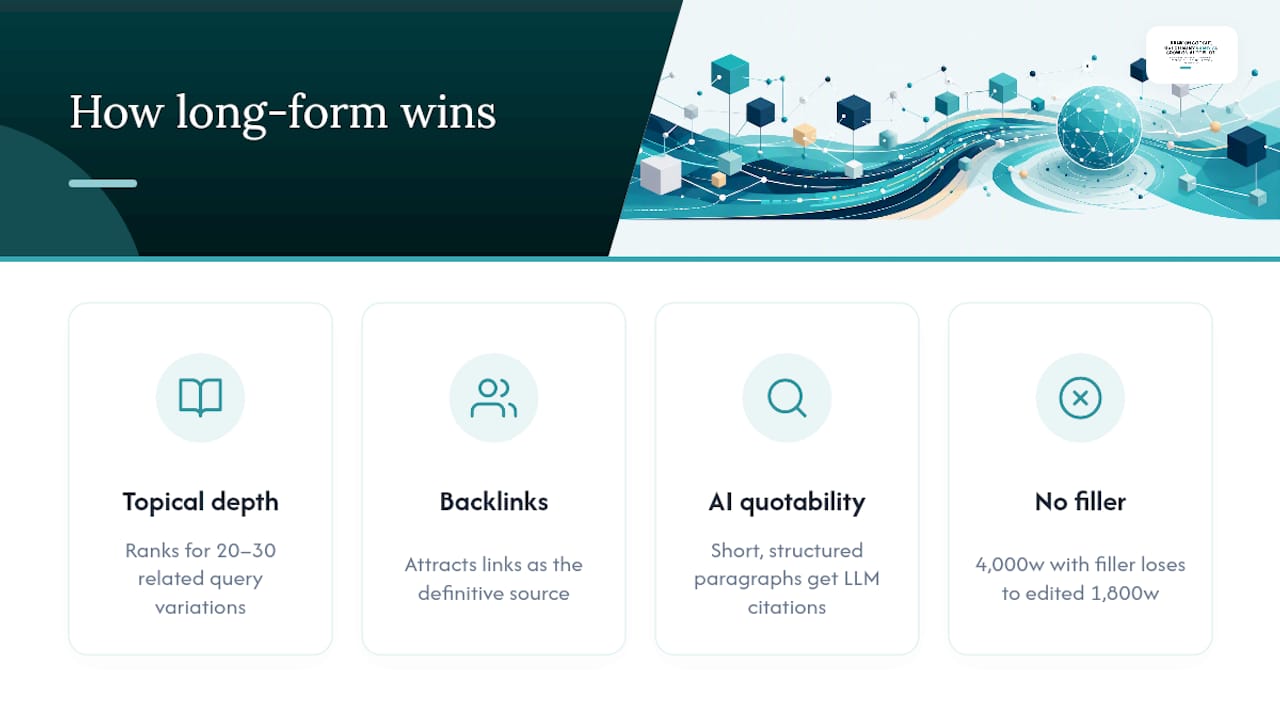
Backlinks follow the same logic. Writers, journalists, and other bloggers link to pages that answer a question completely, because citing a shallow post makes their own work look thin by association. A comprehensive SEO content strategy framework attracts links from smaller posts referencing it as the definitive source, and those links compound the ranking advantage over months, not days.
The AI side works differently but rewards the same instinct toward depth. Search Engine Land’s guide to long-form content notes that ranking in AI Overviews and getting cited by ChatGPT or Perplexity requires structure, topical depth, and demonstrated experience and expertise, often shortened to E-E-A-T. AI systems do not read your whole page and summarize it holistically. They extract specific passages that answer a specific sub-question cleanly, then attribute the source.
That means quotability matters as much as comprehensiveness. A paragraph that states a clear claim in two or three sentences, backed by a specific figure or example, is far easier for a model to lift and cite than a meandering paragraph that buries the point in in the fourth clause. Structured, short paragraphs with clear semantic signals meaningfully increase the odds an LLM excerpts that exact passage when answering a buyer’s prompt.
By the numbers: Search Engine Journal’s analysis of blog post length found that long-form pieces tend to outperform shorter ones for informational queries specifically when the added length serves the reader’s intent rather than existing for its own sake.
None of this is a license to pad. A 4,000-word article stuffed with repeated framing and filler transitions will rank worse than a well-edited 1,800-word version of the same piece, because dwell time drops and bounce rate climbs the moment readers sense they’re wading through filler to find the answer. Depth has to be earned paragraph by paragraph, not manufactured by inflating the word count.
Long-Form Formats and Real Examples That Rank
Five formats consistently outperform for long-form SEO, and each one fits a different business goal.
- The pillar guide. A comprehensive resource covering every major subtopic of a broad theme, built to rank for a head term and dozens of related long-tail variants. The success factor is internal linking: a strong pillar page links out to a dozen supporting articles and pulls topical authority back in return.
- The original research or data report. A piece built around a survey, an analysis of proprietary data, or an aggregation of public statistics presented in a new way. These attract backlinks almost automatically because journalists and bloggers need a primary source to cite, and there are only so many original data sets in any niche.
- The ultimate how-to guide. A sequential, step-by-step resource that solves a complete process rather than a single task, like planning and outlining a long-form article from keyword research through publication. The success factor is completeness. Readers should never need to leave the page to finish the task.
- The case study. A narrative built around a specific, credible outcome with enough detail (timeline, method, obstacles) to be defensible rather than promotional. The success factor is specificity. Vague claims kill trust; exact numbers and named tools build it.
- The long-form video transcript or hub. A written companion to a video or webinar, formatted with timestamps and headers so search engines and AI systems can index the spoken content as text. The success factor is structure: breaking a 40-minute transcript into scannable sections rather than one wall of text.
Choose the format based on what you’re actually trying to accomplish. If the goal is brand authority and backlinks, original research usually wins. If the goal is capturing bottom-of-funnel search traffic, the ultimate how-to guide converts better because it meets readers exactly where they’re stuck. Service businesses often see the fastest returns from location-specific how-to content, similar to the structure used in a local ranking guide for plumbers, where depth and specificity do double duty for both organic rank and AI citation.
How to Plan and Outline a Long-Form Article
Every high-performing long-form piece starts with a cluster map, not a blank document. Pull three to six related queries around your target keyword using whatever keyword tool you already run, then assign each one to a specific H2 or H3 section rather than trying to cram them all into the intro. This is the single biggest difference between an article that ranks for one term and an article that ranks for thirty.
Before drafting, run through a short research checklist:
- Identify at least one primary or original data source you can cite directly, not a secondhand summary of someone else’s summary
- Pull a handful of concrete numbers, named tools, or named frameworks that give the piece specificity instead of generic advice
- Note where a direct quote from a credible source would strengthen a section, and confirm the source is real and citable
- Flag any claim that needs a caveat (a legal threshold, a health claim, a “results vary” disclosure) so it doesn’t get lost during drafting
Internal linking deserves its own planning pass, separate from the outline. Build a hub-and-spoke structure where the long-form pillar links out to narrower supporting articles, and each of those articles links back up to the pillar with consistent anchor text. Internal linking hub structures work because they distribute topical authority across the cluster instead of concentrating it on one orphaned page, and they give Google and AI crawlers a clear map of how your content relates. Assign descriptive anchor IDs to major sections in the HTML itself. Fragment links that jump straight to a relevant H2 improve the odds of a Google sitelink and make it easier for an AI system to point a user directly at the section that answers their question.
Pro Tip: Write each H2’s opening two to three sentences as a self-contained claim that could stand alone as an answer, then follow it with supporting bullets or an example. That structure is what makes a section easy for an AI model to extract and quote.
The editorial workflow itself should follow four fixed stages: draft, review, publish, promote. Draft against the cluster outline without stopping to polish sentences. Review for factual accuracy, internal link placement, and whether each section actually answers its assigned query. Publish with full schema and alt text in place, not as a follow-up task. Promote immediately, because a pillar page with zero backlinks and zero community mentions will sit invisible to both Google and AI crawlers no matter how well it’s written. Teams managing this at scale often lean on a repository of GEO and SEO articles to study cluster structure before building their own.
Writing and On-Page Optimization Checklist for Google and AI
Once the outline is set, on-page execution is what determines whether the piece actually performs. Start with the title tag: keep your primary keyword near the front, and make sure the first 100 words of the article state the core answer plainly, because both Google’s snippet algorithm and most AI crawlers weight the opening heavily when deciding what a page is about.
Heading hierarchy matters more than most writers treat it. Use H2 for major sections and H3 for subsections headings only, never skipping a level, and phrase headings as the actual questions readers are typing into search bars where it reads naturally. Google’s own documentation on how heading tags work confirms that clear, consistent heading structure helps automated systems parse page content and identify the topic of each section.
Schema markup should be non-negotiable for long-form assets. Article schema establishes authorship and publish date. FAQ schema, applied to a genuine FAQ section, increases eligibility for rich results. HowTo schema fits sequential guides. The Schema covers the full vocabulary, and applying it correctly is one of the fastest ways to make a page more legible to both Googlebot and AI crawlers.
Image and media optimization is easy to skip and costly to skip. Every image needs descriptive alt text that states what the image shows, not a keyword-stuffed phrase. Captions should add context the image alone doesn’t convey, since captions get indexed and occasionally surface in AI summaries when a visual explains a concept the surrounding text only gestures at.
| Optimization element | Guideline | Why it matters |
|---|---|---|
| Title tag | Primary keyword near the front, concise length | Improves click-through and topic clarity for crawlers |
| First 100 words | State the direct answer or claim | Snippet and AI-citation systems weight the opening heavily |
| Heading hierarchy | H2 for sections, H3 for subsections, phrased as questions | Improves scannability and machine parsing |
| Keyword density | Natural placement, roughly 1 to 2 percent | Avoids stuffing penalties while signaling topic relevance |
| Alt text | Descriptive, not keyword-stuffed | Supports accessibility and image search visibility |
Keyword density is worth demystifying: there’s no magic percentage, but staying in the 1 to 2 percent range while using synonyms and related phrases naturally keeps the writing readable and avoids the stuffing patterns that both Google’s spam systems and human readers notice instantly.
Promotion and Citation Strategy: Earning Backlinks and AI Visibility
Publishing a long-form piece is half the job. Without promotion, even a well-structured 3,000-word guide sits invisible to the backlink and community signals that both Google’s ranking algorithm and AI answer engines rely on to judge trust. Off-site presence, including mentions on community platforms and roundup posts, measurably improves the odds an AI engine surfaces your page when a user asks a related question.
Four tactics consistently produce results:
- Resource page outreach. Identify pages that already link out to a curated list of guides in your niche, and pitch your piece as an addition, not a replacement. These pages are actively maintained and open to new links.
- Expert roundup participation. Contribute a quoted insight to other publishers’ roundup posts. You get a backlink and a citation-worthy mention, and it costs one paragraph of your time.
- Reddit and forum participation. Answer real questions in relevant subreddits and forums without dropping a link in every comment. AI systems like ChatGPT increasingly pull from Reddit threads when generating recommendations, so a genuinely helpful comment history builds citation probability over months, even without a direct link back.
- Low-cost local promotion. For service businesses, tactics like low-cost lead generation without paid ads show how off-site community presence and local visibility compound the same way link building does for national brands.
Pro Tip: Never open a Reddit comment with your brand name or a link. Answer the actual question first. If your answer is genuinely the most useful one in the thread, people will click through to your profile or your site on their own.
Prioritize outreach by asking which type of page tends to send the most durable traffic: resource pages rarely get taken down, roundups age faster, and forum threads can rank for years if the original question stays evergreen. Track results with a mix of standard backlink monitoring and prompt-based AI visibility checks that log which of your target queries actually surface your brand in ChatGPT, Claude, Perplexity, or Gemini responses over time, similar to the approach covered in using AI to boost local service visibility.

How to Measure, Maintain, and Refresh Long-Form Content
Long-form assets are not “publish and forget” pages. They need a maintenance cadence or they decay, and decay on a pillar page drags down every cluster article linked to it. Track five KPIs on a monthly basis:
- Organic traffic trend for the page itself and for the cluster of supporting articles linked to it
- SERP spread, meaning how many distinct queries the page ranks for, not just its primary target keyword
- Ranking position for the two or three highest-value cluster terms specifically
- AI citation instances, tracked by testing your target prompts against ChatGPT, Claude, Perplexity, and Gemini directly
- Backlink growth, measured as new referring domains gained per month, not raw link count
Run a full audit on priority pillar pages quarterly. Pull Search Console data to spot queries where the page ranks on page two, since those are your fastest wins: a small content edit can push a page eight to twelve spot up rather than requiring a full rebuild. Cross-reference backlink reports to see whether link velocity has stalled, which often signals the piece needs fresh data or a new angle to stay citation-worthy.
Sometimes the right move is not a refresh but a structural change. If a single long-form page has grown too broad and is now competing against its own subtopics for rankings, split it into a pillar plus dedicated cluster articles. If several thin articles cover overlapping ground and cannibalize each other’s rankings, merge them into one authoritative piece instead. And if a page has aged past usefulness with no realistic recovery, prune it and redirect the URL rather than letting it sit as dead weight on the site’s crawl budget.
How Stellor Puts Long-Form and AI Visibility Into Practice
Everything in this guide describes a manual process. Stellor runs the same process as an automated system, publishing 30 GEO- and SEO-optimized articles every month, each mapped to a specific cluster of buyer queries the way the planning section above recommends.
The production model maps directly onto the checklist you just read:
- Weekly technical audits catch missing schema, broken internal links, and llms.txt gaps automatically, the exact machine-readability fixes covered in the optimization section
- A 4,000-site backlink network replaces the manual resource-page outreach most teams struggle to sustain month over month
- Daily Reddit opportunity surfacing flags high-intent threads in real time, so community participation happens without a team member manually scanning subreddits
- LLM visibility tracking queries ChatGPT, Claude, Perplexity, and Gemini weekly against the customer’s actual buyer prompts, turning AI citation from a guess into a tracked metric with a clear baseline and trend line
For a home services business publishing thirty long-form pages a month, the compounding effect shows up in both surfaces at once: rising rankings for cluster terms on Google, and rising citation frequency in AI answers for the same query set, the exact dual outcome outlined throughout this guide as the point of doing long-form well in the first place.
Author Perspective: Trade-Offs, Timelines, and Realistic ROI
Long-form content is not cheap, and it is not fast. A properly researched pillar guide takes real hours to plan, draft, and edit, and most teams underestimate how much of that time goes into research and internal linking rather than writing sentences. First-page rankings for a competitive term typically take three to six months, even with strong execution, and AI citation often lags behind organic rank because crawlers need to encounter and re-index the page multiple times before a model starts referencing it consistently.
For teams with limited resources, prioritize by commercial intent, not by what’s easiest to write. One well-researched pillar guide targeting a query your buyers actually type beats five shallow posts covering adjacent topics nobody searches for. Expect early wins in long-tail rankings within four to eight weeks; save the vanity metric of ranking for your head term for the six-month mark. Track AI citation instances as a leading indicator of authority building, even before rankings catch up, because a model quoting your page is often the earliest signal that your content is being read as a trustworthy source rather than just another result in the pack.
— Cole
How Trystellor Scales Long-Form Production Without Five Vendors
Everything this guide walks through, keyword clustering, internal linking, schema, backlink outreach, Reddit engagement, and AI citation tracking, normally requires a content agency, a link-building service, a technical auditor, and a separate AI monitoring tool. Trystellor is the alternative to running all four separately: one $199-per-month subscription replaces that whole stack, publishing 30 fully optimized long-form articles monthly while running the backlink outreach, technical audits, and LLM tracking in the background.
The direct payoff for teams following this guide is speed to first AI citation. Because every article ships with schema, internal links, and machine-readable passages already in place, and because the 4,000-site backlink network starts building authority signals from week one, customers typically see their first citation in ChatGPT or Perplexity responses well before the six-month mark most manual long-form strategies require. If you want to see what that looks like for your own site, start the 3-day free trial, no card required, and get a full AI Visibility Audit within 48 hours.
Sources
- Word count and SEO: how long should an article or page be? • Yoast
- What Is Long-Form Content? How to Make It Rank in SEO — Search Engine Land
- What’s the ideal blog post length for SEO? • Search Engine Journal
- How to Create a Winning SEO Content Strategy • SEOClarity
FAQ
What Are Examples of Long-Form Content?
Common examples include pillar guides, original research reports, ultimate how-to guides, case studies, and long-form video transcripts formatted with headers for readability.
What Does “Long-Form” Mean in SEO?
In SEO, long-form refers to in-depth content, typically 1,500 words or more, that covers a topic comprehensively enough to rank for a primary term plus many related long-tail queries.
Is SEO Still Worth It?
Yes. Search Engine Journal’s research shows well-executed long-form content still outperforms thin pages for informational queries, and tools like Trystellor’s LLM tracking confirm the same content now drives AI citations too.
Is SEO Dead Because of AI?
No. AI answer engines still crawl and cite the open web, meaning traditional SEO fundamentals, structure, depth, and authority, now double as the requirements for AI visibility rather than being replaced by it.