
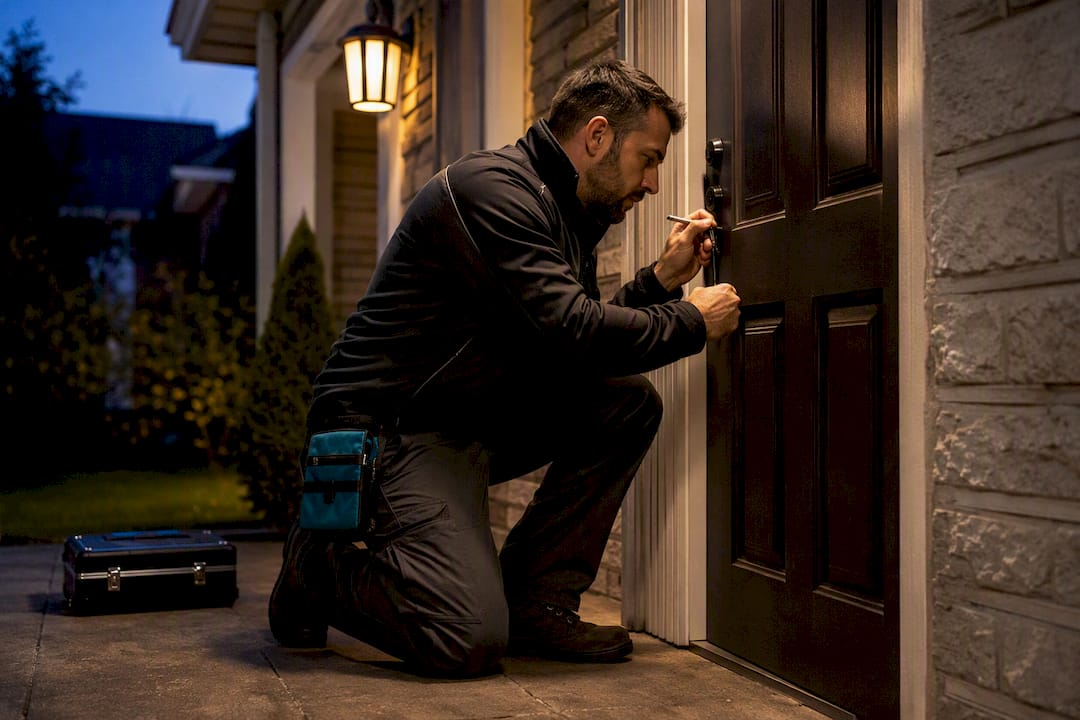
Complete and fully optimize your Google Business Profile, then apply for Local Services Ads and Google Screened verification if you’re eligible. Publish a real pricing page with click-to-call visible on mobile without scrolling. Set up call tracking now, before you spend another dollar on marketing, so you know which channel actually produces paying jobs instead of tire-kickers and scam calls.
TL;DR:
- Local Services Ads provide immediate leads and appear above organic results, but require a verified Google Business Profile and background check that takes one to two weeks.
- Building a complete Google Business Profile with real photos, explicit pricing, and responsive review management significantly boosts trust and local rankings, especially in emergency locksmith searches.
- Website pages should target specific services with clear titles, visible click-to-call buttons, pricing ranges, local proof, and schema markup to enhance conversions and local SEO.
- Monitoring weekly metrics such as booked calls, lead-to-job conversion, review velocity, and AI visibility helps identify opportunities to improve rankings and trust signals across multiple engines.
- Managed platforms like Stellor can streamline content, backlinks, technical audits, and AI tracking, making scaling multiple locations more efficient beyond basic in-house efforts.
Table of Contents
- What Makes Locksmith SEO Different From Other Local Trades?
- LSA vs. Local Pack: Where Should You Put Your Time First?
- What Belongs on Your Website: Pages, Pricing, and Schema
- Turning Reviews Into a Repeatable Lead Engine
- Building Neighborhood Pages That Don’t Read as Duplicate Content
- The Technical Checklist That Actually Moves Rankings
- Paid Ads and Fast Leads While Organic SEO Catches Up
- What to Measure Every Week (and Why AI Visibility Now Counts)
- When It’s Time to Bring in a Managed GEO + SEO Platform
- My 90-Day Priority Order for a Locksmith Owner
- Sources
- FAQ
What Makes Locksmith SEO Different From Other Local Trades?
Locksmith searches skew emergency. Someone locked out of their car at 11 p.m. isn’t reading blog posts. They’re tapping the first result that promises a fast answer and a real person, which is why Local Pack listings and Local Services Ads capture most of the clicks for “locksmith near me” searches.
That urgency creates a second problem most trades don’t face: locksmithing has a well-documented scam pattern, where fake listings quote a low price on the phone and then demand cash after breaking a lock. Google knows this. That’s why verified address, listed pricing, and Google Screened status carry more ranking and trust weight here than in plumbing or landscaping SEO.
The practical takeaway is a two-track strategy:
- Emergency searches (right now, tonight, locked out) get won by LSA and the Local Pack.
- Planned searches (rekey a house next month, install smart locks, commercial master key systems) get won by strong service pages that rank organically over weeks and months.
Both tracks matter. Most locksmith owners over-invest in one and ignore the other.
LSA vs. Local Pack: Where Should You Put Your Time First?
If you’re choosing where to spend the next two weeks, start with Local Services Ads. LSA listings sit above organic results and even above paid search ads, and once Google Screened approves you, leads start arriving immediately. Organic local SEO takes weeks to months to build the same visibility, so LSA buys you time while your Google Business Profile and website catch up.
Here’s how the two compare on the factors that matter for a locksmith:
| Factor | Local Services Ads | Local Pack (organic GBP) |
|---|---|---|
| Position on page | Top, above ads and organic | Below ads, above organic links |
| Cost model | Pay per lead | Free, but requires ongoing upkeep |
| Time to results | Days, once verified | Weeks to months |
| Primary trust signal | Google Screened badge | Review count and rating |
LSA onboarding, step by step:
- Set up your Google Business Profile first. Google Screened checks pull from it.
- Submit business license, insurance proof, and owner background check documents.
- Expect the background check to take one to two weeks depending on your state.
- Set a weekly budget cap and target service categories precisely (don’t bundle “locksmith” with unrelated trades).
- Once approved, monitor lead quality daily for the first two weeks and adjust.
While that’s processing, get your Google Business Profile to 100%: primary category set to “Locksmith,” every service listed, a verified physical address, emergency hours stated explicitly, 20 or more real job photos, price ranges published, and a plan to respond to every review within 24 hours. Locksmith guides consistently rank claiming and populating GBP as the single highest-leverage move a locksmith can make, ahead of paid ads or link building.
What Belongs on Your Website: Pages, Pricing, and Schema
Your website’s job is to catch planned searches and back up what LSA and GBP promise. That means specific pages, not one generic “services” page trying to rank for everything.
Pages to publish, in priority order:
- Emergency lockout (home, auto, business as separate sections or pages)
- Car key replacement and transponder key programming
- Lock rekey
- Smart lock installation
- Commercial locksmith and master key systems
- City or neighborhood pages for each service area you actually cover
Each page needs the target phrase in the title and H1, a click-to-call button visible without scrolling on mobile, real job photos (not stock images of generic keys), a defensible price range instead of “call for quote,” and an FAQ section marked up with FAQ schema. Add LocalBusiness and Service schema so both Google and AI answer engines like ChatGPT and Perplexity can parse exactly what you do and where. Structured data guidance for LocalBusiness types is documented on Schema if you want to check your markup against the official spec.
Publishing a price range does something most locksmiths underestimate: it filters out the fraud-adjacent searchers hunting for a business they can bait-and-switch, while giving legitimate customers the confidence to call instead of bouncing to a competitor with visible pricing. A checklist for locksmith websites built around exactly this structure, dedicated service pages, city-targeted titles, above-the-fold calling, and posted price ranges, consistently outperforms generic one-page sites in conversion, not just rankings.
Pro Tip: Price ranges scare fewer customers than vague pricing does. “Standard residential rekey: $80 to $150” reads as honest. “Contact us for pricing” reads as a red flag to anyone who has read a locksmith scam story.
Turning Reviews Into a Repeatable Lead Engine
Reviews decide whether your GBP listing or your competitor’s gets the call, and locksmiths who text customers a direct review link right after the job get meaningfully higher response rates than businesses that ask in person or wait for a follow-up email days later.
Build this into your close-out routine:
- Send the review request by text within one hour of job completion, while the relief of getting back into their house or car is still fresh.
- Keep the message short: “Glad we could help tonight! If you have 30 seconds, a review helps other neighbors find us: [link].”
- Respond to every review, good or bad, within 24 hours.
- For a negative review, acknowledge the specific issue publicly in one or two sentences, then move resolution to a phone call or email. Never argue in the review thread.
- Pull your best reviews onto your website’s homepage and service pages, and keep your profile consistent across Yelp, Angi, and the Better Business Bureau.
This isn’t a one-time push. Review velocity, meaning a steady trickle of new reviews rather than a burst of 20 in one week, signals to Google that you’re an active, trustworthy business rather than one that bought a review campaign.
Building Neighborhood Pages That Don’t Read as Duplicate Content
A per-city page earns its place only when you serve that city often enough to fill it with real detail. If you cover a metro area but only get occasional calls from its outer suburbs, a single service-area paragraph naming those towns does the job without diluting your site with thin pages.
When you do build a dedicated page, prove locality instead of just claiming it:
- Include job photos with timestamps from actual work in that neighborhood.
- Reference real landmarks or neighborhoods residents recognize, not generic city-wide language.
- Write a short, unique FAQ addressing something specific to that area, like common lock brands in older housing stock or HOA gate access issues.
- Link each neighborhood page back to the relevant core service page, and link core service pages out to two or three neighborhood pages, rather than duplicating full service descriptions on every city page.
Neighborhood pages with unique local proof consistently outrank thin duplicate city pages that just swap the city name in a templated paragraph. That internal linking structure is also what tools like SEO strategies for local services recommend for connecting a growing page library without triggering duplicate content flags.
The Technical Checklist That Actually Moves Rankings
Most technical SEO advice doesn’t apply evenly to every industry. For locksmiths, three things matter more than the rest combined.
- Mobile speed and layout. Your call button needs to be visible without scrolling on a phone screen, and your site should load fast enough that a frantic customer standing outside their car doesn’t bail. Google’s own Core Web Vitals guidance sets the bar most local sites should hit.
- Schema markup. Implement LocalBusiness schema, a more specific service type where relevant, and FAQ schema on every service page. This is what helps AI answer engines cite you correctly when someone asks for a locksmith recommendation.
- Call tracking. Assign a unique tracking number to each channel, LSA, Google Ads, organic, and website direct, and route every call into your CRM so you can see cost and volume by source.
Run this audit checklist monthly. Sites that fix flagged technical issues within the first month of an audit tend to see local ranking improvements faster than sites that let issues sit for a quarter.
Paid Ads and Fast Leads While Organic SEO Catches Up
Organic rankings take time to build, so lean on paid channels to fill the gap. LSA and Google Search Ads both work, but they behave differently: LSA often costs less per qualified lead than standard search ads and converts faster on emergency keywords, while Search Ads give you more control over exact match phrases and landing pages.
- Run call-only campaigns for high-intent phrases like “locksmith open now” or “car locked out.”
- Add negative keywords for “DIY,” “how to,” and “jobs” to cut wasted spend from non-buyers.
- Record calls and use a screening script that confirms the customer’s location and issue before dispatch, which weeds out prank calls and scam-adjacent inquiries.
- Feed every paid lead into the same call tracking and CRM setup you use for organic and LSA, so you can compare true cost per booked job across channels.
What to Measure Every Week (and Why AI Visibility Now Counts)
Track five numbers weekly: booked calls by source, lead-to-job conversion rate, LSA lead volume, whether you’re appearing in the Local Pack for your top three terms, and review velocity. Add cost-per-lead for any paid channel you’re running.
- Booked calls by source (LSA, GBP, organic, paid ads, referral)
- Lead-to-job conversion rate
- LSA lead volume and cost, tracked separately from search ads since quality and cost-per-lead differ between the two
- Local Pack presence for your top service and city terms
- Review velocity and average response time
One newer metric belongs on that list now: AI visibility. Ask ChatGPT, Perplexity, and Gemini “best emergency locksmith near [your city]” once a week and note whether you’re mentioned and who is cited instead. This overlaps with emergency service SEO fundamentals, since the same trust signals, verified address, transparent pricing, review volume, that win the Local Pack also tend to get quoted by AI answer engines.
Pro Tip: Keep a running spreadsheet of your AI query results. A one-time check tells you nothing. A four-week trend tells you whether your trust signals are actually working.
When It’s Time to Bring in a Managed GEO + SEO Platform
Handling GBP, LSA, review requests, service pages, and technical audits yourself works fine for a single-truck operation with one owner wearing every hat. It stops working once you add a second location, take on commercial contracts that demand steady content, or simply run out of hours in the week to keep every listing and page current.
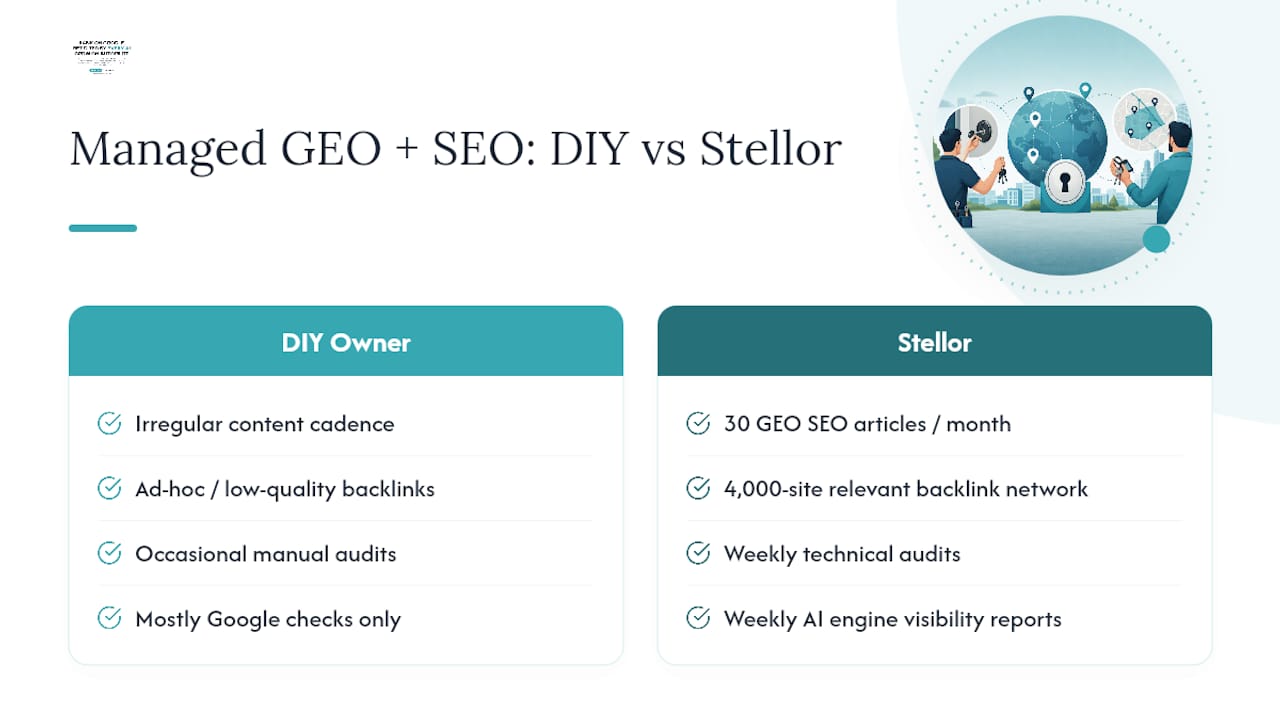
At that point, look for a platform that covers four things: a consistent content cadence targeting your services and cities, a backlink network built from real, relevant sites rather than link farms, recurring technical audits that catch schema and speed issues before they cost you rankings, and visibility tracking across AI answer engines, not just Google.
Stellor was built around exactly that gap. It replaces the five separate tools a growing locksmith business would otherwise need, content, backlinks, technical audits, community engagement, and AI tracking, with one $199 per month subscription that publishes 30 GEO and SEO-optimized articles monthly, taps 4,000-site backlink network, runs weekly technical audits, and reports weekly on how you show up across ChatGPT, Claude, Perplexity, and Gemini. Ask any vendor you’re evaluating for specific deliverables and a timeline. A three-day free trial with no card required is a reasonable way to see what a 90-day plan should actually look like before you commit.
My 90-Day Priority Order for a Locksmith Owner
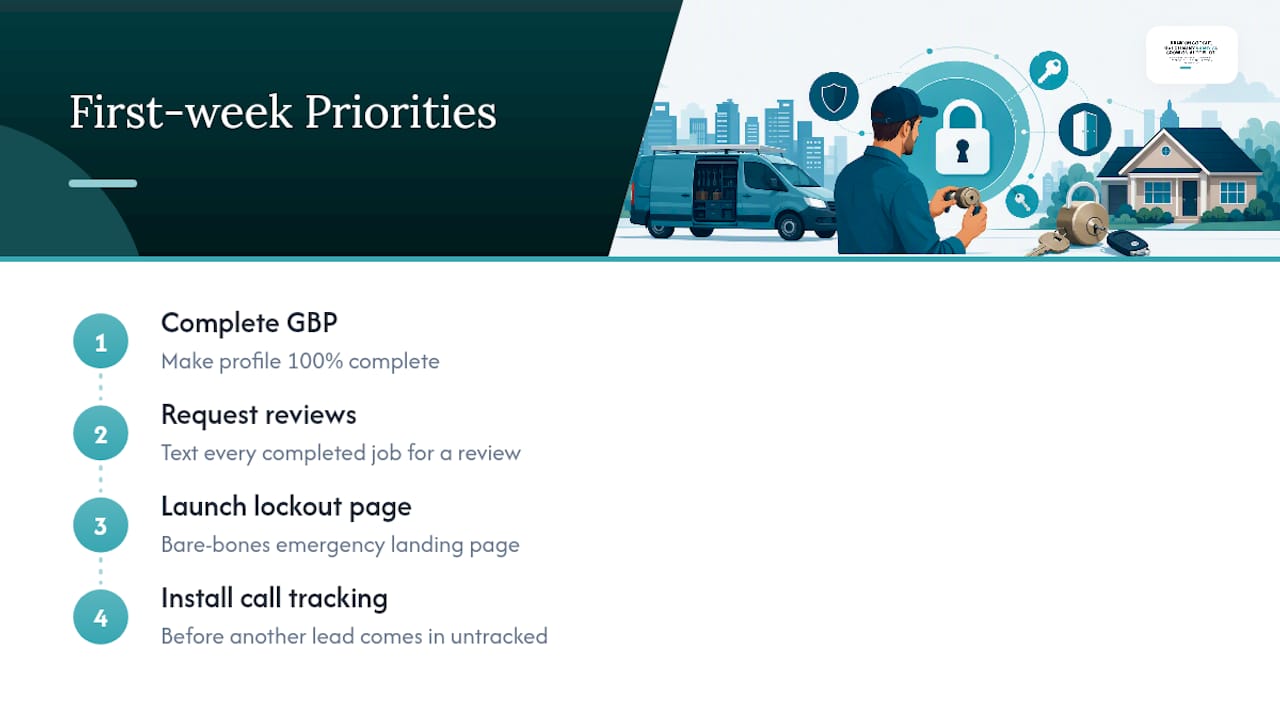
If I were running this for one location starting today, I’d sequence it tight. Days 0 through 7: get GBP to 100% complete, start texting every completed job for a review, launch a bare-bones emergency lockout landing page, and install call tracking before another lead comes in untracked.
Weeks 2 through 8: submit LSA and Google Screened paperwork, publish your core service pages (rekey, car keys, smart locks, commercial), and get a real pricing page live. Start one or two neighborhood pages only where you already have enough job history to make them credible.
Month 2 through 3: fix whatever your technical audit flags, ramp up content cadence toward planned-search keywords, and start reviewing your weekly numbers, call volume, conversion rate, review velocity, closely enough to adjust before a slow month becomes a slow quarter.
— Cole
Sources
- Marketing for Locksmiths in the USA (2026) · Made For Builders
- Locksmith Marketing: Definitive Lead Generation Guide
- Locksmith Marketing: 21 Ways & Ideas to Get More Leads 2024 · ServiceTitan
FAQ
How Much Does It Cost to Hire an SEO Expert for a Locksmith Business?
Costs vary widely by scope, from a few hundred dollars a month for basic GBP management to several thousand for full content, backlinks, and technical audits combined. Some managed platforms consolidate that work into a single subscription instead of paying separate vendors for each piece.
Is Locksmithing a Good Side Hustle?
Locksmithing can work as a side hustle in areas with steady emergency demand, but state licensing and insurance requirements vary, and Google Screened verification for LSA typically expects an established, verifiable business rather than a part-time operation.
What Are the Top SEO Tools for a Locksmith Business?
For a locksmith owner managing this in-house, a practical stack includes Google Business Profile for local listings, Google Search Console for indexing and query data, a call tracking tool tied into your CRM, and a schema markup validator to check your LocalBusiness structured data. Businesses that want the content, backlinks, audits, and AI visibility tracking handled automatically instead of stitched together from separate tools typically move to a unified platform like Stellor.
Should I Focus on LSA or Organic SEO First?
Start with Local Services Ads if you can get Google Screened approved, since it produces leads within days once verified, while organic Local Pack rankings and service page traffic typically take several weeks to months to build. Run both simultaneously rather than choosing one permanently.