

Claim your Google Business Profile first, then move to Bing Places, Yelp, and BBB.org. Before you touch any of them, build one canonical business-data sheet with your exact name, address, phone number, hours, and services so every listing matches. That single document, backed by Google’s own local ranking guidance, prevents the duplicate-listing mess that confuses customers and search engines alike.
TL;DR:
- Claim your Google Business Profile first and ensure your business data sheet matches across all directories to prevent duplicate listings and confusion.
- Prioritize Google and Bing Places, use Yelp for reviews and messaging, and only list on BBB.org if accreditation aligns with your business size and client expectations.
- Verify and populate listings thoroughly, including categories, hours, photos, and service areas, and log each URL for ongoing monitoring.
- Use schema markup on your website to align with directory data, specifically employing the HomeAndConstructionBusiness type with consistent contact details.
- Regularly audit and update your listings within 48 hours of business changes and conduct full audits quarterly to maintain accuracy and performance.
Table of Contents
- 1. Which directories to claim and what each one gives you
- 2. A step-by-step workflow for claiming and verifying listings
- 3. How your website and schema reinforce your listings
- 4. KPIs and audit cadence to keep listings working
- 5. Directory accuracy is the floor, not the finish line
- 6. A managed option for GEO and directory coverage
- FAQ
- Sources
1. Which directories to claim and what each one gives you
Not every directory deserves your time. Some drive calls, some build trust, and some mostly sit there looking tidy. Here is the priority order and the reason each one earns a spot on your list.
Google Business Profile comes first, no question. It is the listing that shows up in the map pack, in local search results, and increasingly in AI Overviews. Google’s own guidance on improving local ranking points to three factors: relevance, distance, and prominence. For contractors, that means your categories and service areas matter more than how many directories you join. Fill in your services, photos, service areas, and hours, then keep review responses current.
Bing Places for Business is the secondary citation most contractors skip, which is a mistake. Microsoft’s search traffic is smaller than Google’s but not trivial, and Bing Places feeds Microsoft Copilot’s local answers too. The Bing Places dashboard asks for the same core fields: business name, address, city, state, ZIP code, and category. Larger operations managing several locations can use the Bing Places API to update listings in bulk instead of logging into each one by hand.
Yelp Business Page works differently than most contractors expect. The free claimed page gives you photo uploads, review management, direct messaging, and a Request a Quote feature that lets homeowners reach you without a phone call, according to Yelp’s own business resources. That part is organic and free. Yelp Ads is a separate, paid product that boosts visibility in search results. Treat the two as different channels: one builds citation value over time, the other buys leads right now. Mixing their results together in your head will make your marketing look more effective, or less effective, than it actually is.
BBB.org splits into two tiers that confuse a lot of business owners. A free BBB profile displays your business details, reviews, and photos. Accreditation is a separate, paid step with its own standards and fees. A profile alone adds a trust signal that shows up when homeowners research a contractor before hiring. Accreditation makes sense if your sales cycle involves larger jobs where buyers specifically look for the BBB seal, like kitchen remodels or roofing replacements. For a one-person HVAC repair business, the free profile usually covers what you need.
Trade, chamber, and licensing directories round out the list, but only the ones you can keep accurate. A few worth checking:
- Your state contractor licensing board, which often publishes a public directory and adds a government-backed trust signal.
- Your local chamber of commerce, useful for community visibility and sometimes a backlink from a .org domain.
- Industry-specific directories like Angi or Houzz, which work best for contractors who already have a steady flow of reviews to carry over.
Skip any directory you cannot update when your hours, phone number, or service area changes. An abandoned listing with stale information does more harm than no listing at all.
2. A step-by-step workflow for claiming and verifying listings
Before you create a single profile, build a canonical business-data sheet. This is the one document every listing pulls from, and it should include your legal business name, any DBA, phone number, primary website URL, hours, service areas, the two or three categories that best describe your work, a full service list, and a folder of current photos.
With that sheet ready, work through each directory in order:
- Search first. Type your business name and address into the directory’s search bar before creating anything. Old listings from a previous owner, a former office manager, or an aggregator often already exist.
- Claim, don’t duplicate. If a record exists, claim it. Creating a second listing for the same business is one of the fastest ways to confuse both customers and search engines, a mistake Google explicitly warns against.
- Pick the fewest accurate categories. Google allows service-area businesses to list up to 20 service areas within a reasonable drive time of your base, according to Google’s service-area guidance. Use that room, but only for areas you actually serve.
- Verify and populate. Complete the verification step, upload your photo set, add your full service list, and confirm your hours.
- Log the live URL. Paste the finished listing’s web address into your master sheet so you have one place to check what is live and what still needs work.
Pro Tip: Set a calendar reminder to revisit every listing within 48 hours of any business change, a new phone number, an address move, updated hours, so stale data never sits live for long.
Schedule a full audit across every listing once a quarter, even if nothing has changed. Directories update their own interfaces, categories shift, and fields you filled in last year sometimes reset.
3. How your website and schema reinforce your listings

Directory listings and your website should tell search engines and AI crawlers the same story. Schema defines a HomeAndConstructionBusiness type, a subtype of LocalBusiness built specifically for contractors, and using it turns your site’s contact details, service area, and offerings into data search engines can read directly instead of guessing at from page text.
A short checklist worth handing to whoever manages your site:
- Add
LocalBusinessorHomeAndConstructionBusinessschema with matching name, address, phone number, andserviceAreaproperties. - Confirm your website’s listed phone number and address match every directory exactly, down to abbreviations like “St.” versus “Street.”
- Add
aggregateRatingmarkup where you have enough reviews to support it honestly. - Run your markup through Google’s Rich Results Test before publishing changes live.
Schema markup is one of the few places where naming the exact property, serviceArea, telephone, aggregateRating, does real work instead of just sounding technical. For a deeper walkthrough with code samples, our LocalBusiness schema examples guide and Wexla Websites’ schema walkthrough both cover implementation in more detail.
4. KPIs and audit cadence to keep listings working
Claiming a listing is the easy part. Knowing whether it is actually producing anything takes a short, repeatable measurement habit.
Track these numbers monthly:
- Referral traffic from each directory, visible in most analytics dashboards.
- Phone calls, messages, and quote requests tied to a specific listing.
- Review count and average rating, watched for sudden drops that signal a service problem.
- The number of indexed listing URLs still live and accurate on your master sheet.
Run a quick check on any listing right after a business change, new address, new hours, a different phone line, and run a full audit across everything quarterly. Use each directory’s own dashboard where available, and lean on the Bing Places API if you manage multiple locations. Our own SEO audit checklist walks through a version of this cadence in more detail. If you run Yelp Ads, measure that paid traffic separately from organic citation value, since blending the two numbers hides which one is actually paying for itself.
5. Directory accuracy is the floor, not the finish line
Here is the part most contractors get wrong: a perfectly accurate set of directory listings will not, by itself, win you AI Overviews or a top-three map pack spot. Directories prove you exist and that your information is consistent. They do not prove to Google, or to ChatGPT, that you are the best choice for the job. That takes content that answers the questions your buyers actually ask, backlinks that signal authority, and a technical foundation that both Googlebot and AI crawlers can read cleanly.
That is the layer most solo contractors never get to, because there is only so much time in a week between jobs and admin work. A system that automates it, 30 GEO-optimized articles a month, a 4,000-site backlink network, weekly technical audits, and direct tracking of how often ChatGPT or Perplexity mention your business, closes that gap without adding it to your own task list.
— Cole
6. A managed option for GEO and directory coverage
We built Stellor to handle the layer most contractors never get around to. We publish 30 GEO and SEO-optimized articles to your site every month, support them with a 4,000-site backlink network, run weekly technical audits that check your schema and listing consistency, and track your visibility across ChatGPT, Claude, Perplexity, and Gemini every week so you know exactly where you stand.
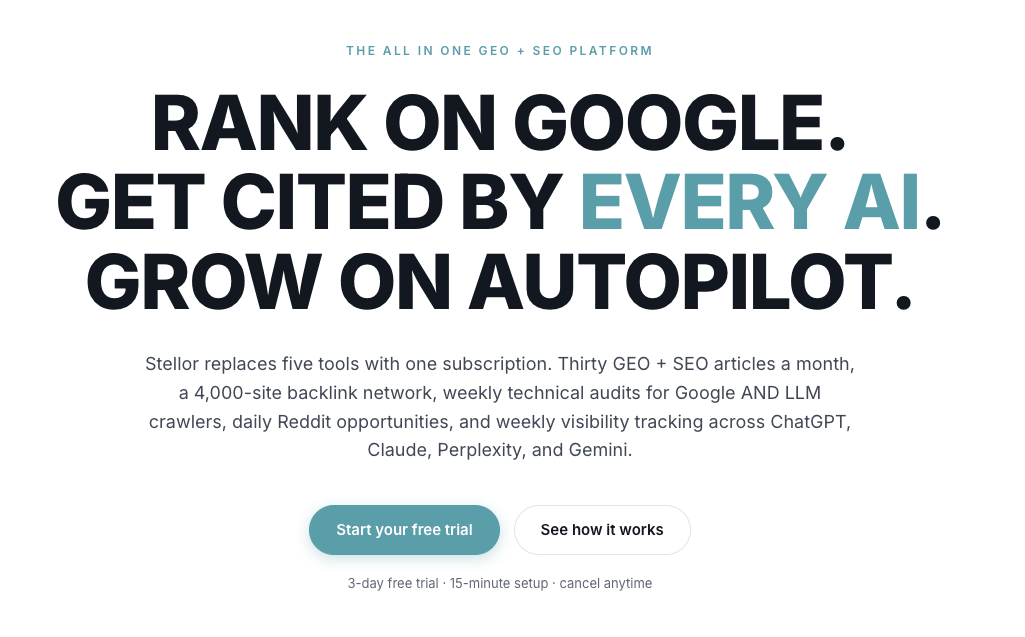
Pricing starts at $199 a month with a 3-day free trial and no credit card required. If you want to see where your business currently stands before committing to anything, start with our product page and request a free AI Visibility Audit.
- Automated GEO content: 30 articles per month tied to your services and locations.
- Backlink support: a 4,000-site network building authority over time.
- Weekly audits: schema, technical health, and AI visibility tracked every week.
FAQ
Do I need to pay for BBB accreditation?
No. A free BBB profile already displays your business details, photos, and reviews. Accreditation is a separate paid tier worth considering only if your buyers specifically look for the BBB seal before hiring.
Should I create a new Google Business Profile for each city I serve?
No. Google’s service-area guidance recommends one profile with up to 20 listed service areas rather than separate profiles per city, which Google treats as duplicates and can suspend.
Is Yelp worth it if I don’t want to pay for ads?
Yes, the free claimed page alone gives you review management, photos, messaging, and a Request a Quote feature according to Yelp’s business resources. Yelp Ads is a separate paid product you can skip entirely and still benefit from the organic listing.
What schema type should a contractor use?
Use HomeAndConstructionBusiness, a subtype of LocalBusiness defined by schema.org specifically for contractors, with matching name, address, phone, and service area properties.
How often should I audit my directory listings?
Run a quick check immediately after any business change, new phone number, address, or hours, and a full audit quarterly across every listing on your master sheet.