

A law firm SEO strategy has to do three things at once: build topical authority around your practice areas, lock down local signals so you win the map pack, and stay measurable across both Google and AI answer engines like ChatGPT and Perplexity. Firms that skip any one of those three see traffic without leads, or rankings that never show up when a prospect asks an AI for a recommendation.
Your first move should be a focused technical and content audit. Open Google Search Console to see what’s already indexed and what’s throwing errors, run your homepage and top service pages through PageSpeed Insights, and pull a local visibility snapshot from BrightLocal. From there, map your three highest-priority practice-area pages to the keywords you actually want to rank for. This is the same audit-first approach covered in Trystellor’s guide on why solo lawyers need SEO to win more clients and the broader SEO audit checklist for local service businesses.
Google’s own Search Central documentation on indexing and crawling is worth bookmarking before you touch a single page.
- Expect several months before you see meaningful ranking movement for competitive terms.
- A realistic early win: cracking the top local pack for one geography, or landing page one for a few long-tail queries within the first months.
- Your first three actions: run the audit, fix crawl blockers, and publish one pillar page tied to your top practice area.
Pro Tip: Don’t wait for the “perfect” content plan before touching technical fixes. A broken sitemap or a 4-second load time will cap your rankings no matter how good the content is.
Key Takeaways
A law firm SEO strategy succeeds when it combines topical authority for practice areas, consistent local signals, and measurable visibility across both Google and AI answer engines.
| Point | Details |
|---|---|
| Start with an audit | Run Google Search Console, PageSpeed Insights, and BrightLocal checks before writing new content. |
| Build clusters, not pages | Pillar pages supported by cluster content outperform standalone pages for practice-area authority. |
| Attorney review is non-negotiable | E-E-A-T requirements mean every YMYL legal page needs attorney-sourced credentials and review. |
| Local signals compound | GBP optimization and clean citations drive map pack rankings more than almost any other factor. |
| Expect 6 to 12 months | Meaningful ranking movement takes time; early wins show up as long-tail rankings or map pack visibility. |
| AI visibility needs its own tracking | Monitor ChatGPT, Claude, Perplexity, and Gemini citations monthly, or let Stellor track them weekly as part of its consolidated GEO + SEO platform. |
This article is general information, not a substitute for advice from a qualified lawyer. Consult a qualified legal professional about your own circumstances before acting on anything here.
Table of Contents
- Does SEO Work for Law Firms, and What Does It Actually Cover?
- How Do You Build a Keyword Map for a Law Firm?
- What Content Structure Builds Topical Authority for Practice Areas?
- What Belongs on a Technical SEO Checklist for Law Firm Sites?
- How Do You Win the Local Map Pack for Legal Searches?
- What Link Building Tactics Are Safe for Law Firms?
- Which UX Fixes Increase Contact Form and Call Conversions?
- What KPIs and Tools Actually Measure Law Firm SEO Progress
- What Should the First 90 Days of a Law Firm SEO Strategy Look Like?
- Why Does AI Visibility Matter for Legal Search Now?
- What Legal Marketers Get Wrong About SEO, and What Actually Works
- How Stellor Handles the Work This Strategy Requires
- FAQ
Does SEO Work for Law Firms, and What Does It Actually Cover?
Law firm SEO is the practice of making your site visible for the searches that lead to hired clients, whether that search happens on Google, in the local map pack, or inside an AI answer from ChatGPT or Gemini. It covers keyword targeting, content built around practice areas, technical site health, local citations, backlinks, and increasingly, how your firm shows up when someone asks an AI for a lawyer recommendation instead of typing a query into Google.
Does it work? Yes, but not overnight. Legal SEO functions as a long-term channel, not a quick-fix campaign, and the firms that see the strongest returns pair genuine legal expertise with disciplined technical execution, according to Best Lawyers’ analysis of evergreen content strategy. Search intent for legal queries tends to run high-value: someone searching “car accident lawyer near me” or “how to file for divorce in [state]” is often close to hiring, which is why legal keywords carry some of the highest cost-per-click rates in paid search. Organic rankings capture that same intent without the ongoing ad spend.
Because legal advice falls squarely into Google’s “Your Money or Your Life” category, E-E-A-T (experience, expertise, authoritativeness, trustworthiness) isn’t optional polish. It’s a ranking prerequisite.
Content on YMYL topics needs clear authorship, verifiable credentials, and evidence the author actually knows the subject. For a law firm, that means:
- Byline every practice-area page with the attorney who reviewed or wrote it, including bar admission date and jurisdiction.
- Cite statutes, case law, or regulatory sources instead of paraphrasing secondhand.
- Keep attorney bios current, with headshots, education, and specific case experience rather than generic “years of experience” claims.
- Link author bios back to a dedicated attorney profile page marked up with schema.
Google’s guidance on creating helpful, reliable, people-first content reinforces this directly: expertise signals matter more for topics that can affect someone’s finances, safety, or legal standing than for almost any other content category online.
How Do You Build a Keyword Map for a Law Firm?
Keyword research for a law practice isn’t about chasing search volume. It’s about matching real client language to the right page type. Then prioritize terms your firm can realistically win and convert.
- Discovery. Pull seed terms from your intake team, not just a keyword tool. The phrases clients actually use on the phone (“my landlord won’t return my deposit”) rarely match the formal legal terminology on your site.
- Intent classification. Sort every term into informational (“what happens at a DUI arraignment”), navigational (“[firm name] reviews”), or transactional (“hire a personal injury lawyer in [city]”). Transactional and local-modified terms get priority for service pages.
- Local and long-tail targeting. Layer in geography (“estate planning attorney [suburb]”) and specificity (“wrongful termination based on disability [state]”). These convert at a much higher rate than broad head terms like “employment lawyer.”
- Keyword-to-page mapping. Assign each cluster to a specific page so you never have two pages competing for the same query.
A typical mapping looks like this: your DUI defense service page targets “DUI lawyer [city],” a dedicated location page targets “DUI attorney [neighborhood/county],” a pillar page targets “what to do after a DUI arrest,” and supporting FAQ content answers “will I lose my license after a first DUI.” That structure mirrors the keyword-to-content approach detailed in Trystellor’s SEO strategies for local services guide.
For tools, start with what’s free: Google Search Console shows you which queries are already sending impressions to pages that aren’t ranking well, which is often the fastest win available. Moz’s Keyword Explorer adds difficulty and volume data so you’re not guessing at effort. BrightLocal fills the local gap, surfacing geo-modified search volume and competitor local rankings that generic keyword tools miss entirely.
Pro Tip: Sort your keyword list by conversion proximity, not volume. A term with 40 monthly searches and obvious “I need a lawyer now” intent beats a 2,000-volume informational term every time for a firm with limited content resources.
What Content Structure Builds Topical Authority for Practice Areas?
Topical authority comes from depth and structure, not word count alone. A single 3,000-word page on “personal injury law” won’t outrank a firm that’s built a real cluster around the topic.
The content types that consistently work for legal practices:
- Service pages for each practice area and location combination, written to convert, not to educate.
- Pillar pages (2,000+ words) that comprehensively cover a practice area, such as “Complete Guide to Chapter 7 Bankruptcy in [state].”
- Cluster pages addressing specific procedures, local variations, and FAQs that link back to the pillar.
- Case summaries and results pages that demonstrate real outcomes, handled carefully to comply with advertising rules.
- Attorney profile pages with credentials, bar admissions, and a photo, marked up with Attorney schema.
- Video content with transcripts, which doubles as accessible text content search engines and AI crawlers can index.
A cluster works like a hub and spokes: your bankruptcy pillar page links out to cluster pages on “means test calculation,” “what property can I keep in Chapter 7,” and “Chapter 7 vs Chapter 13,” and every cluster page links back to the pillar. That internal structure tells search engines which page is the authority and passes ranking signal upward. FindLaw’s guidance on legal SEO specifically recommends replacing dense legalese with plain language across this structure, since readability affects both user engagement and how well AI systems can parse and summarize your content.
Schema markup ties it together. On service pages, implement LegalService and LocalBusiness schema with fields for practice area, service area, and hours. On attorney bio pages, use Attorney schema with bar admission and education fields. On any page answering common questions, add FAQPage schema, formatted per Schema, so Google can surface your answers directly in results.
Production cadence matters more than any single page. A firm publishing one strong cluster page every two weeks, with an attorney reviewing for accuracy, an editor checking readability, and someone checking on-page SEO before it goes live, will outpace a firm that publishes sporadically at higher volume.
Pro Tip: Never publish a legal content page without attorney sign-off. A single factual error on a YMYL page can cost you more in credibility than a dozen missing meta descriptions.
What Belongs on a Technical SEO Checklist for Law Firm Sites?
Technical problems cap everything else you do. You can publish flawless content and still lose to a competitor whose site simply loads faster or gets crawled more efficiently.
Core technical audit items:
- Core Web Vitals scores (LCP, INP, CLS) checked in PageSpeed Insights.
- Mobile responsiveness across every service and location page.
- A clean, submitted XML sitemap. Sitemaps remain one of the most reliable ways to help crawlers discover new URLs, especially on larger multi-location sites.
- A robots.txt file that isn’t accidentally blocking practice-area pages.
- Canonical tags set correctly on any page with URL parameter variations.
- Indexation checks in Google Search Console to catch pages stuck in “Crawled, not indexed.”
On-page items to standardize across every page:
- Title tags between 55 and 65 characters, with the practice area and city near the front.
- Meta descriptions under 155 characters that include a clear reason to click, not just a keyword restatement.
- A single H1 per page, with H2s and H3s following a logical hierarchy instead of skipping levels.
- Clean URL structure (
/practice-area/cityinstead of query strings or auto-generated slugs). - Descriptive alt text on every image, especially attorney headshots and infographics.
LawPay’s breakdown of SEO fundamentals for lawyers puts page speed and mobile performance near the top of the priority list, and that matches what shows up in ranking data across competitive legal markets. If your developer resources are limited, hand them a prioritized list: fix crawl blockers first, then Core Web Vitals, then schema. Trystellor’s SEO audit checklist for local service businesses walks through the same sequencing for any local business, law firms included.
For schema, the practical checklist looks like: Attorney schema on bio pages (name, jurisdiction, bar number field where public), LegalService schema on practice-area pages (service type, area served), LocalBusiness schema sitewide (address, hours, phone), and FAQPage schema on any page with a genuine Q&A section.
How Do You Win the Local Map Pack for Legal Searches?
Your Google Business Profile carries more weight for local legal searches than almost any other single ranking factor, because the map pack sits above organic results for “near me” queries.
Start with the fundamentals: your name, address, and phone number (NAP) must match exactly across your website, GBP listing, and every directory; you can find detailed Local SEO for Real Estate – Attracting Luxury Clients strategies helpful for local marketing in specialized practice areas. Pick the most specific categories available (“Personal Injury Attorney” beats generic “Lawyer”), define your service areas accurately if you serve multiple counties, and write a business description that names your practice areas without keyword stuffing. Add real photos of your office and attorneys, not stock imagery, and keep your Q&A section populated with the questions prospects actually ask. Trystellor’s guide to Google Business Profile optimization walks through the full field-by-field setup.

Citations back up your GBP listing. Claim your profile on Avvo, Justia, FindLaw’s directory, and your state or local bar association listing first, then expand into general directories. Consistency matters more than volume here: fifteen accurate citations outperform fifty with mismatched phone numbers. BrightLocal automates the audit and cleanup work, which Clio’s SEO guide for lawyers points to as one of the more reliable ways to catch citation errors before they drag down your local rankings.
Reviews drive both rankings and conversion. Ask for a review immediately after a case resolves favorably, when the client’s satisfaction is highest, using a short direct text or email rather than a generic mass request. Respond to every review, positive or negative, professionally and without disclosing case specifics. Set a monthly calendar reminder to check for duplicate or outdated listings, since law firms that move offices or change phone numbers accumulate citation errors fast.

Pro Tip: Review velocity matters as much as review count. A firm earning three reviews a month steadily outranks one that got twenty reviews two years ago and then went quiet.
What Link Building Tactics Are Safe for Law Firms?
Backlinks remain one of the stronger ranking signals available, but law firms carry more reputational risk than most industries if they chase the wrong ones. Bar association ethics rules and Google’s own quality guidelines point in the same direction: relevance and legitimacy beat volume every time, a principle the D.C. Bar’s SEO fundamentals report backs with its own link-building guidance.
The opportunities worth pursuing:
- Local press coverage, especially for case results or community involvement.
- Bar association pages, alumni association listings, and legal directory profiles (Avvo, Justia, FindLaw).
- Guest posts on legitimate legal publications, written by the attorney, not outsourced content mills.
- HARO (Help a Reporter Out), which connects journalists looking for expert legal quotes directly to attorneys who respond.
- Community sponsorships and local bar events that generate a natural mention and link.
Avoid private blog networks, paid link sellers promising bulk placements, and any directory that will list your firm without verifying you’re a real, licensed practice. These schemes violate Google’s link spam policies and can trigger professional conduct scrutiny in some jurisdictions, since bar rules around attorney advertising extend to how your firm is represented across the web.
A workable outreach template: identify the journalist or publication, reference a specific recent article or HARO query, offer a two-sentence credential summary, and answer the actual question asked instead of pitching your firm. Run outreach in weekly batches, aim for five to ten pitches a week, and track response rates so you can refine the approach monthly.
Pro Tip: One link from your state bar journal or a local paper’s legal section is worth more than fifty from generic “write for us” blogs. Quality and topical relevance outweigh raw backlink count for legal sites specifically.
Which UX Fixes Increase Contact Form and Call Conversions?
Rankings without conversions don’t pay the bills. A handful of UX fixes consistently move the needle on attorney sites.
- Put your phone number in the header, visible without scrolling, on every page.
- Add a sticky mobile CTA bar with “Call Now” and “Free Consultation” buttons.
- Cut load time under 3 seconds; slow pages lose mobile visitors before the phone number even loads.
- Rewrite legalese into plain language, especially on service pages where prospects are deciding whether to call.
- Show trust signals (bar memberships, awards, verified reviews) above the fold, not buried at the bottom.
For tracking, set up call tracking so you know which pages and campaigns generate actual phone calls, configure form submissions as events in GA4, and separate organic conversions from paid ones so you’re not crediting the wrong channel.
- Test one CTA change at a time (button color, copy, placement).
- Run each test for 4 to 8 weeks to get a reliable sample size.
- Track micro-conversions too, like click-to-call taps and time on the contact page, since not every valuable action ends in a form submission.
What KPIs and Tools Actually Measure Law Firm SEO Progress
Track organic sessions, but weight leads generated from organic (calls plus form submissions) far more heavily. Ranking movement on your priority keyword list, local pack visibility for your core geographies, backlink quality (not just count), and, increasingly, whether your firm shows up when AI tools are asked for a recommendation, round out the core KPI set.
| Tool | What It Tracks |
|---|---|
| Google Search Console | Indexing status, query-level impressions, and crawl errors |
| GA4 | Organic sessions, form submissions, and conversion events |
| PageSpeed Insights | Core Web Vitals and mobile performance scores |
| BrightLocal | Local pack rankings and citation accuracy |
| Moz | Keyword difficulty and backlink profile quality |
| HARO | Earned media placements from journalist queries |
| Stellor | Consolidated GEO + SEO tracking and AI citation monitoring across ChatGPT, Claude, Perplexity, and Gemini |
Report ops-level metrics (rankings, indexing issues, GBP impressions) weekly, and step back for a strategic review monthly, looking at lead volume trends and content ROI. To connect SEO to revenue, build a conservative lead value model: take your average case value, multiply by your historical close rate, and apply that to organic leads specifically. Even a rough model turns “we ranked for 12 more keywords” into “organic generated an estimated $40,000 in case value this quarter,” which is the number that actually gets SEO budget approved. Trystellor’s guide on measurable SEO results for local service businesses walks through building that model in more detail.
What Should the First 90 Days of a Law Firm SEO Strategy Look Like?
A realistic 90-day plan front-loads audits and technical fixes, then shifts into content and outreach.
- Weeks 1 to 2: Discovery and audit. Run the full technical audit (Search Console, PageSpeed Insights, BrightLocal), pull your current keyword rankings, and map your top three practice-area pages to priority keywords.
- Weeks 3 to 4: Quick technical fixes and GBP optimization. Fix crawl errors and slow pages, complete every field on your Google Business Profile, and claim your top five directory listings.
- Weeks 5 to 8: Content plan and first pillar page. Build your cluster architecture for one practice area and publish the pillar page plus two supporting cluster pages, all with attorney review.
- Weeks 9 to 12: Outreach and citations. Begin HARO outreach, pitch local press on any newsworthy case results, and finish cleaning up local citations across remaining directories.
Set realistic expectations from day one: meaningful ranking movement for competitive terms typically takes 6 to 12 months, not 90 days. What you can validate at 30, 60, and 90 days is progress, not final rankings: fixed technical errors, a fully optimized GBP, published content, and early movement on long-tail terms.
Staffing this in-house works if someone owns it as a real responsibility, not a side task. A part-time marketing hire or an agency retainer typically runs from a few thousand dollars a month upward depending on market competitiveness, while a consolidated platform approach can cost meaningfully less than stitching together separate content, backlink, and audit vendors. Trystellor’s SEO for accountants guide shows how a comparable professional services firm tracked this same kind of measurable early progress.
Why Does AI Visibility Matter for Legal Search Now?
AI visibility is retrieval-based, not ranking-based. When someone asks ChatGPT or Perplexity to recommend a personal injury lawyer, the model pulls from trusted directories, structured web content, and cross-platform mentions rather than crawling a search index the way Google does, which means a solid mention on Avvo can influence an AI citation even without a direct backlink.
A checklist to increase AI citation odds:
- Claim and fully complete profiles on Avvo, FindLaw, and Justia.
- Publish attorney-authored pillar content with
FAQPageandLegalServiceschema attached. - Produce video content with full transcripts, since transcripts give AI crawlers indexable text.
- Track AI citations monthly by prompting ChatGPT, Claude, Perplexity, and Gemini with the same queries your prospects would use.
A firm that publishes one strong pillar page, claims its top three directory profiles, and posts a transcribed video explaining a common legal question tends to see AI citation improvement faster than one relying on website content alone, since AI search strategy guidance for law firms points to exactly that multi-source presence as the deciding factor. Stellor’s LLM tracking checks this weekly across all four major AI platforms, and its content and backlink engine handles the publishing and directory-adjacent authority building that this checklist demands, without a firm having to manually check four different chatbots every week.
What Legal Marketers Get Wrong About SEO, and What Actually Works
The most common mistake isn’t a technical one. It’s chasing broad keywords (“lawyer,” “attorney”) instead of building depth around three or four practice areas the firm can genuinely dominate. Close behind that: firms that treat their Google Business Profile as a set-it-and-forget-it listing, when it needs monthly attention. And too many firms still buy cheap bulk backlinks, a shortcut that risks more than it gains for a licensed profession where reputation is the actual product.
What works is almost boringly consistent: pick a narrow set of practice-area clusters, keep local signals current, measure leads instead of vanity traffic, and make sure your firm shows up wherever prospects are actually looking, including inside an AI chat window. The firms that treated AI visibility as a real channel a year before their competitors caught on are the ones showing up in ChatGPT recommendations today. That gap only widens from here.
How Stellor Handles the Work This Strategy Requires
Running everything above by hand, content production, backlink outreach, weekly technical audits, and AI citation tracking across four platforms, usually means juggling five separate vendors or burning your own hours. Stellor consolidates all of it into one $199-a-month subscription built specifically for this workflow.
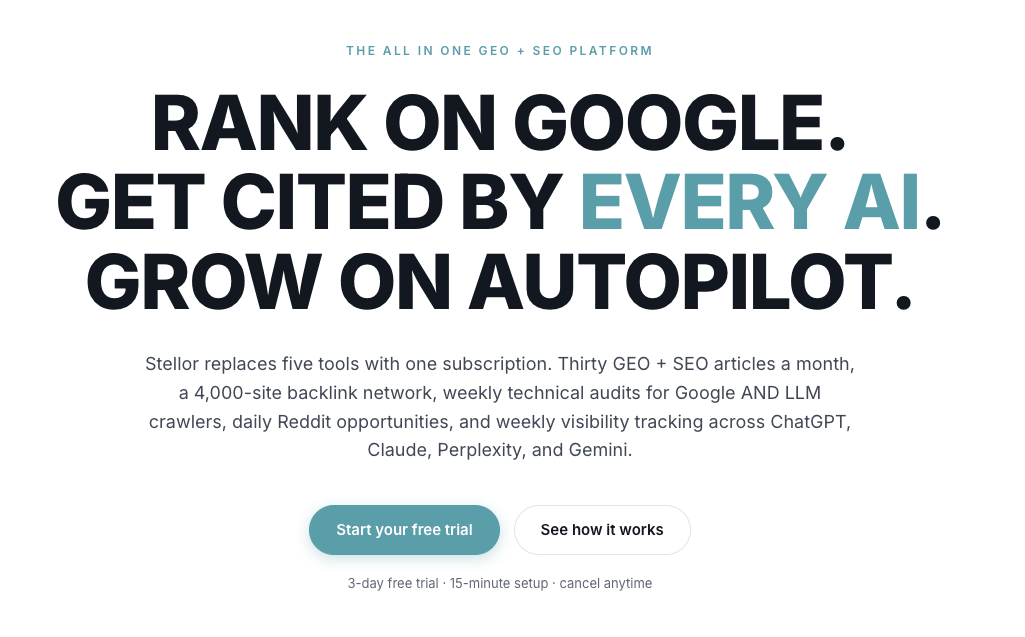
Stellor publishes 30 GEO and SEO-optimized articles a month tuned to your practice areas and locations, backed by a 4,000-site backlink network so your authority builds without manual outreach. Weekly technical audits catch the Core Web Vitals and schema issues covered in this article’s checklist before they cost you rankings, and the platform tracks your AI citation status across ChatGPT, Claude, Perplexity, and Gemini every week, the exact monitoring this article recommends doing manually. That maps directly onto the 90-day plan above: fast audit in week one, content cadence starting week five, backlink and authority building running throughout.
Start with a 3-day free trial, no card required, and see your current AI visibility and technical baseline before committing to anything.
FAQ
Does SEO Work for Law Firms?
Yes. It functions as a long-term channel rather than an instant fix, and firms that pair genuine legal expertise with consistent technical execution see measurable gains in organic leads within 6 to 12 months.
How Much Does Law Firm SEO Cost?
Costs vary widely by market competitiveness and approach, ranging from a few thousand dollars a month for an agency retainer to a consolidated platform subscription like Stellor’s $199-a-month plan that bundles content, backlinks, and audits together.
What Is SEO in Law, Specifically?
Legal SEO applies standard SEO fundamentals, keyword targeting, technical health, content, and links, to the specific demands of legal practice: attorney-sourced E-E-A-T, YMYL content standards, and professional conduct rules around advertising.
How Long Before a Law Firm Sees SEO Results?
Expect 6 to 12 months for meaningful rankings on competitive terms, though local pack visibility and long-tail keyword rankings can show movement within the first 90 days if the technical audit and GBP work happen early.
Can Small or Solo Law Firms Compete With Larger Firms on SEO?
Yes, by narrowing focus to a small set of practice areas and specific locations rather than competing broadly, a solo firm can out-rank larger competitors on the exact long-tail terms that convert best.
How Do I Know if My Firm Is Being Cited by AI Tools Like ChatGPT?
Prompt ChatGPT, Claude, Perplexity, and Gemini monthly with the questions your prospects would ask, or use a platform like Stellor that tracks these citations automatically every week across all four.