

Hire a landscaping-focused SEO agency if you want hands-off local execution, or run a GEO+SEO platform like Stellor if you want predictable content volume and AI visibility tracking without a long contract. Either way, start now on three things: complete your Google Business Profile, split your service pages into recurring versus one-time work, and build a seasonal content calendar 60 to 90 days ahead of demand. A solid first deliverable from any provider is a written audit plus a 90-day plan, not a vague promise of “more traffic.”
TL;DR:
- Local landscaping companies should choose their SEO provider based on their footprint, control needs, and budget, often starting with a detailed audit and a 90-day plan.
- Avoid vendors promising specific rankings or refusing to disclose backlink sources; ask for actual client rankings, process for reviews, and how leads convert to booked jobs.
- Budget ranges from $800 to $2,500 monthly for small firms, with enterprise costs scaling higher; long-term ROI favors SEO over paid ads once organic growth surpasses paid leads.
- The first 14 days focus on fixing the Google Business Profile, requesting reviews, and auditing contact calls, while weeks 2-8 involve creating local service and neighborhood pages.
- Tracking booked jobs, conversion rates, average job value, and AI citation presence is crucial to measure SEO success beyond rankings, especially as AI-driven search snippets rise in importance.
Table of Contents
- What Kind of Landscaper SEO Provider Do You Actually Need?
- How Do You Vet a Landscaping SEO Agency Before You Sign?
- What Should You Budget for Landscaper SEO?
- Your 90-Day Landscaper SEO Checklist
- How Do You Measure Whether Landscaping SEO Is Working?
- Where Landscapers Actually Lose Ground
- The Real Gap in Most Landscaper SEO Advice
- A Faster Path to Landscaper SEO Without the Agency Overhead
- Where to Go Deeper on Landscaper SEO
- Sources
- FAQ
What Kind of Landscaper SEO Provider Do You Actually Need?
The right provider depends on your budget, your footprint, and how much control you want to keep. Landscaping companies typically choose from four provider types, and each one delivers a different first move once you sign on.
Specialist landscaping SEO agencies work best if you want bespoke, hands-off execution and you’re a single-location or regional operation with the budget for dedicated strategy. They usually start with a full audit and a Google Business Profile overhaul, since GBP completion, service pages, and reviews are the core local ranking factors for landscaping searches.
Local home-services marketing agencies fit companies running paid ads and SEO together. Because they manage both channels, their first deliverable is usually GBP cleanup paired with citation fixes across directories like Angi, Yelp, and Nextdoor, so your paid and organic listings match.
National home-services SEO firms make sense once you’re running multiple crews across several metro areas. They deliver content and technical audits at scale, using standardized templates across locations rather than the bespoke, one-off pages a boutique shop might write.
GEO+SEO automation platforms, including Stellor, suit owners who want steady content output, backlink growth, and AI citation tracking without managing five separate vendors. The first deliverable is typically a rapid visibility audit followed by a content cadence that starts publishing within days, not weeks.
| Provider Type | Best For | Delivers First | Typical Setup Time |
|---|---|---|---|
| Specialist landscaping agency | Hands-off, bespoke local execution | Audit + GBP overhaul | 2 to 4 weeks |
| Local home-services agency | Integrated paid + local listings | GBP + citation cleanup | 1 to 3 weeks |
| National home-services firm | Multi-location scale | Content + technical audits | 3 to 6 weeks |
| GEO+SEO automation platform | Predictable volume + AI monitoring | Visibility audit + content cadence | 48 hours to 1 week |
None of these is universally “best.” A three-truck mowing company in one suburb has different needs than a hardscape contractor running crews across five counties. Match the provider type to your actual operating footprint before you compare price sheets.
How Do You Vet a Landscaping SEO Agency Before You Sign?
Ask specific questions, weigh vendors against clear criteria, and watch for the red flags that separate real operators from people selling a rebranded template.
Start every vendor call with these questions:
- Can you show me three landscaping or lawn care clients you’ve ranked, with before-and-after screenshots?
- How do you structure Google Business Profile service entries for recurring maintenance versus one-time installs?
- Do you build separate pages for individual suburbs or ZIP codes, or one generic city page?
- What’s your process for collecting and responding to reviews, and how do you handle photo uploads?
- How do you tie rankings to actual booked jobs, not just impressions or keyword position?
Weigh what you hear against five criteria: local performance history (the heaviest weight, since a firm that’s never ranked a landscaper is guessing), service mix relevance to route-based businesses, reporting clarity, cost transparency, and how they source backlinks. A vendor that scores well on four of five but goes vague on link sourcing is still a risk, because bad links can tank a domain months after the invoice clears.
Three red flags should end the conversation immediately. First, any guarantee of a specific ranking position. Google’s own Search Central guidelines make clear no one controls the algorithm tightly enough to promise a #1 spot. Second, refusal to name where backlinks come from. Third, a sales pitch built entirely around traffic charts instead of booked jobs, average job value, or lead quality.
Pro Tip: Ask for a sample audit of your actual site before you sign anything. A firm that can’t produce a specific, actionable audit in the sales process won’t produce one after you’re a paying client.
If a rep can’t answer question two or three above without stumbling, that’s your answer.
What Should You Budget for Landscaper SEO?
Pricing runs in three rough bands. A one-time audit from a specialist agency typically runs a flat fee and gives you a punch list without ongoing work. Small retainers for single-location landscaping businesses generally land between $800 and $2,500 a month, covering GBP management, a handful of monthly articles, and basic technical maintenance. Enterprise retainers for multi-location firms climb well past that, scaling with the number of service areas and the content volume required to support them.
To judge ROI, work backward from your numbers:
- Take your monthly SEO spend and divide it by the number of organic and GBP-sourced leads you closed that month. That’s your cost per booked job.
- Compare that figure to your average job value. If mowing routes average $60 a visit but one hardscape lead averages $8,000, your payback period on that single lead can cover months of retainer cost.
- Track how many months of compounding content and links it takes before organic overtakes paid as your primary lead source, usually somewhere between month four and month eight for most local firms.
Long-term, SEO tends to out earn paid ads by a wide margin. Benchmarks compiled by Sideways8 put SEO’s return in trade industries around $19.90 per dollar invested, versus roughly $4.40 per dollar for paid ads. That doesn’t mean drop paid entirely. Google Ads and Local Services Ads still deliver faster leads during peak spring and fall demand spikes, so a blended budget, heavier on SEO year-round and topped up with paid during your two or three busiest months, gets you both immediate volume and a compounding organic base.
Your 90-Day Landscaper SEO Checklist
This is the tactical sequence. Work through it in order, because each phase builds on groundwork from the one before it.
Days 1 to 14: Fix the foundation
- Audit your Google Business Profile line by line. Confirm your primary category, service list, service area radius, hours, and photos are current. Add every distinct service (lawn mowing, mulching, hardscape installation, snow removal if applicable) as a separate service entry, since complete GBP listings generate far more clicks and direction requests than incomplete ones. Our own Google Business Profile guide walks through the setup fields most owners skip.
- Launch a review request system. Send a text or email template soon after job completion asking for a specific, honest review. Aim for a steady trickle rather than a burst, since review velocity itself is a signal.
- Audit your contact CTAs. Make sure your phone number, quote form, and booking link appear above the fold on every page and load correctly on mobile.
Weeks 2 to 8: Build the pages that convert
Split your service pages by buyer type. Recurring services like mowing, fertilization, and maintenance plans attract a different searcher than one-time projects like patios, retaining walls, or drainage work, and these two buyer groups have distinct lifecycles and lifetime value. A single “landscaping services” page trying to rank for both dilutes your relevance for either.
Add five suburb or ZIP-level pages targeting your most profitable service areas, not a blanket citywide page. Route-based businesses can’t absorb long drives profitably, so pages built around specific neighborhoods with real local detail outperform generic metro pages for landscape construction and installation leads specifically. Write 600 to 1,200 words per page with actual portfolio photos from jobs in that area, not stock imagery.
Deploy FAQPage schema on your service pages so common buyer questions (cost ranges, turnaround times, what’s included) surface directly in search results and get read correctly by AI systems summarizing your site. The Schema covers the exact markup structure.
Weeks 4 to 20: Compound your visibility
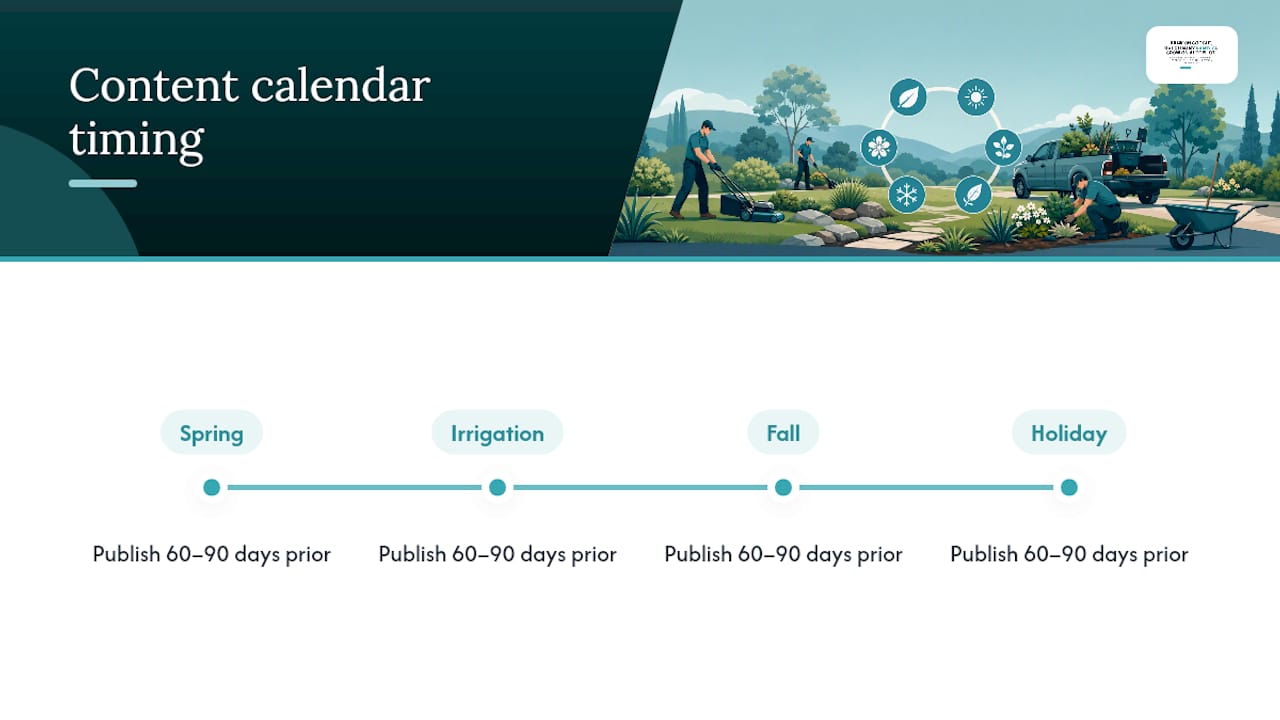
Build a seasonal content calendar and publish 60 to 90 days ahead of the season you’re targeting, since rankings lag real-world demand and a spring cleanup article published in March is already too late to rank by the time homeowners search for it. Map out fall cleanup, spring planting, irrigation startup, and holiday lighting content on a rolling calendar rather than writing reactively.
Optimize your portfolio images with descriptive file names and alt text, and pair before-and-after shots wherever possible. Visual proof converts landscaping browsers into leads better than almost any other content type on the page.

Pursue 8 to 12 high-quality local links over the next several months rather than chasing volume. Targeted links from community sites, local news coverage, and trade directories carry far more weight than dozens of low-quality directory submissions. Our guide to local link-building strategies breaks down which local sources actually move rankings. A soil-testing resource like this piece on landscaping and gardening prep is the kind of relevant, non-competing local content worth a link exchange or citation.
Technical checklist
Run through Core Web Vitals in Google’s PageSpeed Insights and fix the worst offenders first, usually large uncompressed images and unoptimized third-party scripts. Confirm your site renders cleanly on mobile, since most local landscaping searches happen on a phone standing in someone’s yard. Check your XML sitemap is submitted and your key pages are indexed, not blocked by a stray robots.txt rule. Verify your structured data validates cleanly using Google’s Rich Results Test.
Pro Tip: Don’t publish all five suburb pages in one week. Stagger them over a month so Google can crawl and evaluate each one individually rather than treating a sudden batch as a low-effort content dump.
How Do You Measure Whether Landscaping SEO Is Working?
Rankings alone tell you nothing about revenue. Track these four numbers monthly:
- Booked jobs from organic and GBP sources, tagged separately from paid and referral leads so you know which channel actually closed the work.
- Conversion rate per service page, since a mowing page converting at 2% and a hardscape page converting at 8% tells you where to invest more content effort.
- Average job value by lead source, because organic leads for one-time projects often run far higher value than recurring maintenance leads.
- Repeat and referral rate among customers who originally found you through search, a strong proxy for whether your content set accurate expectations.
Set up call tracking with a dedicated number for your website, tag every form submission with UTM parameters tied to its traffic source, and keep a simple spreadsheet mapping lead source to closed revenue. This doesn’t require expensive software. It requires discipline.
One newer metric matters more each quarter: AI visibility. Homeowners increasingly ask ChatGPT, Perplexity, or Gemini which landscaper to hire before they ever open Google, and AI Overviews now summarize local service answers directly in search results, pulling from content that answers questions conversationally and with local specificity. Monitoring whether your business gets cited by name in these answers, weekly rather than quarterly, is becoming as important as tracking your map pack position.
Where Landscapers Actually Lose Ground
Most landscaping SEO advice sounds correct and still fails in practice, because it ignores timing and structure. Publishing your spring content in March instead of January means you’re optimizing for a season that’s already underway. By the time Google trusts a new page enough to rank it, the demand spike has passed.
The second failure is structural. Owners lump mowing and hardscape installation onto one “services” page because it feels simpler to maintain. That page then ranks for neither, because it answers two different buyer intents at once and satisfies neither fully.
The third failure is neglecting Google Business Profile service entries specifically, not just the general listing. A profile with hours and a phone number but no itemized services is leaving visibility on the table for every specific job type a homeowner might search.
Stellor was built around exactly these patterns: 30 GEO-optimized articles a month, weekly technical audits, a 4,000-site backlink network, and continuous LLM monitoring across ChatGPT, Claude, Perplexity, and Gemini. The Reddit module surfaces daily conversation threads where homeowners ask for landscaper recommendations, since AI answer engines increasingly pull from those discussions.
A landscaping company that splits its service pages correctly and publishes seasonal content on a real calendar will consistently outrank a competitor spending more money but treating their site as one big brochure page. Structure beats budget almost every time in this category.
Pro Tip: If your provider can’t tell you which specific pages are ranking for which specific ZIP codes, ask why. Route-density businesses need that granularity to know where to focus crew capacity.
The Real Gap in Most Landscaper SEO Advice
Most guides treat landscaping SEO like generic local SEO with a green filter over it. It isn’t. A plumber’s search volume is steady year-round; a landscaper’s swings hard by season, and that swing punishes anyone who treats content publishing like a monthly checkbox instead of a calendar built around when homeowners actually search.
The conventional advice, “publish consistently and build links,” is technically true and practically useless without the timing layer. Publishing a fall cleanup guide in October is publishing into a market that already made its decision. The businesses winning right now are the ones publishing 60 to 90 days ahead and splitting their service pages by buyer intent, not by internal org chart convenience.
If you take one thing from this guide, prioritize the calendar and the page split before you spend a dollar on links or ads. Everything else compounds on top of that foundation, and nothing compounds on top of a generic services page publishing reactively.
— Cole
A Faster Path to Landscaper SEO Without the Agency Overhead
If you’d rather not manage a retainer, wait weeks for a strategy deck, or juggle separate vendors for content, links, audits, and reputation, Stellor replaces that whole stack for landscaping and lawn care businesses at a fixed $199 a month. It runs 30 GEO and SEO-optimized articles monthly, tied into a 4,000-site backlink network, weekly technical audits, and weekly tracking of how often ChatGPT, Claude, Perplexity, and Gemini cite your business by name.
New accounts get a free AI Visibility Audit within 48 hours, covering your current AI citation status, a competitor benchmark showing who’s winning the answers you should be getting, and a custom 90-day plan mapping exactly what publishes in the first, second, and third month. You keep the audit even if you never subscribe.
Choose a specialist agency if you want a dedicated strategist on the phone every week. Choose Stellor if you want steady, predictable content and monitoring without negotiating a contract. Start the 3-day free trial, no card required, and see the audit before you commit to anything.
Where to Go Deeper on Landscaper SEO
These sources back the claims in this guide and are worth bookmarking for ongoing reference:
- Pro Landscaper’s local SEO strategy piece breaks down GBP, reviews, and local link priorities specific to the trade.
- SkillMammoth’s landscaping SEO playbook covers seasonal timing and service-page architecture in more technical depth.
- Sideways8’s marketing strategy benchmarks provide the ROI comparison between SEO and paid channels.
- Scorpion’s landscaping SEO overview explains how AI Overviews are changing homeowner search behavior.
- Google’s Search Central starter guide remains the primary source for what Google actually rewards.
- Schema covers the exact markup for structured FAQ content.
Sources
- Landscaping SEO strategy: How landscapers can win more local jobs from Google - Pro Landscaper
- Landscaping SEO: The Complete Lawn Care SEO Playbook (2026) - SkillMammoth
- How Landscaping Companies Grow: Marketing Strategies (2026) - Sideways8
FAQ
Is $100 an hour too much to pay for landscape work?
It depends entirely on your market and job complexity. In most metro areas, hourly rates for skilled hardscape or design work vary widely, though routine mowing typically prices per visit rather than hourly.
How much should you pay for SEO services?
Small landscaping businesses typically pay between $800 and $2,500 a month for an ongoing retainer covering GBP management, content, and technical maintenance, while a GEO+SEO platform like Stellor offers a fixed $199 a month covering content, links, audits, and AI visibility tracking together.
What is the 80/20 rule in SEO?
The 80/20 rule suggests roughly 80% of your ranking gains come from 20% of your effort, typically Google Business Profile optimization, core service page structure, and a handful of strong local links, rather than spreading effort evenly across dozens of minor tactics.
What is an SEO contractor?
An SEO contractor is an independent specialist or small agency hired to handle search optimization for a business, distinct from a full-service marketing agency or an automated platform, usually working on a project or retainer basis with a narrower scope of services.
How long before landscaper SEO shows results?
Most local landscaping businesses see measurable ranking movement within 60 to 90 days of fixing GBP and service page structure, with meaningful lead volume typically building by month four to six as seasonal content and links compound.
Should landscapers monitor AI visibility separately from Google rankings?
Yes. AI Overviews and chatbot answers now surface local service recommendations directly, so tracking whether your business gets cited by name in ChatGPT, Perplexity, or Gemini responses is becoming a separate, measurable signal from traditional map pack rankings.