

The five highest-impact local SEO moves for independent retailers are: optimize your Google Business Profile completely, publish location and product pages with city-level keywords, build a consistent review capture process, fix NAP consistency across core directories, and add LocalBusiness schema to your site. A specialty apparel shop in Austin that claimed its GBP, added 20 product photos, and published one city-specific collection page saw direction requests climb within the first 30 days, similar to the 34% increase reported by Flowland Counter-Culture Outlet — no ad spend required. These independent retailer local SEO examples are reproducible, and the playbook below shows you exactly how to execute each one.
Top 5 copyable wins — by priority:
- High: Claim and fully complete your Google Business Profile (name, category, hours, photos, products, attributes)
- High: Publish one location page and one product page targeting city + product keywords
- High: Launch a 30-day review capture campaign (in-store card + post-purchase SMS)
- Medium: Audit and fix NAP consistency across Google Business Profile, Yelp, and Facebook Business Page
- Low: Add LocalBusiness and Product schema to your homepage and product pages
Table of Contents
- Why local SEO actually moves the needle for independent shops
- Top local SEO checklist for independent retailers
- How to optimize your Google Business Profile step-by-step
- How to build location and product pages that rank locally
- Gathering, displaying, and responding to customer reviews
- Citations, directories, and earning local links
- Technical basics: structured data, speed, mobile, and map signals
- What to measure and how to track foot-traffic impact
- A 90-day action plan for independent stores
- Three mini case studies with copy-and-paste templates
- Key Takeaways
- What most independent retailers actually get wrong
- Trystellor automates this playbook for independent retailers
- FAQ
Why local SEO actually moves the needle for independent shops
Local signals translate directly into foot traffic. When your Google Business Profile is complete, your map pack ranking improves, and that ranking drives direction requests and phone calls from people who are already nearby and ready to buy.
The numbers from real retailers make this concrete. After profile optimization and localized content work, Flowland Counter-Culture Outlet recorded Phone Calls up 29%, Website Clicks up 17%, and Direction Requests up 34%. Those are not vanity metrics — each direction request is a potential customer who opened Google Maps and chose your store.
Flowland Counter-Culture Outlet saw direction requests rise 34% and phone calls increase 29% after GBP optimization and localized content, according to the Web Rank Digital case study.
Three ways better local visibility converts to revenue:
- Direction requests: Someone searches “record store near me,” finds your optimized profile, and taps “Directions.” That tap is a committed store visit.
- Product searches: Shoppers searching “vintage denim jacket [city]” land on your product page and walk in to try it on.
- Branded search conversion: Once your name appears consistently across Google, Yelp, and Facebook, trust rises and conversion from branded searches improves.
Google’s own guidance confirms that local results depend on relevance, distance, and popularity — all three of which you can influence directly through the steps below.
Top local SEO checklist for independent retailers
Work through these tasks in priority order. Pair each with a realistic time estimate so you can block calendar time rather than treating this as an open-ended project.
High priority (do in the first 30 days):
- Claim and verify your Google Business Profile — Owner, 30 min
- Select a narrow primary category (e.g., “Vintage Clothing Store,” not just “Retail Store”) — Owner, 15 min
- Add all business hours, phone, website, and service area — Owner, 20 min
- Upload at least 10 high-quality photos (exterior, interior, products, staff) — Owner or staff, 60 min
- Audit NAP on Yelp and Facebook Business Page; fix any mismatches — Staff, 45 min
- Publish one location page targeting “[city] + [product/category]” — Owner or contractor, 2–3 hrs
- Set up a review request process (in-store card + post-purchase text) — Owner, 60 min
Medium priority (days 31–60):
- Add products and attributes to your GBP — Staff, 60 min
- Publish one product page per week with local keywords — Owner or contractor, 1–2 hrs each
- Submit your listing to local chamber of commerce and top local directories — Staff, 60 min
- Add LocalBusiness schema to your homepage — Contractor or developer, 1–2 hrs
- Run a technical SEO audit to catch crawl errors and speed issues — Contractor, 2–3 hrs
Low priority (days 61–90):
- Earn two local backlinks (event co-host, supplier page, neighborhood blog) — Owner, ongoing
- Add Product schema to top-selling product pages — Contractor, 1–2 hrs
- Set up call tracking and UTM-tagged local landing pages — Contractor, 2 hrs
Pro Tip: Post one local event or product highlight to your GBP every week, then share it to your neighborhood Facebook group and local community board. A single post can drive search traffic, fill an event, promote inventory, and feed your email list — four goals from one piece of content.
How to optimize your Google Business Profile step-by-step
A fully completed GBP is the single highest-leverage local signal you control. GBP completeness is a top local ranking factor — and most independent retailers leave half the fields blank.

Complete these fields first: business name (exactly as it appears on your storefront), primary category, address, hours, phone number, website URL, products, services, and attributes (e.g., “Women-owned,” “In-store pickup,” “Wheelchair accessible”).
Step-by-step GBP setup
- Claim and verify your profile at business.google.com. Choose postcard, phone, or video verification depending on what Google offers your address.
- Pick a narrow primary category. “Vintage Clothing Store” outperforms “Clothing Store” for qualified local searches. Add up to 9 relevant secondary categories.
- Add products and services. List your top 10–20 products with photos, prices, and descriptions. Google can surface these directly in search results.
- Upload photos. Minimum: 3 exterior shots, 3 interior shots, 5 product shots. Update monthly. Profiles with more photos receive more direction requests.
- Enable messaging so customers can text you directly from your profile.
- Set your appointment URL if you offer consultations, fittings, or classes.
- Publish a GBP post every week (see sample below).
Sample GBP post you can copy and adapt
Four common GBP mistakes and how to fix them
- Wrong primary category: Audit competitors in your map pack; if they use a more specific category, switch to match or beat it.
- Inconsistent NAP: Your name, address, and phone must match exactly across GBP, Yelp, and your website. Even “St.” vs. “Street” creates a mismatch.
- Missing business hours: Profiles without hours rank lower and lose clicks to competitors who show “Open now.”
- Low-quality photos: Blurry or dark images signal neglect. Use natural light, a clean background, and a recent smartphone camera.
For more GBP tactics in a service-adjacent context, the auto shop GBP guide from Trystellor covers photo and attribute optimization that translates directly to retail.
How to build location and product pages that rank locally
Use city + product in your URL and title tag. Put your store address, pickup option, inventory status, and a local reference in the first two paragraphs. That combination tells Google exactly what you sell and where.
Recommended URL structure:
yourstore.com/{city}/{category}/{product-slug}
yourstore.com/austin/vintage-denim/levis-501-jeans
For multi-location sellers, set a canonical tag on each city page pointing to itself — never to a parent page — so Google indexes each location independently.
Location page template (copy and adapt)
Headline: [Store Name] in [City, State] — [Category] Shop
Opening paragraph: “[Store Name] is [City]'s go-to shop for [product category], located at [full address]. We carry [specific brands or styles], and everything in the store is available for same-day pickup. Parking is [detail]. Hours: [hours].”
Second paragraph: “Shoppers in [neighborhood or nearby landmark] have been finding us for [X years]. Our [specific product] selection is updated weekly — check our Google profile for the latest arrivals or call us at [phone].”
Product page microcopy examples
- Pickup badge: “In stock at our [City] location — pick up today”
- Inventory CTA: “Call [phone] to hold this item”
- Directions link: “Get directions on Google Maps” (link to your GBP directions URL)
Avoid duplicating the same body copy across multiple city pages. Write at least one unique paragraph per page referencing a local landmark, neighborhood, or event. Add a short FAQ specific to that location. Kandi Korner, a handmade goods retailer, published 10 hyper-local pages with LocalBusiness schema and reached multiple #1 rankings for city-specific queries within weeks, outranking national chains.
Gathering, displaying, and responding to customer reviews
Consistent, local reviews increase your map pack prominence and build consumer trust faster than any other signal you can generate in-house. The key is a repeatable process, not a one-time ask.
Two copyable review request templates:
In-store card: “Enjoyed your visit? Leave us a quick Google review — it takes 60 seconds and helps our small shop get found by neighbors like you. [Short URL or QR code to your GBP review link]”
Post-purchase SMS: “Hi [first name], thanks for shopping at [store name]! If you have 60 seconds, a Google review helps us a lot: [review link]. Reply STOP to opt out.”
Response templates:
Positive review: “Thank you, [name]! We’re glad you found exactly what you were looking for. Come back soon — we update our [product category] weekly.”
Negative review: “We’re sorry your experience fell short, [name]. Please call us at [phone] so we can make it right.”
Review schema and placement: Add AggregateRating markup from schema.org to your product pages and testimonial sections. This markup makes your star rating eligible to appear directly in Google search results. Place it on pages that already have at least five reviews to avoid thin-data penalties.
Review gating rules: Never filter customers before asking for a review (e.g., asking only happy customers to leave one). Google’s review policies prohibit gating, and it can get your reviews removed. Ask every customer, respond to every review.
Citations, directories, and earning local links
Consistent NAP across your core directories matters more than broad citation volume. Start with the three platforms that carry the most weight: Google Business Profile, Yelp, and Facebook Business Page. Then expand to local directories that your customers actually use.
Priority directory list:
- Google Business Profile (highest weight)
- Yelp (strong consumer trust signal)
- Facebook Business Page (social proof + local discovery)
- Local chamber of commerce directory
- Top local news outlet business listings (e.g., your city’s alt-weekly or newspaper site)
- Industry-specific directories (e.g., Etsy for handmade goods, Houzz for home goods)
For a broader view of directory alternatives and listing management options, this guide to local directory alternatives covers platforms worth evaluating for citation coverage.
Creative local link ideas:
- Co-host a community event with a neighboring business and get listed on their event page
- Ask your product suppliers to add you to their “where to buy” or retailer locator page
- Sponsor a local school, sports team, or charity and earn a link from their site
- Pitch a local neighborhood blog or city publication with a story angle (new product launch, anniversary, local sourcing)
- Offer a local resource page (e.g., “Best vintage shops in [city]”) that earns organic links over time
Three tools to audit citation inconsistencies:
- Google Search Console (check how your site appears in search)
- Yelp’s business owner dashboard (verify your listing data directly)
- A manual search of your business name + city in Google to spot rogue or outdated listings
Technical basics: structured data, speed, mobile, and map signals
Implement LocalBusiness schema on your homepage, Product schema on product pages, openingHours on your contact or location pages, and geo coordinates wherever you describe your physical location. Set correct canonical tags on all city pages. These are the plumbing behind the walls of your digital presence — invisible to customers but critical to how Google and AI systems read your site.
Schema checklist:
LocalBusiness(homepage and location pages): name, address, phone, hours, geo coordinates, URLProduct(product pages): name, description, price, availability, imageAggregateRating(product and testimonial pages): ratingValue, reviewCountBlogPosting(local event and content pages): headline, datePublished, author
Kandi Korner applied LocalBusiness and BlogPosting schema to every article and attributed faster indexing and richer snippets to that structured data.
Validation and monitoring tools:
- Google Search Console — monitor indexing, coverage errors, and search performance
- Google PageSpeed Insights — check Core Web Vitals; aim for a mobile score above 70
- Google’s Mobile-Friendly Test — confirm your pages render correctly on phones
- schema.org — reference for correct markup syntax
Mobile speed basics: Compress images to under 150KB before uploading. Defer non-critical JavaScript. Use a content delivery network if your hosting plan supports it. More than half of local searches happen on mobile devices, so a slow mobile page directly costs you map pack clicks.
What to measure and how to track foot-traffic impact
Track five KPIs from day one: Search Views, Direction Requests, Phone Calls, Website Clicks, and conversions attributed to local pages. All five are available inside your GBP Insights dashboard without any additional setup.
Where to find each KPI:
- Search Views and Direction Requests: GBP Insights (Performance tab)
- Phone Calls: GBP Insights (Calls tab) or a call-tracking number
- Website Clicks: GBP Insights + Google Analytics (source/medium = google/organic)
- Local page conversions: Google Analytics with UTM-tagged URLs on your location and product pages
Three-step tracking setup:
- Enable GBP Insights and link to Search Console. In your GBP dashboard, connect your verified website to Search Console. This surfaces the exact queries driving impressions and clicks to your profile.
- Set up call tracking. Use a forwarding number (available through Google’s call history feature or a third-party service) to log every call that originates from your GBP.
- Tag local landing pages with UTM parameters. Add
?utm_source=gbp&utm_medium=local&utm_campaign=location-pageto any URL you publish in your GBP posts or directory listings. Monitor these in Analytics under Acquisition.
Realistic timelines: Direction requests and phone calls typically respond within 30–60 days of a complete GBP optimization. Organic rankings for location and product pages usually move within 60–90 days. For measurable SEO results benchmarks across local service businesses, the pattern holds: the first 90 days establish the baseline; compounding gains follow.
A 90-day action plan for independent stores
Days 1–30: foundation
- Claim and verify GBP — Owner, 30 min. Highest-leverage task; do this before anything else.
- Fix NAP on Yelp and Facebook Business Page — Staff, 45 min. Mismatches suppress rankings.
- Upload 10+ photos to GBP — Owner or staff, 60 min. Profiles with photos get more direction requests.
- Publish one location page — Owner or contractor, 2–3 hrs. Target “[city] + [your main product category].”
- Launch review capture process — Owner, 60 min. Print in-store cards and set up a post-purchase SMS.
If you have 1 hour/week: Focus only on tasks 1 and 2 in week 1, then task 3 in week 2. Defer the location page to a contractor.
Days 31–60: content and citations
- Publish two product pages per week targeting specific city + product queries
- Add products and attributes to GBP
- Submit to chamber of commerce and two local directories
- Add LocalBusiness schema to homepage (contractor, 1–2 hrs)
- Post one GBP update per week (new arrivals, events, promotions)
If you have 5 hours/week: Run the full list above and add one local link outreach email per week to a supplier or neighborhood blog.
Days 61–90: links, schema, and measurement
- Earn two local backlinks (event co-host, supplier locator page)
- Add Product schema to your top five product pages
- Set up UTM-tagged URLs and call tracking
- Review GBP Insights; identify which queries drive the most direction requests and double down on those topics
- Run a full local SEO audit to catch any remaining technical gaps
Three mini case studies with copy-and-paste templates
These are reproducible playbooks. Each one reflects patterns from real independent retailers, with realistic outcome ranges and 30–90 day timelines.
Specialty apparel store
Situation: Single-location women’s boutique in a mid-size city. GBP unclaimed, no location page, zero reviews.
Actions: Claimed GBP, added 15 product photos, published one location page (“women’s boutique [city]”), launched in-store review card.
Expected outcomes (30–60 days): +15–25% Search Views, +20–30% Direction Requests, first 10–15 Google reviews.
GBP post template:
Independent record store
Situation: Vinyl and music shop targeting local collectors. Competing against national chains for “record store [city]” queries.
Actions: Published a multi-layer content strategy targeting traditional SEO, featured answers, and AI citations simultaneously. Added event pages for Record Store Day, local artist spotlights, and genre guides.
Expected outcomes (30–90 days): #1 local ranking for core queries, AI Overview citations for event-related searches, measurable increase in event attendance.
Product page intro template:
Handmade goods maker (local retail)
Situation: Small maker selling at a physical shop and online. Wanted to outrank national craft chains for city-specific searches.
Actions: Published 10 hyper-local pages with city + product combinations, added LocalBusiness and BlogPosting schema to every page, and built citations on local directories.
Expected outcomes (30–60 days): Multiple top-3 rankings for city-specific queries, richer search snippets from schema, increased in-store traffic from local discovery.
Local link outreach email template: Scaling execution is where volume matters. Trystellor’s 30-articles-per-month publishing cadence, paired with its 4,000-site backlink network and weekly technical audits, compresses the timeline for retailers who want to run this playbook at scale without hiring a full agency.
Key Takeaways
The three highest-impact actions to start with are: claim and complete your Google Business Profile, publish one location page targeting your city and main product category, and launch a 30-day review capture campaign.
| Point | Details |
|---|---|
| GBP completeness drives direction requests | Flowland saw +34% direction requests after profile and content optimization. |
| Location pages outrank national chains | Kandi Korner reached multiple #1 rankings within weeks using 10 hyper-local pages plus LocalBusiness schema. |
| Reviews need a repeatable process | Use an in-store card and post-purchase SMS; respond to every review within 48 hours. |
| Schema speeds up rich results | Add LocalBusiness, Product, and AggregateRating markup to earn richer snippets and AI citations. |
| Trystellor scales the playbook | Trystellor publishes 30 GEO + SEO-optimized articles per month, runs weekly audits, and tracks AI citations across ChatGPT, Claude, Perplexity, and Gemini. |
What most independent retailers actually get wrong
Most small retailers spend their first month on the wrong things. They write blog posts about broad topics, ignore their GBP photos, and never ask a single customer for a review. The result is a site that looks active but ranks for nothing local.
The pragmatic order is the opposite of what feels natural. Fix your GBP before you write a single blog post. Get 20 reviews before you worry about backlinks. Publish one tight location page before you build a content calendar. The foundation has to exist before the superstructure matters.
Three rules of thumb that hold across every retailer I’ve seen do this well:
- Local pages before broad blog volume. One “[city] + [product]” page outperforms ten generic posts every time.
- GBP photos and inventory are your first impression. A profile with 20 sharp product photos converts browsers into direction requests. A profile with two blurry shots does not.
- Treat reviews as a business process, not a marketing campaign. Build the ask into your checkout flow and your post-purchase SMS. Review velocity compounds over months, not days.
These steps are repeatable whether you execute them manually, hand them to a contractor, or run them through a platform like Trystellor that automates content, audits, and AI visibility tracking in one place.
Trystellor automates this playbook for independent retailers
Running this full playbook manually takes 5–10 hours per week, every week. Trystellor is built for retailers who want the results without the overhead.
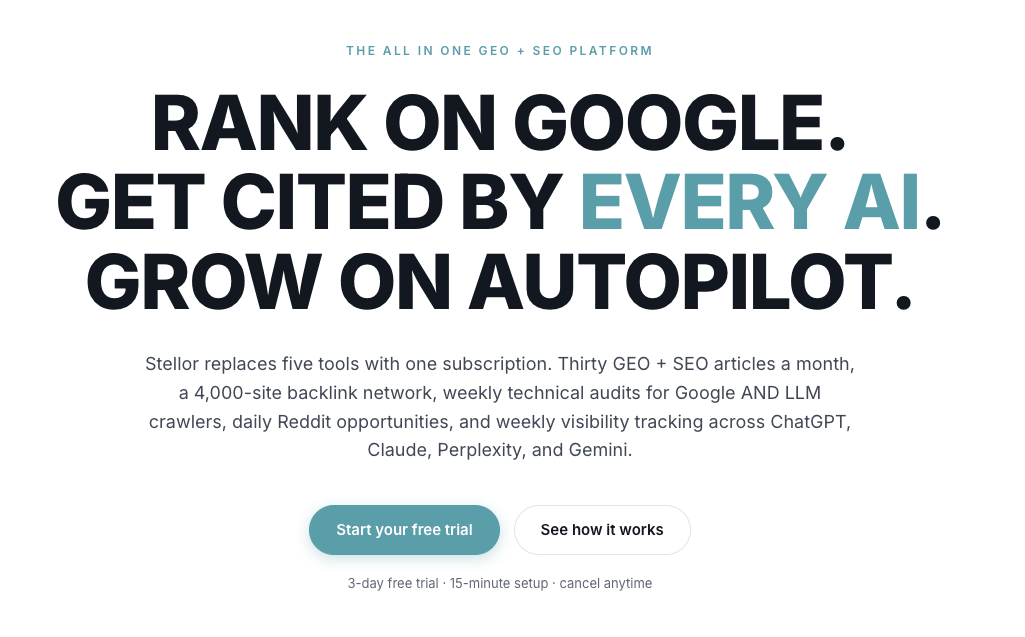
Trystellor publishes 30 GEO + SEO-optimized articles per month directly to your CMS, including location pages, product pages, and local event content. Its 4,000-site backlink network builds the authority signals that move map pack rankings. Weekly technical audits catch schema errors, speed issues, and crawl problems before they cost you rankings. Its LLM visibility tracker monitors whether ChatGPT, Claude, Perplexity, and Gemini are citing your store when local buyers ask for recommendations in your category.
Onboarding takes 15 minutes. Within 48 hours, you receive a free AI Visibility Audit covering 25 buyer prompts, a competitor benchmark, and a custom 90-day content plan. Pricing starts at $199/month with a 3-day free trial and no credit card required. Start your free audit at trystellor.com/product.
FAQ
What is an example of local SEO for a retail store?
A local SEO example for a retail store is claiming your Google Business Profile, adding product photos and hours, and publishing a location page targeting “[city] + [product category].” Flowland Counter-Culture Outlet used exactly this approach and saw direction requests rise 34% after profile and content optimization.
Can I do local SEO myself as a store owner?
Yes. The highest-impact tasks — claiming your GBP, fixing NAP on Yelp and Facebook, and publishing one location page — take under five hours total and require no technical background. Schema markup and call tracking are the only steps that typically benefit from a contractor.
Is local SEO still worth it in 2026?
Local SEO is more important now than it was two years ago. AI Overviews and local AI features now appear on a significant share of local searches, and GBP completeness directly feeds those systems. A well-optimized profile and structured local pages earn both traditional map pack rankings and AI citations.
What is the 80/20 rule applied to local SEO?
Most of your local search results come from a small core of work: a complete GBP, consistent NAP, a handful of location pages, and a steady review flow. Broad blog content, advanced link building, and social media amplification matter, but they compound on top of that foundation rather than replacing it.
How long does local SEO take to show results?
Direction requests and phone calls typically respond within 30–60 days of a complete GBP optimization. Organic rankings for location and product pages generally move within 60–90 days, consistent with the timelines seen across the case studies in this article.