

Each one raises the odds a model retrieves and quotes your page instead of a competitor’s. None of it works without measurement, so weekly probes across ChatGPT, Claude, Perplexity, and Gemini are how you prove it’s working.
TL;DR:
- Pages with citation potential should prioritize clear FAQ sections, verifiable statistics, and author credentials to enhance retrieval by AI systems.
- Technical optimization, including proper robots.txt, server-side rendering, and accurate structured data, is essential to ensure pages are fetchable and snippet-ready for AI citations.
- Regular weekly probes across ChatGPT, Claude, Perplexity, and Gemini reveal fluctuations in citation frequency and identify content gaps or technical issues early.
- Building authority through earned backlinks, Reddit engagement, and frequent content refreshes significantly improves a page’s chances of being cited by AI models over time.
- AI-specific citation practices vary among major platforms, necessitating targeted strategies focusing on crawlability, structured data, and community presence to boost overall AI visibility.
Table of Contents
- What AI citations are and how AI systems pick sources
- Core strategies that move the needle
- Technical checklist: make your content fetchable and snippet-ready
- How to measure and track AI citations: weekly probes and KPIs
- How Stellor operationalizes citation growth
- Tools, templates, and quick content assets you can use today
- Differences in AI citation practices across major AI models and platforms
- Author perspective: realistic timelines, common pitfalls, 90-day milestones
- Stellor: a managed path to increase AI citations
- FAQ
What AI citations are and how AI systems pick sources
An AI citation happens when a chatbot or AI Overview pulls text from your page, often word for word, to answer someone’s question. That process runs on retrieval-augmented generation, or RAG: the model doesn’t “know” your page from training, it fetches it live, scans the content, and grounds its answer in whatever it finds. Google’s own documentation on optimizing for generative AI features confirms that its generative features retrieve indexed pages from Search and then build responses on top of that retrieved content.

That matters because it means the old SEO fundamentals, crawlability, structured data, and genuinely useful content, are still the primary levers. AI features are extensions of search, not a separate universe with separate rules.
There’s a second layer worth understanding: the difference between a quick search summary and a deep research mode. OpenAI explains that ChatGPT uses fast search summaries for simple questions, but switches to a deep research mode for complex ones, synthesizing multiple verified sources rather than skimming one. Dense, well-cited pages win more often in that research mode because they give the model more to work with in one fetch.
Before any page can be cited, a few prerequisites have to be true:
- The page must be crawlable by the AI system’s bot, not just by Googlebot.
- The core content must render without requiring JavaScript execution the crawler can’t perform.
- The answer the model needs has to sit near the top of the page, not buried under three paragraphs of preamble.
- The claim has to be verifiable: a number, a named source, or a direct quote the model can attribute with confidence.
Miss any one of these and the page simply doesn’t make it into the pool of sources a model considers, no matter how good the writing is.
Core strategies that move the needle
Once the mechanics are in place, the real work is prioritization. Not every tactic deserves equal time, and doing them in the wrong order wastes weeks. Here’s the sequence that tends to produce results fastest.
- Build FAQ and short-answer atoms. Structure the first 30% of any citation-worthy page as a tight question-and-answer unit: a clear question, a one-sentence answer that includes a statistic or named source, and a takeaway line. This format mirrors exactly what a model needs to lift and quote.
- Add bylines, credentials, and verifiable data. A page with an identifiable author and sourced claims reads as more trustworthy to both human readers and retrieval systems. Our guide to E-E-A-T in SEO breaks down how bylines and credentials factor into that trust signal in more depth.
- Earn natural mentions instead of manufacturing them. Helpful, specific replies in relevant Reddit threads and earned backlinks from credible sites build the kind of authority models reward. Synthetic mention campaigns tend to look exactly like what they are, and Google’s own guidance warns against the scaled, low-effort content that often accompanies them.
- Keep a steady cadence and refresh core assets quarterly. A page that was accurate a year ago but hasn’t been touched since starts losing ground to fresher competitors, especially on anything tied to pricing, statistics, or regulation.
The order matters because each step compounds the one before it. A perfectly structured FAQ atom on a page with no author credibility still underperforms, and credible bylines on a page buried behind thin, unoptimized structure never get fetched in the first place.
A statistic and a named source in the top third of a page is one of the most consistently cited patterns in research on generative AI search behavior, which documents that AI features ground responses on retrieved, indexed content rather than paraphrasing from memory.
The Reddit piece deserves its own emphasis. ChatGPT frequently cites Reddit threads when answering recommendation-style questions, because forum discussions read as unfiltered, peer-sourced opinion rather than marketing copy. That’s a structural advantage brands can’t fully replicate on their own domain, which is exactly why a presence in the right threads, built on genuinely useful answers, pays off over time.
Freshness is the quiet multiplier. Google’s 2026 guidance on generative AI optimization reiterates that unique, people-first content built and maintained over time outperforms anything produced at scale with no editorial oversight, and explicitly warns against scaled content abuse as a shortcut.
Pro Tip: Rewrite your top five FAQ answers every quarter even if nothing factual has changed. A model retrieving a page updated last week reads differently than one untouched for a year.
Technical checklist: make your content fetchable and snippet-ready
Content quality is wasted if the crawler never reaches it. This is the part teams skip, and it’s the part that quietly blocks citations before anyone notices.
- Check your robots.txt and explicitly allow OAI-SearchBot and other AI crawlers where you want visibility. OpenAI’s publisher guidance spells out exactly which user agents to permit and how to verify access.
- Use server-side rendering, or reliable pre-rendering, for any page you want cited. If your site depends entirely on client-side JavaScript, models often can’t execute that script and simply won’t see the text.
- Add JSON-LD structured data that matches what’s visible on the page, word for word, then confirm it with Google’s URL Inspection tool to check indexation and snippet eligibility. Mismatched structured data, where the markup claims something the visible text doesn’t say, tends to get ignored or flagged.
- Set snippet controls deliberately. If you want to manage how much preview text appears, use
nosnippetormax-snippettags, and make sure your analytics are set up to capture AI referral traffic through UTM parameters, since that traffic often arrives looking different from a standard organic click.
A surprising number of blocked citations trace back to one overlooked line in a robots.txt file or a page that renders as a blank shell to anything that isn’t a full browser. If you’re auditing an existing site, our breakdown of common local SEO mistakes covers several crawling and indexation issues that apply directly here, and a partner resource on website structure and SEO fundamentals is worth a look if you’re rebuilding key pages from scratch.
Pro Tip: Run your most important page through a text-only browser or a crawler simulator before publishing. If the answer isn’t visible there, it isn’t visible to most AI crawlers either.
How to measure and track AI citations: weekly probes and KPIs
You can’t improve what you don’t measure, and AI citations don’t show up in a standard analytics dashboard. The practical method is a weekly LLM probe: a fixed list of buyer prompts, run consistently against ChatGPT, Claude, Perplexity, and Gemini, with every citation and its surrounding context logged.
- Select 15 to 25 prompts that mirror how real buyers phrase questions in your category, not generic keyword variants.
- Run the same prompts weekly across all four major platforms to catch shifts before they become trends.
- Log which domain gets cited, in what context, and whether your content appears at all.
- Correlate changes with recent publishing, new backlinks, or community activity to separate cause from coincidence.
| KPI | What it tells you |
|---|---|
| Citation frequency | How often your domain appears across the probe set each week |
| Citation share per prompt cluster | Whether you’re winning a category outright or splitting it with competitors |
| AI referral traffic | Whether citations are translating into actual visits, via UTM-tagged links |
| Indexation status | Whether a page is even eligible to be fetched in the first place |
When citation frequency jumps the same week a new FAQ page goes live or a batch of backlinks lands, that’s a strong signal of causality. When it stays flat despite new content, the problem is usually upstream, in crawlability or structure, not in the writing itself.
How Stellor operationalizes citation growth
Everything above is doable manually, but it’s also exactly the workload that tends to stall once the initial audit excitement fades. Stellor was built to run this stack continuously rather than as a one-time project.
- Thirty GEO and SEO-optimized articles per month, including FAQ hubs and comparison guides, each built around the citation-friendly structure covered above.
- A 4,000-site backlink network that builds the kind of earned, diversified authority signals models and search engines both reward.
- Weekly technical audits covering schema completeness, crawlability, and the other items on the checklist, with one-click fixes surfaced in a dashboard.
- A Reddit module that identifies relevant threads and drafts non-spammy reply suggestions, turning community presence into a repeatable habit instead of a one-off effort.
- Weekly LLM visibility tracking across ChatGPT, Claude, Perplexity, and Gemini, using the actual prompts a business’s buyers type.
New customers get a free AI Visibility Audit within 48 hours of onboarding, covering current citation status across 25 buyer prompts, a competitor benchmark, a technical report, and a 90-day plan laying out what gets published and which prompts the platform expects to win first. The audit is yours to keep even if you never subscribe further.
Tools, templates, and quick content assets you can use today
You don’t need a full platform to start. A few templates and a short monitoring stack will get the basics moving this week.
A simple FAQ atom template looks like this: state the question as a header, answer it in one sentence that includes a statistic or named source, then close with a one-sentence takeaway or a link to the source.
For monitoring, combine a few categories of tooling rather than relying on one dashboard:
- Weekly LLM probes, run manually or through an automated service, to track citation frequency over time.
- Search Console, to confirm indexation and catch crawl errors before they block citations.
- A backlink monitor, to see when new links land and correlate them with citation shifts.
- A Reddit listening setup, to catch relevant threads early enough to reply while the conversation is still active. A partner resource on operational tools for service businesses covers several categories worth exploring if you’re assembling this stack piece by piece.
Placement matters as much as content. Put author bios near the top of long-form pages, not buried in a footer. Put statistic callouts and named sources inside the first few paragraphs, not after three sections of context. And make sure JSON-LD schema sits in the page head and matches the visible FAQ text exactly, since Google’s structured data documentation notes that valid markup supporting what’s actually on the page is what drives richer, more discoverable results.
Pro Tip: Keep one master FAQ document updated across your top pages so every answer, statistic, and source citation stays consistent site-wide.
Differences in AI citation practices across major AI models and platforms
Not every AI system sources content the same way. ChatGPT leans heavily on Reddit and forum-style discussion for recommendation questions, which is why community presence pays off disproportionately there. Perplexity tends to favor pages with clear, numbered structure and visible publication dates, treating freshness as a stronger signal than some competitors. Claude’s citations often skew toward longer, more narrative sources when operating in research modes, consistent with OpenAI’s own description of how deep research synthesizes multiple verified documents rather than skimming single pages. Gemini, tightly integrated with Google’s index, tends to mirror whatever already ranks well organically, reinforcing that traditional SEO fundamentals still carry weight even inside AI-generated answers.
The practical takeaway: don’t optimize for one platform and assume the others follow. A page built for crawlability, structured data, and verifiable sourcing tends to perform reasonably across all four, but the platforms that lean on community discussion or narrative depth reward slightly different emphases. Teams tracking citations weekly across all four systems catch these divergences early instead of guessing.

Author perspective: realistic timelines, common pitfalls, 90-day milestones
Most teams see measurable movement in AI citations somewhere between 8 and 12 weeks, not sooner, and anyone promising faster is probably selling something closer to the synthetic mention campaigns Google explicitly warns against. The pitfall I see most often isn’t laziness, it’s impatience: teams publish a burst of thin, scaled content, see no movement in two weeks, and conclude the whole approach doesn’t work. It wasn’t the approach that failed, it was the shortcut.
A realistic 90-day path looks like this: run a technical audit and fix crawlability issues in the first two weeks, publish 6 to 12 genuinely citation-focused assets over the following month, and run weekly probes from day one so you have a baseline before the content even goes live. By day 90 you should have enough data to know which prompts you’re winning, which you’re not, and why.
— Cole
Stellor: a managed path to increase AI citations
Running this entire stack by hand works, but it’s a lot of moving parts to keep synchronized every week: content, backlinks, technical audits, Reddit replies, and citation tracking across four different AI models. Stellor runs all five as one managed subscription instead of five separate tools.
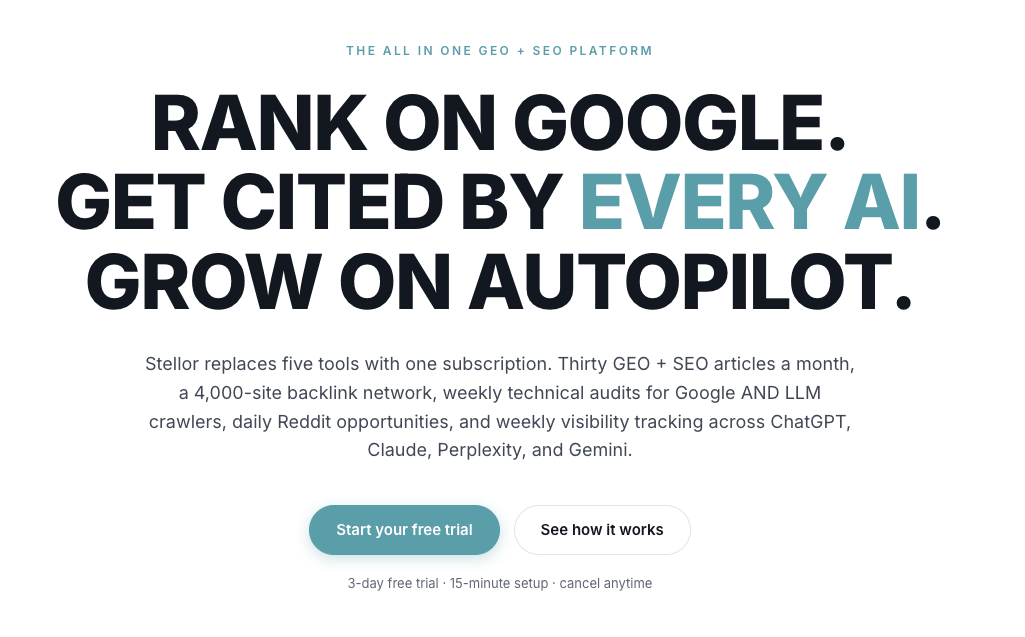
The platform publishes 30 GEO and SEO-optimized articles a month, builds authority through a 4,000-site backlink network, runs weekly technical audits with one-click fixes, surfaces daily Reddit opportunities, and tracks your citations across ChatGPT, Claude, Perplexity, and Gemini every single week.
- New customers receive an AI Visibility Audit shortly after signing up, covering current citation status across multiple buyer prompts.
- Review the audit’s competitor benchmark and 90-day plan before deciding whether to subscribe further.
- Start with a 3-day free trial, no credit card required.
Check your current standing and see the Stellor product page for full platform details, then claim your audit and see exactly where you stand against the businesses already being cited in your category.
FAQ
How can I increase AI citations?
Track progress with weekly prompts run across ChatGPT, Claude, Perplexity, and Gemini rather than guessing.
What is the 30% rule for AI citations?
Models retrieving content for quick answers tend to pull from whatever appears earliest and most directly addresses the question.
Can AI help with citations?
AI systems don’t generate citations for you, but they do reward pages built the way a retrieval system expects: crawlable, well-structured, and backed by verifiable sources. Tools that track weekly citation frequency across major models can show you which of your pages are already working and which need fixing.
Is a high number of citations a lot?
There’s no universal benchmark, since citation counts depend on how many buyer prompts you track and how competitive your category is. What matters more is trend: whether your citation share per prompt cluster is growing week over week relative to the competitors showing up in the same answers.
How do I know if my content is blocked from AI crawlers?
Check your robots.txt file for disallow rules affecting OAI-SearchBot and similar bots, and confirm your key pages render without relying solely on client-side JavaScript. OpenAI’s publisher documentation lists the specific user agents to permit and how to verify access.